Tanja Lepcheska

Bear hug test: Procedure, interpretation and free template
The bear hug test is a quick shoulder special test that screens for subscapulari...

4
Last Updated: Oct 23, 2026
Free PDF 2 pages, print-ready Clinician-reviewed
An exercise worksheet is a structured document that records a patient’s exercise routine, including the exercises, sets, reps, frequency and progress over time.
Clinicians use it to give patients a clear home exercise program they can follow between appointments.
This page explains what an exercise worksheet should contain and how to build a home exercise program from it. It also covers where the worksheet fits in physical therapy, sports medicine and wellness care.
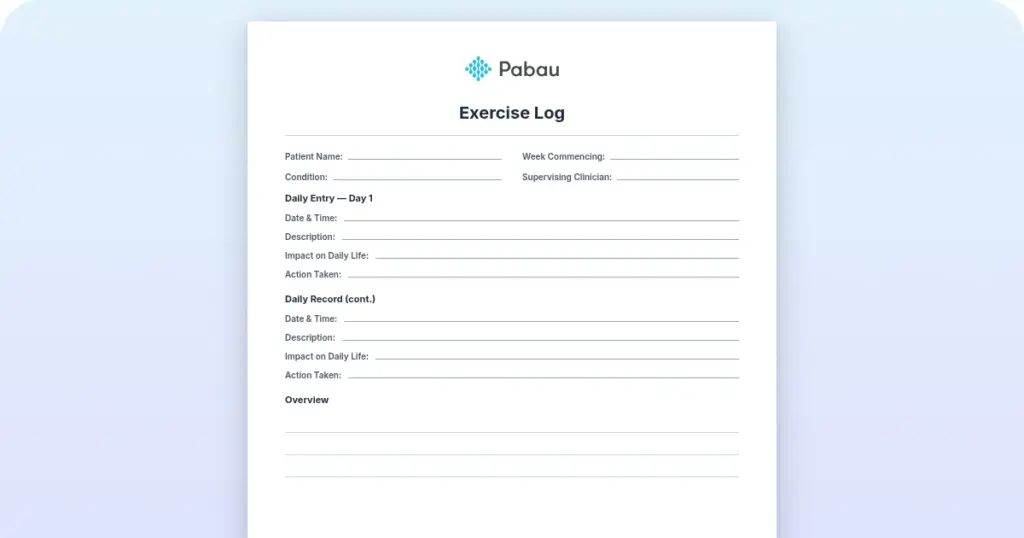
The printable sheet records each exercise’s name, sets, reps and frequency. It also has space for progress measurements, personal fitness goals and clinician notes.
Start from scratch, or upload this PDF or any form you already use, and Pabau's AI Form rebuilds it with tick boxes, text fields and a signature. Attach it to the treatment once, and every patient gets it on time.
AI Form rebuilds the consent, history and aftercare forms you already use. You review each one, then publish.
Patients complete forms on their phone before they arrive, so the front desk stops retyping paper.
Every signed form is versioned and attached to the treatment record, ready when you need it.
Set how long a consent stays valid. Returning patients skip forms they have already signed.
Supports HIPAA and GDPR compliance AES-256 encryption 4.8 on G2 4.7 on Capterra Trusted by 4,000+ practices worldwide

An exercise worksheet records exercises, sets, reps and frequency for a patient’s program.
Good worksheets capture goals, progress measurements and clinician notes, not just exercise names.
Condition-specific exercises must be reviewed by a qualified clinician before patient use.
Practice software such as Pabau lets you attach the worksheet to the patient record, next to the clinical notes.
An exercise worksheet is a tracking tool that clinicians use to write down a patient’s exercise plan and monitor progress against it. It turns a verbal instruction into a written reference the patient can take home.
In physical therapy and rehabilitation, the worksheet usually forms the core of a home exercise program (HEP). It supports adherence by making the plan specific. The patient sees which movement to do, how many repetitions, how often, and when to stop. The worksheet does not replace a clinical assessment or a treatment plan.
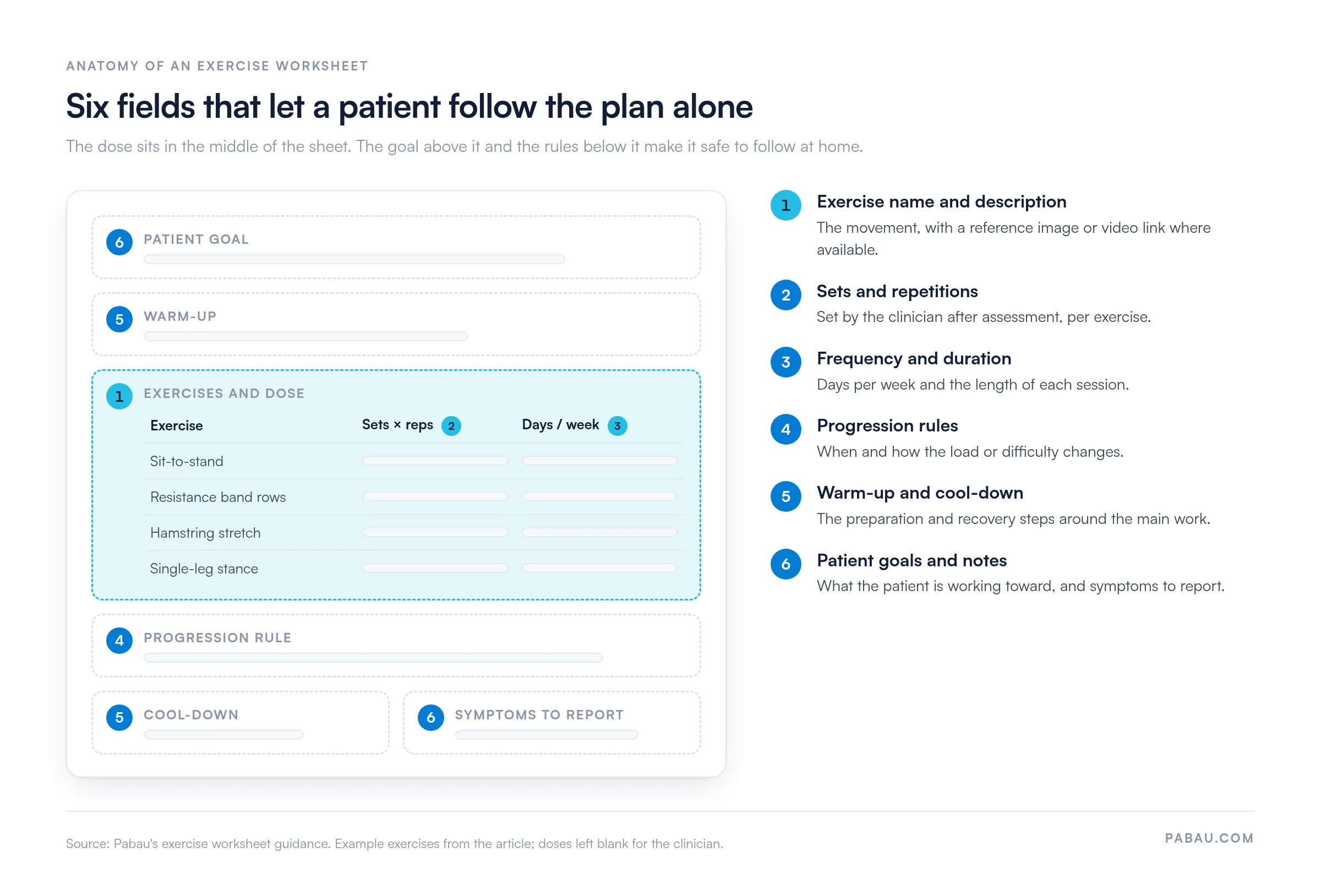
An effective worksheet records enough detail that a patient or a colleague could follow it without guesswork. Most practices include the following fields.
Treat the sets and reps on any sample worksheet as a starting point. The right numbers depend on the individual’s condition, fitness and response to the program, so the clinician sets them after assessment. Laid out on one page, the six fields put the dose in the middle, with the goal above it and the safety rules below.
Most patient programs combine several exercise types. Grouping them on the worksheet makes the weekly balance easy to see.
Strength work often uses resistance band exercises, so record the band’s resistance level next to the reps. For older patients, balance exercises for seniors are usually logged by hold time and the support used.
A home exercise program works best when the clinician builds it around one clear goal. Start from the patient’s functional problem rather than from a list of exercises.
Check the plan against the patient’s clinical record before sending it home. Contraindications and recent procedures change what is safe.
A weekly schedule shows the patient when each exercise group falls, so recovery days are built in rather than forgotten.
Clinicians often adapt a general worksheet for a specific condition. The structure stays the same, while the exercises and dosing change. Each example below must be reviewed by a qualified clinician before a patient uses it. For knee patients, a meniscus rehab handout shows how one condition-specific sheet is laid out.
Regular physical activity is linked to better mental well-being, and public health guidance supports it as part of care. Evidence suggests that structured activity can help with mood, though exercise is not a standalone treatment for mental health conditions.
In mental health settings, a worksheet can pair planned activity with a simple mood rating. Over several weeks, the clinician and patient can then spot patterns.
Pabau is all-in-one practice management software for practices, including physical therapy practices that run home exercise programs. The worksheet can be attached to the patient record, for example as a document or form, next to the clinical notes. Staff can review it at each visit rather than searching for a paper copy.
For the sharing step, digital forms can send a patient their worksheet ahead of or after a session. Digital forms are included in every Pabau subscription, so there’s no add-on to buy first.
At follow-up, the clinician opens one record and sees the last plan beside the notes from that session. Progressing the dose then starts from the written plan the patient followed, instead of from memory.

Pabau keeps the exercise worksheet, clinical notes and appointment history in one patient record. Send the plan through digital forms, then review and update it at the next visit.

Start every worksheet from one functional goal, pick three to five exercises, and write the dose down before the patient leaves. A sheet that names the movement, the dose and the symptoms to report is one a patient can follow without calling the practice.
The trade-off is upkeep. A worksheet only helps while it matches what the patient can do, so update it at each follow-up instead of reprinting the first version. Book a demo to see how Pabau keeps exercise worksheets, clinical notes and follow-ups in one patient record.

Need to explain why a program progresses? List the principles of exercise sets out the training principles that sit behind progression rules.
Struggling with adherence? The Exercise motivation inventory-2 (EMI-2) template helps you learn why a patient exercises before you set the plan.
Working with older adults? Resistance training for seniors covers strength work you can add to an older patient’s worksheet.
Treating back or neck pain? McKenzie method exercises gives a ready-made sequence to record on the sheet.
Planning a longer block of sessions? The 6 week exercise plan shows how to structure progress over six weeks.
An exercise worksheet is a written record of a patient’s exercises, sets, reps and frequency. Clinicians use it to make a home exercise program clear and trackable between appointments.
Include the exercise name, sets, reps, frequency, progression rules, warm-up and cool-down steps, and patient goals. Add clinician notes on symptoms to report.
A clinical exercise worksheet is set by a clinician for a specific patient and includes safety notes. A workout template is a general plan for self-directed training.
The frequency depends on the condition and the clinician’s plan, so it must be set after assessment. Review the worksheet at each follow-up to adjust it.