Physician credentialing checklist
A physician credentialing checklist lists every license, certificate, verificati...

Last Updated: Oct 23, 2026
An antiemetic medication list is a structured reference of the drugs that prevent or treat nausea and vomiting, grouped by drug class.
Each entry records the drug’s mechanism, typical use and prescription status. The six classes it covers are serotonin (5-HT3) antagonists, dopamine antagonists, antihistamines, anticholinergics, corticosteroids and NK1 receptor antagonists.
These drugs act on the brain’s vomiting center or on the gut and its signaling pathways. That’s why very different medicines can treat the same symptom. Clinicians and practice teams use a consistent list to check a drug quickly, document it clearly and spot the safety warnings that matter most.
This template sets out each class in one place. The drug name, strength, route, frequency and review date go into the same fields every time. The sections below explain how the classes are organized and where the highest-risk warnings sit.
A one-page reference of the six antiemetic drug classes, with representative drugs, typical uses and OTC or prescription status. Each entry has fields for strength, route, frequency, QTc and extrapyramidal warnings, pediatric limits and a review date.
Download template
Antiemetics are grouped into classes by their mechanism of action, and the class decides which warnings apply.
Ondansetron and other 5-HT3 antagonists can prolong QTc. Dopamine antagonists carry extrapyramidal warnings.
Metoclopramide has a black-box warning for tardive dyskinesia with long-term use.
Dimenhydrinate and meclizine are the main OTC options, while most other antiemetics need a prescription.
Record the class, indication, safety flags and a review date on every entry so the list stays comparable.
An antiemetic drug class is a group of medicines that share a mechanism of action. Most lists recognize several classes, and the table below sets out the six main ones with their representative drugs. The class, not the brand, determines which safety warnings apply.
The class sets the pattern of side effects. Dopamine antagonists can cause extrapyramidal symptoms, while anticholinergic agents commonly cause dry mouth, drowsiness and blurred vision. Record the class on every entry so the right warnings follow the drug, as the grid below shows class by class.
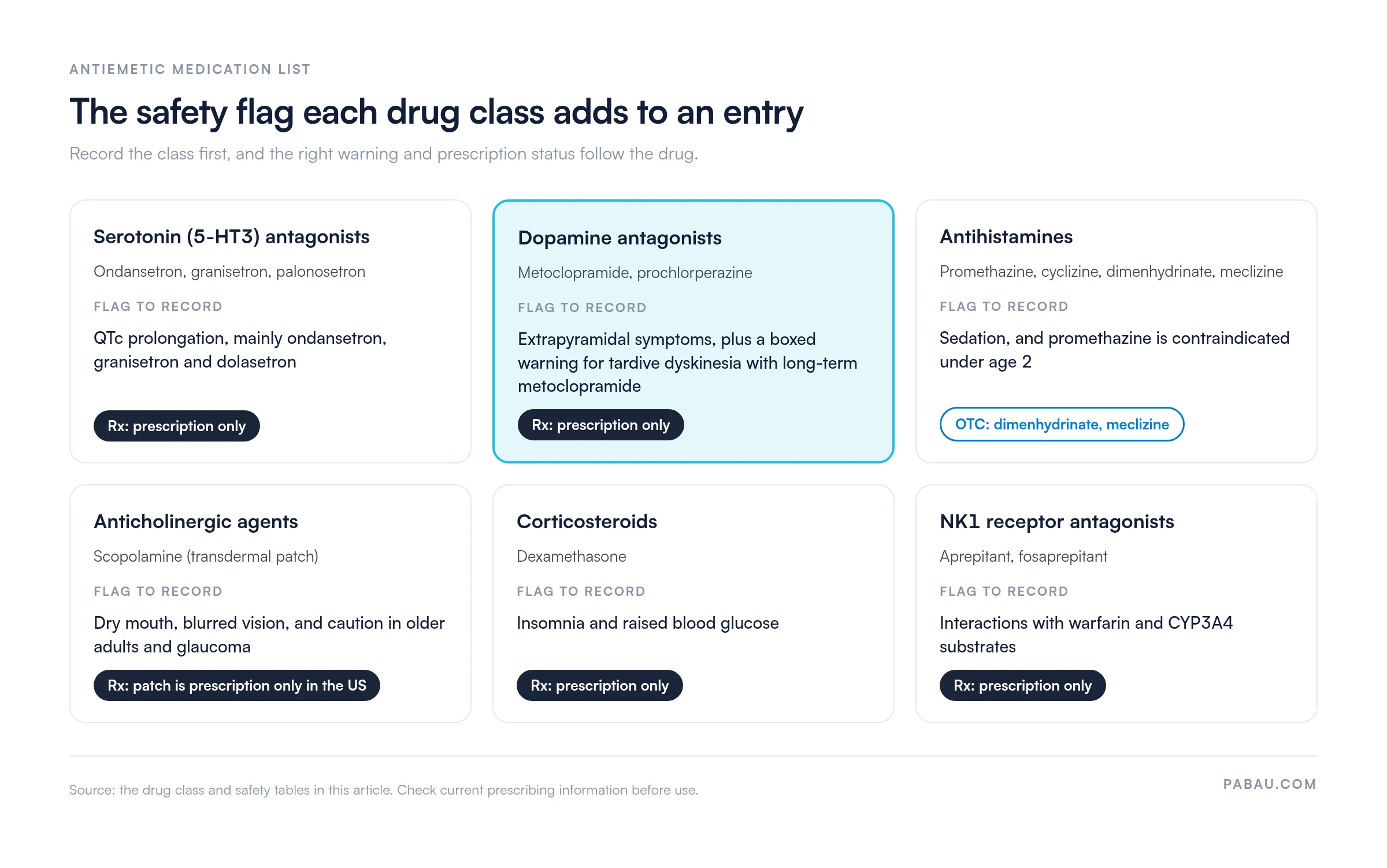
Serotonin (5-HT3) antagonists are the usual first choice for chemotherapy-induced and postoperative nausea. Ondansetron is the most widely referenced member. Ondansetron, granisetron and dolasetron can prolong the QTc interval on an ECG, while palonosetron has minimal QTc effect. The list should record that risk so baseline readings and interacting medicines get checked.
Metoclopramide carries an FDA black-box warning for tardive dyskinesia with long-term use, and this must appear in any clinical reference. Dopamine antagonists also carry a risk of extrapyramidal symptoms, which the list should flag as a mandatory safety call-out. Our black box medication list collects these warnings across other drug classes too.
Promethazine is contraindicated in children under 2 years according to its FDA black-box warning, so check the pediatric field before completing any entry. Scopolamine patches are prescription only in the US and are used to prevent motion sickness, with anticholinergic effects to record. For doses and sedation risk across the wider class, see the antihistamine medication list.
Dexamethasone and aprepitant are standard components of multimodal CINV regimens, as set out in MASCC antiemetic guidance. Dosing should follow the relevant prescribing information and the treating team’s protocol rather than a generic figure.
Some antiemetics are available without a prescription, and the list should separate these from prescription-only agents. Dimenhydrinate and meclizine are common OTC antihistamine options for travel-related nausea. Scopolamine patches and most 5-HT3 and dopamine antagonists require a prescription.
OTC status does not mean low risk. Sedation, anticholinergic effects and interactions still apply, so the list should keep the same safety fields for every entry. The OTC medication list applies the same fields to non-prescription drugs beyond antiemetics.
The template gives a fixed structure for recording each antiemetic, so entries stay comparable across patients and reviews. It suits pharmacy, nursing, internal medicine and primary care teams who need a consistent reference. When a patient moves between care settings, pair it with a medication reconciliation form.
Adapt the fields to your own formulary, but keep the safety columns intact. Pabau, the practice management platform we build, can turn the template into a digital form. Its patient intake software then keeps the same structure on every chart.
Every class carries its own watch-outs, and the summary below is the minimum a prescriber should check. The table is a prompt for review, not a substitute for the prescribing information.
Audit the list every time a patient starts a new antiemetic or a new interacting medicine. Check the QTc, sedation and extrapyramidal fields against the current prescribing information, and set a review date so the entry does not go stale.
Many practices keep a medication reference as a PDF or a shared spreadsheet, then copy details into each chart by hand. That copying step is where a QTc note or a pediatric limit gets dropped.
In Pabau, the list becomes a form stored on the patient record. The class, indication and safety fields appear on every entry, so nobody has to remember which warning belongs to which drug. Prescribing sits in the same system through Pabau’s prescription management software.
At the next review, the prescriber sees the completed entry beside the treatment notes. A new antiemetic or interacting medicine gets checked against the same fields, and the review date is already on the chart.

Pabau’s digital forms store your antiemetic medication list on the patient record, so class warnings and review dates follow every entry.

Start every entry with the class, not the brand name. Once the class is recorded, the QTc, extrapyramidal and sedation checks come with it. A new team member can then audit the list without a pharmacology refresher.
The trade-off is upkeep. Prescribing information changes, and a list nobody reviews drifts out of date, so set a review date on every entry and keep to it.
Book a demo to see how Pabau keeps the template on the patient record, alongside the rest of your clinical documentation.

Managing drugs that need extra safeguards? High-alert medication list sets out the ISMP categories and the checks each one needs.
Teaching or revising drug classes? Pharmacology drug card template condenses one medicine’s mechanism, dosing and warnings onto a single card.
Recording each dose given on the ward? Medication administration record logs every administration against the prescribed schedule.
Helping patients keep track at home? Medication tracker template gives clinicians and caregivers a simple daily record.
Handling cytotoxic or hazardous drugs? Hazardous medication list covers the handling precautions for each group.
An antiemetic drug is a medicine that prevents or treats nausea and vomiting. Antiemetics work through several pathways, including serotonin, dopamine, histamine and muscarinic receptors.
Dimenhydrinate and meclizine are the common OTC antihistamine antiemetics used for motion-related nausea. Check the current product label for dosing and age limits.
Prescription antiemetics include 5-HT3 antagonists, dopamine antagonists and NK1 antagonists, which need clinical assessment before use. OTC options are mainly lower-risk antihistamines such as dimenhydrinate and meclizine, plus a few non-prescription remedies for milder symptoms.
Side effects depend on the class. Dopamine antagonists can cause extrapyramidal symptoms, 5-HT3 antagonists can prolong the QTc interval, and anticholinergics commonly cause dry mouth and drowsiness.