Intake note template
An intake note is the clinical record a therapist or counselor writes at the sta...

3
Last Updated: Oct 22, 2026
An anger volcano worksheet is a printable handout that pictures anger as a volcano. It helps children and teenagers see how anger builds before it erupts. This free PDF has three build-up stages, an eruption section, and two questions about what happens afterward.
Therapists, school counselors and social workers use it in calm moments to name early warning signs and agree a coping step. It works as a teaching aid within a wider therapeutic plan and doesn’t diagnose or treat anger on its own.
A one-page PDF with name, age and date fields, three build-up stages, an eruption section, and two after-the-eruption questions. A closing box gives a parent, teacher or practitioner room for notes and recommendations.
Download template
The worksheet moves through three build-up stages, then the eruption, then what happens after the eruption.
Check the young person’s feelings vocabulary before asking them to fill in or color the volcano.
Adapt the language and number of steps for ages 5-11 versus teenagers.
Always teach at least one coping strategy alongside the volcano, not after it.
Use it as a psychoeducational aid within a wider therapeutic plan, not as a standalone treatment.
The handout represents anger as a volcano, with the build-up beneath the surface and the eruption at the top. The metaphor is widely used in school counseling and child-focused therapy to make an abstract emotion concrete.
The worksheet is a teaching aid, not a diagnostic instrument. It supports discussion about anger patterns, but it does not assess or treat any condition on its own.
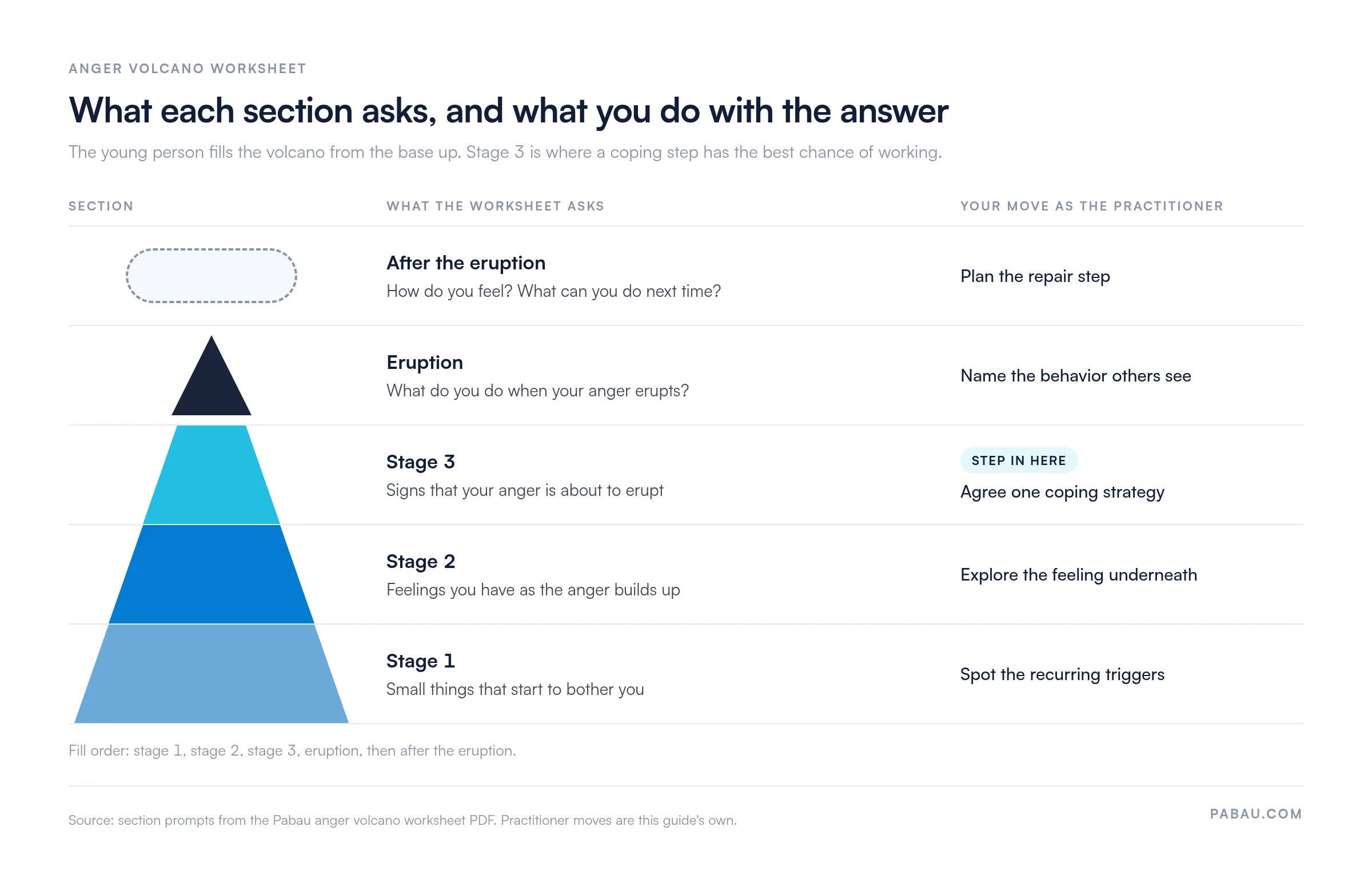
The worksheet follows anger up the volcano in five sections. The young person fills in the base first, starting at stage 1 and working up to stage 3.
Each section also gives you, the practitioner, a job to do with the answer, as the diagram below shows.
Physical signs often appear before the young person notices any change in thinking. Flushed skin, clenched fists, and a racing heart are common cues that belong in stage 3 of the volcano.
Each section of a completed volcano answers a different clinical question. Read them in order, and the answers point to the stage where an intervention is most likely to land.
The notes box at the bottom of the sheet turns it into a shared record. When a parent, teacher, and therapist all add to it, everyone works from the same warning signs.
The worksheet suits practitioners who work with children and young people on anger and emotional regulation. Choose the wording that fits the young person’s developmental stage.
A session works best when the young person already has words for feelings. Check their feelings vocabulary first, and keep a list of feelings nearby in case they get stuck.
Run it during a calm moment rather than straight after an outburst. A young person who is still upset can’t step back far enough to map the stages.
Younger children engage best with the volcano as a drawing or coloring activity. Keep the stages to three or four and use concrete examples such as a sibling taking a toy.
Teenagers often respond better when they can personalize the triggers and rate their own anger on a scale. A feelings thermometer handles that rating well alongside the volcano. Invite them to write the warning signs in their own words rather than choosing from a list.
The volcano shows where anger escalates, but the worksheet is more useful when it ends with a plan. Pair it with one or two strategies the young person can practice between sessions.
A breathing exercises handout or a grounding worksheet gives them a take-home version of the first two.
The anger volcano and the anger iceberg are both therapeutic metaphors, but they answer different questions. The volcano focuses on how anger escalates, while the iceberg focuses on the feelings sitting beneath it.
If stage 2 answers keep pointing to hurt or fear, an anger iceberg worksheet makes a natural next session.
Review your session notes after the first use. Did the young person name a trigger you did not expect? Add it to their next copy so the worksheet reflects their own experience.
A shared visual model reduces the time spent explaining an abstract emotion. Patients can point to the stage they are in, which makes the conversation concrete and easier to track over several sessions.
Keeping completed worksheets in the patient record also gives you a documented baseline for progress reviews. Use digital forms to store and retrieve these securely, rather than relying on loose paper copies.
Printable versions are useful for group work, but they should be used within a clinical context. Store and send any completed worksheet in line with your data protection obligations.
That means GDPR in the UK, and HIPAA in the US where you are a covered entity (school settings may fall under FERPA instead).
The ICO’s UK GDPR guidance sets out how practitioners should handle personal data they hold about patients.
Most practitioners print the volcano, fill it in during the session, and file the paper copy. Parents and teachers then add their notes on separate sheets, if they add them at all.
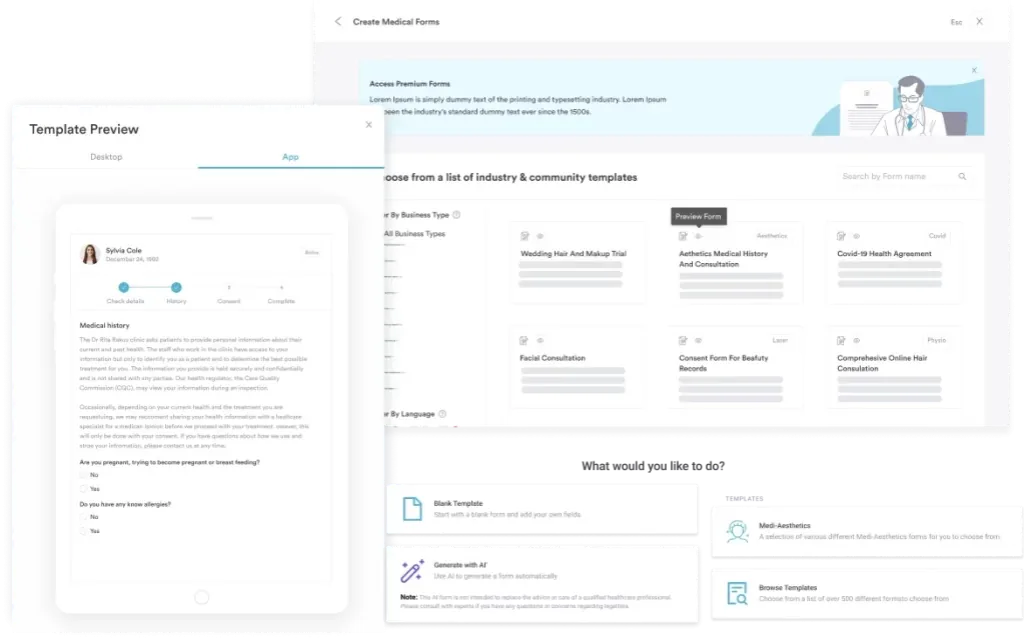
Pabau, the practice management platform we build, can turn the worksheet into a digital form. Patients or parents complete it in the session or before the appointment, and it saves straight to the patient record.
Each completed volcano then sits next to your session notes, so a progress review can compare stage 3 warning signs across weeks. Pabau’s software built for therapists also handles booking and reminders, so session time goes to the coping plan.

Pabau’s digital forms let patients and parents complete the anger volcano worksheet on screen and save it to the patient record. Track warning signs across sessions without chasing paper copies.

The volcano pays off at stage 3. Use those answers to pick one coping step, then check at the next session whether the young person used it.
The trade-off is depth. The volcano tracks how anger escalates, so pair it with the iceberg when the feelings underneath need more attention.
Keep each completed sheet, because changing stage 3 answers over a few weeks are your clearest sign of progress. Book a demo to see how Pabau stores completed worksheets alongside session notes for your therapy practice.

Want a quicker check-in tool? Anger meter worksheet gives younger children a simple scale for rating how angry they feel.
Need more structured formats? Worksheet on anger management compares five clinical formats for longer anger work.
Building a coping plan? Coping wheel template helps the young person choose strategies they will actually use.
Working on regulation more broadly? Emotional regulation worksheet extends the volcano work to other strong emotions.
Tracking triggers between sessions? Anger triggers diary logs triggers day by day for review at the next session.
An anger volcano worksheet is a printable psychoeducational handout that uses a volcano to show how anger builds through three stages, erupts, and settles afterward. It is a teaching aid for discussion, not a diagnostic or treatment tool.
It is commonly used with children aged 5 to 11 and with teenagers, with the wording and number of stages adjusted for each group. Practitioners should confirm suitability against the young person’s developmental stage.
Yes, teenagers can use it, particularly when they write their own triggers and warning signs. Keep the activity short and focused on situations from their own week.
The volcano shows how anger escalates from small triggers to an outburst. The iceberg shows the feelings hidden beneath anger, such as hurt, fear, or embarrassment.
Yes, the Pabau template is available as a free PDF download from this page. You can print it for individual or group sessions.