Despina Petrushevska
Client questionnaire template: Free PDF and what to include
What is a client questionnaire? A client questionnaire is an intake form that co...

Last Updated: Oct 27, 2026
Free PDF 3 pages, print-ready Clinician-reviewed
A character personality test is a self-report questionnaire that describes a person’s stable traits, meaning how they think, feel, and relate to others. For example, some tests use a validated framework such as the Big Five or VIA Character Strengths. Others, however, match the person to a fictional character, which makes the results easy to talk about.
Our free version is the second kind. It’s a three-page PDF with five trait ratings, 12 preference questions, and a reflection that ends in a character match. In fact, therapists and coaches use it to open a conversation about personality, not to score or diagnose. For a validated result, pair it with one of the framework instruments compared below.
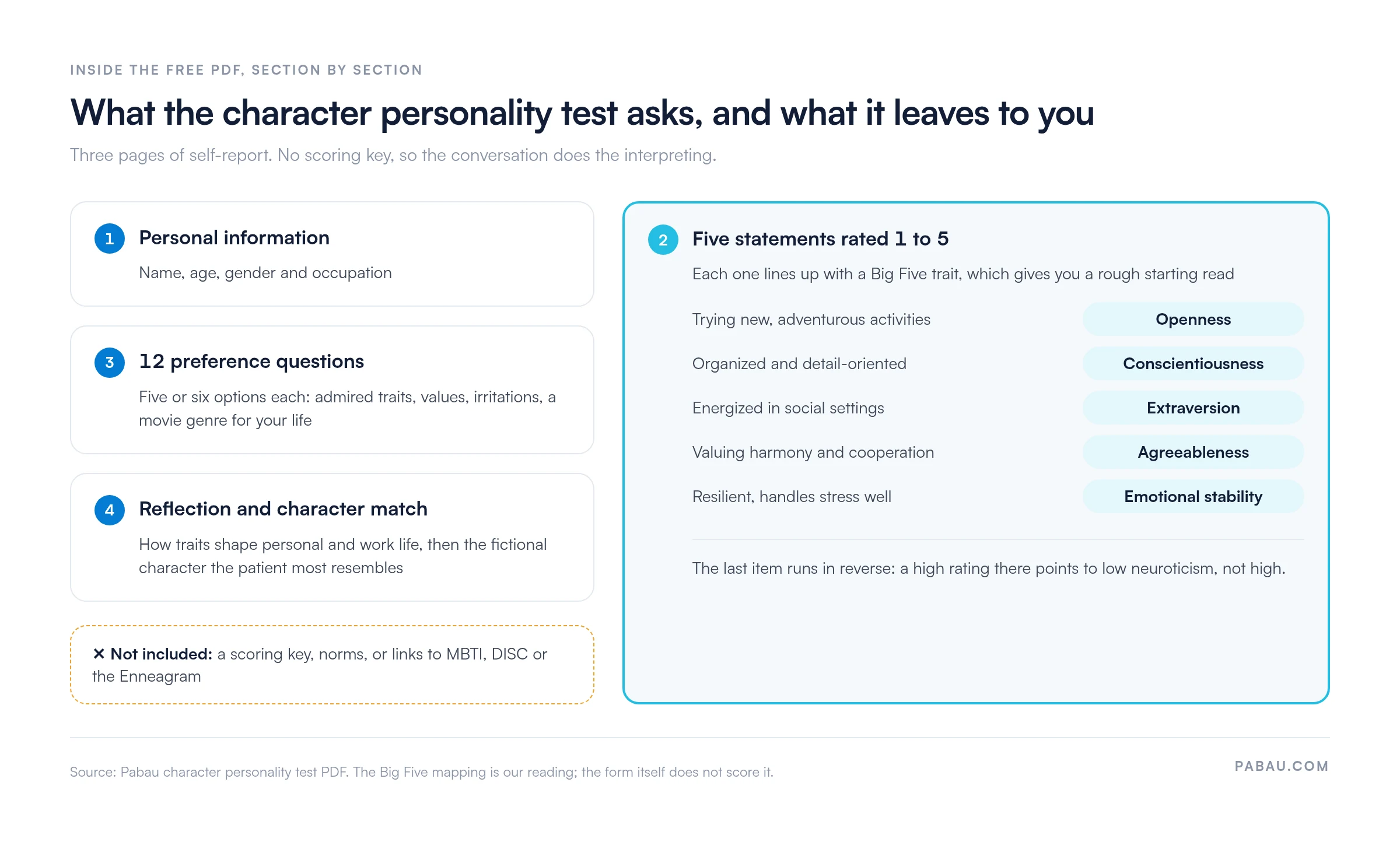
A three-page self-assessment with five 1-to-5 trait ratings, 12 multiple-choice preference questions, and reflection prompts. It ends with the patient naming the fictional character they most resemble. It has no scoring key, so use it to start a conversation rather than to measure.
Start from scratch, or upload this PDF or any form you already use, and Pabau's AI Form rebuilds it with tick boxes, text fields and a signature. Attach it to the treatment once, and every patient gets it on time.
AI Form rebuilds the consent, history and aftercare forms you already use. You review each one, then publish.
Patients complete forms on their phone before they arrive, so the front desk stops retyping paper.
Every signed form is versioned and attached to the treatment record, ready when you need it.
Set how long a consent stays valid. Returning patients skip forms they have already signed.
Supports HIPAA and GDPR compliance AES-256 encryption 4.8 on G2 4.7 on Capterra Trusted by 4,000+ practices worldwide

A character personality test describes stable traits, either through a validated framework like the Big Five or by matching a person to a fictional character.
The Big Five has the strongest support in peer-reviewed research, while MBTI and the Enneagram are popular but have weaker evidence behind them.
Validated instruments suit clinical decisions and lighter character quizzes suit rapport building, so match the tool to the job.
Our free PDF is a self-reflection quiz with no scoring key, and its five rating statements roughly track the five Big Five traits.
Results work best when you discuss them in session and file them with the patient record, so later reviews can build on them.
A character personality test measures the patterns of thinking, feeling, and behavior that stay fairly stable across time and situations. Unlike a passing mood, these traits shape how a person handles challenges, relates to others, and pursues goals. Moods shift from week to week, and externalizing a difficult feeling as a character suits that shorter-term work better.
In therapy and coaching, a personality test serves three purposes:
It helps to separate validated instruments from character quizzes. A validated test has published reliability and validity data, plus a standard scoring protocol. In contrast, a character quiz matches answers to fictional characters, as the Open Psychometrics character quiz does. In short, it’s built for self-reflection more than for clinical decisions, and both have a place once you know which one you’re using.
Five models dominate clinical, educational, and coaching settings. Specifically, each one organizes personality traits in a different way.
The Myers-Briggs Type Indicator (MBTI) sorts people on four preference pairs, which combine into 16 types:
MBTI is popular in career counseling and coaching, where it gives coaching practices a shared vocabulary for communication style. Treat it with caution, though. In fact, peer-reviewed psychologists have questioned its reliability and construct validity. The free 16Personalities test uses MBTI-style four-letter types, although its model differs from the official MBTI.
The Big Five measures five continuous dimensions, and people score high, moderate, or low on each one rather than fitting into discrete types:
The Big Five is the most scientifically validated personality model, with extensive research across clinical, educational, and organizational psychology. Specifically, therapists use it to understand how a patient’s traits might shape their engagement with a given approach. Open Psychometrics hosts a free IPIP Big Five test online. For in-session use, we also offer a printable Big Five personality test.
The Enneagram organizes personality into nine types, each with a core motivation, fear, and defense pattern. Each type also sits between two neighbors on the circular diagram, called wings. That gives 18 type-and-wing combinations, from 1w9 to 9w1. The Enneagram also maps growth paths, describing how each type shifts under stress and in supportive conditions.
Therapists and coaches use it for deeper character exploration and personal development work. Its roots are in spiritual psychology, and it’s especially popular in coaching and wellness. However, empirical research on its validity is limited compared to the Big Five.
DISC measures four behavioral quadrants: Dominance (action-oriented, decisive), Influence (people-focused, persuasive), Steadiness (reliable, calm), and Conscientiousness (detail-focused, analytical). In particular, it focuses on how people interact at work and in social settings, which makes it popular in team development and organizational coaching.
Healthcare teams use DISC to improve communication and role clarity between clinical and administrative staff. In addition, many publishers sell DISC assessments, and both free and paid versions are available.
The VIA Inventory of Strengths measures 24 character strengths, such as curiosity, kindness, and perseverance, grouped under six broad virtues. Results rank a person’s strengths from most to least characteristic rather than listing weaknesses. Notably, the VIA Institute on Character offers the survey free online, and it’s widely used in positive psychology and strengths-based therapy.
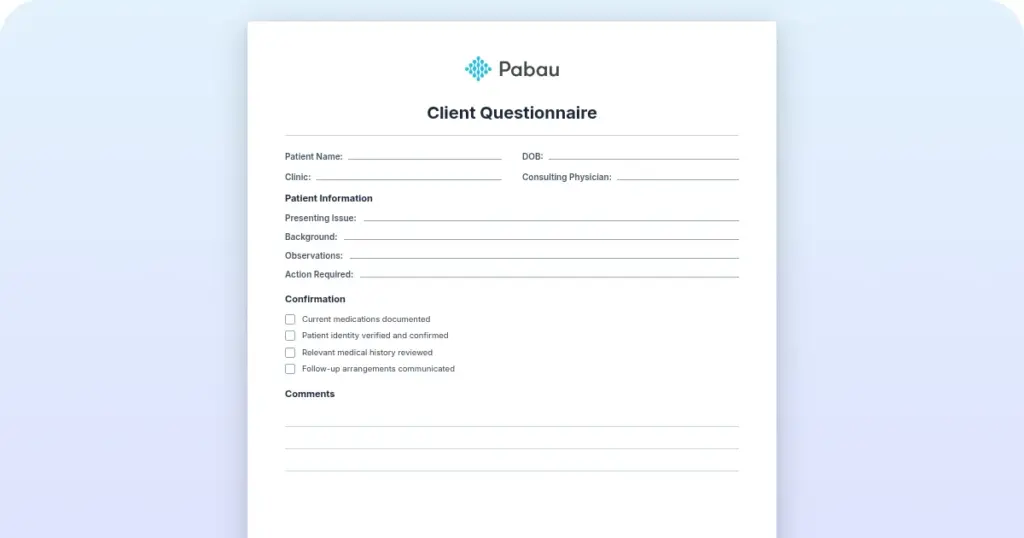
The free PDF works best as a structured conversation starter. Five steps take it from the waiting room to the treatment plan, and the diagram below shows what each section of the form asks.
Pro tip: Repeat the exercise at a natural review point, such as a treatment-plan review. Core traits stay fairly stable, but growing self-awareness can change how patients answer. Comparing the two forms gives you something concrete to discuss.
Each framework uses its own terms, but several core traits appear across models. Research comparing MBTI with the Big Five found matching dimensions for four of the five traits, while neuroticism has no MBTI counterpart.
These overlaps help you read results side by side when a patient has taken more than one assessment. As a result, keeping every result in the same patient record makes patterns easier to spot over time.
Personality tests are most useful inside a structured clinical or coaching relationship. Specifically, they help you tailor interventions and explain behavioral patterns to patients.
In therapy: Big Five and Enneagram results can surface personality factors that affect mood, relationships, and behavior. For instance, a therapist might use them to explain why an introverted patient experiences social anxiety differently from an extroverted one. Low conscientiousness scores can also open a conversation about procrastination and self-care. Therapists who log results in a mental health EMR can revisit them as treatment progresses.
Couples work takes that a step further. A written relationship agreement turns the communication preferences a test surfaces into commitments both partners sign.
In coaching: DISC and MBTI give coaches a shared language for team dynamics, communication preferences, and role fit. For example, a coach might use them to show why an unstructured role stresses a highly conscientious client. From there, they can find ways of working that suit that style.
In practice operations: Software for therapy practices can send personality questionnaires out with intake paperwork. That way, the first session opens with context and leaves more time for discussion instead of form-filling.
On paper, a personality quiz gets printed, completed, scanned, and filed away from the session notes. As a result, by the next review, finding it means a search through folders or shared drives.
Practice management software like Pabau turns the questionnaire into one of your digital intake forms. Care Pathways prompt patients to complete it on their phone before the visit. As a result, their answers flow straight into their Client records.
Because the form sits beside treatment notes and appointment history, you can compare a patient’s answers across reviews in a few clicks. Every Pabau subscription includes forms, records, and notes, and structured onboarding helps you set them up.

Pabau’s digital forms send the character personality test before the session and file every answer in the patient’s record. Repeat results sit side by side, so you can discuss change with the evidence in front of you.

Use a character personality test for what it does well. It gets patients talking about themselves in concrete terms, and a fictional character makes that easier than an abstract trait label.
When a decision rides on the result, switch to a validated instrument such as the Big Five. In short, the trade-off is simple: the quiz buys rapport, and the framework buys evidence. Using the quiz first and the instrument later gives you the benefit of each.
Book a demo to see how Pabau sends personality questionnaires before the session and keeps every result with the patient record.

Working with MBTI-style types? Jungian personality test covers the Jungian preference pairs behind four-letter personality types.
Exploring Enneagram types? Riso-Hudson Enneagram test helps patients identify their core type among the nine.
Prefer a strengths-based lens? Character strengths assessment focuses on what a patient does well rather than on deficits.
Need a broader intake questionnaire? Personality questionnaire gathers trait information in a format you can file with intake paperwork.
Want more detail than a quick quiz? In-depth personality test goes further into traits and behavior patterns for longer assessment sessions.
The Big Five (OCEAN) has the strongest empirical support and is the model most research psychologists endorse. In fact, peer-reviewed studies back its reliability, validity, and use across cultures. MBTI and the Enneagram are popular but have weaker scientific support, though both can help with self-understanding. Match the tool to the job: the Big Five for clinical and research use, MBTI for career exploration, and the Enneagram for personal development.
Most personality assessments take 15 to 30 minutes. MBTI and Big Five tests typically take 15 to 20 minutes. Enneagram tests can run 20 to 30 minutes because they probe motivations in more detail. The VIA survey takes about 15 minutes. Add the discussion afterward, and a full session usually runs 45 to 60 minutes.
Yes. Personality assessments build self-awareness, help patients understand why they react as they do, and give them language for relational and behavioral patterns. Therapists use results to match interventions to personality style, such as structured homework for conscientious patients. Used within treatment planning, they support work on anxiety, depression, and interpersonal concerns.
The PDF runs to three pages. It collects basic personal details, then asks for five 1-to-5 trait ratings and answers to 12 multiple-choice preference questions. Finally, it closes with two reflection prompts, including the fictional character the patient most resembles. It has no scoring key.