

CCSD code G5100: Bypass of duodenum billing guide
CCSD code G5100 bills a bypass that leaves the duodenum in place CCSD code G5100...

Last Updated: Oct 16, 2026
V5080 is the HCPCS Level II code for glasses, bone conduction. It reports an eyeglass hearing aid that sends sound through the skull bone to the inner ear, bypassing the ear canal and middle ear.
V5070 covers the air conduction version of the same eyeglass device. Traditional Medicare excludes both under the statutory hearing aid exclusion, so payment depends on Medicare Advantage, Medicaid or commercial plan benefits.
Let Pabau's smart automation suggest the right codes, reduce claim denials, and keep your practice compliant—effortlessly.
Automate repetitive tasks and focus on what matters most—your patients.
Reduce coding errors and ensure compliance with the latest regulations.
Clean claims, fewer denials, and faster reimbursements.
Powerful insights and reporting to help your practice thrive.
HIPAA compliant SOC 2 certified GDPR-compliant Trusted by 4,000+ clinics worldwide

HCPCS code V5080 reports glasses with a built-in bone conduction hearing aid, which sends sound through the skull bone instead of the ear canal.
V5070 is the air conduction version of the same eyeglass device, and V5150 is the code set’s entry for binaural eyeglass aids.
Traditional Medicare excludes V5080 under Social Security Act section 1862(a)(7), so CMS sets no Medicare payment amount for it.
Implanted bone-anchored devices are treated as prosthetic devices, but a headband-worn processor billed as L8692 is excluded just like V5080.
Medicare Advantage, Medicaid and commercial coverage varies by plan, so verify the benefit and any prior authorization before ordering the device.
HCPCS code V5080 is the Level II code for “Glasses, bone conduction,” a hearing aid built into an eyeglass frame. A vibrating receiver in the frame rests against the bone behind the ear and carries sound to the inner ear.
Because the sound skips the ear canal and middle ear, audiologists consider this design for patients who cannot use a conventional aid. Typical reasons include conductive or mixed hearing loss, a closed or absent ear canal, and chronic ear drainage.
Key code facts from the CMS HCPCS file (October 2026 quarterly update):
V5070 and V5080 share the eyeglass format and differ in how the receiver delivers sound. Our guide to HCPCS code V5070 covers the air conduction version.
The V5080 descriptor does not state a number of ears. The HCPCS Level II codes list binaural eyeglass aids separately under V5150, so confirm which code the payer expects for a two-ear fitting.
Dispensing and fitting services carry their own codes, such as V5241 for a monaural dispensing fee and V5011 for fitting and orientation. A CROS eyeglass aid has its own device code, V5190.
Medicare draws its coverage line at osseointegration, the surgical anchoring of a device to the skull. How the device delivers sound does not decide it.
Under 42 CFR 411.15(d), Medicare excludes hearing aids and examinations for prescribing, fitting or changing them. The Medicare Benefit Policy Manual (Chapter 16, §100) treats osseointegrated implants as prosthetic devices rather than hearing aids.
The HCPCS file shows the split. L8690, the implanted system, carries coverage code C, so the Medicare contractor decides coverage. L8692, a processor worn on a headband without surgery, carries the same 1862(a)(7) exclusion as V5080.
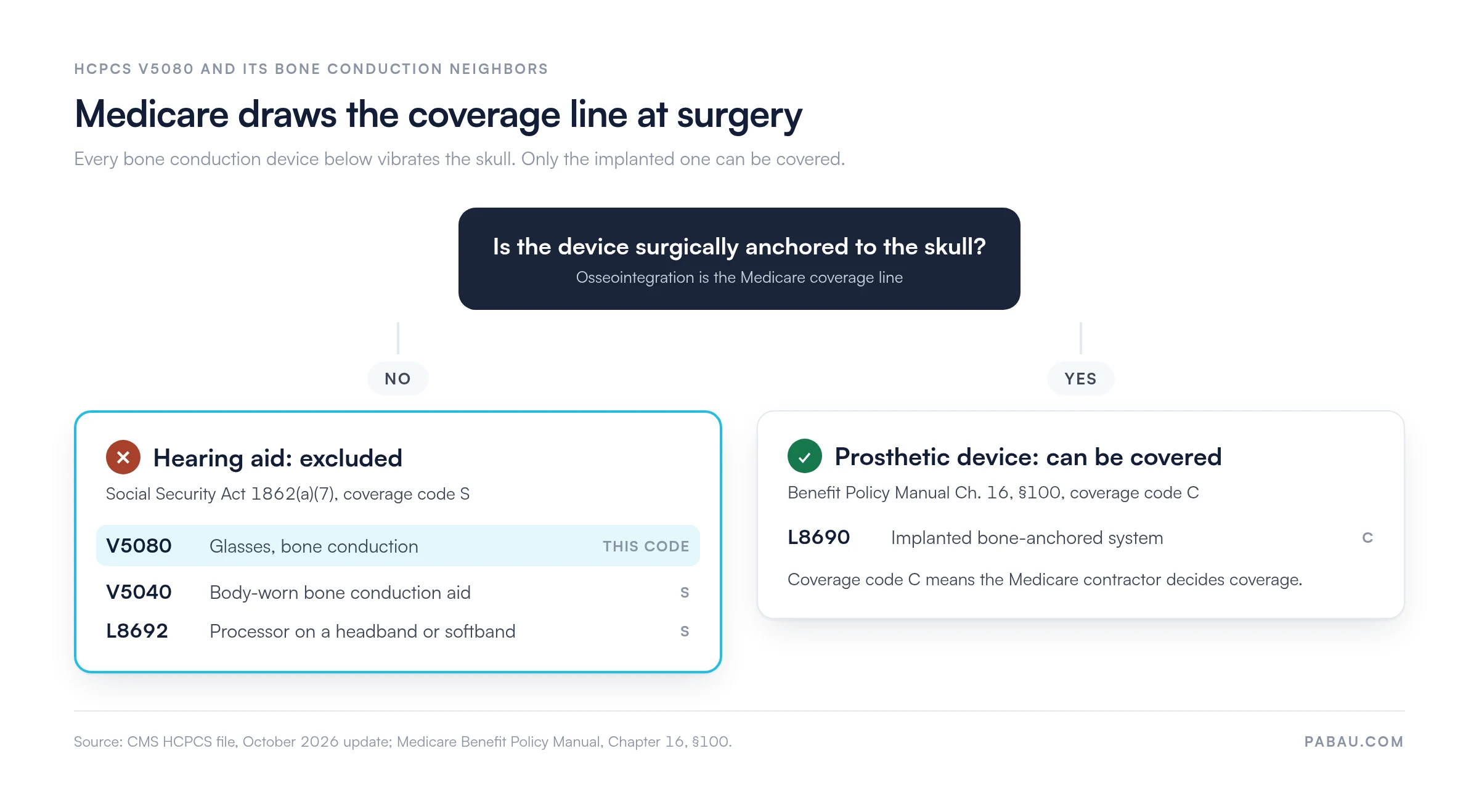
For a patient weighing bone conduction glasses against a softband or an implant, the code range and the payment source change together. Explain that difference before the patient commits to a device.
Traditional Medicare does not pay for V5080. Section 1862(a)(7) of the Social Security Act excludes hearing aids, and CMS gives the code coverage code S, noncovered by statute.
The pricing indicator is 00, so Medicare publishes no fee schedule amount for V5080. Check the CMS HCPCS file rather than the Physician Fee Schedule when you confirm its status each quarter.
What the exclusion means at the front desk:
Medicare Advantage plans can offer hearing aids as a supplemental benefit. Each plan sets its own allowance, network and authorization rules, and some route the benefit through a hearing benefit vendor. Verify the benefit before the fitting appointment.
Medicaid coverage of hearing aids for adults is optional, so each state decides which hearing aid codes it covers and what authorization it requires. Check the state hearing services manual for V5080 before you order the device.
For enrollees under 21, the Early and Periodic Screening, Diagnostic, and Treatment (EPSDT) benefit requires states to cover medically necessary hearing aids. A child who needs a bone conduction aid can qualify even where the adult benefit is limited.
Commercial coverage depends on whether the plan includes a hearing aid benefit. Many states mandate hearing aid coverage, often for children only, so check both the state mandate and the plan terms.
Where a plan pays a separate dispensing fee, that service goes on its own line under a code such as V5241. Other plans fold the fitting into the device allowance.
A payer reviewing V5080 wants to see why a bone conduction eyeglass aid suits this patient better than a standard air conduction aid. Build the record around that question.
Request prior authorization before ordering the device, and dispense within the approval’s validity window.
Modifier use on V5080 follows the Medicare exclusion and each payer’s own policy. The table covers the modifiers that come up most often.
Most V5080 denials trace back to a coverage check or a code choice made before the fitting.
Logging each denial by reason code shows which of these causes costs your practice most. A structured denial management process turns that log into fixes at the front desk.
Audiologists and licensed hearing instrument specialists bill most V5080 claims. State licensure sets who may dispense hearing aids, and each payer decides whom it credentials for its hearing benefit.
Confirm each provider is enrolled with the payer before the first claim. A credentialing mismatch denies the line however strong the documentation is.
A superbill that lists V5070, V5080 and the dispensing codes side by side helps the right code reach the claim.
Many hearing practices keep audiograms in one system, ABNs on paper and claim status in payer portals. When a plan asks for records, staff rebuild the file by hand.
Pabau, the practice management platform we build, holds the audiogram, signed forms and device details on the patient’s record. Patients sign a voluntary ABN or plan notice as a digital form before the device is ordered.
Pabau’s claims management software pulls data already on the record into a pre-filled claim. It submits through Claim.MD and tracks each claim, so your team sees paid, pending and denied V5080 lines in one place.

Pabau keeps audiograms, signed forms and device details on one patient record, then submits and tracks claims through Claim.MD. See how it fits a hearing practice.

V5080 has a fixed Medicare answer, so the billing work happens before the fitting. Confirm the patient’s plan pays for an eyeglass aid, and document why bone conduction was chosen over an air conduction aid.
When a patient might qualify for a bone-anchored device instead, raise it early. That choice changes the code range and who pays, and the patient should hear it before frames are ordered.
Book a demo to see how Pabau keeps hearing aid records, signed notices and claim status in one place for your practice.

Fitting an air conduction eyeglass aid instead? HCPCS code V5070 covers glasses with an air conduction hearing aid and how they are billed.
Billing the dispensing service on its own line? HCPCS code V5241 explains the monaural dispensing fee and where it sits beside the device code.
Need to understand how claims denials are categorized and appealed? Denial management in healthcare covers the CARC/RARC framework and the most effective appeal workflows.
Looking for guidance on superbill setup for hearing care claims? Superbill best practices explains how to build encounter forms that capture every code and modifier required for clean claim submission.
Want to understand the full scope of medical billing compliance for a hearing care practice? Medical billing compliance covers documentation, audit risk, and payer policy adherence across specialties.
HCPCS code V5080 describes glasses, bone conduction. It is an eyeglass frame with a built-in hearing aid that sends sound through the bone behind the ear to the inner ear.
No. Traditional Medicare excludes hearing aids under Social Security Act section 1862(a)(7), and the CMS HCPCS file marks V5080 as noncovered by statute. Some Medicare Advantage plans cover hearing aids as a supplemental benefit.
Both codes describe hearing aids built into eyeglasses. V5070 delivers sound through the air into the ear canal, while V5080 sends it as vibration through the bone behind the ear.
No. An implanted bone-anchored system is reported with L8690 and treated by Medicare as a prosthetic device. A processor worn on a headband without surgery is L8692, which Medicare excludes like V5080.
An ABN is not required, because the statutory exclusion makes the patient liable either way. Many practices issue a voluntary ABN and report GX with GY if they file the claim to Medicare.
It depends on the payer. Medicaid programs and commercial plans with hearing aid benefits often require authorization before the device is ordered, so verify it before the fitting appointment.



