CPT Code 62284: Injection procedure for myelography
CPT Code 62284: official descriptor and procedure overview The American Medical ...

Last Updated: Oct 19, 2026
V5190 is the HCPCS Level II code for hearing aid, contralateral routing, monaural, glasses. It covers a CROS system built into eyeglass frames, which picks up sound on the poorer-hearing side and sends it to the better ear.
The code turns on mounting style and routing. A behind-the-ear CROS aid bills as V5181 and an in-the-ear one as V5171, while a binaural glasses BiCROS system bills as V5230.
Let Pabau's smart automation suggest the right codes, reduce claim denials, and keep your practice compliant—effortlessly.
Automate repetitive tasks and focus on what matters most—your patients.
Reduce coding errors and ensure compliance with the latest regulations.
Clean claims, fewer denials, and faster reimbursements.
Powerful insights and reporting to help your practice thrive.
HIPAA compliant SOC 2 certified GDPR-compliant Trusted by 4,000+ clinics worldwide

HCPCS Code V5190 covers a monaural CROS hearing aid built into eyeglass frames, not a BTE, ITE or ITC device.
Monaural CROS aids in other styles bill as V5181 (BTE), V5171 (ITE) or V5172 (ITC), and a binaural glasses BiCROS system bills as V5230.
Medicare Part B excludes hearing aids, including V5190, under Section 1862(a)(7) of the Social Security Act. Some Medicare Advantage and state Medicaid plans do cover it.
A missing audiogram, the wrong device-style code and absent prior authorization are the three leading causes of V5190 denials.
Practice management software like Pabau keeps the audiogram, order and PA number on one patient record, so each V5190 claim goes out complete.
HCPCS Code V5190 is the Level II code for a monaural contralateral routing of signals (CROS) hearing aid built into eyeglass frames. It sits in the V5120-V5267 hearing aid range maintained by the Centers for Medicare and Medicaid Services (CMS). The official descriptor is Hearing aid, contralateral routing, monaural, glasses.
Each part of that descriptor narrows the code. Contralateral routing means a microphone on the poorer ear sends sound across to the better-hearing ear. Monaural means only the better ear has a receiver, which separates CROS from BiCROS. Glasses means the components sit in eyeglass frames.
The table below places V5190 among the neighboring codes that coders most often confuse with it.
Mounting style decides the code. A behind-the-ear CROS system bills as V5181, and an in-the-ear one as V5171. When the CROS components sit in eyeglass frames, V5190 applies. Billing the wrong mounting code is the most preventable denial on CROS claims, and the code map below lays out each option side by side.
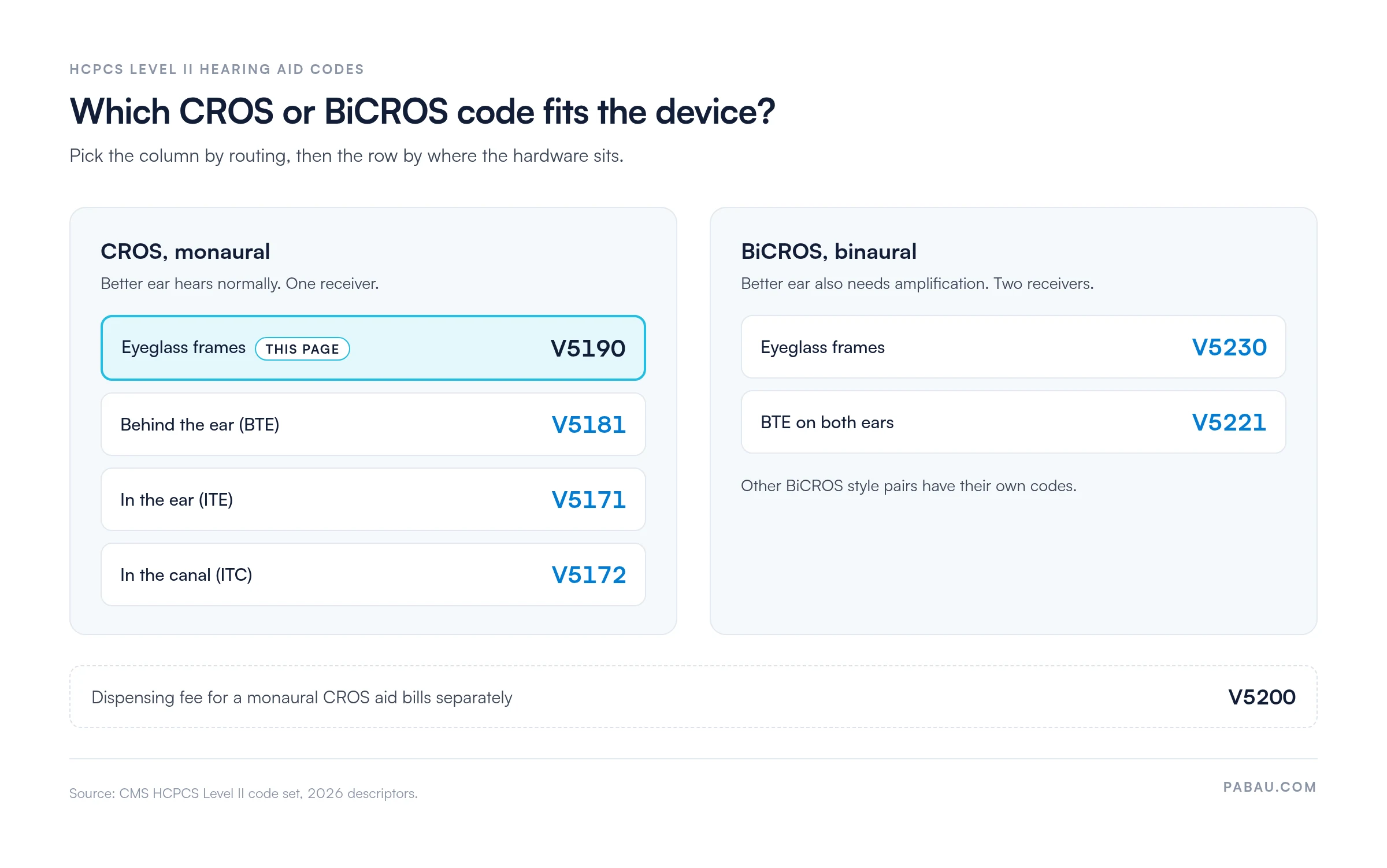
V5190 covers one device configuration. The components must be built into eyeglass frames, and the device must route sound from a nonfunctional or profoundly impaired ear to the better-hearing ear.
BiCROS causes the most coding confusion. A BiCROS device serves a patient with hearing loss in both ears, where one side is much worse. The better ear also needs amplification, so it gets its own receiver. CROS has only one receiver. A BiCROS system in eyeglass frames bills as V5230, not V5190.
V5190 is clinically appropriate for a patient with single-sided deafness or profound unilateral sensorineural hearing loss. A standard aid on the impaired side must offer no benefit. The audiogram must show that the affected ear falls below usable aided thresholds, which supports CROS as the right intervention.
The ICD-10-CM diagnosis codes most commonly paired with V5190 claims include:
Payer policies vary on which ICD-10 codes they accept alongside V5190. Some commercial plans require the H90.4x unilateral codes specifically. Submitting H90.3 without documenting the difference in severity between ears can trigger a medical necessity denial. Confirm the diagnosis code requirements in the payer’s coverage policy before you submit.
Pull the audiogram into the claim package rather than referencing it by date. Payers reviewing CROS medical necessity want the threshold values, not a note saying an audiogram was performed. Attach it as a PDF with the 837P or include it in your prior authorization submission.
Insufficient documentation is one of the leading reasons HCPCS Code V5190 claims are denied. Audiology practices that standardize the documentation package before dispensing get paid faster. Most payers require the following:
Missing even one element frequently leads to a CO-4 or CO-50 denial and a resubmission. A documentation checklist built into the patient’s intake forms prompts staff to confirm each item before the claim goes out.

Prior authorization (PA) requirements for HCPCS Code V5190 vary significantly across payers. PA rules change with contract cycles, so treat the table below as a starting reference and verify with each payer before dispensing.
Verify eligibility and PA status before you dispense. Otherwise you risk fitting the device, submitting the claim and only then learning that PA was required. A retroactive PA denial on a spectacle CROS system is rarely reversible.
Medicare Part B does not cover HCPCS Code V5190. Section 1862(a)(7) of the Social Security Act excludes hearing aids from Medicare coverage, and the exclusion applies to every hearing aid HCPCS code. No Medicare Local Coverage Determination (LCD) overrides it for spectacle CROS devices.
Three exceptions are worth knowing:
When Medicare is primary and the device is non-covered, document the Advance Beneficiary Notice (ABN) process. A signed ABN before dispensing protects your practice from carrying the financial risk. Flag Medicare patients for the ABN step at scheduling, before the fitting appointment.
V5190 has a predictable set of denial patterns. Most are avoidable with a pre-submission checklist tied to the device style and the payer’s requirements.
Every denial on a V5190 claim should become a worklist item. Identify the reason code, correct the cause and resubmit within the payer’s timely filing window. Denials left to age lose both the revenue and the appeal window. A reference to medical billing denial codes helps coders read the remittance advice and pick the right fix.
Clean submission for HCPCS Code V5190 depends on a handful of fields that payers audit closely. Follow this sequence for commercial and Medicaid plans that cover the code:
A clearinghouse that validates HCPCS codes against the current CMS file catches code-level errors before the claim reaches the payer. A clearinghouse rejection takes hours to fix, while a payer denial takes weeks.
CROS and BiCROS are clinically distinct, and that distinction drives code selection. Getting it wrong is a quick route to a CO-11 denial.
Spectacle BiCROS systems have their own code, V5230 (hearing aid, contralateral routing system, binaural, glasses). Bill it instead of V5190 whenever the better ear also has a receiver. Payer coverage for V5230 varies as widely as it does for V5190. Describe the exact device configuration in the prior authorization request, and keep the payer’s written response in the patient’s record.
Give your dispensing team a one-page card that maps each device to its code. BTE CROS is V5181, ITE CROS is V5171, ITC CROS is V5172 and spectacle CROS is V5190. Spectacle BiCROS is V5230. Post it at the fitting station, because a wrong code chosen at dispensing takes longer to correct than to prevent.
A V5190 claim often lives in three places at once: the fitting notes, a payer spreadsheet and the clearinghouse portal. When the audiogram sits in one and the PA number in another, the claim goes out incomplete.
Practice management software like Pabau keeps those pieces on the patient record. Digital forms capture the provider order, the device details and the signed coverage acknowledgment before the fitting. The audiogram is stored against the same record, so staff can find it when the claim is built.
Pabau’s audiology claims software then submits the claim electronically and tracks its status. Your billing team can see where each V5190 claim sits and follow up on a denial before the appeal window closes.

Pabau keeps the audiogram, order and PA number on the patient record, then submits and tracks each hearing aid claim so denials get caught early.

V5190 is only the right code when the CROS hardware sits in eyeglass frames and just one ear gets a receiver. Confirm both at the fitting rather than at billing, and wrong-code denials largely disappear.
Coverage is the harder call. Medicare Part B won’t pay, so the ABN and a clear self-pay conversation matter as much as the code. With every other payer, PA and a complete audiogram decide whether you’re paid on the first pass.
If your team still reconciles fitting notes with payer rules by hand, one patient record removes that step. Book a demo to see how Pabau keeps CROS documentation and hearing aid claims together for your audiology practice.

Need to understand how claims flow through a clearinghouse? How medical claims clearinghouses work explains the submission pathway from practice to payer.
Dealing with repeated denials on hearing device claims? Denial management in healthcare covers the workflows that turn denials into paid claims.
Want to reduce revenue cycle errors across your practice? What is revenue cycle management outlines the end-to-end process from patient registration to payment posting.
Billing the batteries and tubing that go with the device? HCPCS Code V5267 covers hearing aid supplies and accessories billed separately.
Coding unspecified hearing loss in the right ear? ICD-10 Code H91.91 explains when the unspecified right-ear code applies.
HCPCS Code V5190 is the billing code for a monaural CROS hearing aid built into eyeglass frames. It routes sound from a nonfunctional ear to the better-hearing ear for a patient with single-sided deafness. Behind-the-ear CROS systems bill as V5181 instead.
No. Section 1862(a)(7) of the Social Security Act excludes hearing aids from Medicare coverage, and that exclusion applies to V5190. Some Medicare Advantage plans add hearing aid benefits that may include CROS devices, so check the plan’s benefit schedule each year.
Most payers require a current audiogram showing thresholds for both ears and a physician or audiologist order. They also expect a Certificate of Medical Necessity or clinical note, the device model and serial number, fitting notes, and a signed coverage acknowledgment. Attach the audiogram to the claim rather than referencing it by date.
V5190 covers a monaural CROS hearing aid mounted in eyeglass frames. V5171 covers a monaural CROS aid worn in the ear (ITE), and the behind-the-ear version is V5181. Routing works the same way in each, so the mounting style decides the code. Billing one for the other leads to a CO-4 or CO-11 denial.
It depends on the payer. Medicare Part B has no PA step because it doesn’t cover the device at all. Medicare Advantage plans, commercial insurers such as BCBS and UnitedHealthcare, and many state Medicaid plans commonly require PA for V5190. Verify with the specific payer before dispensing.
Monaural CROS aids bill by style: V5171 in the ear, V5172 in the canal, V5181 behind the ear and V5190 in glasses. Binaural BiCROS systems have their own codes, including V5221 for BTE on both ears and V5230 for glasses. The dispensing fee for a monaural CROS aid bills separately as V5200.