HCPCS Code G0163: Skilled nursing observation and assessment
What is HCPCS Code G0163? HCPCS Code G0163 is a deleted Level II code for skille...

Last Updated: Oct 15, 2026
V5070 is the HCPCS Level II code for glasses, air conduction. It covers a device that combines corrective lenses with a hearing aid, delivering amplified sound through the outer ear canal.
The code sits in the V5000-V5999 HCPCS range for hearing services. Medicare Part B excludes conventional hearing aids from coverage, so payer identification and prior authorization come before any V5070 claim. Most denials trace back to a missing audiogram, prescription, or fitting note rather than the device itself.
Let Pabau's smart automation suggest the right codes, reduce claim denials, and keep your practice compliant—effortlessly.
Automate repetitive tasks and focus on what matters most—your patients.
Reduce coding errors and ensure compliance with the latest regulations.
Clean claims, fewer denials, and faster reimbursements.
Powerful insights and reporting to help your practice thrive.
HIPAA compliant SOC 2 certified GDPR-compliant Trusted by 4,000+ clinics worldwide

V5070 covers glasses with an air conduction hearing aid, which is distinct from the monaural and binaural hearing aid codes in the V5000 range.
Medicare Part B does not cover hearing aids, and Medicare Advantage and Medicaid coverage vary by plan and by state.
Applicable modifiers are LT, RT, NU, RR, and UE, and the wrong choice is the most common denial trigger.
Required documentation includes a current audiogram, a prescription, fitting notes, and a medical necessity statement.
Pabau’s claims management software embeds HCPCS code libraries and tracks claim status, so audiology practices submit clean V5070 claims first time.
HCPCS code V5070 is the alphanumeric Level II supply code for glasses with an air conduction hearing aid. The device combines corrective lenses with a hearing aid that delivers amplified sound through the outer ear canal. Unlike bone conduction devices, air conduction hearing aids route sound through a standard ear canal pathway. The glasses frame houses the hearing aid components, which separates V5070 from codes such as V5249 that cover monaural or binaural behind-the-ear and in-the-canal devices.
The code is maintained by the Centers for Medicare and Medicaid Services (CMS) within the HCPCS Level II alphanumeric system. V-prefix codes in the V5000-V5999 range cover hearing services only. Vision codes sit in a separate range, V2000-V2999. Knowing where V5070 falls among the wider set of HCPCS Level II codes is the first step to an accurate claim.
Reimbursement rates for V5070 are set by individual payers rather than by a single national Medicare rate. Medicare Part B excludes conventional hearing aids from its covered benefits, so no national rate exists to publish. Where a payer does reimburse this code, rates are subject to geographic adjustment under the Durable Medical Equipment (DME) benefit category.
The DME geographic adjustment can move reimbursement up or down by 10-20% depending on the jurisdiction. Practices billing across several states should verify rates against the current CMS HCPCS code list and fee schedule files, which are published each fiscal year. Rates listed on third-party fee schedule tools may lag behind the annual CMS updates.
Medicare Part B does not cover hearing aids, including glasses-style air conduction devices billed under V5070. This exclusion is statutory: The Social Security Act explicitly excludes hearing aids from Medicare Part B benefits. Claims submitted to traditional Medicare for V5070 will be denied without appeal rights on the coverage ground.
Medicare Advantage plans operate differently. Many offer supplemental hearing benefits, and some reimburse glasses-style hearing aids where the clinical need is documented. Before billing any Medicare Advantage plan for V5070, confirm three points through insurance eligibility verification:
Medicaid coverage for V5070 varies significantly by state. Several states cover pediatric hearing devices as part of their early intervention mandates, while adult hearing aid coverage under Medicaid remains inconsistent.
States with established hearing aid benefits, including California, New York, and Illinois, publish specific fee schedule rates for V-codes in their Medicaid provider manuals. Pull the current state Medicaid fee schedule before billing rather than relying on prior-year rates. Private payers set reimbursement contractually, so rate verification at the point of care is the only reliable approach.
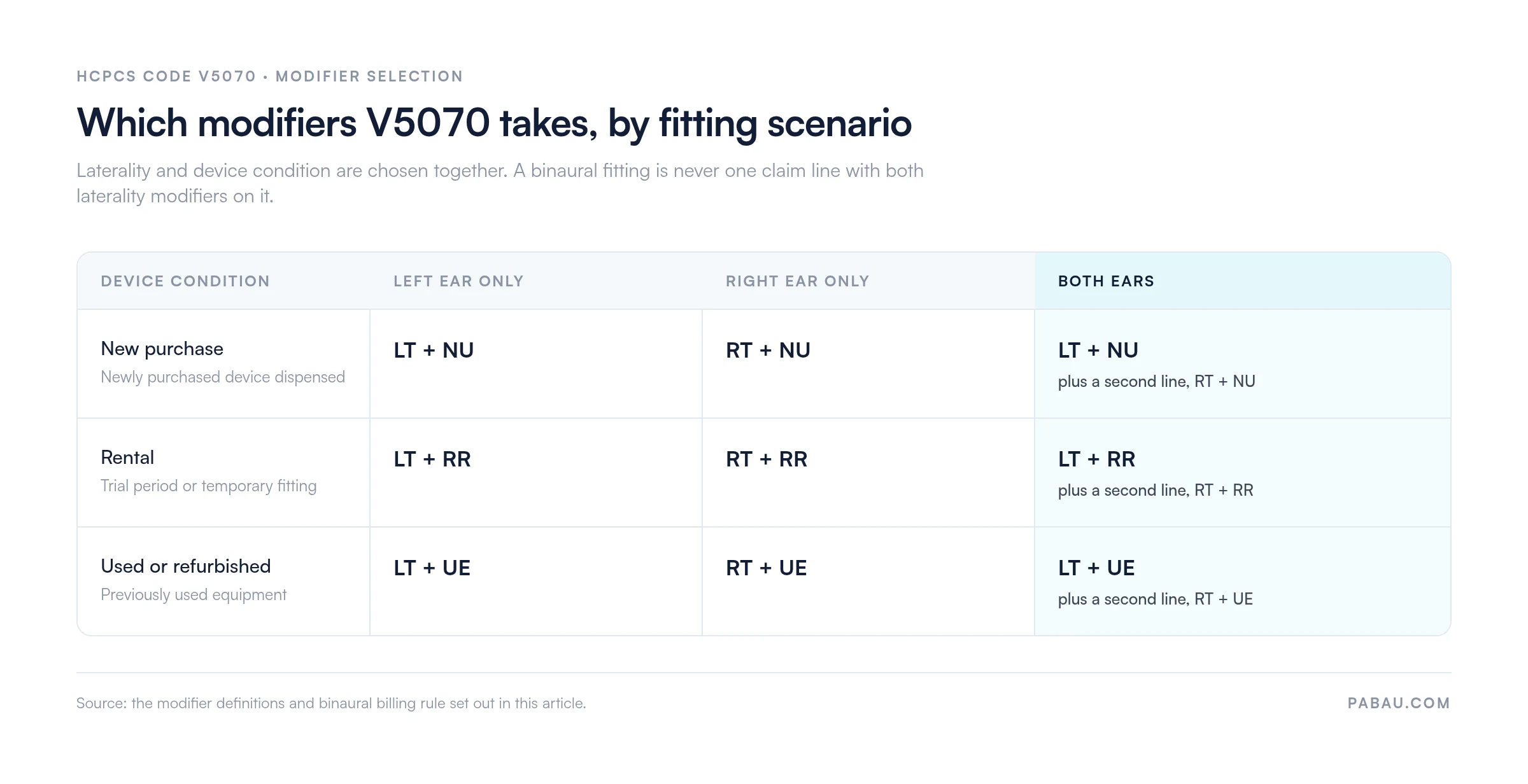
Modifier selection for V5070 is the most common denial trigger for this code. The wrong laterality or condition modifier causes the claim to fail medical necessity or bundling edits. The table below covers the five modifiers applicable to V5070 and the correct clinical context for each.
Verify modifier guidance against current HCPCS Level II modifier guidance from AAPC before submitting claims, as CMS modifier rules update annually. For binaural fittings, bill two line items: One with LT and one with RT. A single line carrying both modifiers will not pass. Laterality and device condition are always chosen together, so the grid below pairs them.
Audit your V5070 claims from the past 90 days and filter for modifier-related denials. If more than 15% of denials cite modifier errors, the problem usually sits in the dispensing workflow rather than the billing step. Laterality should be confirmed and recorded at fitting, not reconstructed later from memory.
Complete documentation separates a clean claim from a denial for V5070. Payer audits of hearing device claims focus on whether the file demonstrates medical necessity and supports the specific device type billed. Every V5070 claim file should contain all of the following before submission.
Standardizing these documents into a pre-claim checklist cuts documentation-related denials. The audiogram and the prescription are the two documents most often missing from denied V5070 claims. That pattern comes from audiology billing guidance published by the American Academy of Audiology.
V5070 sits within a narrow cluster of hearing device codes. Selecting the correct code depends on the specific device type being dispensed. The table below shows the codes adjacent to V5070 in the NLM HCPCS Level II code database. Check it to confirm you have the right code before billing.
The most common wrong-code error is billing V5080 (bone conduction) when the device is an air conduction glasses model. The two are clinical opposites, so the audiogram and the fitting notes will contradict a V5080 claim for an air conduction device. That contradiction triggers a medical necessity denial. Confirm the sound conduction pathway in the device specification sheet before selecting the code.
If that check shows bone conduction and the amplifier is body worn, the single-ear code is V5040, not the glasses-mounted V5080.
Most V5070 denials trace back to four root causes, and each one is preventable with a checklist at the point of claim preparation.
Corrected claims for V5070 typically require a cover letter explaining the error, with the corrected documentation attached. Verifying the file before the claim leaves the practice removes most of these rework cycles.

Pabau’s claims management software embeds HCPCS code libraries, flags missing documentation before submission, and tracks claim status across payers. V5070 and related hearing device codes reach the right payer with the right modifier, first time.

The billing workflow for V5070 touches at least four separate steps. Eligibility verification, prior authorization, documentation assembly, and claim submission each carry their own failure mode. An error at any one of them produces a denial.
Practice management software like Pabau can embed HCPCS code libraries, so staff pick V5070 rather than V5080 from a validated list. Nobody has to type the code from memory.
Pabau’s claims management software tracks claim status across payers and flags incomplete documentation before a claim goes out. For audiology practices running several practitioners, a missing audiogram or an unsigned medical necessity statement is caught in the workflow. The alternative is reading about it in a denial letter three weeks later.
Digital intake forms can capture the audiogram date, the device serial number, and the ear fitted. All three are recorded at the point of the patient visit. Those are the fields most often absent from a denied V5070 claim file.
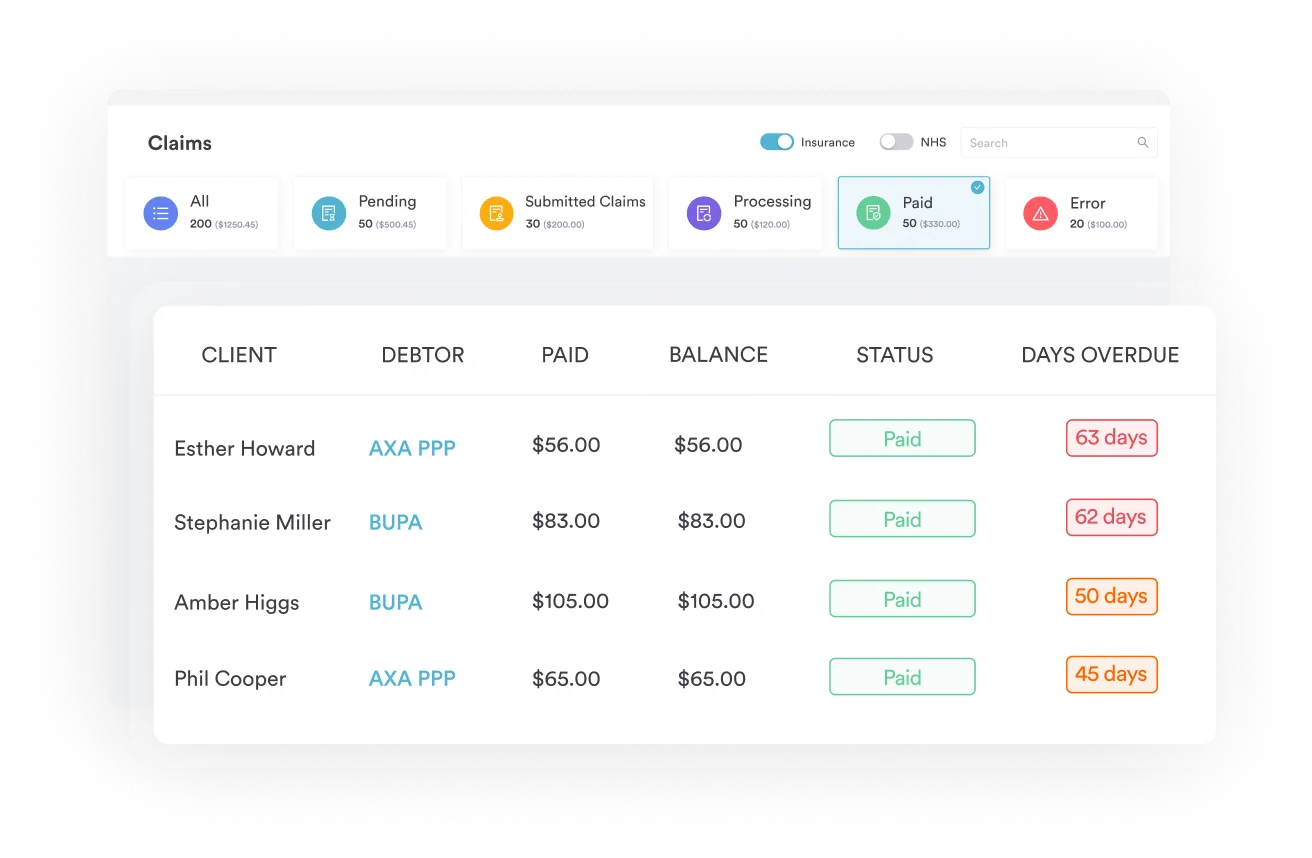
When the HCPCS code and the modifier populate automatically from the clinical record, manual entry errors drop. That same workflow generates the documentation trail required for prior authorization submissions to Medicare Advantage plans.
Build a V5070 pre-claim checklist inside your practice management system: Audiogram date, signed prescription, device make and model, laterality, and prior authorization. Running this check before submission takes under two minutes per claim and removes the most common denial triggers for this code.
HCPCS code V5070 is a narrow, device-specific code, and most claim failures trace back to incomplete documentation and modifier errors rather than genuine coverage disputes. Confirm the conduction pathway, pick the right laterality and condition modifier, then assemble the full documentation file before submission. Those three habits keep V5070 claims out of the denial queue.
Pabau helps audiology and ENT practices enforce those habits at the point of care. The audiogram, the prescription, and the modifier get captured correctly the first time.
To see how Pabau handles HCPCS billing workflows for hearing device practices, book a demo.

List Item #1
List Item #2
HCPCS code V5070 is the Level II supply code for glasses with an air conduction hearing aid. The device combines corrective lenses with a hearing aid that delivers sound through the outer ear canal. It sits within the V5000-V5999 HCPCS range and is used by audiologists, ENT specialists, and licensed hearing aid dispensers.
No. Medicare Part B does not cover hearing aids, including glasses-style air conduction devices billed under V5070. That exclusion is written into the Social Security Act. Medicare Advantage plans may offer supplemental hearing benefits that include V5070, but coverage varies by plan. Always verify benefits before dispensing the device.
The applicable modifiers for V5070 are LT (left side), RT (right side), NU (new equipment), RR (rental), and UE (used durable medical equipment). Laterality modifiers are required by most payers when billing a monaural device. For binaural fittings, bill two separate line items, one with LT and one with RT, rather than combining both on a single claim line.
Required documentation includes a current audiogram, typically dated within 6 months, and a signed physician or audiologist prescription specifying the air conduction glasses-style device. The file also needs fitting and verification notes, the device manufacturer and model number, and a signed medical necessity statement. A missing element is the most common reason V5070 claims are denied on audit.
Medicaid coverage for V5070 varies by state. Some states cover pediatric hearing devices under early intervention mandates, while adult hearing aid benefits under Medicaid are inconsistent across states. Always check the current state Medicaid provider manual and fee schedule for the rate and coverage criteria before billing.
Prior authorization requirements for V5070 vary by payer. Traditional Medicare does not cover the code at all, so prior authorization is not applicable. Medicare Advantage plans that include a hearing benefit often require prior authorization before the device is dispensed. Many Medicaid programs and private payers also require it, so confirm with each payer before fitting.