HCPCS code A4714: Treated water for peritoneal dialysis billing guide
HCPCS code A4714: Official descriptor, code type, and payment status HCPCS code ...

Last Updated: Oct 15, 2026
V2630 is the HCPCS Level II code for an anterior chamber intraocular lens. A surgeon places this lens in front of the iris when the posterior capsule cannot hold an implant. It applies to secondary implants in aphakic eyes and to cataract surgery where a complication rules out posterior placement.
V2630 can be confused with V2631, the iris supported lens, and V2632, the posterior chamber lens. The operative report has to name the lens position, and the implant log has to match it.
Let Pabau's smart automation suggest the right codes, reduce claim denials, and keep your practice compliant—effortlessly.
Automate repetitive tasks and focus on what matters most—your patients.
Reduce coding errors and ensure compliance with the latest regulations.
Clean claims, fewer denials, and faster reimbursements.
Powerful insights and reporting to help your practice thrive.
HIPAA compliant SOC 2 certified GDPR-compliant Trusted by 4,000+ clinics worldwide

HCPCS code V2630 describes an anterior chamber intraocular lens, distinct from V2631 (iris-supported) and V2632 (posterior chamber).
Medicare covers a standard IOL as a prosthetic device, but pays for it inside the surgical or facility payment, not as a separate V2630 line.
The operative report must confirm anterior chamber placement, and the implant log should record the lens manufacturer, model, and lot number.
Pabau, the practice management platform we build, submits IOL claims and tracks their status, so rejections surface as soon as the payer returns them.
HCPCS code V2630 is the CMS code for an anterior chamber intraocular lens, and its long descriptor reads simply Anterior chamber intraocular lens. It belongs to the V-series of HCPCS Level II codes, which cover vision and hearing items.
V2630 through V2632 form the three-code IOL set, split by where the lens sits in the eye. Choosing between them is the core coding decision, because the three codes look alike but describe different placements.
Per CMS’s HCPCS program, V-series codes are maintained annually and may be subject to descriptor updates or status changes. Coders should verify V2630’s active status against the current CMS HCPCS Alpha-Numeric release file for the billing year before submitting claims.
V2630 has no national Medicare Physician Fee Schedule rate, so payment depends on where the lens is inserted. In an ambulatory surgical center (ASC) or hospital outpatient department, the lens is packaged into the facility payment for the surgery.
When an IOL is inserted in a physician’s office, the Medicare contractor prices it, which is what HCPCS pricing indicator 56 signals. Confirm the current-year rules with your Medicare Administrative Contractor (MAC), as CMS updates payment files each January 1.
ASC bundling note: Under Medicare, the standard IOL is packaged into the ASC facility payment for the lens procedure. CMS’s ASC payment addenda list V2630 as a packaged item with no separate payment, so it is not billed for separate Medicare payment.
Commercial payers set their own rules. Check each contract before billing the supply code apart from the procedure code.
V2630 captures the supply cost of a single anterior chamber IOL. It applies when the lens sits in the anterior segment of the eye, in front of the iris. That placement is used when the posterior capsule cannot support a standard posterior chamber implant.
Anterior chamber IOL placement arises in two distinct surgical situations. The operative report should make clear which one applies, so the coder can select the V-code without a query.
During cataract extraction, a posterior capsule rupture can leave the capsular bag unable to hold a standard IOL. When that happens, the surgeon may implant the lens in front of the iris instead. The operative report will document the complication and the change in surgical plan.
Aphakic patients, who had cataract surgery without an IOL or had a primary IOL removed, may undergo a secondary implant procedure. With no capsular bag left, the anterior chamber is often the chosen placement site. In this scenario, V2630 is reported alongside CPT code 66985.
V2630, V2631, and V2632 describe the same supply category, an intraocular lens, at three distinct anatomical positions. The codes can be confused with one another, and a claim carrying the wrong lens position will not match the operative report.
V2632 is the code used in most cataract surgeries, because most procedures achieve uncomplicated posterior capsule placement. V2630 is far less common, and billing it correctly requires the operative report to state that the lens went into the anterior chamber. The choice comes down to one question, shown below.
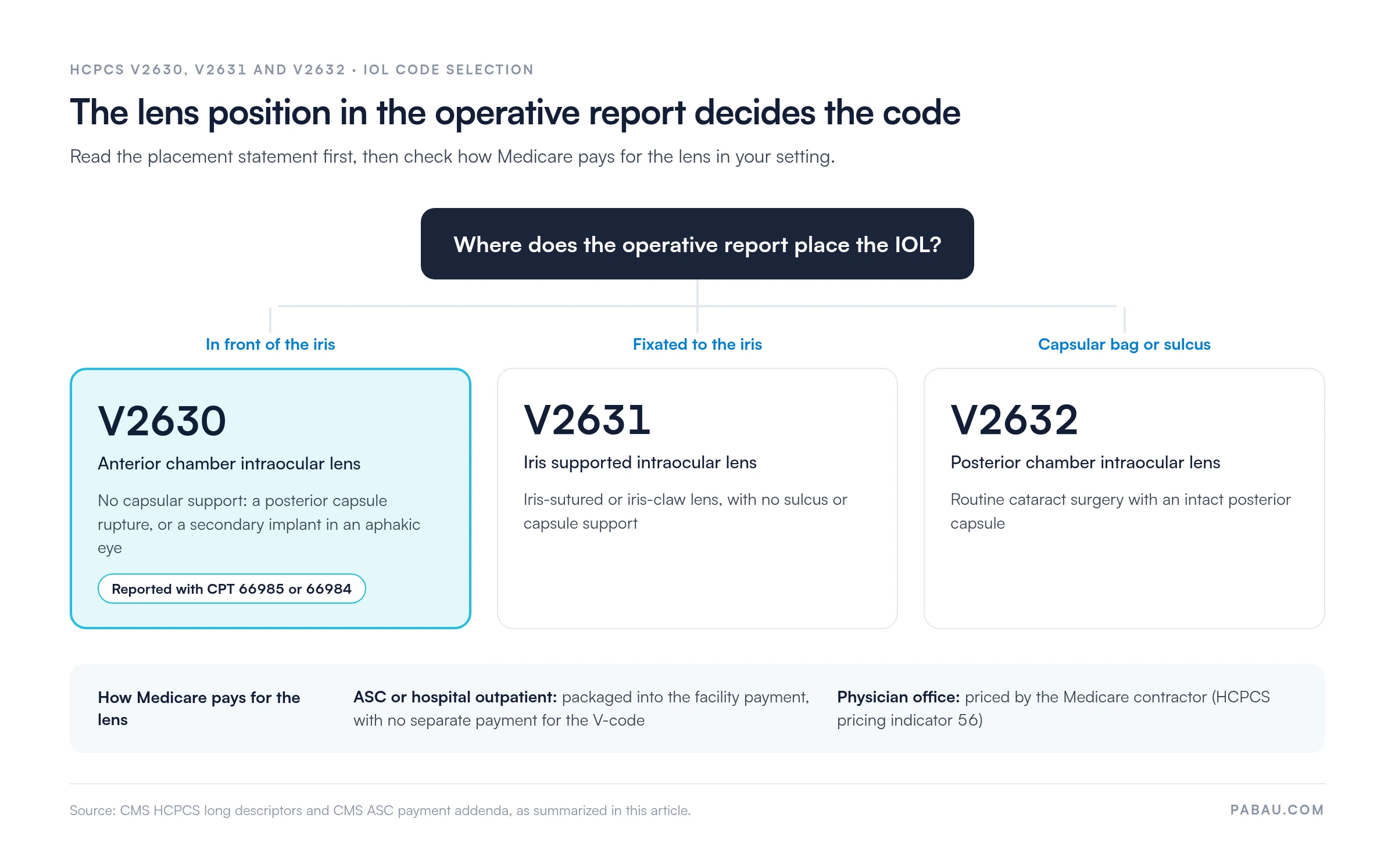
V2630 is a supply code. It reports the lens implant itself, and a separate CPT procedure code reports the surgical work. The two pairings below match the clinical scenarios described above.
Bundling rule: Verify NCCI edits before reporting V2630 alongside any CPT code. The National Correct Coding Initiative (NCCI) publishes procedure-to-procedure edits that govern which code combinations are payable.
An incorrect pairing can trigger an automated denial before a human reviewer sees the claim. The AAPC’s HCPCS code reference provides pairing context, though NCCI edits should always be verified directly from CMS.
Medicare and most commercial payers expect a specific documentation package to support V2630. Strong medical billing compliance processes at the practice level catch missing documents before claims reach the payer.
Medicare Part B covers a standard IOL after cataract surgery under the prosthetic device benefit (Medicare Benefit Policy Manual, Chapter 15, Section 120). Medicare pays for that lens inside the surgical or facility payment, not as a separate V2630 line.
If the surgeon implants a premium or accommodating IOL instead, Medicare still pays only for the standard equivalent. The patient pays the upgrade cost difference, which is not separately reportable under V2630 or any other Medicare supply code.
Commercial payers apply their own policies. BCBS and Highmark, for example, have published reimbursement policies that may restrict coverage for accommodating or premium IOL designs. Running insurance eligibility verification before scheduling the procedure flags payer-specific limitations and prior authorization requirements in advance, rather than after a denial.
Prior authorization: Medicare does not require prior authorization for standard IOL implantation under Part B. Many commercial payers do require it. Because requirements differ by plan, state, and benefit year, practices should verify authorization for each commercial patient individually. Skipping that check risks non-covered claims that are difficult to appeal after the fact.
V2630 denials tend to fall into a few predictable categories, and each one has a clear corrective action. Practices that track denial patterns through structured denial management workflows catch these before they recur.
Review the operative report against V2630 before the claim is built. If the report says ‘IOL placed’ without specifying ‘anterior chamber,’ request a surgeon addendum before submission. A single missing phrase is enough to trigger a code mismatch denial that takes weeks to resolve.
A consistent pre-submission checklist prevents the most common V2630 denials. In medical billing, a clean claim depends on documentation being in place before it leaves the practice, not after a denial prompts a review.
Without a central view of submitted claims, a rejected V2630 line can sit in a payer portal for weeks before anyone notices it. By then, the surgeon has moved on and an addendum is harder to get.
With Pabau’s simpler claims management, your team submits claims electronically and tracks the status of each one in one place. A rejection shows up as soon as the payer returns it, so the team can correct and resubmit while the operative report is still fresh.
The coding checks above stay with your coders. Pabau keeps submission and follow-up in the same system as appointments and patient records, so the billing team works from one view.
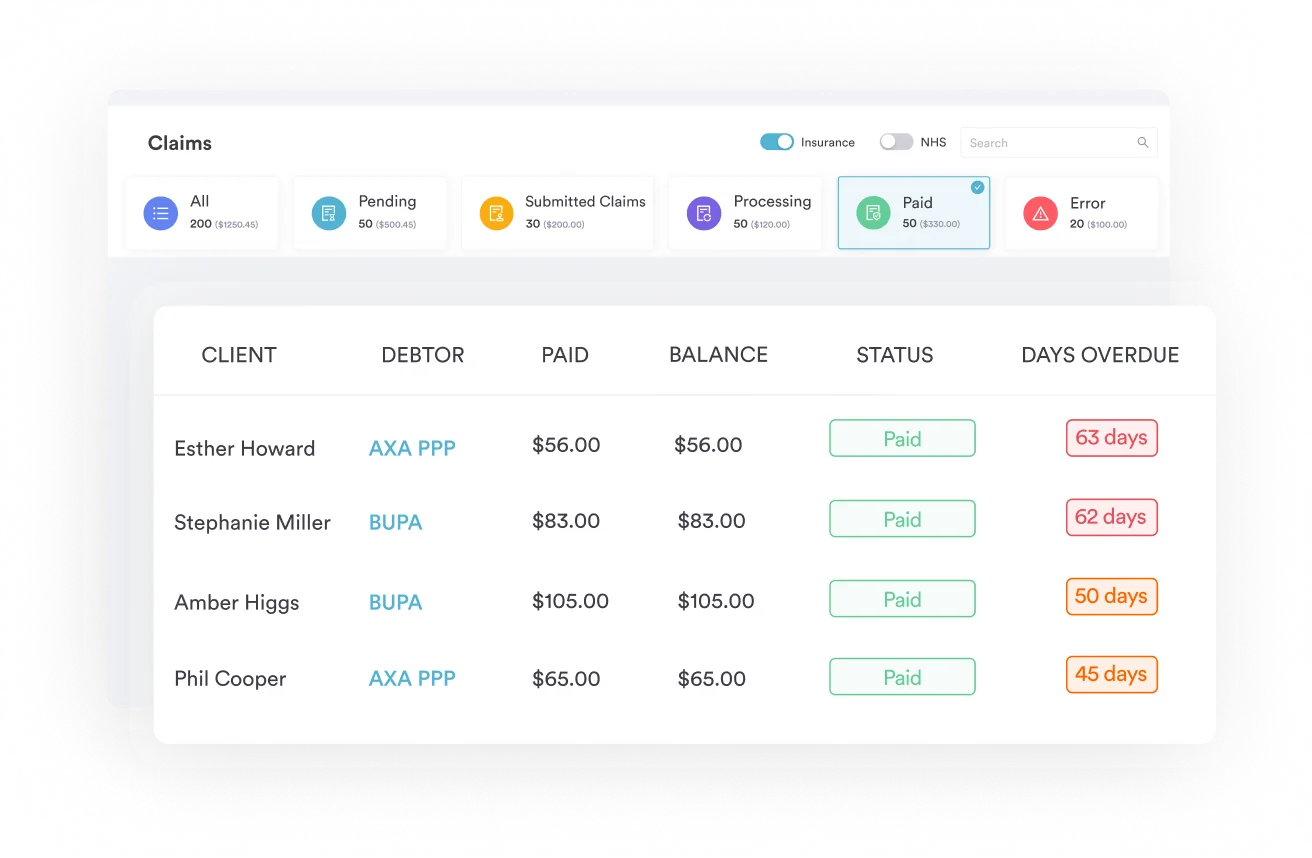

Pabau’s claims management submits ophthalmology claims and tracks each one’s status. Your team spots rejected V2630 claims early and resubmits them faster.

HCPCS code V2630 rarely causes trouble when the operative report names the lens position. Problems start when that wording is missing, so the fix belongs upstream, in how surgeons dictate and how coders query.
Make anterior chamber placement a required phrase in the operative template, and confirm each payer’s bundling rules before the first claim. Under Medicare, expect the lens to be paid inside the facility payment rather than as a separate line.
For the encounter paperwork, our superbill guide covers what each record should carry. Book a demo to see how Pabau submits IOL claims and tracks their status for surgical practices.

Need guidance on managing billing denials systematically? Denial management in healthcare covers how to build workflows that catch and resolve denied claims faster.
Want to understand how eligibility checks prevent IOL coverage surprises? Insurance eligibility verification explains how eligibility checks surface payer restrictions before the procedure date.
Coding an iris-supported lens instead? HCPCS code V2631 explains when an iris-fixated lens applies instead of an anterior chamber one.
Looking for the broader picture on how billing works? What is revenue cycle management walks through the end-to-end process from patient encounter to collected payment.
HCPCS code V2630 is the supply code for an anterior chamber intraocular lens (IOL). It reports a lens placed in the anterior segment of the eye, in front of the iris. That placement is usually chosen when the posterior capsule cannot support a posterior chamber implant. V2630 belongs to the V-series vision range of HCPCS Level II codes.
CPT code 66985 (secondary IOL insertion, not concurrent with cataract removal) pairs with V2630 when an aphakic patient receives a secondary implant. CPT 66984 (extracapsular cataract removal with IOL) can pair with V2630 when a complication forces anterior chamber placement during primary surgery. Always verify NCCI edits before submitting any code combination.
Required documentation includes an operative report explicitly confirming anterior chamber IOL placement and an implant log with the lens manufacturer, model, and lot number. The claim also needs a linked ICD-10-CM code supporting the indication, plus a laterality modifier (-RT or -LT) where the payer requires one. Some commercial plans also require physician attestation of medical necessity.
Medicare Part B does not require prior authorization for standard IOL implantation. Commercial payer requirements vary by plan and state. Practices should verify authorization requirements with each commercial insurer before the procedure is scheduled, as claims submitted without required authorization are typically non-payable on appeal.