HCPCS code V2300: Sphere trifocal lens billing guide
HCPCS code V2300 covers one sphere trifocal lens up to 4.00D HCPCS code V2300 is...

Last Updated: Oct 19, 2026
V2304 is the HCPCS Level II code for spherocylinder, trifocal, plano to plus or minus 4.00d sphere, 2.25-4.00d cylinder, per lens. It describes one trifocal spectacle lens, so a pair of glasses takes two claim lines.
Most V2304 denials trace to one of three errors. The sphere or cylinder power may fall outside V2304's band, or the RT or LT modifier may be missing. The third is a diagnosis that does not support Medicare's post-cataract lens benefit.
Let Pabau's smart automation suggest the right codes, reduce claim denials, and keep your practice compliant—effortlessly.
Automate repetitive tasks and focus on what matters most—your patients.
Reduce coding errors and ensure compliance with the latest regulations.
Clean claims, fewer denials, and faster reimbursements.
Powerful insights and reporting to help your practice thrive.
HIPAA compliant SOC 2 certified GDPR-compliant Trusted by 4,000+ clinics worldwide

HCPCS code V2304 covers one spherocylinder trifocal spectacle lens with a plano to ±4.00d sphere and a 2.25 to 4.00d cylinder.
V2304 is an eyeglass lens code. Contact lenses are billed from the V2500-V2599 range instead.
Cylinder power alone separates V2304 from V2303 and V2305, while a sphere above ±4.00d moves the lens into a higher sphere band.
Medicare covers V2304 only for pseudophakia, aphakia, or congenital aphakia, and each lens goes on its own line with RT or LT.
Practice management software like Pabau keeps the prescription, dispense record, and claim together, so billing staff can check each V2304 line before it goes out.
HCPCS code V2304 is the Level II supply code for one spherocylinder trifocal spectacle lens. Its long descriptor reads “Spherocylinder, trifocal, plano to plus or minus 4.00d sphere, 2.25-4.00d cylinder, per lens.” The code set is maintained by the Centers for Medicare and Medicaid Services (CMS).
V2304 sits in the Lenses, trifocal section (V2300-V2399) of the Vision services range. It describes the lens itself, not the eye exam or the refraction. Each unit is one lens, so a pair of glasses takes two claim lines.
A trifocal lens carries three zones for distance, intermediate, and near vision. The spherocylinder part means the lens corrects astigmatism as well as sphere power. V2304 applies when that astigmatism correction falls between 2.25 and 4.00 diopters.
The V2300 series sorts trifocal lenses by sphere power first and cylinder power second. V2300 to V2302 are sphere-only trifocals. From V2303 onward, each code pairs a sphere band with a cylinder band. V2304 is the second of four cylinder bands at the lowest sphere range.
Read the table as a two-step check. First confirm the sphere sits between plano and ±4.00d, then confirm the cylinder sits between 2.25d and 4.00d. A lens finished at 4.25d cylinder is V2305, and one at 2.00d is V2303. Descriptors are listed in the AAPC trifocal lens code range and the CMS HCPCS file.
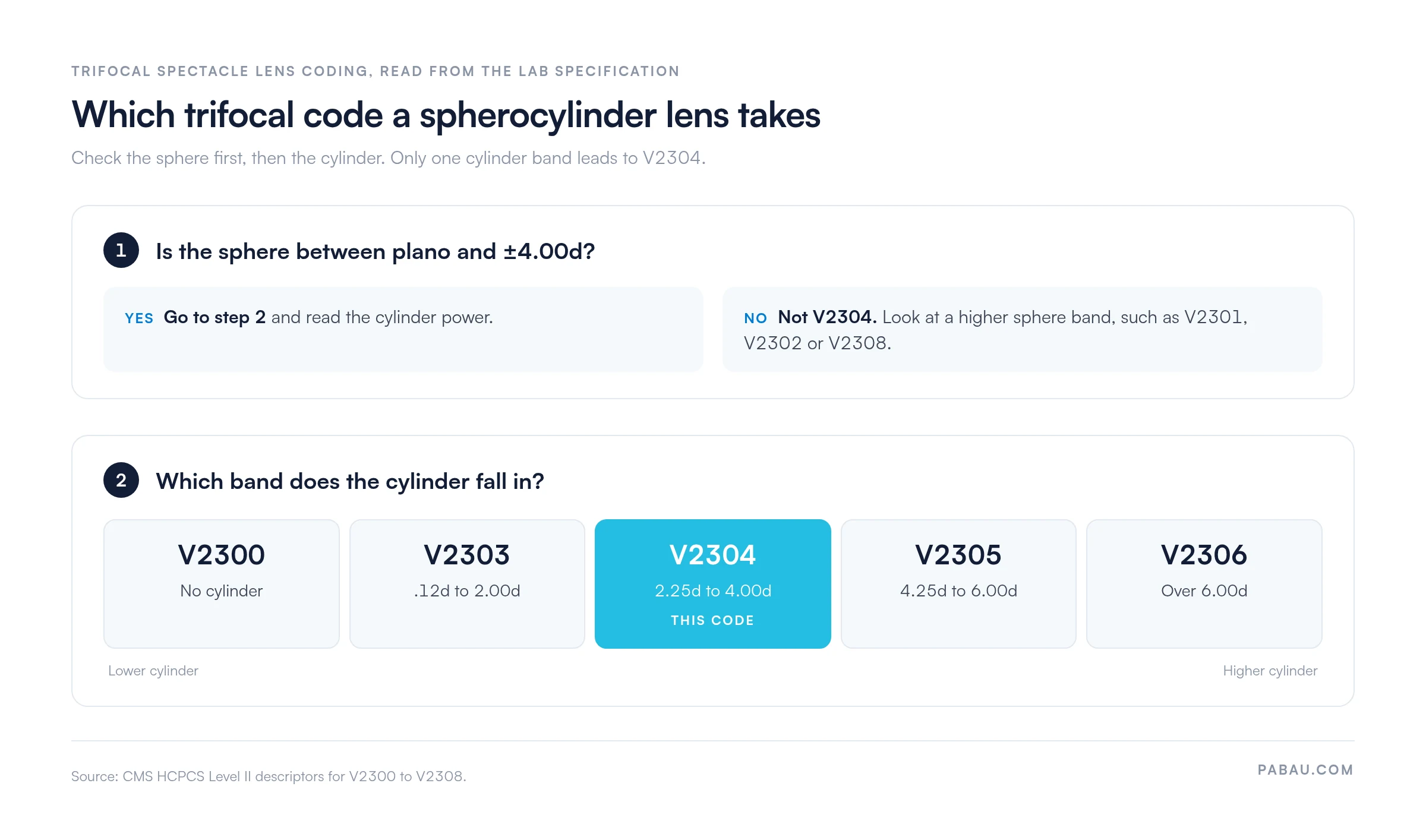
Take both powers from the final lab specification rather than the written prescription. Labs sometimes adjust a parameter during manufacturing, and the code has to describe the lens the patient received.
HCPCS sorts eyeglass lenses into separate ranges by lens design. Contact lenses have a range of their own, so a contact lens of any design never takes V2304.
A spectacle lens with one focal zone belongs in that first range, even when it carries the same astigmatism correction. V2108 covers ±4.25d to ±7.00d sphere with 2.12d to 4.00d cylinder, the single vision counterpart of V2308.
Medicare covers V2304 only under the prosthetic device benefit, for patients without a natural lens. That means pseudophakia after cataract surgery with an intraocular lens (IOL), aphakia, or congenital aphakia. The rules sit in the Refractive Lenses policy article (A52499) and LCD L33793.
For a pseudophakic patient, coverage is limited to one pair of eyeglasses or contact lenses after each cataract surgery with an IOL. Trifocals prescribed for presbyopia or astigmatism alone are denied as noncovered. Replacement lenses fall outside the benefit too.
Payment comes from the DMEPOS fee schedule, which varies by state. The patient owes 20% coinsurance after the Part B deductible. Claims go to the DME MAC that serves the patient’s state.
Where coverage is uncertain, have the patient sign an Advance Beneficiary Notice of Noncoverage (ABN) before dispensing. Checking the plan up front is part of routine insurance eligibility verification.
Check the Refractive Lenses LCD (L33793) and policy article A52499 before billing V2304 to Medicare. Noridian serves DME jurisdictions A and D, and CGS serves B and C. All four jurisdictions apply the same refractive lens coverage rules.
A clean V2304 claim follows the same order every time. Each step below closes off one common denial reason before the claim leaves the practice.
Set a reminder for the payer’s filing deadline as soon as a V2304 line denies. Medicare allows 12 months from the date of service to file a claim. Commercial and vision plans often allow less, so check each contract.
Every V2304 line needs a laterality modifier, because the code describes a single lens. Since March 1, 2019, DME MACs reject a line billed with RTLT and two units. Bill each lens on its own line with one unit.
The E1 to E4 modifiers describe eyelids and do not belong on lens codes. A line without RT or LT is rejected as incorrect coding. The denial codes on the remittance show whether a modifier or the code itself caused the rejection.
The diagnosis decides whether Medicare pays for V2304 at all. Medicare needs a diagnosis showing the natural lens is missing. Vision plans usually accept the refractive diagnoses behind the prescription.
Where a diagnosis code carries laterality, match it to the modifier on the same line. An H27.01 right-eye diagnosis pointed at the LT line invites a denial.
A V2304 claim rests on six records. Each one answers a question an auditor asks about the lens, the eye, or the coverage. Keep all six in the same patient record, so an audit request can be answered from one place.
When a vision plan is billed instead, the superbill should carry the same lens parameters and diagnosis as the lab order.
Most V2304 denials come from a short list of causes, and each has a set fix. Sort every rejection by cause first, because the cause decides whether you recode, add a modifier, or bill the patient.
In many optical practices the V2304 claim is assembled by hand. One person reads the lab sheet and picks the code. Someone else adds the modifiers, and the prescription sits in a different system.
Pabau keeps the patient record, the prescription, and the claim in one place. Its error-catching claims software lets billing staff check each V2304 line for code, modifier, and diagnosis before submission.
Claim statuses stay visible in one list, so a denied lens line gets worked before the filing deadline. When a DME MAC asks for the order or the ABN, it is already in the record the claim came from.

Pabau’s claims management software keeps prescriptions, dispense records, and claims in one patient record. Billing teams can check codes and modifiers before submission and track each claim to payment.

V2304 comes down to two numbers on the lab sheet. When the sphere sits within ±4.00d and the cylinder between 2.25d and 4.00d, the code is V2304. Any other reading points to a neighbor in the V2300 series.
Coverage is the harder call. Medicare pays only for patients without a natural lens, so check the surgical history before the lens is ordered. Where that history is missing, get the ABN signed first.
Build the lens power, modifier, and diagnosis checks into the claim workflow rather than a reviewer’s memory. Book a demo to see how Pabau handles vision lens billing from prescription to payment.

Need guidance on billing clean claims from the start? Clean claim best practices covers the documentation and submission standards that reduce first-pass denials across all payer types.
Seeing the same lens denial come back? Denial management in healthcare sets out a process to find, fix, appeal, and prevent denied claims.
HCPCS code V2304 covers one spherocylinder trifocal spectacle lens. The sphere runs from plano to ±4.00 diopters and the cylinder from 2.25 to 4.00 diopters. It is billed per lens, so a pair takes two claim lines.
No. V2304 is an eyeglass lens code in the V2300-V2399 trifocal range. Contact lenses are billed from V2500-V2599, whatever their design.
Medicare covers V2304 only for pseudophakia, aphakia, or congenital aphakia. After cataract surgery with an IOL, that means one pair of eyeglasses or contact lenses per surgery. Trifocals for presbyopia alone are noncovered, so get an ABN signed first.
Cylinder power is the only difference. V2303 covers .12 to 2.00 diopters of cylinder, and V2304 covers 2.25 to 4.00 diopters. Both share the plano to ±4.00d sphere range.
V2305 covers the next cylinder band up, from 4.25 to 6.00 diopters. The sphere range is the same, so a lens finished at 4.25d cylinder moves from V2304 to V2305.
Bill two claim lines with one unit each. Put RT on one line and LT on the other. DME MACs reject a single line billed with RTLT and two units.
Keep the signed order and prescription, the lab specification, and a record of which eye each lens is for. For Medicare, add the operative note or aphakia diagnosis, proof of delivery, and any signed ABN.