CPT Code 25210: Excision of a single carpal bone
CPT Code 25210: Official descriptor and quick-reference data CPT Code 25210 is a...

Last Updated: Nov 26, 2026
E3100 is the CCSD code for reconstruction of the larynx with graft. It covers open surgery through the neck that rebuilds the laryngeal framework with cartilage, synthetic or donor graft material.
The main indications are laryngeal stenosis, laryngeal trauma and repair after partial laryngectomy. Endoscopic dilation, injection laryngoplasty and tracheal reconstruction are coded separately.
Let Pabau's smart automation suggest the right codes, reduce claim denials, and keep your practice compliant—effortlessly.
Automate repetitive tasks and focus on what matters most—your patients.
Reduce coding errors and ensure compliance with the latest regulations.
Clean claims, fewer denials, and faster reimbursements.
Powerful insights and reporting to help your practice thrive.
HIPAA compliant SOC 2 certified GDPR-compliant Trusted by 4,000+ clinics worldwide

CCSD Code E3100 covers reconstruction of the larynx with graft: open surgery that rebuilds the laryngeal framework with cartilage, synthetic or donor graft material.
The main indications are subglottic or glottic stenosis, laryngeal trauma, and reconstruction after partial laryngectomy.
Graft harvest from a remote site, such as rib or ear cartilage, may need its own line, so confirm the insurer’s bundling rules first.
UK private insurers such as Bupa, AXA Health, Aviva and Vitality expect pre-authorization for elective E3100 surgery, and claims usually travel through Healthcode.
CCSD Code E3100 describes reconstruction of the larynx with graft. It is listed in the CCSD Schedule, the UK procedure code set maintained by the Clinical Coding and Schedule Development (CCSD) Group. The code covers open procedures that rebuild the laryngeal framework with implanted graft material, to restore structural support, airway patency or voice.
UK private medical insurers, including Bupa, AXA Health, Aviva and Vitality, use CCSD codes to authorize and pay for private procedures. Our guide to CCSD codes explains how the schedule is organized and how insurers apply it.
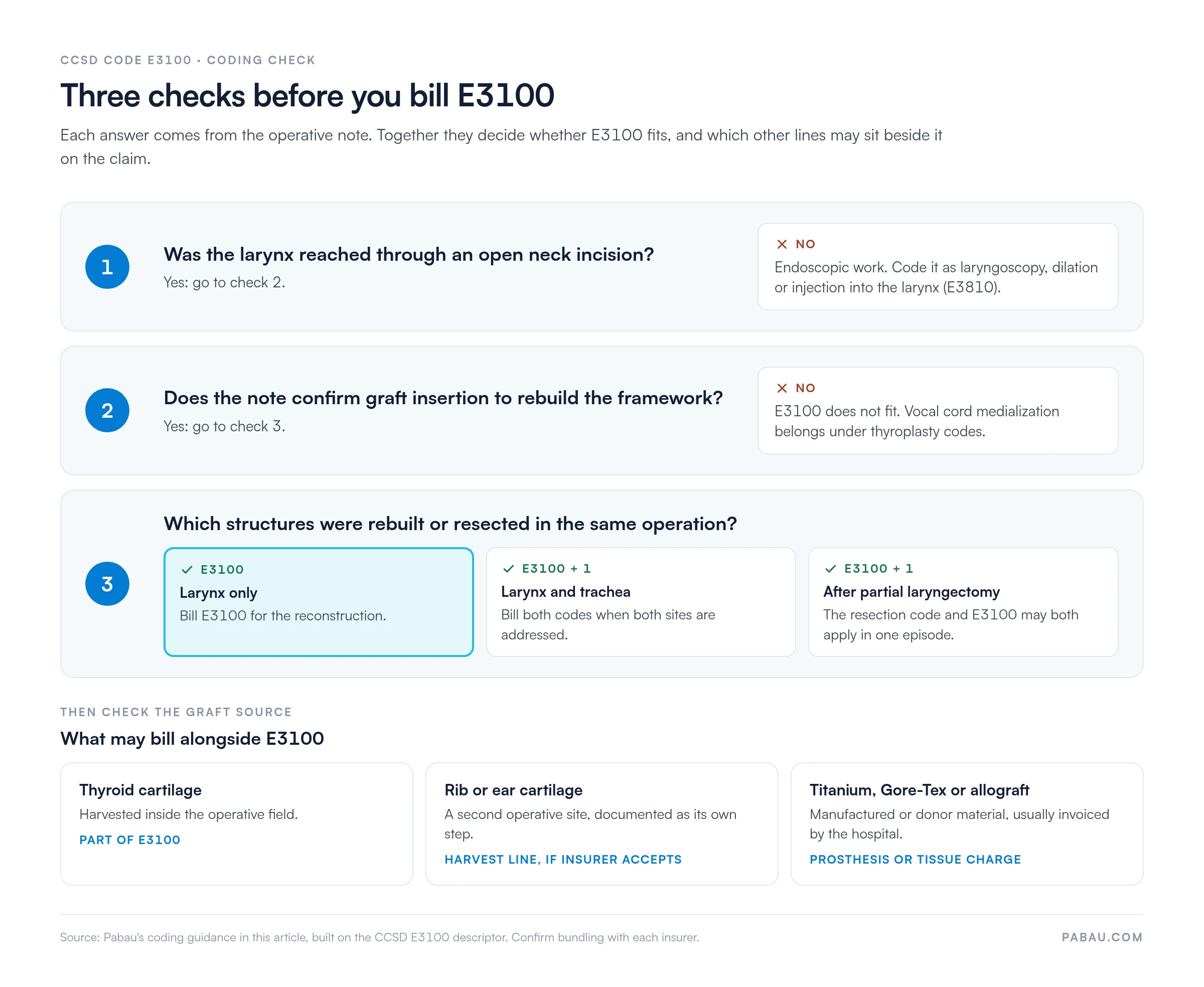
The descriptor does not name a graft source. Rib or ear cartilage, synthetic materials such as titanium mesh, and donor allografts all fit E3100 when the operative note confirms graft insertion. Endoscopic work does not fit. Laryngoscopy with dilation, injection laryngoplasty and laser cordotomy are coded separately, and injection into the larynx has its own code, E3810.
Reconstruction of larynx with graft is an open operation under general anesthesia. An ENT or head and neck surgeon reaches the larynx through a neck incision. They then reshape, expand or stabilize the laryngeal cartilages with graft material.
The technique depends on the indication. For subglottic stenosis, the surgeon divides the thyroid cartilage in the midline (laryngofissure) and grafts cartilage to widen the airway. After trauma, fractured cartilage is reduced and supported with plates or graft material. After partial laryngectomy, the graft replaces the missing section of framework wall.
Key steps a coder should confirm in the operative note before billing E3100:
If the surgeon forms a new tracheostomy during the operation, ask the insurer whether it accepts a separate E4210 line alongside E3100.
Four clinical scenarios lead to laryngeal reconstruction with graft under E3100:
UK private insurers expect an ICD-10 diagnosis code alongside the CCSD procedure code on each claim. The diagnosis must reflect the documented reason for surgery, not a generic laryngeal code. Check every code against the ICD-10 edition the insurer uses before you submit.
When stenosis follows intubation or earlier airway surgery, J95.5 is more specific than J38.6. Confirm the cause in the clinical notes before choosing between them. The WHO ICD-10 browser shows the full hierarchy for each code above.
The graft source is the biggest coding decision on an E3100 claim. E3100 covers the reconstruction itself. Whether a remote harvest can be billed as a separate line depends on where the graft came from and on the insurer’s bundling rules.
Remote graft harvest is a gray area for many insurers. Record the harvest as a distinct surgical step in the operative note, whatever you decide to bill. The note has to support the claim, not the other way around.
Before you bill a separate harvest line alongside E3100, ask the insurer whether it accepts one for this procedure. Keep the written reply on the patient record in case the claim is queried later.
E3100 sits near several laryngeal codes that share terms but differ in scope. Picking the wrong one is a common E3100 billing error, alongside ICD-10 mismatches. The table below covers the procedure groups most often confused with E3100.
Three questions about the operative note settle most of these choices, in the order a coder reads it. The graft source then decides what else may go on the claim.
A clear operative note is the difference between a clean E3100 claim and a query that holds up payment. Insurers review complex ENT reconstruction against the operative note, not the invoice alone.
The operative note should cover each of the following for an E3100 claim:
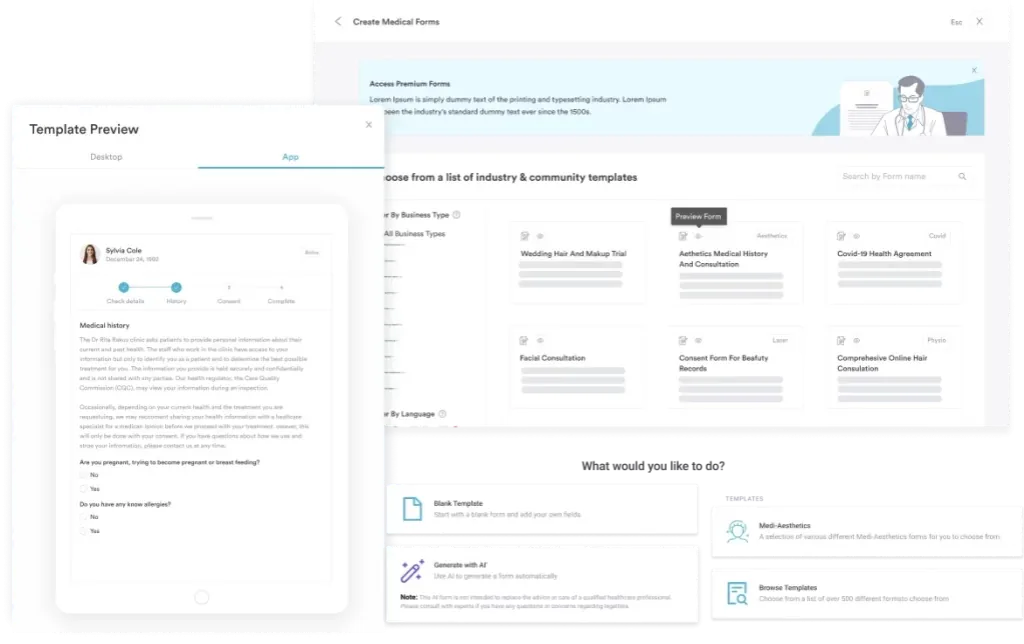
A digital operative-note form can require each of these fields before the case moves to billing. Fixing a missing field before submission is far easier than answering an insurer’s query afterward.
UK private insurers expect pre-authorization before elective laryngeal reconstruction with graft. Authorization confirms the insurer will fund the episode in principle. It does not guarantee payment if the claim later turns out to be coded or documented wrongly.
The usual pre-authorization workflow for E3100 is:
For an emergency airway case, contact the insurer as soon as practical after the operation and follow its emergency notification process. The Bupa code search portal lets providers check how Bupa treats a CCSD code.
Insurers look closely at high-value reconstructive surgery, and E3100 has specific documentation needs. These are the refusal patterns ENT billing teams see most often:
Some laryngeal reconstructions happen in two stages, such as initial grafting followed by stent removal or revision. Tell the insurer about the staged plan when you request the first authorization. Otherwise the second claim arrives without context and can look like a duplicate.
Ask whether the second stage needs its own authorization number. Most insurers treat it as a new episode, so the answer is often yes.
UK private insurers set their own fees for each CCSD code. Bupa, for example, publishes the maximum it pays a recognized consultant for each procedure. Check the current schedule for the patient’s insurer before you quote, because fees change and differ between insurers.
If the surgeon charges more than the insurer pays, the patient may owe the shortfall. Some insurers ask consultants to agree to charge within their fees, so check the surgeon’s arrangement with each insurer. The Bupa procedure codes fee schedule explains how Bupa’s published fees work.
Tell the patient in writing about any expected shortfall before surgery. A clear estimate prevents disputes after the insurer has paid its share.
Healthcode is the electronic billing network most UK private insurers use, so confirm each insurer’s submission route before you send an E3100 claim. The workflow is:
Built-in claims management software maps CCSD codes straight onto Healthcode-ready invoices. That cuts the field errors that get claims rejected at validation.
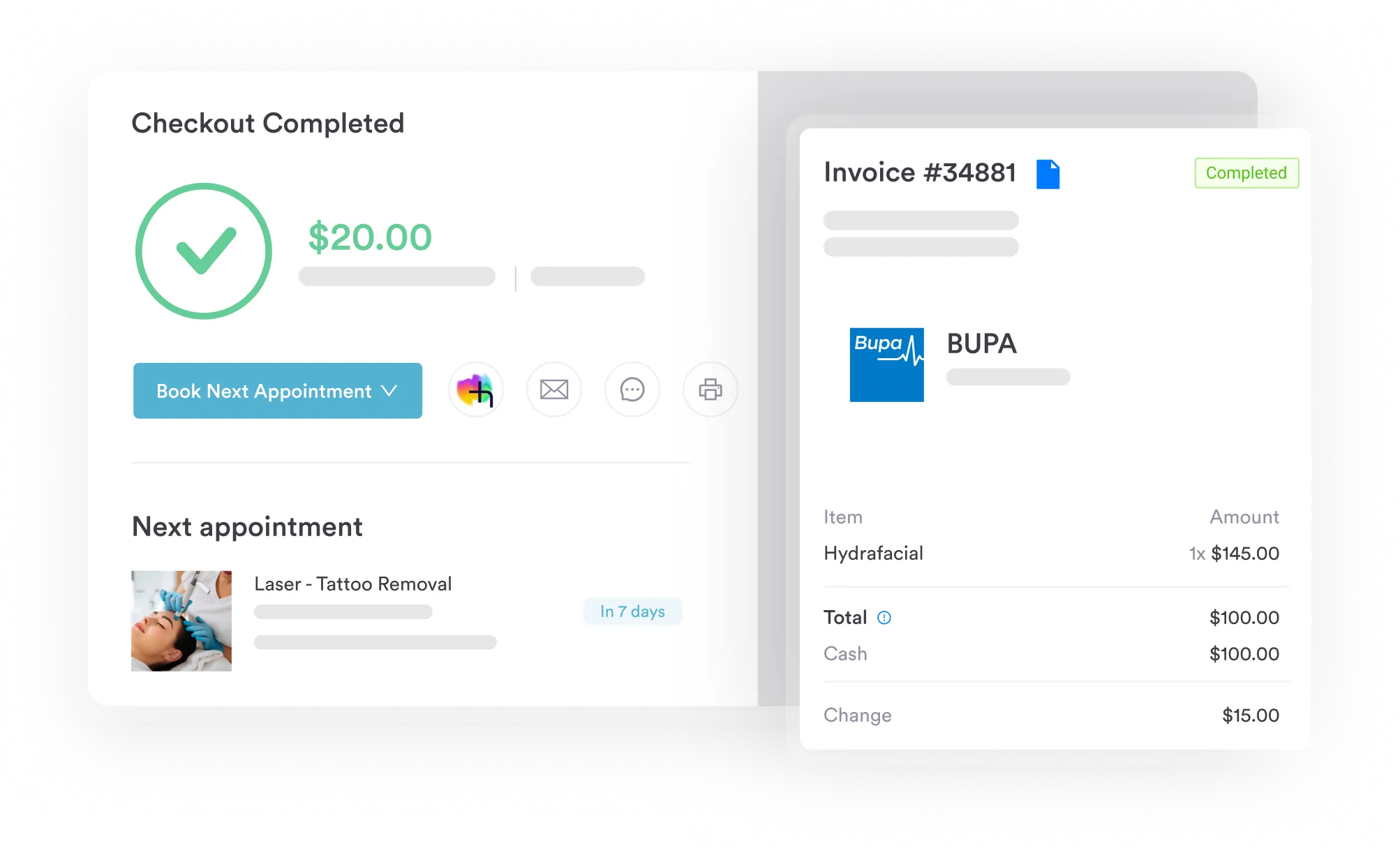
E3100 refusals often trace back to three records kept in different places: the operative note, the authorization number and the invoice. When a biller chases each one by hand, a missing field only shows up once the insurer refuses the claim.
Pabau holds all three in the patient record. Digital forms capture the graft type, harvest site and airway outcome in the operative note. The authorization number sits on the same record as the invoice.
Invoices then go to Healthcode, or straight to Bupa, with E3100 and the matching ICD-10 code already mapped. Your team spends less time reworking refused claims and more time on the next theater list.

Pabau keeps pre-authorization records, operative notes and Healthcode-ready invoices in one system, so your E3100 claims go out complete.

An E3100 claim pays when the operative note, the codes and the authorization all describe the same reconstruction. Before you submit, check that the note names the graft and its source. Confirm the insurer’s view on any harvest line, and put the authorization number on the invoice.
Laryngeal reconstruction is rare and costly, so expect insurers to ask why open surgery was needed. A specialist letter that sets out the treatment history answers that question before the claim goes out. Book a demo to see how Pabau keeps operative notes, authorizations and Healthcode invoices together for every ENT claim.

Need the wider CCSD picture? CCSD codes guide explains how the UK schedule is structured and how insurers use it.
Billing Bupa patients? Bupa CCSD codes covers Bupa’s procedure code rules and how to check cover before surgery.
Checking what an insurer pays? Bupa procedure codes fee schedule shows how Bupa’s published fees work for each CCSD code.
CCSD Code E3100 covers reconstruction of the larynx with graft. That means open framework surgery that restores the larynx with cartilage, synthetic or donor graft material. Endoscopic procedures, injection laryngoplasty and thyroplasty for vocal cord medialization are coded separately.
Harvest from inside the operative field, such as local thyroid cartilage, is generally treated as part of E3100. Harvest from a remote site, such as rib or ear cartilage, may justify a separate line. Insurers apply their own bundling rules, so confirm the position before you bill it.
Yes, insurers such as Bupa, AXA Health, Aviva and Vitality expect pre-authorization before elective laryngeal reconstruction. They usually want a referral, the specialist’s recommendation and the planned CCSD code. Record the authorization number on the invoice.
Common pairings are J38.6 (stenosis of larynx), J95.5 (postprocedural subglottic stenosis), C32.0 or C32.1 (laryngeal cancer) and Q31.1 (congenital subglottic stenosis). The code must match the indication documented in the operative note.
Most UK private insurers receive electronic claims through Healthcode. The invoice carries E3100, the matching ICD-10 code, the authorization number and the surgeon’s details. Keep the submission reference so you can track the claim.
The usual reasons are an ICD-10 mismatch, missing graft details in the operative note and no pre-authorization for an elective case. Insurers also query claims that don’t explain why endoscopic treatment wasn’t enough. An unannounced second-stage procedure can look like a duplicate claim.