

HCPCS code E0198: Water pressure pad billing guide
HCPCS code E0198 is a water pad for a standard mattress HCPCS code E0198 is the ...

Last Updated: Oct 13, 2026
T2027 is the HCPCS Level II code for specialized childcare, waiver; per 15 minutes. It covers structured childcare for children with disabilities who are enrolled in a Medicaid home and community-based services (HCBS) waiver program. One hour of service equals four billable units.
Coverage and payment come from state Medicaid agencies rather than Medicare, so the code appears on no Medicare fee schedule. Assignment turns on modifiers, which vary by state and distinguish the service type, the funding stream, and sometimes the provider category.
Let Pabau's smart automation suggest the right codes, reduce claim denials, and keep your practice compliant—effortlessly.
Automate repetitive tasks and focus on what matters most—your patients.
Reduce coding errors and ensure compliance with the latest regulations.
Clean claims, fewer denials, and faster reimbursements.
Powerful insights and reporting to help your practice thrive.
HIPAA compliant SOC 2 certified GDPR-compliant Trusted by 4,000+ clinics worldwide

HCPCS code T2027 covers specialized childcare delivered under a Medicaid HCBS waiver, billed in 15-minute units.
One hour of service equals four billable units, so a six-hour authorized day bills 24 units.
Modifier requirements vary by state Medicaid program, so check UD and U1 through U9 against your payer’s manual.
T2026 bills the same service per diem, and no per-hour specialized childcare waiver code exists.
Pabau’s claims management tools support unit-based HCPCS billing and modifier assignment for Medicaid waiver claims.
HCPCS code T2027 is an active HCPCS Level II code for specialized childcare, waiver services billed per 15 minutes. The Centers for Medicare and Medicaid Services (CMS) maintains it within the T-code range reserved for Medicaid waiver billing.
It is not a Medicare-covered code. Coverage flows through individual state Medicaid agencies that hold HCBS waiver authority under 42 CFR §441.301.
The T-code range is reserved for Medicaid-covered services. T2027 does not appear on Medicare fee schedules and cannot be submitted on a CMS-1500 for a Medicare beneficiary. Providers billing it must be enrolled in the relevant state Medicaid program and authorized under the applicable HCBS waiver plan.
Specialized childcare waiver services are structured childcare supports for children with disabilities or complex needs. These children need more supervision, skill-building, or personal care than a standard childcare setting provides. Funding comes from HCBS waiver authority rather than generic childcare licensing, which is why the billing code sits in the T-code range.
Eligibility usually turns on three conditions. The child is enrolled in the applicable HCBS waiver program. An individualized service plan authorizes specialized childcare. The provider meets state-defined qualification standards.
Provider qualification requirements vary considerably by state. Some states require childcare workers to hold certifications in special education or applied behavior analysis. Others set minimum training-hours requirements instead. Do not generalize provider qualifications across states without checking the applicable state billing manual.
Setting also drives code selection. T2027 does not cover a child who is served in an approved residential facility. That care is billed under a residential waiver code, and HCPCS T2033 is the per diem catch-all. Where the state waiver names a more specific residential code, that code takes precedence.
T2027 is billed per 15-minute unit, and one hour of continuous service equals 4 units. Most state Medicaid programs and managed care organizations (MCOs) apply the 8-minute rounding rule.
Eight minutes or more rounds up to the next unit, and fewer than 8 minutes is not billable. Check the rounding convention in your payer’s billing manual first, because some states apply a strict 15-minute rule with no tolerance.
Per-day unit caps apply in many waiver programs. If a child’s waiver plan authorizes up to 6 hours of specialized childcare per day, the maximum daily submission is 24 units. Submitting more units than the authorization allows produces an automatic denial.
Cross-reference the prior authorization on file before every submission. Unit counts get harder to track when a child’s services span several shifts or caregivers, so reconcile the whole day before the claim goes out.
Modifier requirements for T2027 are state-specific, and no modifier applies universally across Medicaid programs. Several do appear frequently in HCBS waiver billing for this code.
Applying the wrong modifier, or omitting a required one, is among the most common causes of T2027 claim denials. Providers billing across several states should keep a payer-specific modifier matrix and update it whenever a state Medicaid agency issues a new billing manual.
A structured approach to denial management matters once modifier errors start generating rejections across a high volume of claims.
Build a payer-specific modifier matrix for T2027 before submitting any claims. List each state Medicaid program or MCO you bill, the required modifiers for T2027, and the date you last confirmed those requirements. Review the matrix whenever a payer issues a provider bulletin or updates its billing manual. Catching a modifier change early is far cheaper than working a denial queue.
H2015 is the HCPCS code for comprehensive community support services, also billed per 15 minutes. Both codes appear in HCBS waiver billing for people with complex needs. That overlap is why coders ask which one to use, and whether both can go on the same claim.
The Detroit-Wayne Integrated Health Network (DWIHN) Bulletin 20-008 gives one of the clearest published examples of how the two interact. In that program, H2015 and T2027 carry different modifiers to distinguish the service type and the provider category. T2027 applies to the specialized childcare component, while H2015 covers broader community support activities.
That is one payer’s policy rather than a national rule. Whether H2015 and T2027 can be billed together on the same date, and which modifiers apply, depends on your state program and your MCO contract.
If you bill in Michigan under DWIHN, or under an MCO that has published explicit guidance on the pairing, follow that guidance precisely. For every other program, contact the payer before billing T2027 and H2015 on the same date of service. Assumptions here produce denials, and sometimes compliance reviews.
The T-code against H-code trap repeats elsewhere in waiver billing. HCPCS Level II T2034 is crisis intervention under a waiver, while H2034 is halfway house services under standard Medicaid. Both are billed per diem, so only waiver enrollment separates them. Sending the T-code for a beneficiary who is not waiver-enrolled returns a PR-96 non-covered denial.
T2027 reimbursement rates are set at the state Medicaid level rather than by CMS, so there is no national fee schedule for this code. Rates vary between states, between managed care organizations in the same state, and sometimes between waiver programs inside one MCO.
The CMS Physician Fee Schedule lookup returns no T2027 rate, because this is a Medicaid-only code outside the Medicare fee schedule framework.
To get the current rate, contact your state Medicaid agency, read its published fee schedule, or ask your MCO contract manager. Fee schedules are usually published annually, and rates can change mid-year with a waiver amendment. Never submit claims against a fee schedule more than 12 months old without confirming it is still current.
Medicaid waiver claims draw heightened scrutiny during audits. Incomplete service records are the leading cause of post-payment recovery actions on T2027 claims. State Medicaid agencies and MCOs expect the elements below in the record behind every claim.
Some states require electronic visit verification (EVV) for T2027, particularly where the service happens in a home or community setting. Where EVV is mandated, the system timestamp is the primary record of start and end time, and the paper timesheet is secondary.
Confirm your state’s EVV requirements with the Medicaid agency before assuming manual timesheets are sufficient. Standardizing how each session is recorded across the team is what keeps unit counts defensible a year later.
T2027 sits inside a run of T-codes used for Medicaid waiver services, and their descriptors are easy to mix up. Reading the wider range of HCPCS Level II codes before building a charge description master saves rework later. The AAPC HCPCS code lookup is a useful cross-reference for official descriptor text.
Only two codes in this run cover specialized childcare. T2026 is billed per diem and T2027 is billed in 15-minute units. There is no per-hour childcare waiver code, so an hourly service is converted into 15-minute units under T2027. T2024, T2025 and T2028 describe different services entirely.
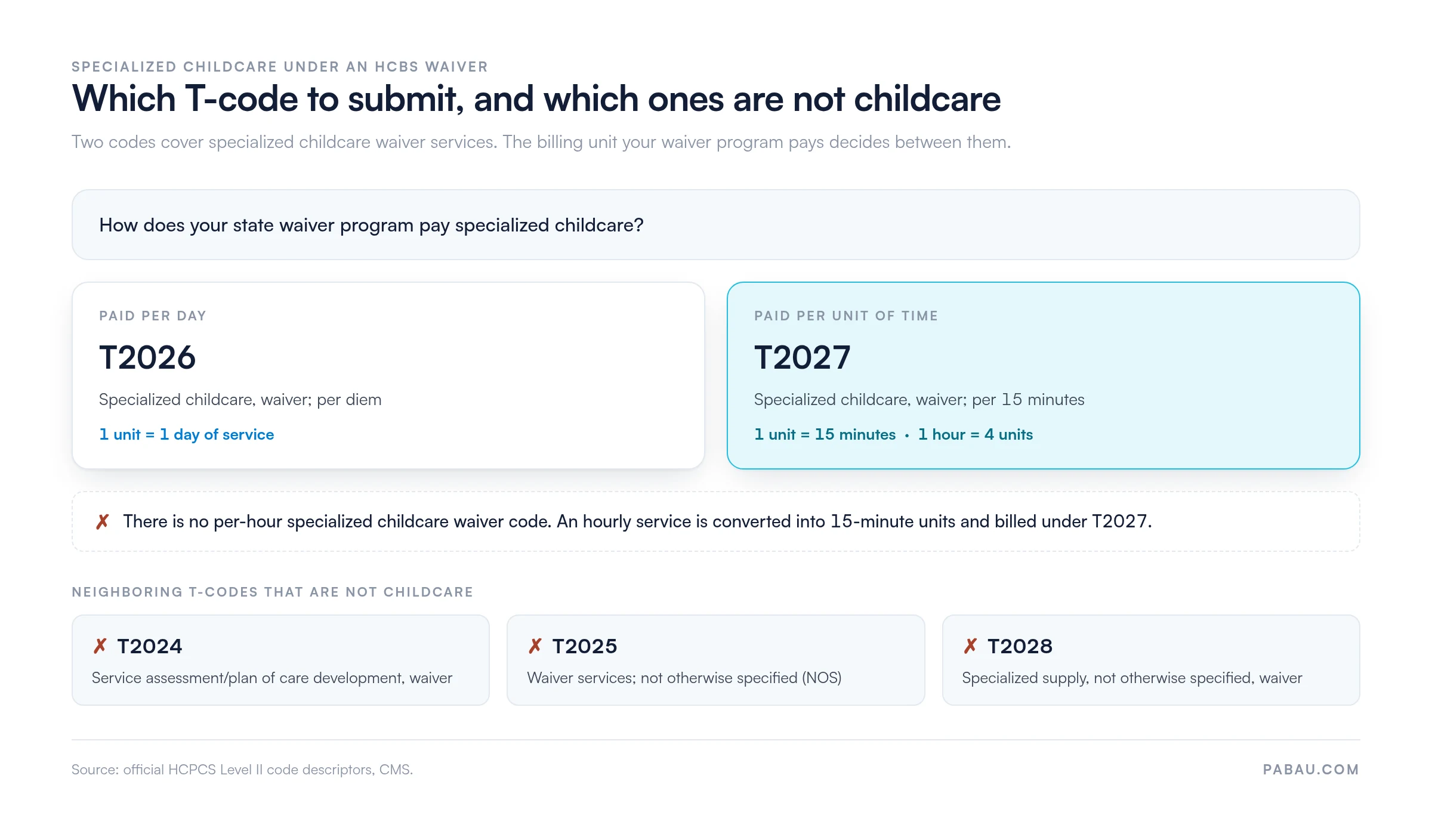
Your state Medicaid program specifies which childcare code it recognizes for your service type. Submitting T2027 where the program pays only T2026 produces a denial, so confirm the accepted code before the first claim.
Audit T2026 and T2027 against your state’s current HCBS waiver billing manual before submitting childcare waiver claims. The two codes describe the same service. They differ only in the billing unit, per diem for T2026 and 15 minutes for T2027. Picking the wrong one adds denial turnaround time and can create a pattern flag during a payer audit.
T2027 billing breaks in predictable places. Unit counts have to be derived from start and end times. Modifiers change by payer. Prior authorizations cap the units available each day. The service record has to be complete before the claim is built.
Tracking all of that by hand across several children, several caregivers and several MCOs is where waiver providers lose time. Practice management software like Pabau replaces the spreadsheet with one record per service.
Pabau offers claims management without spreadsheets, covering unit-based HCPCS billing, modifier assignment and claim submission in one place. Start time, end time, provider and a short narrative sit with the claim, so the evidence behind a unit count is attached before submission.
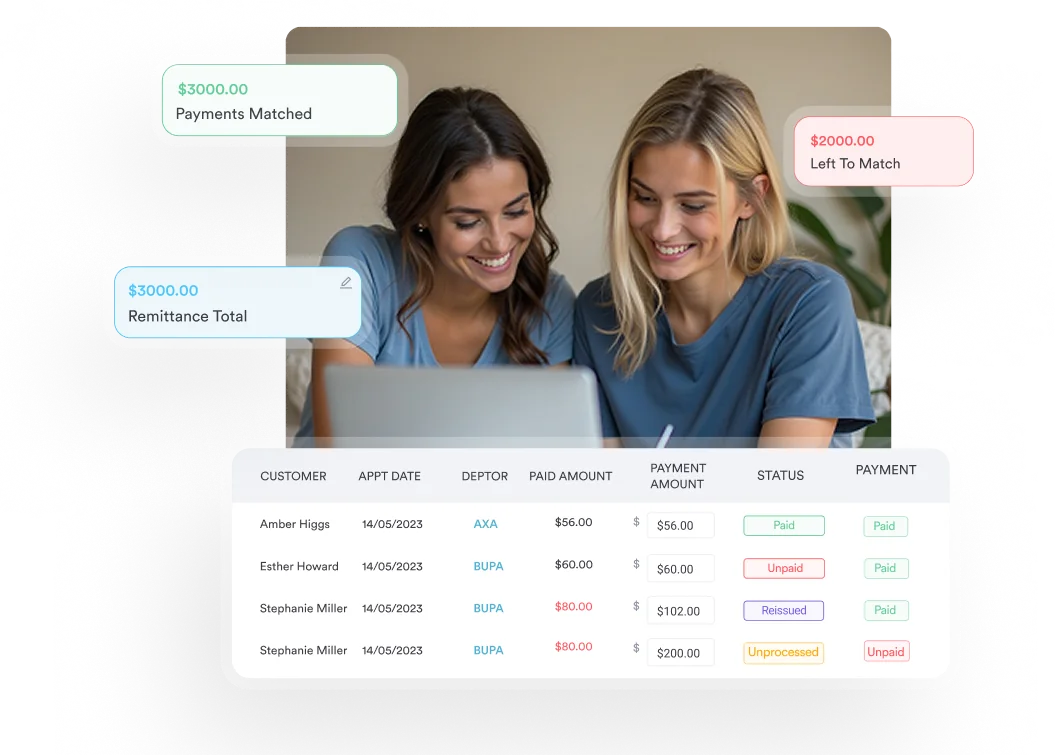

Pabau’s claims management tools let you track per-unit billing, attach modifiers, and submit Medicaid waiver claims without spreadsheets. See how it works with a short demo.

The 15-minute unit is the only part of T2027 that is fixed everywhere. Modifier requirements, fee schedules, documentation standards and EVV mandates are all set by the state, and each new billing manual can move them. Treat your payer’s current manual as the authority and this page as orientation.
Build the payer-specific reference before claim volume grows, not after the first recovery letter arrives. A provider who can produce exact times, a matching authorization number and the right modifier clears most audits without an appeal. Book a demo to see how Pabau tracks T2027 units against authorization limits.

Need to understand clean claim requirements before submitting T2027? Clean claim fundamentals covers the core elements every Medicaid waiver claim must include to avoid front-end rejections.
Managing claim denials from T2027 modifier errors? Denial management in healthcare outlines systematic approaches to tracking, appealing, and preventing repeat denials.
Want to see how revenue cycle management connects to waiver billing? What is revenue cycle management breaks down the full billing lifecycle for practices managing complex payer mixes.
HCPCS code T2027 is the billing code for specialized childcare, waiver services provided in 15-minute increments. It applies under a Medicaid home and community-based services (HCBS) waiver program. The code is a HCPCS Level II T-code used only for Medicaid billing, never Medicare. Individual state Medicaid programs determine coverage.
T2027 is billed per 15-minute unit, not per visit. One hour of specialized childcare equals 4 units. There is no per-hour childcare waiver code, so hourly services are converted into 15-minute units. Most states use an 8-minute rounding rule, but confirm the exact convention with your state Medicaid agency or MCO.
Modifiers UD, U1 through U9, and sometimes HQ are commonly used with T2027, but modifier requirements vary by state Medicaid program. No modifier list is universally applicable. Always consult your state’s current HCBS waiver billing manual or MCO provider guide before assigning modifiers.
T2027 covers specialized childcare services specifically. H2015 covers comprehensive community support services more broadly. Both are billed per 15 minutes under HCBS waiver programs, but they describe different service types. Different modifiers are often used to tell them apart. Whether they can be billed on the same date depends on your state program’s policy.
Every T2027 claim needs the date of service, exact start and end times, and the provider’s name and credentials. It also needs a service narrative, the prior authorization number, the member’s Medicaid ID, and the waiver service plan reference. Some states additionally require EVV timestamps and caregiver signatures. Verify requirements in your state’s HCBS waiver billing manual.
Yes, HCPCS code T2027 is active in 2026. The code has no termination date in current HCPCS Level II files. Verify annually against the CMS HCPCS update files, as code status can change with each fiscal year update.



