

CCSD code G5100: Bypass of duodenum billing guide
CCSD code G5100 bills a bypass that leaves the duodenum in place CCSD code G5100...

Last Updated: Oct 16, 2026
T1009 is the HCPCS Level II code for child sitting services for children of the individual receiving alcohol and/or substance abuse services.
It pays for supervising a patient's children while the parent attends alcohol or drug treatment, such as counseling or group sessions. T1009 is not valid for Medicare. Each state Medicaid program, managed care plan or block grant contract sets its own unit, rate, modifiers and authorization rules.
Let Pabau's smart automation suggest the right codes, reduce claim denials, and keep your practice compliant—effortlessly.
Automate repetitive tasks and focus on what matters most—your patients.
Reduce coding errors and ensure compliance with the latest regulations.
Clean claims, fewer denials, and faster reimbursements.
Powerful insights and reporting to help your practice thrive.
HIPAA compliant SOC 2 certified GDPR-compliant Trusted by 4,000+ clinics worldwide

HCPCS code T1009 pays for child sitting while a parent attends alcohol or substance use treatment, so the parent can keep their sessions.
T1009 is not valid for Medicare, so bill it to the state Medicaid program, managed care plan or block grant program that funds it.
There is no national unit or rate, so the state program decides whether you bill per visit, per hour or per 15 minutes.
Each billed sitting session should line up with a documented treatment session for the parent on the same date and time.
T1009 is often confused with T1021, S9122 and T1019, which cover home health aide and personal care services instead.
HCPCS code T1009 covers child sitting services for the children of a person receiving alcohol and/or substance abuse services. It lets a parent attend counseling, group sessions or medication visits while a qualified caregiver supervises their children.
T1009 is an HCPCS Level II T-code. The Centers for Medicare and Medicaid Services (CMS) maintains these national codes for state Medicaid agencies. Each state then decides whether and how to cover them. T1009 took effect on July 1, 2001, alongside the rest of the T1006 to T1012 substance abuse group.
T1009 pays for supervising a patient’s children during the time the patient is in treatment. It supports parents who could not otherwise attend because nobody else can watch their children.
Arizona’s Medicaid agency, AHCCCS, shows how tight the rule can be. Its covered behavioral health services guide allows child sitting only while the member is receiving services that prevent them from supervising the child. It also requires that no other child care is readily available.
T1009 is a state-program code, so coverage depends on where you bill. Some state Medicaid plans and managed care organizations pay it. Other states fund it through the Substance Use Prevention, Treatment, and Recovery Services Block Grant (SUBG) instead.
The block grant link is direct. Under 45 CFR 96.124(e), funded programs for pregnant women and women with dependent children must provide or arrange child care while the women receive services. In Arizona, providers bill that child care as T1009 with the U7 modifier, so only SUBG funds pay the claim.
Medicare does not pay T1009. CMS assigns it coverage indicator I, meaning the code is not valid for Medicare purposes. A Medicare contractor will reject or deny the line, so route the claim to the program that funds the service.
No national unit applies to T1009, because the descriptor names no time or visit unit. Each state Medicaid program, block grant contract or managed care plan sets it. Per-visit, per-hour and per-15-minute definitions are all in use.
Worked example: a parent attends a 90-minute group session, and a sitter watches one child for the whole session. The table shows how that session converts under each unit definition.
Bill only the time the parent was in treatment, even if the sitter arrived early. Programs also differ on whether you bill once per family or once per child, so check before you build the charge. The timeline below puts the worked example and the early-arrival rule side by side.
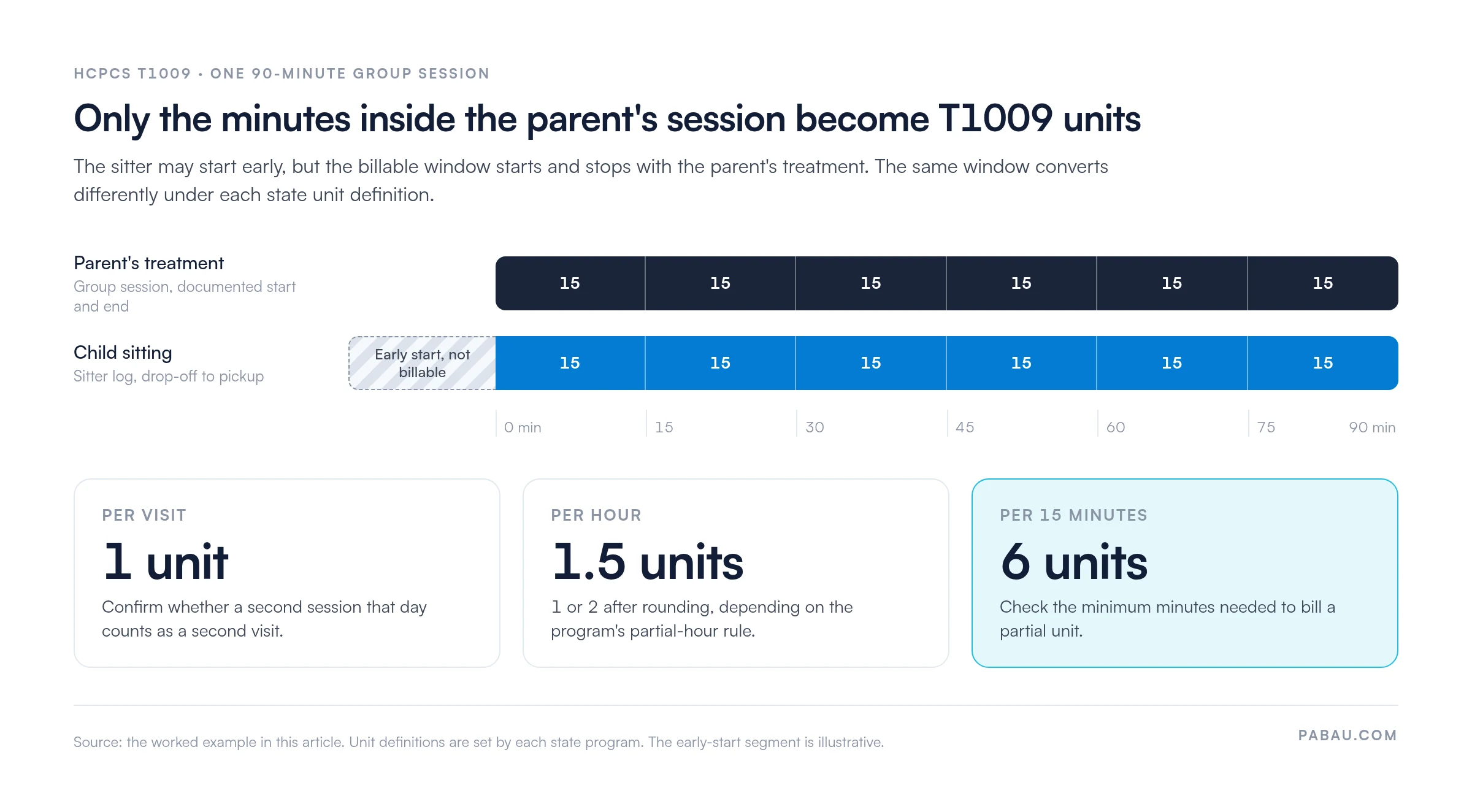
A T1009 claim rests on two records at once: the parent’s treatment and the child sitting session. Reviewers look for the two to line up by date and time, which is the core of medical billing compliance for this code.
Keep these records for the retention period set in your Medicaid provider agreement or grant contract.
Authorization rules for T1009 depend on who funds it. A Medicaid managed care plan may require prior authorization before the first session. A block grant program may instead require the parent to be enrolled in an approved priority-population program.
Ask the funder for written confirmation of the billing unit, cap and required modifiers for T1009. Program bulletins change, and a written answer is what you can rely on in an appeal.
No modifier is required on T1009 nationally. State programs add their own requirements, often to show the funding source or program type. The table lists modifiers you may meet.
Always use the modifier list in your state’s billing manual. A national modifier only applies where your program recognizes it.
Most T1009 denials trace back to the funder, the modifier or the match with the parent’s treatment. A structured denial management routine catches repeat causes faster than claim-by-claim review.
Most T1009 denials are fixable if you act within the funder’s timely filing limit. Start from the remittance advice, then work through these steps.
T1009 has no Medicare fee schedule amount. CMS gives it pricing indicator 00, which means Part B does not price it separately. Each state Medicaid agency, managed care plan or block grant contract sets its own rate and unit.
Look up the rate in your state’s Medicaid fee schedule or your grant contract before you start the service. A rate quoted per hour cannot be compared with one quoted per 15 minutes until you convert the units.
T1009 sits in the T1006 to T1012 range of alcohol and/or substance abuse service codes. T1008 and T1011 no longer appear in the current HCPCS file, so five codes in the range remain active.
Some billing content describes T1009 as a home care aide code. That description belongs to the codes below. Billing aide or personal care visits as T1009 misreports the service, and the claim can be denied or recouped.
T1009 claims get harder to defend when the sitting log and the treatment record live in different places. A paper sign-in sheet in the child care room rarely matches the times in the clinical note.
Pabau, the practice management platform we build, keeps both on the parent’s record. Your team books the child sitting slot alongside the treatment session and captures drop-off and pickup times on a digital form.
When the claim goes out, Pabau’s claims management software pulls the data already on the record into the claim and tracks its status. Your billers can compare sitting units against attended sessions before the claim is submitted.
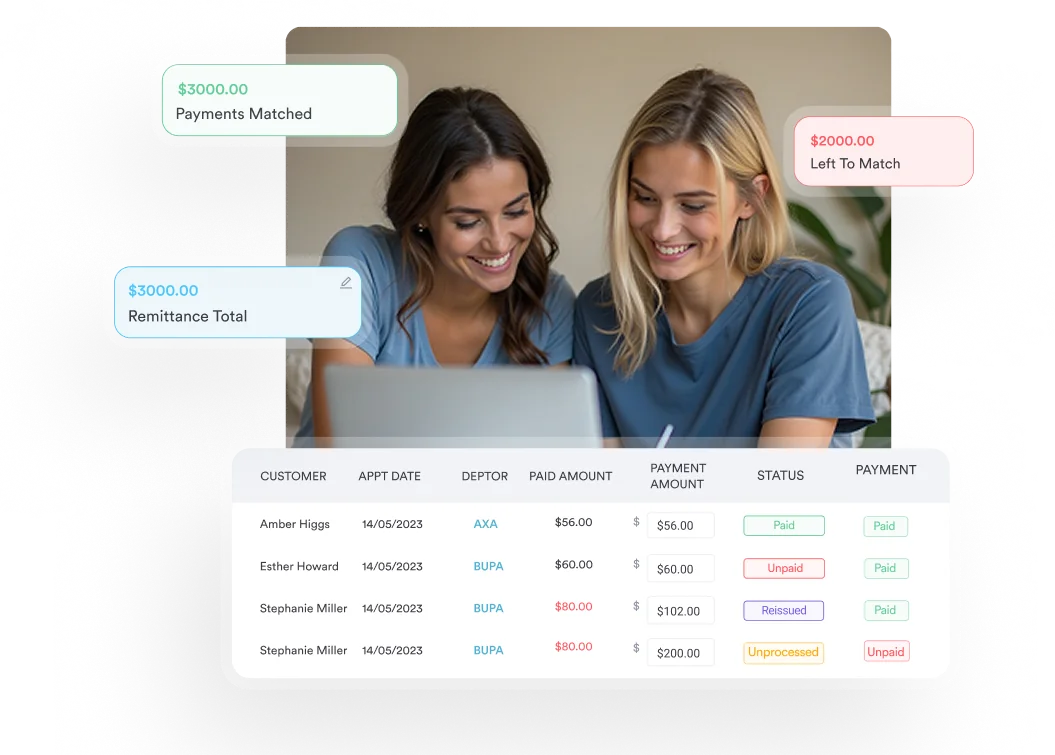

Pabau links each child sitting session to the parent’s treatment record, so billed units match attended sessions and audit records sit in one place.

T1009 is a narrow code with a clear purpose: paying for child care so a parent can stay in substance use treatment. Bill it only where your state program or grant funds it. Confirm the unit, modifiers and authorization rules in writing first.
The defensible claim is one where every sitting minute falls inside a documented treatment session. Build that match into scheduling rather than month-end review, and a clean claim follows. Book a demo to see how Pabau links child sitting sessions to treatment records for cleaner T1009 claims.

Need help understanding denial codes on returned Medicaid claims? Denial codes in medical billing explains the most common CARC and RARC remark codes and how to act on each one.
Billing the parent’s group counseling session? HCPCS code H0005 covers alcohol and drug group counseling, the kind of session a T1009 sitting log has to match.
Need the sibling code for program meals? HCPCS code T1010 explains billing meals for people in substance abuse treatment when the program rate leaves them out.
Want the bigger picture behind every Medicaid claim? Revenue cycle management fundamentals covers the end-to-end workflow from eligibility through remittance.
Looking for a structured billing workflow overview? How superbills work in medical billing explains how visit data moves from the clinical encounter into the claim.
HCPCS code T1009 covers child sitting services for the children of a person receiving alcohol and/or substance abuse services. It pays for supervising the children while the parent attends treatment. The child’s own care, general daycare and sitting outside treatment time fall outside the code.
No. T1009 is a child sitting code for parents in substance use treatment. Home health aide visits are billed with T1021 per visit or S9122 per hour, and personal care uses T1019 per 15 minutes.
No. CMS assigns T1009 coverage indicator I, meaning the code is not valid for Medicare purposes. Bill it to the state Medicaid program, managed care plan or block grant program that funds the service.
T1009 has no national unit. Your state Medicaid program, managed care plan or grant contract defines it as per visit, per hour or per 15 minutes. Bill only the time the parent spent in treatment.
State Medicaid programs and managed care plans pay T1009 where they cover it. Some states fund it through the Substance Use Block Grant, which requires child care for pregnant and parenting women in funded programs. Commercial payers rarely recognize it.
No modifier is required nationally. States may require their own U-series modifiers, such as Arizona’s U7 for block grant funding. Some programs also use HD for pregnant and parenting women’s programs, HF for substance abuse programs or H9 for court-ordered care.



