

CCSD code G5100: Bypass of duodenum billing guide
CCSD code G5100 bills a bypass that leaves the duodenum in place CCSD code G5100...

Last Updated: Oct 16, 2026
HCPCS code S0630 covers suture removal by a physician other than the one who originally closed the wound. The classic case is a family practice taking out stitches that an emergency department placed 10 days earlier. The most important fact is the payer rule. Medicare does not pay S0630, because it is a temporary national S-code.
Commercial plans and state Medicaid programs each decide whether to accept it. That means the right code depends on who closed the wound and who pays. The sections below cover payer acceptance, the 99211 alternative, a pre-submission checklist, and fixes for common denials.
Let Pabau's smart automation suggest the right codes, reduce claim denials, and keep your practice compliant—effortlessly.
Automate repetitive tasks and focus on what matters most—your patients.
Reduce coding errors and ensure compliance with the latest regulations.
Clean claims, fewer denials, and faster reimbursements.
Powerful insights and reporting to help your practice thrive.
HIPAA compliant SOC 2 certified GDPR-compliant Trusted by 4,000+ clinics worldwide

HCPCS code S0630 applies only when someone other than the original closing provider removes the sutures.
Medicare fee-for-service does not pay S-codes, so S0630 goes to commercial payers and, in some states, Medicaid.
When a payer rejects S-codes, bill CPT 99211 instead, with add-on +15853 or +15854 where the payer recognizes them.
Billing S0630 during the global surgical period without the correct modifier is a frequent cause of denial.
Record who closed the wound, when, and the suture type, because an S0630 claim rests on proving a different provider did the removal.
HCPCS code S0630 is a Level II code in the Healthcare Common Procedure Coding System. Its official descriptor reads: Removal of sutures; by a physician other than the physician who originally closed the wound.
In plain terms, the code fits one situation. A provider who didn’t close the wound takes the sutures out.
S0630 sits in the S-code series of the HCPCS set published by the Centers for Medicare and Medicaid Services (CMS). S-codes are temporary national codes used by commercial payers and some state Medicaid programs, and Medicare does not pay them.
The same verdict applies to the rest of the S-code series. HCPCS code S0601 for a screening proctoscopy is accepted by some commercial plans and never paid by Medicare.
The table below has the key facts at a glance.
S0630 covers suture removal by a provider who did not close the wound. A later visit with the same provider doesn’t qualify.
The classic case is an urgent care center or family practice removing sutures that a surgeon or emergency department placed. The descriptor names sutures only, and payers differ on whether staple removal fits under it.
Several situations fall outside the code’s scope and can’t be billed with S0630.
Here’s how that plays out. A patient has a forearm laceration closed in a hospital emergency department. Ten days later, she visits her family practice to have the sutures out. The family practice didn’t close the wound, so S0630 fits if her commercial plan accepts S-codes.
CPT 99211 is the minimal-problem, staff-level office visit code. Some practices default to it for suture removal because Medicare and nearly every commercial payer recognize it.
S0630 is the more specific choice when removal is the only service and the payer accepts S-codes. The table below maps the decision.
CPT also gives you a third route. Since January 2023, add-on codes +15853 (sutures or staples) and +15854 (sutures and staples) cover removal that needs no anesthesia. They’re reported only with a qualifying E/M visit, such as 99211. If the removal needs general anesthesia or moderate sedation, the code is CPT 15851 instead.
A useful rule of thumb is to check payer acceptance before the patient arrives. If the payer doesn’t recognize S-codes, bill 99211 for the visit. Sending S0630 to Medicare fee-for-service is a guaranteed denial. The decision tree below runs the whole choice in three questions.
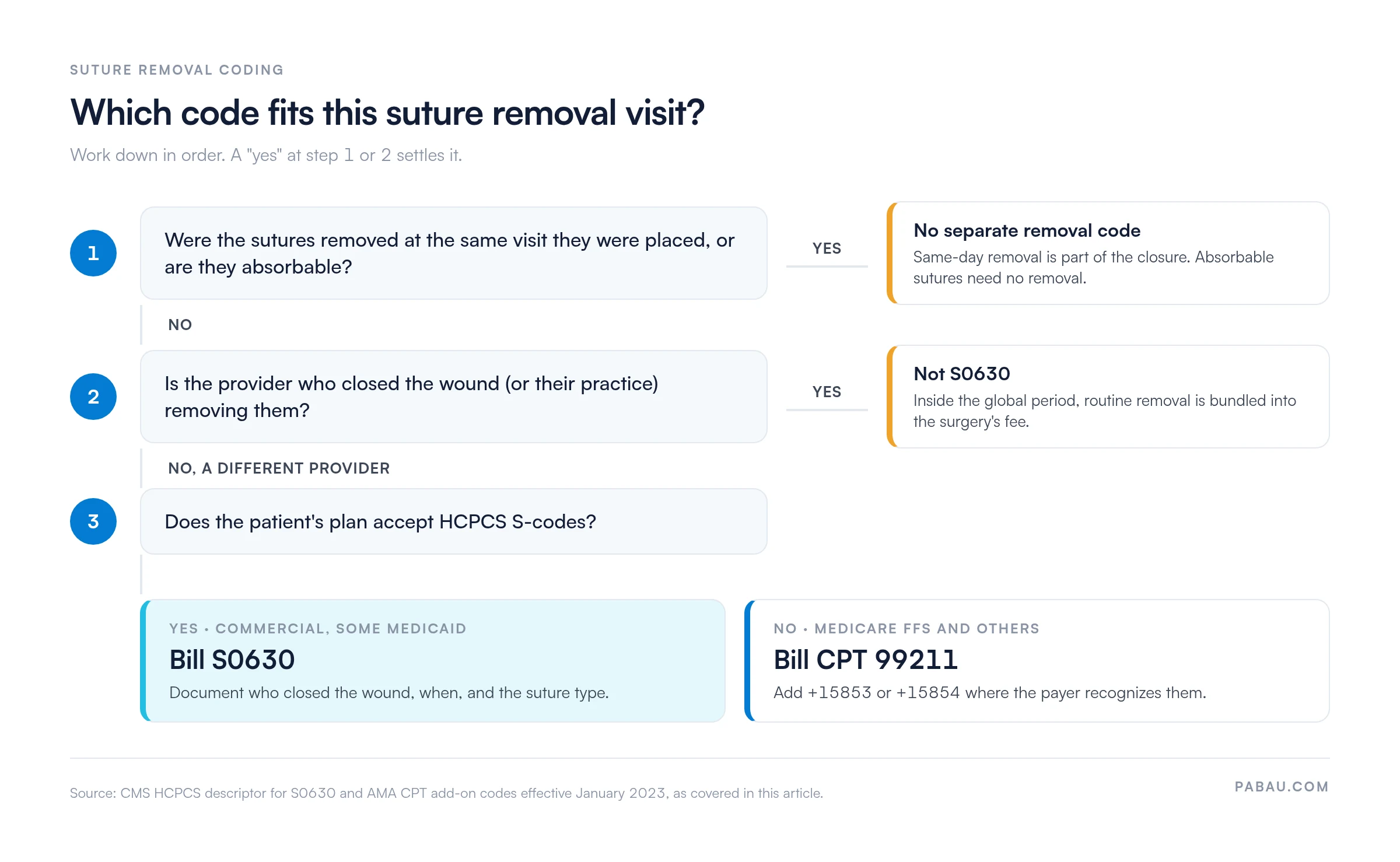
Acceptance of HCPCS code S0630 follows the payer program. Knowing the category before you bill prevents avoidable rejections.
Reimbursement for S0630 varies widely across commercial contracts. CMS publishes no allowable, because the code isn’t a Medicare benefit.
Check your contract fee schedule or the payer’s provider portal before you assume a rate. Then fold the S-code question into your insurance eligibility verification routine, so the front desk knows the answer at booking.
With the payer question settled, the claim itself takes seven checks. Rushing them is the fastest way to a denial. A clean claim for suture removal starts with payer eligibility, not with pulling up the code.
Verify S-code acceptance at insurance verification, not at checkout. Flag patients who will need suture removal in your scheduling workflow. Then confirm the plan accepts S0630 before the removal visit is booked, so the front desk can warn the patient about any out-of-pocket cost.
Incomplete documentation is another frequent reason S0630 claims are denied, alongside billing within the global period. Medical billing compliance for suture removal hinges on a record that links the removal visit to the original wound closure.
Run through this list before the claim goes out. The medical record for an S0630 encounter must include each item.
Modifiers tell the payer that the circumstances around a service differ from a standard submission. For HCPCS code S0630, three modifiers appear most often. Always confirm in advance whether the payer accepts modifiers with S-codes.
Modifier 79 only makes sense once you know how global periods work. When a surgical procedure carries a global period, CMS bundles related post-operative services into a single payment. Routine suture removal by the operating provider inside that window is part of the global fee. It can’t be billed separately.
Minor procedures typically carry a 0-day or 10-day global period, and major procedures a 90-day period. Check the CMS global-days indicator for the original code.
During these periods, the operating provider’s practice can’t bill separately for routine wound care or suture removal. Billing S0630 in that context draws a denial for bundled services.
The line that matters is routine versus complicated removal. Routine removal within the global period by the same practice is never separately billable. Anything outside those limits needs documentation and the correct modifier before submission.
Build a global period flag into your scheduling system. When a patient is booked for suture removal, check the original procedure date and the operating provider. If the dates fall inside the global window and the same practice is removing them, pull S0630 off the claim before it goes to billing. A 30-second check saves a denial cycle that can take weeks.
Even with the global period checked, a few denial patterns keep coming back. Most trace to one of five billing mistakes, each with its own fix.
Reviewing your denial management process alongside your S0630 workflow catches them early. The denial codes on the remittance usually point straight to the right row below.
Plenty of suture removal denials start at the front desk. Someone books the visit without checking the plan’s S-code policy. Then the claim goes out with a blank field or the wrong code, and it bounces back weeks later.
Pabau, the practice management platform we build, includes claims management software that fills the claim form from the patient record. The code attached to the visit lands on the charge line. Required fields such as membership numbers and authorization codes must be complete before the claim can be sent.
On the US pipeline, your team can also run eligibility checks and track claim status from the same place. The result is fewer claims returned for avoidable reasons, so your billing team spends its time on appeals worth fighting.
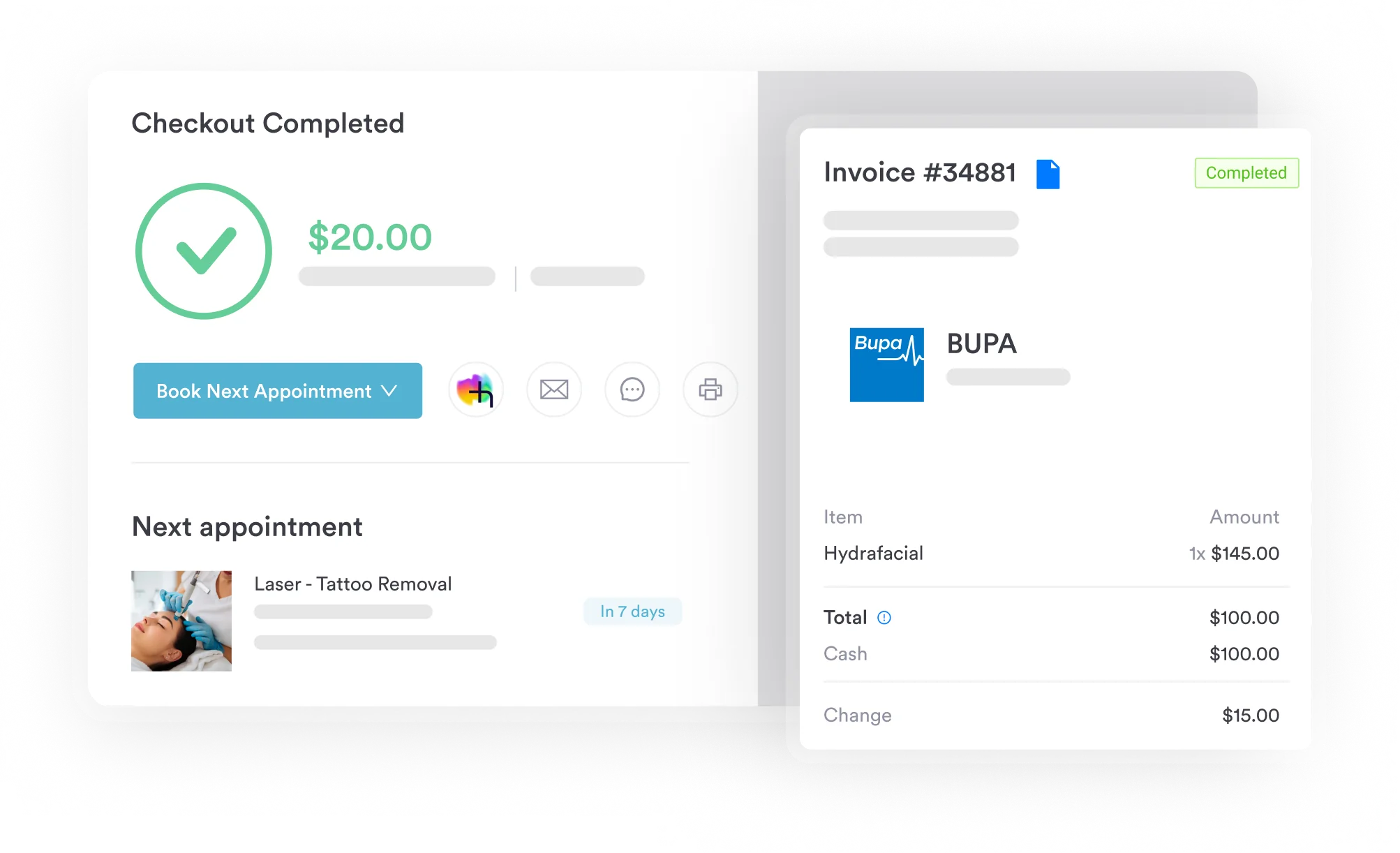

Pabau’s built-in claims management pre-fills claims from the record and checks required fields before sending, so suture removal visits generate fewer preventable denials.

S0630 rewards practices that pick the code before the patient sits down. Confirm who closed the wound, check the global period, and look up the payer’s S-code policy at booking. Do that, and the claim either goes out clean as S0630 or goes out as 99211 from the start.
The trade-off is a few extra minutes at the front desk. That costs far less than reworking a denied claim weeks later. Book a demo to see how Pabau pre-fills and checks your suture removal claims before they leave the practice.

Need help managing claim denials systematically? Denial management in healthcare covers the workflows and audit processes that reduce rejection rates across your full claims volume.
Want to understand how clearinghouses process HCPCS claims? Medical claims clearinghouse explains how claims are scrubbed, validated, and routed before they reach the payer.
Worried a denied S0630 claim will run out of time? Timely filing limits lays out the payer deadlines for first submissions, corrections, and appeals.
Reading the reason codes on a returned claim? Electronic remittance advice shows how to read the ERA so you can tell a fixable denial from a final one.
Looking to tighten your overall billing process? Revenue cycle management outlines the end-to-end process from eligibility check to payment posting.
It depends on why the wound was closed. For a healing laceration, report the original injury code with seventh character D for a subsequent encounter. ICD-10-CM guidelines don’t allow aftercare Z codes for injuries. After a surgical closure, Z48.02, encounter for removal of sutures, usually fits.
No. CPT deleted 15850 on January 1, 2023. Office removal without anesthesia now goes on add-on +15853 or +15854, reported with an E/M visit. Removal under general anesthesia or moderate sedation uses 15851.
It depends on the payer. The descriptor names a physician, so read the plan’s policy before a non-physician provider bills it. When a nurse removes sutures under supervision, 99211 is often the safer code.
The descriptor names sutures only, so check the payer’s policy before using it for staples. If the payer won’t take it, +15853 covers sutures or staples. Use +15854 when the wound was closed with both.
There’s no national rate. CMS publishes no fee for S-codes, so each commercial contract sets its own allowable. Compare it with what 99211 pays before you pick a default code for these visits.



