

CCSD code G5100: Bypass of duodenum billing guide
CCSD code G5100 bills a bypass that leaves the duodenum in place CCSD code G5100...

Last Updated: Oct 16, 2026
HCPCS code S0311 is the Level II code for comprehensive management and care coordination for advanced illness, per calendar month. It is a temporary S-code. Commercial plans and some Medicaid programs use it, but Medicare does not pay for it.
One claim covers a full month of care for a patient with a serious, progressive condition, such as heart failure, COPD, cancer, or dementia. Each payer's policy sets who qualifies, which services count, and whether prior authorization applies. Most S0311 claims succeed or fail on the checks made before they are sent.
Let Pabau's smart automation suggest the right codes, reduce claim denials, and keep your practice compliant—effortlessly.
Automate repetitive tasks and focus on what matters most—your patients.
Reduce coding errors and ensure compliance with the latest regulations.
Clean claims, fewer denials, and faster reimbursements.
Powerful insights and reporting to help your practice thrive.
HIPAA compliant SOC 2 certified GDPR-compliant Trusted by 4,000+ clinics worldwide

HCPCS code S0311 bills one calendar month of comprehensive management and care coordination for a patient with advanced illness.
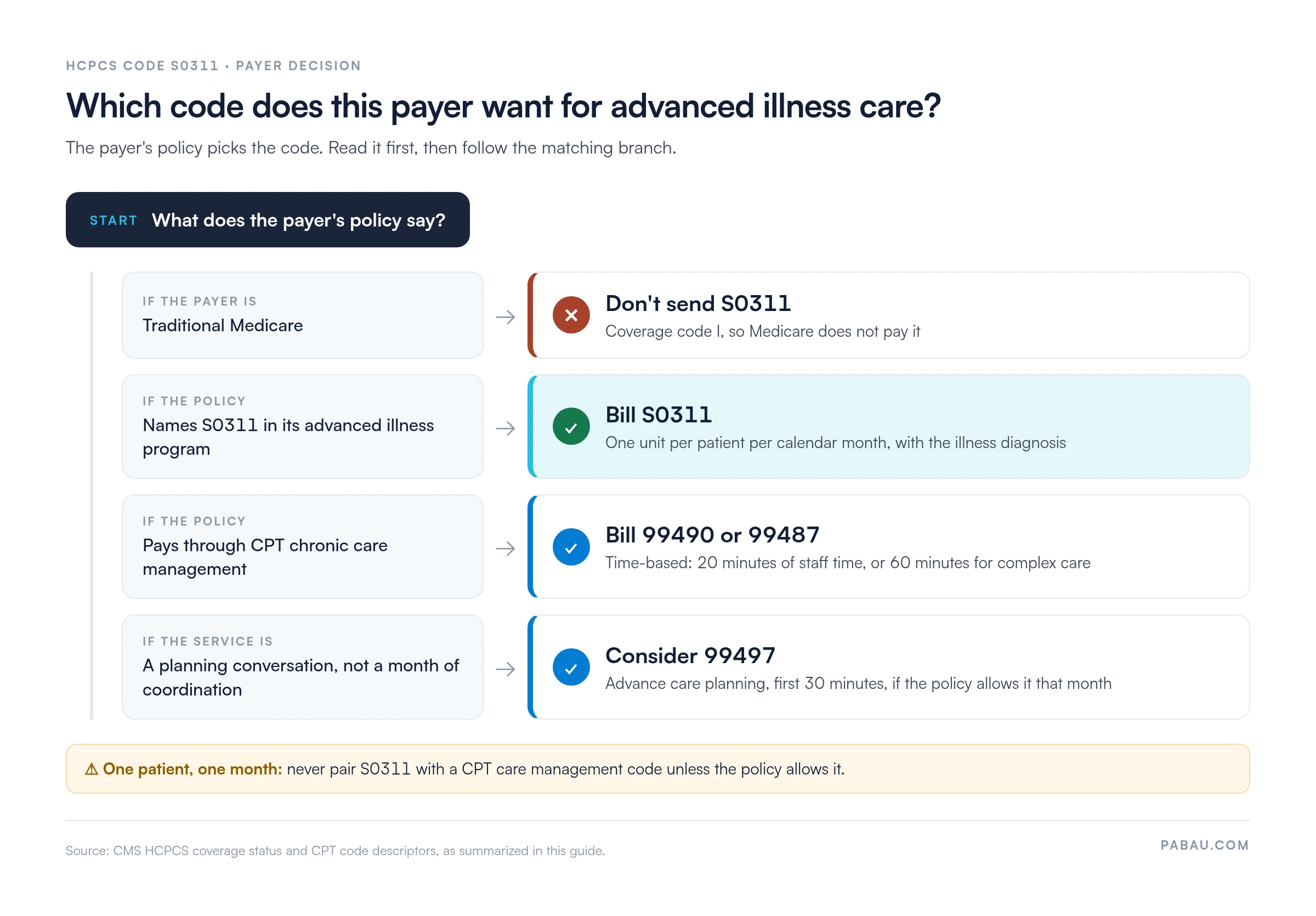
Medicare does not pay S0311, so send it only to commercial or Medicaid plans whose policy recognizes it.
Each payer’s policy defines advanced illness, the services that count, and whether prior authorization applies.
Report one unit per patient per month, with the diagnosis of the illness you are managing.
Most denials trace back to an unrecognized code, a missing authorization, or a second claim for the same month.
HCPCS code S0311 describes comprehensive management and care coordination for advanced illness, per calendar month. It sits in section S of HCPCS Level II.
These are temporary national codes built for payers other than Medicare. CMS gives S0311 coverage code I, which means Medicare does not pay it.
So who does pay? Commercial plans and some Medicaid programs, when their policy recognizes the code. Each payer decides which patients qualify, which services count, and what a month pays.
Read that policy before your first claim, because the descriptor is a single line.
You can confirm the code’s status in the CMS HCPCS overview, which also explains the quarterly update cycle.
The payer decides, because the S0311 descriptor never defines advanced illness. Its medical policy or program contract sets the criteria.
In practice, these programs serve patients with serious, progressive conditions. Think late-stage heart failure, COPD, cancer, kidney disease, or dementia. A policy may add criteria, such as recent hospital stays or declining function.
Your claim needs an ICD-10-CM code for the illness you are managing. Common examples include:
Code to the highest specificity the note supports. A vague diagnosis gives the payer an easy reason to question medical necessity. Also check the policy’s list of eligible conditions, since some programs cover only a few.
Picture an 81-year-old patient with class IV heart failure and COPD. Her commercial plan runs an advanced illness program that recognizes S0311. Here’s how her month runs, week by week.
When the month closes, the practice bills one unit of S0311. The record shows who did each task, on which date, and how it tied back to the care plan.
Program documents usually spell out the expected activities. Expect some mix of care planning, symptom management, medication review, caregiver support, and coordination with other providers. If a task isn’t in the policy, don’t assume it counts.
S0311 often sits alongside CPT codes that describe similar work. They are not interchangeable. Each has its own rules, and a payer that accepts one may refuse another.
So which one do you use? Follow the payer. If a plan’s advanced illness program names S0311, bill S0311. If it pays for chronic care management under CPT code 99490 or complex care under CPT code 99487, meet their time rules instead.
Advance care planning is a separate service. Check whether the policy lets you report CPT code 99497 in the same month. Never report S0311 and a CPT care management code for one patient and month unless the policy allows it.
The diagram below puts the whole decision on one page.
Commercial plans, Medicare Advantage plans, and some Medicaid programs may pay S0311, each at its own rate. Medicare publishes no fee, so there is no national benchmark. Each payer sets its rate in a contract or fee schedule. Medicaid programs that recognize the code list it in their state fee schedules.
Rates differ widely, so treat any published average with caution. Your own contract is the only figure that matters. If you are new to how fee schedules work, start with these medical billing basics.
An S0311 claim takes six steps from the first note to payment. Most problems start in steps one and two, long before anyone opens the claim form.
Run this check on every claim before it goes out. Most lines match a denial code in the next section, so a miss here usually comes back as a denial.
S0311 denials cluster around a handful of claim adjustment reason codes. Read the code on the remittance, then fix the cause before you resubmit. For the full list, see our guide to medical billing denial codes.
Behind those denial codes, the same few mistakes come up again and again:
Once the checklist is clear, the claim still has to reach the payer. Pabau, the practice management platform we build, includes claims management for that step. It pre-fills the CMS-1500 from the patient record, so the diagnosis and service code carry over from the chart.
Before a claim can go, Pabau checks that required fields are complete, such as the authorization number in Box 23. In the US, claims then go out through Claim.MD, with eligibility checks and remittance posting in the same place.
Your team still owns the payer checks above. Each plan sets its own policy, authorization, and documentation rules, so keep the checklist in your monthly routine.
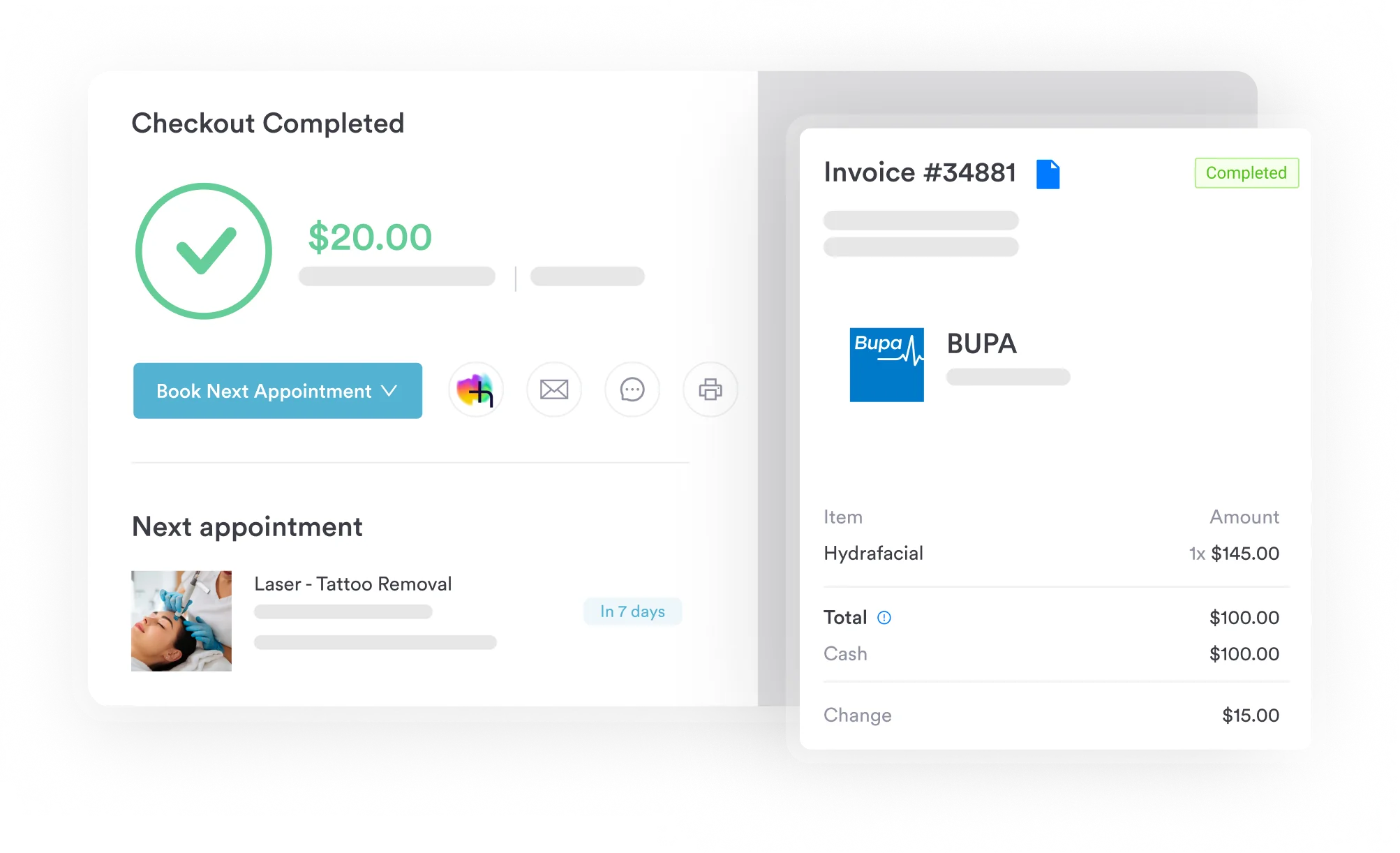

Pabau’s claims management pre-fills each claim from the patient record and checks required fields before it goes out. In the US, claims submit through Claim.MD.

S0311 rewards preparation more than coding skill. The code itself is simple: one unit, one month, one patient with advanced illness. The work lies in matching each claim to the payer’s program rules before it goes out.
So start with your two or three biggest payers. Pull their advanced illness policies, note the eligibility and authorization rules, and fold them into the checklist above. That one round of setup stops the same denial from coming back every month.
Book a demo to see how Pabau handles claim submission for your care management services.

Want fewer rejections on the first pass? Submitting a clean claim walks through the pre-submission checks that keep claims moving.
Denials piling up? Denial management in healthcare shows how to track, fix, and prevent repeat denials.
Worried about audit risk? Medical billing compliance covers the rules that keep your claims defensible.
Billing an interdisciplinary team meeting? HCPCS code S0220 explains the S-code for a physician-led care conference.
Managing hospice patients at home? HCPCS code S0271 covers physician management of home care at a hospice monthly case rate.
No. S0257 covers counseling about advance directives or end-of-life planning, listed in addition to an E/M visit. S0311 covers a full month of management and coordination. A payer may allow both, so check its policy.
The descriptor requires none. Add a modifier only when the payer’s policy names one, such as a program or telehealth modifier. An unsupported modifier can trigger a denial.
Traditional Medicare does not pay it. A Medicare Advantage plan writes its own provider rules and may run its own care programs. Confirm in the plan’s provider manual before you bill.
The descriptor doesn’t say. Programs often use a team, such as a physician, a nurse care manager, and a social worker. The payer’s contract decides who may provide the services and who bills.
No. Hospice has its own benefit and billing rules. Payers decide whether a hospice patient can also qualify for S0311. A separate code, S0271, covers physician management of home care at a hospice monthly case rate.



