HCPCS code E0198: Water pressure pad billing guide
HCPCS code E0198 is a water pad for a standard mattress HCPCS code E0198 is the ...

Last Updated: Oct 13, 2026
CPT code 99487 is the billing code for complex chronic care management (CCM) services. It requires at least 60 minutes of clinical staff time per calendar month, plus moderate-to-high complexity medical decision-making by the supervising provider.
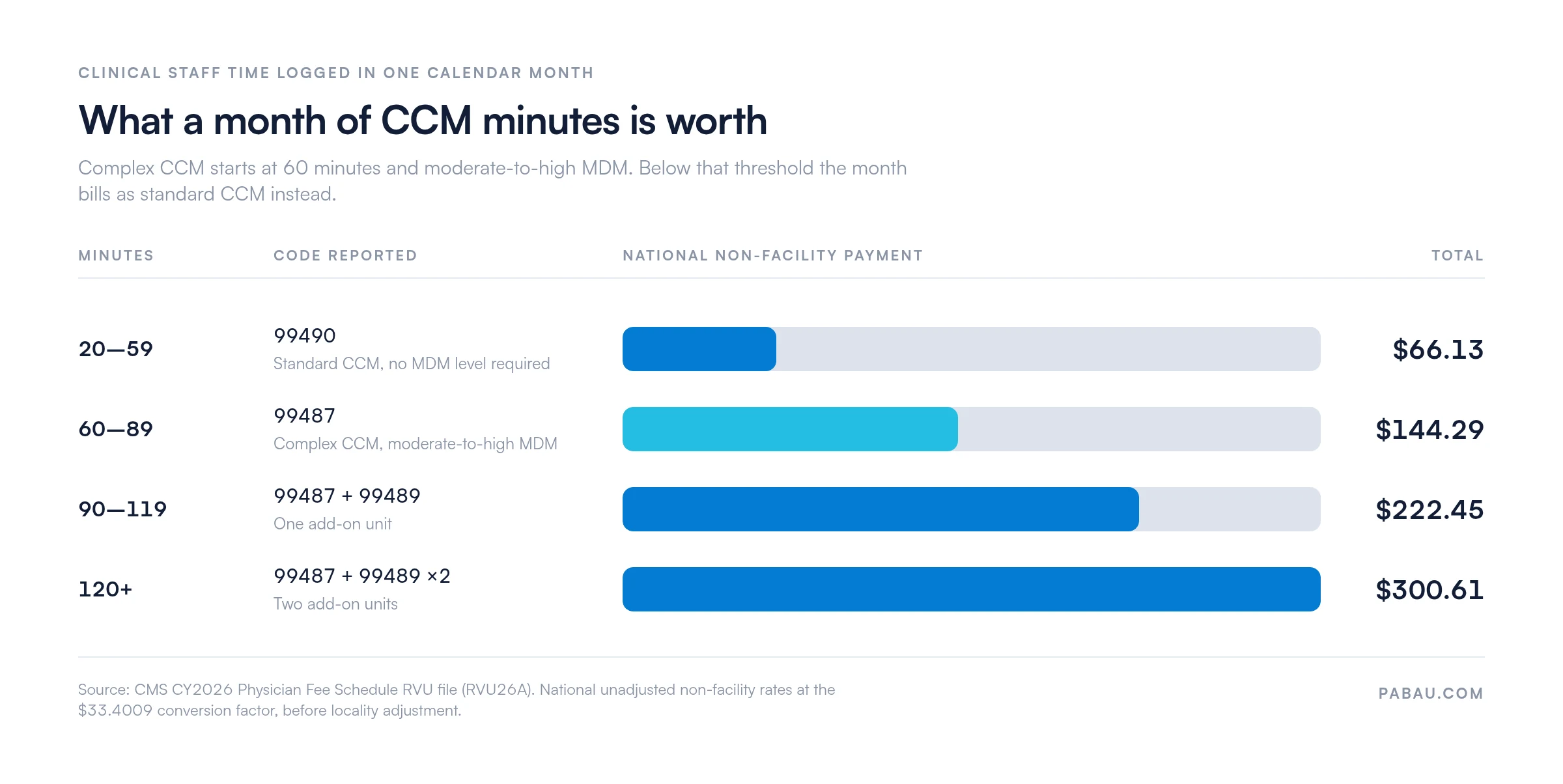
It applies to Medicare patients with two or more chronic conditions that place them at significant risk of death, acute exacerbation, or functional decline. Medicare pays $144.29 for the month at the 2026 national non-facility rate. Missing either the time threshold or the MDM attestation is the leading cause of 99487 denials.
This reference covers the official descriptor, the time and documentation requirements, and 2026 Medicare reimbursement rates. It also covers add-on code 99489, the comparison with 99490, the billing rules, and the errors that trigger denials.

CPT code 99487 covers complex CCM for patients with two or more chronic conditions, billed once per calendar month.
A minimum of 60 minutes of clinical staff time must be logged within the calendar month before this code can be billed.
The supervising provider must document moderate-to-high complexity MDM, and the claim is denied without that attestation.
Medicare pays $144.29 for 99487 at the 2026 national non-facility rate, before any locality adjustment.
Practice management software like Pabau keeps CCM time logs, care plan notes, and claim submission in one workflow.
CPT code 99487 describes complex chronic care management delivered by clinical staff, directed by a physician or other qualified health care professional. The American Medical Association’s CPT code set lists five required elements, and a billable month carries all of them.
The phrase “per calendar month” is critical. Time does not roll over between months. A patient who receives 55 minutes of CCM services in January cannot carry those minutes into February.
CPT code 99487 sits within a family of CCM codes. Understanding which code applies requires matching time thresholds, complexity levels, and who performs the service.
Key distinction: 99487 and 99489 require the supervising provider to personally attest to moderate-to-high complexity MDM. 99490 and 99491 carry no MDM requirement, which makes them the fit for lower-acuity panels. Rates change every year and vary by locality. Check your own figures in the CMS Physician Fee Schedule lookup tool before you project revenue.
Eligibility for complex CCM rests on the criteria below, and all of them must hold in the same month. Establishing eligibility at enrollment is far easier than reconstructing it at claim submission.
Common qualifying conditions include diabetes mellitus, congestive heart failure, chronic obstructive pulmonary disease, hypertension, chronic kidney disease, depression, and Alzheimer’s disease. The list is not exhaustive. What matters is meeting the duration and risk criteria above.
CPT code 99487 requires a minimum of 60 minutes of clinical staff time per calendar month, directed by the supervising provider. This is the threshold that distinguishes complex CCM from standard CCM (99490), which requires only 20 minutes.
Time is cumulative across the calendar month. A patient receiving 25 minutes of coordination in week one and 35 minutes across weeks two and three reaches the 60-minute threshold. Each session needs its own date, duration, and the name of the staff member who did the work.
Where the month’s total lands decides both the code and the payment, and the steps are further apart than the minute counts suggest.
CPT code 99487 may be billed by physicians, nurse practitioners, physician assistants, clinical nurse specialists, and certified nurse-midwives, subject to state scope-of-practice law. The clinical staff who do the coordination work under the direction of the billing provider. That provider personally performs and documents the moderate-to-high complexity MDM.
CMS assigns general supervision to the clinical-staff CCM codes, which are 99487, 99489, 99490 and 99439. The billing practitioner does not have to be physically present while staff deliver the service. Staff time may also be billed incident to the billing practitioner, subject to state law and licensure.
The clinical staff logging the 60 minutes do not need to be licensed providers. Medical assistants, care coordinators, and registered nurses can all contribute to the time log. They must be employed by, or under contract with, the billing provider’s practice.
Strong documentation is the difference between a clean claim and an audit finding. Every element below has to be in the medical record before the claim goes out. Practices that log each activity as it happens, rather than reconstructing the month at the cutoff, see far fewer claim errors.
The diagnosis codes on the claim carry the medical necessity, so each qualifying condition needs its own ICD-10-CM code on the submission. Two chronic conditions have to be visible on the claim, not only in the care plan.
Medicare reimbursement for CPT code 99487 is set each year through the Medicare Physician Fee Schedule (MPFS). Payment is the code’s total RVU multiplied by a conversion factor, then adjusted for your locality and your site of service.
CY2026 runs two conversion factors. Clinicians in a qualifying alternative payment model are paid at $33.5675, and everyone else at $33.4009. The figures below use the lower one and the RVUs published in the CMS CY2026 RVU file, so they are national and unadjusted.
Multiply the total RVU by $33.4009 to check any figure in that table. A qualifying APM participant is paid at $33.5675 instead, which lifts 99487 to $145.01. Your own rate then moves again with the locality adjustment for your practice address.
The volume matters more than the rate. A panel of 50 complex CCM patients, billed cleanly every month, is roughly $7,214 from 99487 alone, before any 99489 units.
CPT code 99489 is the add-on code to 99487. It is reported for each additional 30 minutes of clinical staff time beyond the first 60 in a calendar month. It cannot be billed alone; it always accompanies 99487 as the primary code.
Take a patient with five chronic conditions who needs 95 minutes of coordination in March. That month bills as one unit of 99487 for the first 60 minutes, plus one unit of 99489 for the remaining 35. Payers differ on how they round a partial increment, so check your payer’s policy before submitting.
Log CCM time as it happens rather than reconstructing the month at the cutoff. A session recorded as 28 minutes on the day it happens is defensible. A session documented three weeks later as 30 minutes is a red flag for auditors. Timestamp entries and include the staff member’s name and the activity performed for every CCM interaction.
The core difference between 99487 and 99490 is complexity and time. Practices billing standard CCM across a panel, then moving eligible patients up to complex CCM, must track both codes month by month.
Several hard rules govern 99487, and missing one means a denial now or a recoupment later. Build them into the billing workflow rather than checking them after the claim has gone out.
Remote physiologic monitoring sits outside those exclusions. CMS allows 99457 in the same month as complex CCM, provided each minute counts toward only one service. Where behavioral health integration suits the patient better, 99484 carries its own consent, time and documentation rules.
Most 99487 denials trace back to a handful of recurring errors. Effective denial management workflows flag these before submission rather than during an appeal.
Audit your CCM panel a few days before the billing cutoff. Pull every enrolled patient and check four things: consent on file, time logged to date, care plan last updated, and MDM note present. A deficiency caught on day 25 can still be corrected. The same deficiency caught at claim submission cannot.
The documentation load for 99487 is heavy. Time logs, the care plan, the MDM note, structured data, and a monthly claim all have to line up before the month closes. A practice running spreadsheets alongside a separate CCM tool reconciles the two by hand every cutoff.
Pabau is practice management software that holds the patient record, the time log, and the claim in one system. Clinical staff log each CCM activity against the record as it happens, so the month’s total is already there at the cutoff. The provider’s MDM note sits on the same record as the minutes it covers.
Pabau’s claims tools for practices then generate 99487 and any 99489 units from that record, alongside the practice’s E&M billing. Claims route to US payers electronically and remittances post back automatically, so a denial surfaces within days rather than weeks.

Pabau connects time tracking, care plan documentation, and claim submission in one workflow. See how practices are capturing every eligible 99487 encounter without a separate CCM tool.

Complex CCM pays well because it is hard to document. The 60 minutes and the MDM note are what a payer looks for first. Both have to exist before the month closes, and neither can be reconstructed afterwards without inviting an audit.
So the decision worth making is how the practice will record minutes as they are worked. A panel enrolled without that habit produces months that look eligible and cannot be defended.
Pabau keeps the consent, the time log, the care plan and the claim on one patient record, so the month’s evidence assembles itself. Book a demo to see how a complex CCM month closes without a separate spreadsheet.

Need a complete picture of medical billing compliance? What is medical billing covers the end-to-end revenue cycle process for US practices.
Worried about claim denials cutting into CCM revenue? Denial codes in medical billing breaks down the most common CARC codes and how to respond to each one.
Exploring clearinghouse options for CCM claims? Our Claim.MD clearinghouse guide explains how electronic claim routing works for Medicare and commercial payers.
CPT code 99487 bills complex chronic care management for Medicare patients with two or more chronic conditions. Those conditions must be expected to last at least 12 months. They must also place the patient at significant risk of death, acute exacerbation, or functional decline. The code covers 60 minutes of clinical staff time a month, directed by a provider who performs moderate-to-high complexity MDM.
Yes. Nurse practitioners may bill CPT 99487 under their own NPI where state scope-of-practice law allows it. CCM is a general supervision service, so the billing practitioner does not have to be on site while clinical staff deliver it. Staff time may also be billed incident to the billing practitioner, subject to state law.
Yes. CPT 99489 is the add-on code to 99487. It is reported for each additional 30-minute increment of clinical staff time beyond the first 60 minutes. One unit is added at 90 minutes of total CCM time, and two units at 120 minutes. 99489 cannot be billed without 99487 as the primary code.
Any chronic condition qualifies if it meets two criteria. It must be expected to last at least 12 months or until the patient’s death. It must also place the patient at significant risk of death, acute exacerbation, or functional decline. Common qualifying conditions include diabetes, congestive heart failure, COPD, hypertension, chronic kidney disease, depression, and Alzheimer’s disease. The list is not exhaustive.