

HCPCS Code G0163: Skilled nursing observation and assessment
What is HCPCS Code G0163? HCPCS Code G0163 is a deleted Level II code for skille...

Last Updated: Oct 15, 2026
HCPCS code S0220 reports a physician's conference with an interdisciplinary team to coordinate a patient's care. The patient is in the room, and the conference runs approximately 30 minutes. The team can include health professionals or community agency staff, such as social services.
Start with the payer, because it decides whether S0220 can be billed at all. It is a Temporary National Code that private payers and Medicaid programs use, and Medicare does not pay it. Send it to the wrong plan, or bill an hour-long meeting that belongs under S0221, and the claim comes back. Below, each step from payer check to appeal is laid out in order.
Let Pabau's smart automation suggest the right codes, reduce claim denials, and keep your practice compliant—effortlessly.
Automate repetitive tasks and focus on what matters most—your patients.
Reduce coding errors and ensure compliance with the latest regulations.
Clean claims, fewer denials, and faster reimbursements.
Powerful insights and reporting to help your practice thrive.
HIPAA compliant SOC 2 certified GDPR-compliant Trusted by 4,000+ clinics worldwide

HCPCS code S0220 reports a physician-led conference with an interdisciplinary team, with the patient present, lasting approximately 30 minutes.
S0220 is not an office visit or an evaluation and management (E/M) code, so the note records attendees, duration, and care decisions.
A conference of approximately 60 minutes is reported with S0221, and a conference without the patient does not qualify for either code.
Medicare does not pay any S-code, so S0220 belongs only on claims to Medicaid programs and commercial payers that list it.
HCPCS code S0220 describes a medical conference in which a physician and an interdisciplinary team coordinate a patient’s care.
The patient is present, and the conference lasts approximately 30 minutes. The team can include health professionals or representatives of community agencies, such as social services or home care providers.
S0220 sits in the S-series of HCPCS Level II codes. These are Temporary National Codes that private payers and Medicaid programs use, and Medicare does not recognize. The Centers for Medicare and Medicaid Services (CMS) maintains the HCPCS code set. That payer split shapes every later billing step for this code.
S0220 fills a slot that CPT leaves to other codes. CPT’s medical team conference codes, 99366 to 99368, cover nonphysician professionals with the patient present and any participant when the patient is absent.
When a physician joins face to face with the patient, CPT points to an E/M code instead. S0220 gives payers that use it a dedicated code for that physician-led, patient-present conference.
The choice comes down to the payer contract and who attended. If the payer lists S0220 and the physician led a conference with the patient in the room, S0220 applies.
If the payer works only from CPT, the same meeting follows CPT’s conference and E/M rules. CPT code 99366 covers the nonphysician side of that patient-present conference.
Put together, those rules form a short sequence of checks, run in the order below.
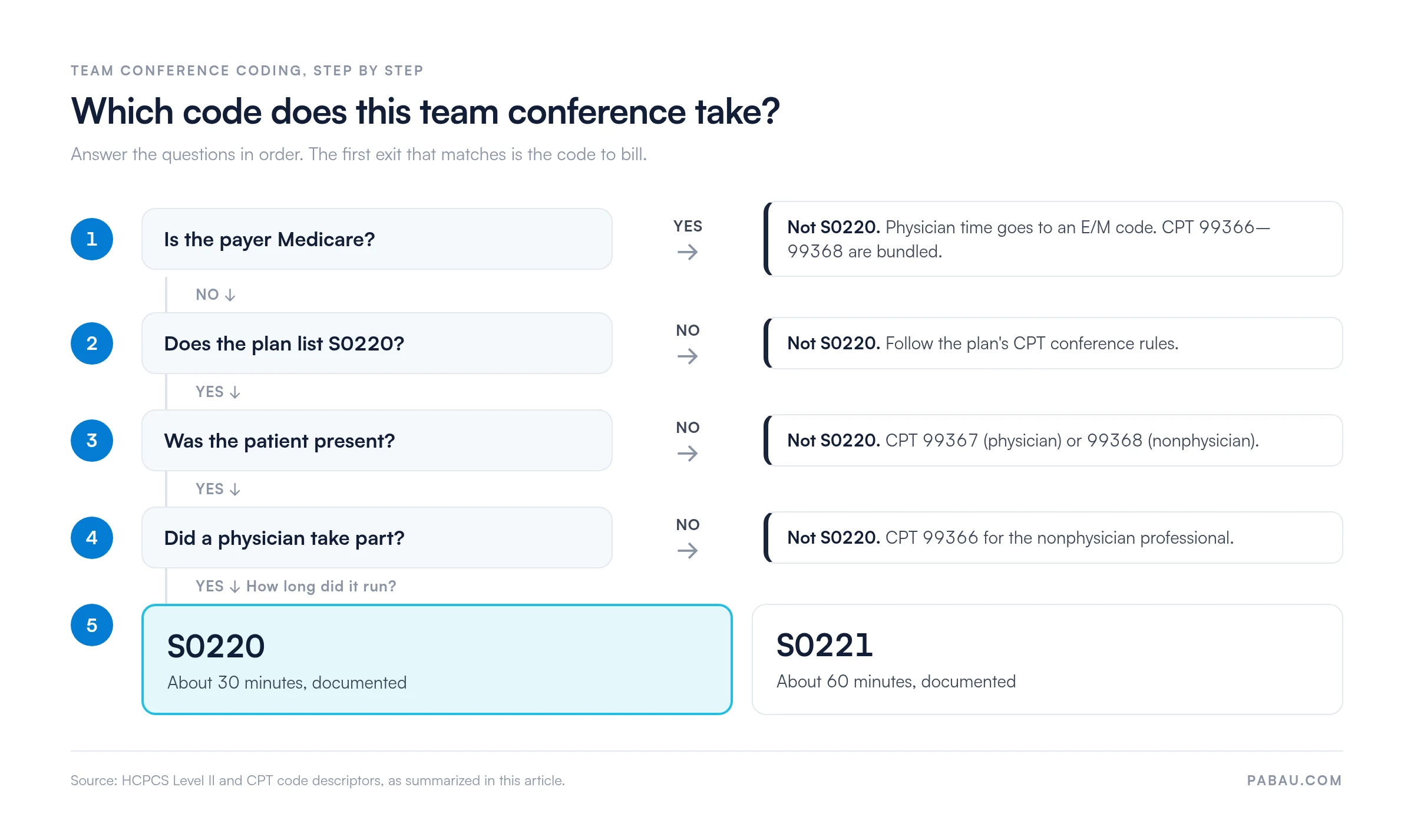
S0220 is one of the Temporary National Codes that private payers and Medicaid programs use, and Medicare does not recognize. Even among those payers, coverage varies plan by plan. Running insurance eligibility verification before the conference is the fastest way to confirm a plan pays S0220.
No. Medicare does not recognize or reimburse any HCPCS S-series code, including S0220. CMS assigns the code coverage status I, which means Medicare does not pay it. A claim carrying S0220 for a Medicare beneficiary is denied at adjudication.
For Medicare patients, check whether the conference is separately reportable under CPT rules. A physician’s face-to-face participation goes to an E/M code, and CPT team conference codes 99366-99368 are bundled by Medicare. S0220 is never a valid Medicare substitute.
Medicaid coverage of S0220 varies by state. Some programs list care coordination conferences under S0220 and S0221. Others pay only CPT codes, or don’t pay team conferences at all. Managed care organizations (MCOs) can also set their own rules under their provider agreements.
So check the specific MCO’s billing manual, rather than assuming state Medicaid rules carry over. Each payer’s contract sets the rate for S0220, and there is no national fee schedule. Commercial plans work the same way, with coverage tied to the plan’s benefit design.
Before billing S0220, pull the payer’s provider billing manual for the current contract year. Payers update their code lists annually, and a conference code paid last year may be dropped this year. Your clearinghouse can flag a code the payer no longer accepts before the claim goes out.
Once the payer checks out, the note carries the claim. It has to show a care coordination conference, rather than a clinical visit. Auditors look for who attended, how long the conference ran, and what the team decided.
History, exam, and decision-making levels don’t support this code. A note built around these elements also supports clean claim submission.
Duration is the element most likely to decide the code. A conference that runs closer to an hour belongs under S0221. Without recorded times, the payer has no way to confirm which code fits.
Place of service (POS) codes tell the payer where the conference took place. Report the setting where the team met with the patient, and confirm that the payer accepts S0220 there.
A POS code that doesn’t match the conference setting can trigger an adjustment or denial. Record the location in the conference note, so the claim and the record agree.
S0220 does not require a modifier by itself. Payers that pay S-codes set their own modifier rules, and the most common case is a conference held by telehealth.
Telehealth modifier rules for S0220 vary by payer and can change each contract year. Confirm the current payer policy before appending either modifier. The AAPC Codify entry for S0220 carries the official descriptor to check against the payer’s manual.
With the codes and the note settled, the remaining risk is the handoffs. A conference claim passes through several hands before it reaches the payer. Here’s the usual path, with the point where each step tends to break.
Run this quick check on every conference claim before it leaves the practice.
S0220 denials cluster around a handful of predictable errors. Reading the denial reason on the electronic remittance advice (ERA) is the first step toward knowing which correction to apply.
A structured appeal recovers many denied S0220 claims, particularly those denied for documentation reasons. The denial management process follows a consistent sequence regardless of payer.
Several codes describe interdisciplinary conferences. They differ by duration, who reports, and whether the patient attends.
The S0220 and S0221 split matters most for practices that run long care-planning meetings. Billing every conference as S0220 undercounts the hour-long ones. Billing short ones as HCPCS code S0221 invites recoupment. The documented conference time decides which code is correct.
Conference codes are easy to lose because the meeting rarely sits on the schedule like a visit. A coordinator often writes up the conference later, and the claim waits on someone remembering to create it.
Pabau, the practice management platform we build, keeps the conference note and the claim in the same patient record. Its error-checking claims management tool pre-fills the claim from that record. It also checks that payer-required fields are complete before the claim can be sent. In the US, claims go out through Claim.MD with eligibility checks and ERA posting, so a denied S0220 surfaces quickly.
The outcome is fewer missed conference claims and faster answers when a payer rejects one. Your team spends less time rebuilding claims from scattered notes.
Add S0220 and S0221 to the fee schedule only for the payers that list them, with the time each one requires noted beside it. Staff then pick the right conference code by payer and duration instead of from memory.

Pabau pre-fills claims from the patient record and checks required fields before submission, so conference claims reach the payer complete.

Treat S0220 as a payer question first and a coding question second. If the plan doesn’t list the code, no note will get it paid. That makes the eligibility check the step worth protecting.
When the payer does list it, the note carries the claim. Recorded times settle S0220 versus S0221, and the attendee list and outcome hold up on audit.
Book a demo to see how Pabau keeps conference notes and claims in one patient record, so team conference claims go out complete.

Need to understand how denials are tracked and worked? Denial management in healthcare covers the full denial workflow from remittance code identification through appeal resolution.
Want to understand the clearinghouse role in claim submission? Medical claims clearinghouse explains how claims are validated and routed before they reach the payer.
Looking for guidance on revenue cycle fundamentals? Revenue cycle management covers the end-to-end billing process from eligibility verification through payment posting.
S-codes are HCPCS Level II Temporary National Codes. Private insurers created them to report drugs, services, and supplies that have no national code. Medicaid programs use them too, but Medicare does not recognize them.
Not as written. The S0220 descriptor requires the patient to be present and doesn’t mention family. CPT 99366, by contrast, accepts the patient and/or family. Ask the payer before billing S0220 for a family-only conference.
Neither descriptor sets an exact cutoff, since both say approximately. Check the payer’s manual for a time rule first. Without one, bill the code nearer the documented duration, and keep start and end times in the note.
No. S0220 describes a conference by a physician. Under CPT, a nonphysician professional reports 99366 when the patient is present and 99368 when the patient is absent.
No. S0220 carries coverage code I, which means Medicare doesn’t pay it. For Medicare patients, physician participation in a face-to-face conference goes to an E/M code instead.
Only the duration. S0220 covers a conference of about 30 minutes, and S0221 covers the same conference at about 60 minutes.




