

CCSD code G5100: Bypass of duodenum billing guide
CCSD code G5100 bills a bypass that leaves the duodenum in place CCSD code G5100...

Last Updated: Oct 16, 2026
S0271 is the HCPCS Level II code for physician management of patient home care, hospice monthly case rate (per 30 days). One unit covers all physician oversight of a home care or hospice patient across a 30-day period, not a single visit.
S0271 is a non-Medicare S-code, so traditional Medicare denies it. Medicaid programs and some commercial plans pay it. For Medicare patients, physician care plan oversight is billed with G0181 or G0182 instead.
Let Pabau's smart automation suggest the right codes, reduce claim denials, and keep your practice compliant—effortlessly.
Automate repetitive tasks and focus on what matters most—your patients.
Reduce coding errors and ensure compliance with the latest regulations.
Clean claims, fewer denials, and faster reimbursements.
Powerful insights and reporting to help your practice thrive.
HIPAA compliant SOC 2 certified GDPR-compliant Trusted by 4,000+ clinics worldwide

HCPCS Code S0271 covers physician management of home care or hospice, billed once per patient per 30-day period rather than per visit.
The official descriptor is physician management of patient home care, hospice monthly case rate (per 30 days).
Medicare assigns no national fee schedule rate to S-codes, so submit S0271 to Medicaid programs and select commercial payers only.
Missing care plan documentation and incorrect units are the top two denial triggers for S0271 claims.
Pabau holds the care plan, the oversight note, and the monthly claim on one patient record, so denials fall.
HCPCS Code S0271 is a Level II S-series code under the Healthcare Common Procedure Coding System (HCPCS). The Blue Cross Blue Shield Association maintains the S-series. The official descriptor is: Physician management of patient home care, hospice monthly case rate (per 30 days).
The CMS HCPCS overview describes S-codes as temporary Level II codes. Medicaid programs and commercial payers are their main users. Traditional Medicare does not cover them.
The quick-reference table below captures the key attributes coders need before placing S0271 on a claim.
S0271 bundles physician oversight activity into a single monthly case rate. It covers the coordination work a physician performs on a home care or hospice patient’s care plan during a 30-day window. Individual face-to-face visits are not part of it.
Services included in the S0271 case rate:
Services not included and billable separately:
S0271 and a home visit E/M code describe different work. If the physician travels to the home and provides a substantive clinical service, that encounter is an E/M visit rather than care oversight. Billing S0271 on the same date as a face-to-face home visit takes documentation showing the oversight activity was distinct from the visit.
One unit of S0271 covers all eligible physician management activity during a single month for a single patient. Billing more than one unit per patient per 30-day period is the second most common reason for denial.
Here is how the billing cycle operates in practice:
There is no national Medicare fee schedule rate for HCPCS Code S0271. Because S-codes sit outside Medicare’s standard coverage framework, reimbursement is entirely payer-dependent.
Rates vary by state Medicaid program, managed care contract, and commercial plan. Verify contracted rates through the payer’s provider portal rather than a Medicare fee schedule lookup, which carries no S-code rate to find.
Because S0271 sits outside Medicare’s standard fee schedule, payer acceptance is the first question to resolve before submitting a claim. Read the insurance eligibility verification result carefully, because a Medicare Advantage plan may accept S0271 where traditional Medicare will not. Confirm the code in the AAPC HCPCS code lookup and in the payer’s own HCPCS policy.
Prior authorization requirements differ sharply across payers. Some Medicaid programs require authorization for the home care episode rather than for each monthly S0271 claim.
Others require the physician to attest to the patient’s homebound status at the start of each case rate period. Check the payer’s HCPCS billing policy before the first claim, not after the first denial.
Incomplete documentation is the primary driver of S0271 denials. The medical record has to support every element of the claim before submission. The following must be present and available for audit:
Retain the supporting documentation for at least six years, and keep access controls on the record. Physician practices billing S0271 should build the documentation check into the monthly billing routine, rather than reviewing records only after a denial.
Several codes operate in the same home care and hospice billing space as S0271. Picking the wrong one causes a denial. It can also raise a compliance question when the billed code misrepresents the service or the billing provider type. Where the patient is on home care but not hospice, the standard monthly case rate is S0270.
Where the ongoing work is maintaining a medical home program care plan, the code is S0281.
Two facts settle almost every one of these calls. The first is who rendered the service, and the second is who is paying. The chart below routes the decision on those two axes, and the table after it carries the descriptors.
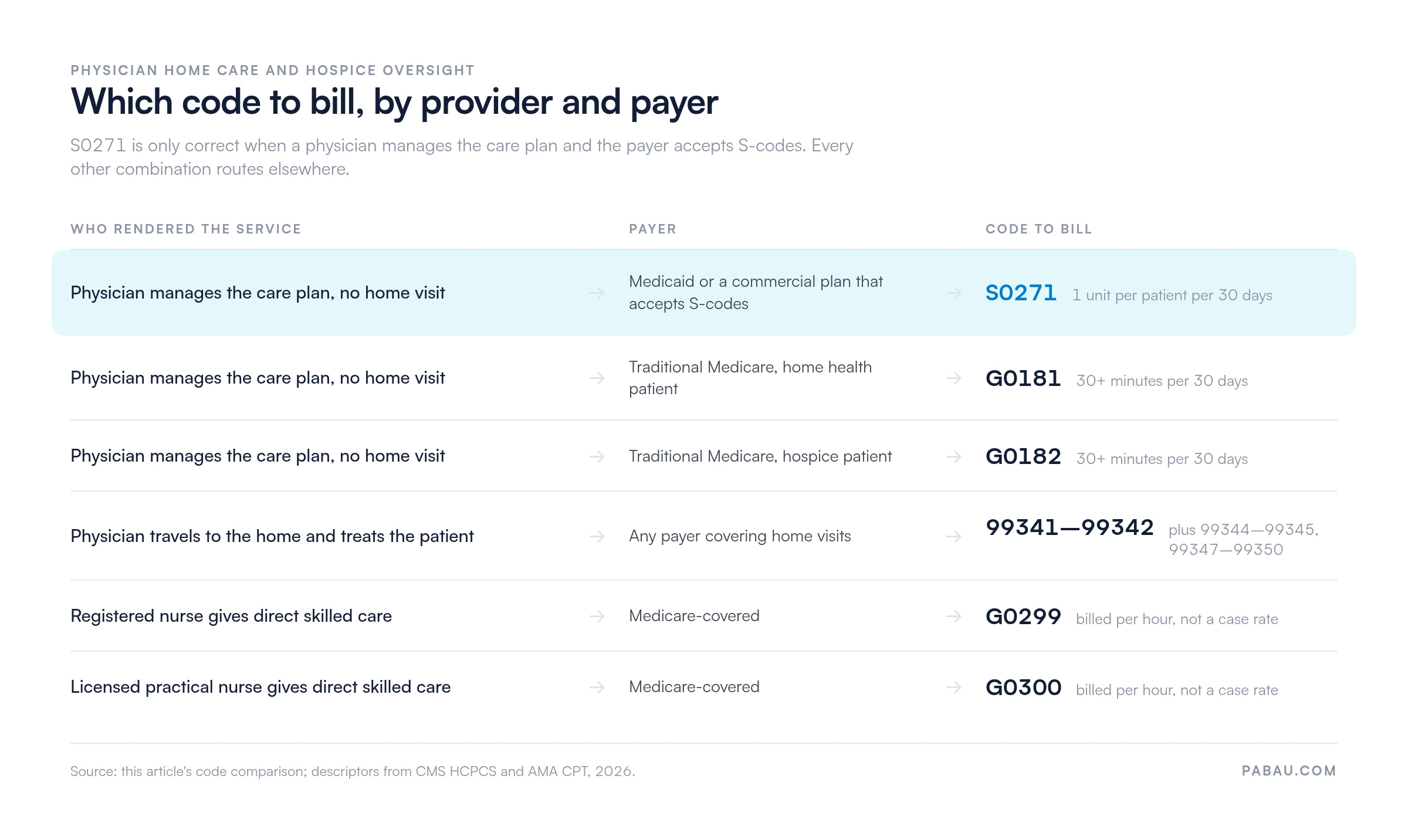
Descriptor and status changes for every code below are published in the CMS HCPCS quarterly update.
S0271 and G0299 are frequently confused because both appear on hospice-related claims. The decisive distinction is provider type. S0271 is billed by the supervising physician, and G0299 is billed by the registered nurse providing direct skilled care.
Both codes can appear on the same patient’s account in the same month, as long as each service is rendered and documented separately.
The payer context differs just as sharply. G0299 carries a Medicare national fee schedule rate and is submitted to traditional Medicare. S0271 has no Medicare rate and goes to a Medicaid program or a commercial plan that accepts S-codes.
Billing G0299 when you mean physician management, or sending S0271 to Medicare, are distinct errors with distinct denial codes. Identifying which provider rendered which service is the fastest way to route the right code to the right payer.
Most S0271 denials fall into one of six categories, and five of them are preventable before the claim is submitted:
Run a monthly pre-submission audit on every pending S0271 claim. Check that the claim carries one unit per patient. Check that the record holds a signed care plan for that period. Check that at least one oversight event is documented inside the 30-day window. Those three checks remove most S0271 denial volume.
A denied S0271 claim is recoverable in most cases. The steps below follow standard corrected-claim protocol:
Practices carrying a high volume of home care physician claims benefit from a dedicated denial-tracking workflow. Our reference on denial codes covers the most common CARC codes and what each one requires for resolution.
Most physician home care teams track S0271 in two places at once. The care plan and the oversight note live in the clinical record, while the monthly claim lives in a billing spreadsheet. Nobody reconciles the two until a denial arrives.
Pabau, practice management software for healthcare practices, holds both in one patient record. The signed plan of care, the physician’s oversight note, and the claim sit together, so a biller can check them without leaving the file.
That single view is what cleaner claims management comes down to on a monthly case rate code. Before the claim goes out, your team can confirm one unit, one documented oversight event, and a payer that accepts S-codes.
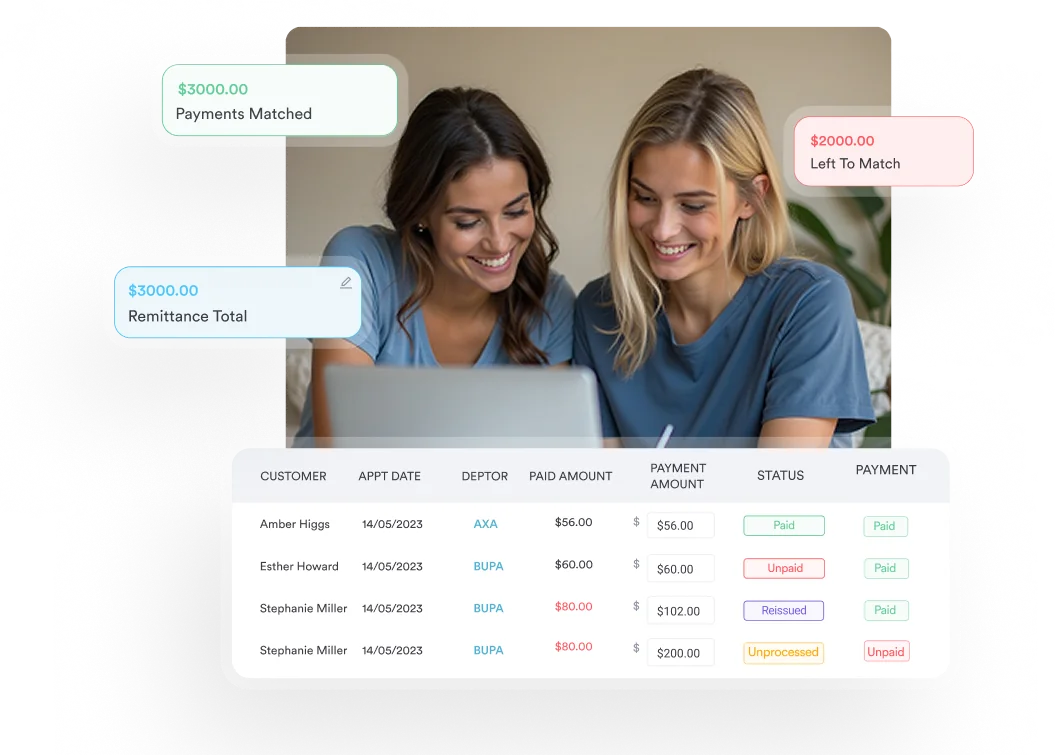

Pabau keeps the care plan, the oversight note, and the S0271 claim in one patient record. Your team can check a monthly case rate claim before it goes out.

S0271 rewards practices that treat it as a monthly routine rather than a claim raised after the fact. Settle the payer first, then the unit count, then the oversight note for that month. Three checks, in that order, before submission.
The trade-off worth remembering is that S0271 has no Medicare floor to fall back on. Where a payer declines S-codes, the same oversight work is still billable for Medicare patients under G0181 or G0182. Route it rather than write it off.
Pabau keeps the care plan, the oversight note, and the monthly claim on one patient record. Book a demo to see how that shortens the check before an S0271 claim leaves your practice.

Need a structured claims compliance framework? Medical billing compliance covers the documentation retention, audit, and corrected-claim protocols that apply to HCPCS billing.
Want to see how denials move through the revenue cycle? Revenue cycle management explains how each billing stage connects to denial prevention, from the eligibility check to payment posting.
Billing for a home care or hospice practice? Denial management in healthcare walks through systematic denial tracking and appeal processes for complex code sets.
HCPCS Code S0271 covers physician management of a patient’s home care or hospice care, billed as a single monthly 30-day case rate. The case rate bundles all physician oversight activity for that period into one billable unit. That includes care plan review, team communication, and care coordination. Face-to-face home visits and nursing services are billed separately.
No. Traditional Medicare does not cover S0271, and S-codes have no national Medicare fee schedule rate. Medicare patients receiving physician home care oversight should be billed under G0181 for home health or G0182 for hospice. Some Medicare Advantage plans may cover S0271 under supplemental benefits, so verify with each plan individually.
Yes. S0271 is billed once per patient per 30-day period, every month that the physician renders qualifying home care management services and the supporting documentation exists. Billing more than one unit per patient per period is a common error and a top denial trigger.
Six reasons account for most S0271 denials. The payer does not recognize S-codes, prior authorization is missing, or care plan documentation is incomplete. The others are more than one unit per 30-day period, and ICD-10 codes that do not support medical necessity. A claim filed under a non-physician NPI is denied too. Each denial carries a CARC code naming the reason on the remittance advice.



