CPT Code 72193: CT Pelvis With Contrast Billing Guide
CPT code 72193: Official descriptor and procedure overview CPT code 72193 descri...

Last Updated: Nov 13, 2026
S0106 is the HCPCS Level II code for bupropion HCl sustained release tablets, 150 mg, billed per bottle of 60 tablets. One unit on the claim is one full bottle, not one tablet or one milligram.
S0106 is a temporary national S code. Medicare does not pay it, so coverage, rates, and prior authorization come from the Medicaid program or private payer that recognizes it. The NDC line carries the tablet count, while the HCPCS units field carries the bottle count.
Let Pabau's smart automation suggest the right codes, reduce claim denials, and keep your practice compliant—effortlessly.
Automate repetitive tasks and focus on what matters most—your patients.
Reduce coding errors and ensure compliance with the latest regulations.
Clean claims, fewer denials, and faster reimbursements.
Powerful insights and reporting to help your practice thrive.
HIPAA compliant SOC 2 certified GDPR-compliant Trusted by 4,000+ clinics worldwide

HCPCS code S0106 is a temporary national S code for bupropion HCl sustained release tablets, 150 mg, billed per bottle of 60 tablets.
One unit of S0106 is one bottle of 60 tablets. The claim counts bottles, never tablets or milligrams.
Medicare does not pay S codes. Medicaid programs and private payers that recognize S0106 set their own rates, rules, and prior authorization.
The NDC line and the HCPCS units field count different things. One bottle is 60 tablets on the NDC line and 1 unit of S0106.
Pabau, the practice management platform we build, keeps the prescription, prior authorization, and claim on one patient record. The bottle count on the claim then matches what was dispensed.
HCPCS code S0106 is the Level II code for bupropion HCl sustained release tablets, 150 mg, billed per bottle of 60 tablets. CMS’s October 2026 HCPCS release lists its long descriptor as Bupropion HCl sustained release tablet, 150 mg, per bottle of 60 tablets. AAPC’s S0106 entry carries the same wording. One unit on the claim is one full bottle.
S0106 belongs to the S code series, which CMS keeps as temporary national codes for private payers and Medicaid programs. Medicare does not pay S codes. The code was added on April 1, 2002, and is still active in that October 2026 release. The same series includes S code S0117 for topical tretinoin, billed per 5 grams.
Because each payer sets its own S0106 rate, there is no single national allowable to quote. When a rate appears in an appeal or a billing note, cite the payer, the fee schedule version, and its effective date.
Before billing S0106, download your state Medicaid drug fee schedule for the current fiscal year. Rates change annually and sometimes mid-year. A claim priced from last year’s schedule often pays short without a formal denial, which slows cash flow quietly.
S0106 describes one product: Bupropion hydrochloride sustained release (SR) tablets at 150 mg, packed 60 to a bottle. The descriptor names a single strength and a single package size. Other SR strengths and other bottle sizes fall outside it, so ask the payer how it wants those reported.
Bupropion SR is sold under two brand names with different FDA-labeled uses. Wellbutrin SR is labeled for major depressive disorder, and Zyban is labeled as an aid to smoking cessation. The code itself names no indication.
The diagnosis on the claim comes from the ICD-10-CM diagnostic codes and should describe the condition the prescriber documented. For smoking cessation, that is usually a nicotine dependence code from F17.2-, such as F17.210 for cigarettes. For depression, it is a major depressive disorder code from F32 or F33. Whether S0106 is covered for that diagnosis is set by each payer, so read its policy before the first claim.
S0106 does not cover:
The billing unit for S0106 is the bottle. Report 1 unit for each bottle of 60 × 150 mg SR tablets dispensed, so two bottles is 2 units. Entering 60 (the tablets) or 9,000 (the milligrams) in that field bills 60 or 9,000 bottles instead of one. Payer edits will reject that line, or the payer recoups it later.
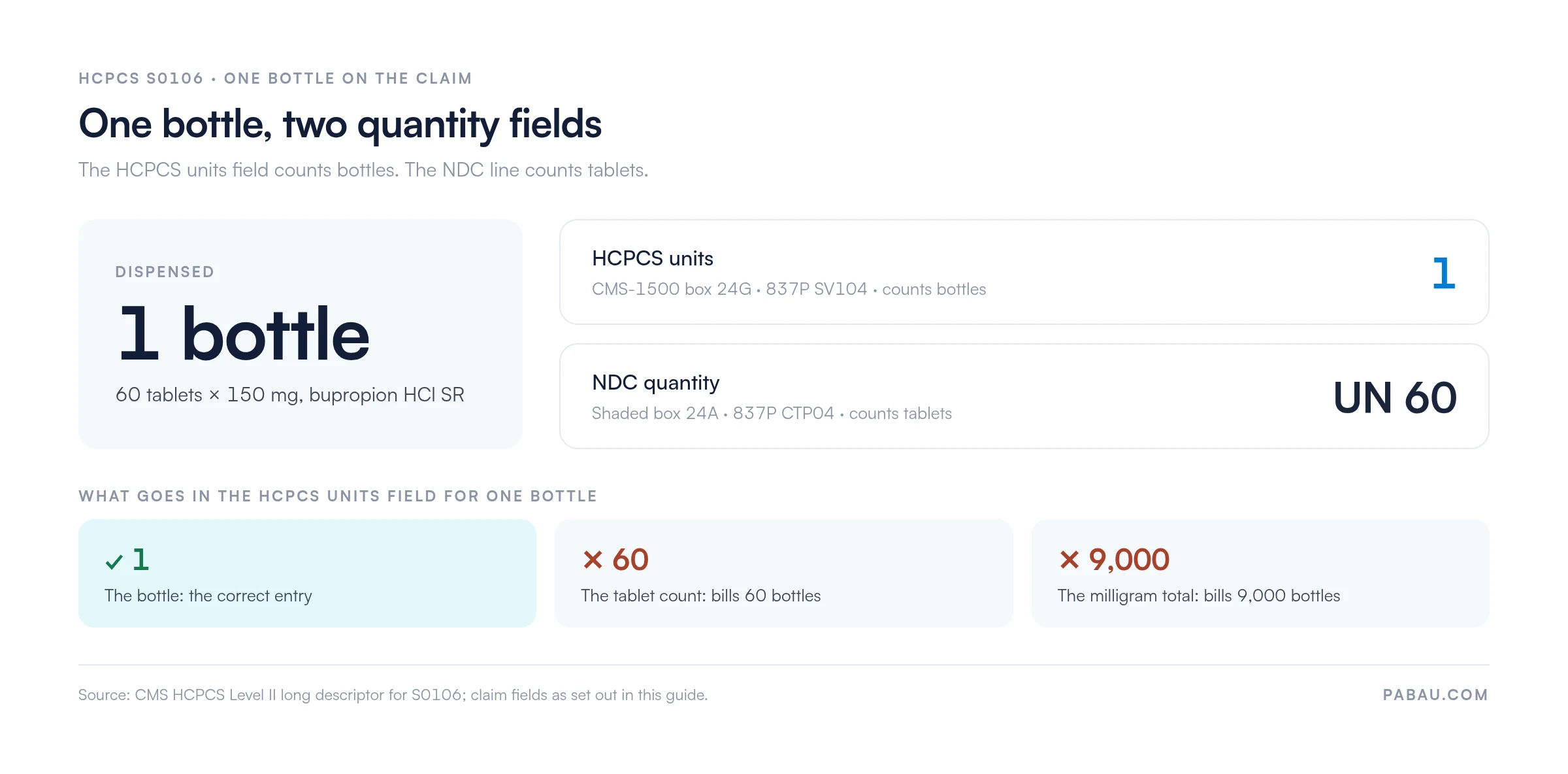
Two quantity fields sit on an S0106 line, and they count different things:
Mixing the two up is the most common way an S0106 quantity goes wrong. Keep bottles in the units field and tablets on the NDC line.
Step-by-step billing sequence for S0106:
The NDC on an S0106 line has to match the product that left the practice. Several manufacturers make bupropion SR, each under its own NDC, and a single labeler can list several strengths and pack sizes.
An NDC mismatch does not always deny at once. Some payers pay the claim and catch the mismatch on a later audit, then recoup the payment. Building NDC checks into the superbill documentation workflow catches it at the point of dispensing.
Review your bupropion SR NDCs every quarter. Generic supplier contracts change often, and a new NDC can fall off a payer’s accepted list without warning. Check each new NDC before it goes live in your dispensing system.
Coverage for HCPCS code S0106 depends on the payer. Medicare does not pay S codes, and a Medicare patient’s oral bupropion usually runs through a Part D pharmacy claim. For other payers, coverage, rates, and prior authorization are set plan by plan. Oral sildenafil follows the same pattern under S0090, billed per 25 mg.
For smoking cessation, the Affordable Care Act requires most non-grandfathered private plans to cover FDA-approved tobacco cessation medications without cost-sharing. That rule governs coverage, not coding. A plan can still send bupropion SR through its pharmacy benefit rather than accept S0106.
Confirm the billing route with each plan before the first claim. Run that check when the drug is prescribed, so a plan that wants a pharmacy claim never receives an S0106 line.
S0106 sits next to several codes that billers mix up. The usual confusion involves J codes, smoking cessation counseling codes, and other bupropion formulations.
Many billers assume every drug HCPCS code is a J code. That assumption fails here, because bupropion SR has its own S code and no J code.
Payers reviewing an S0106 claim look for a connected chain of records. That chain runs from the clinical reason for the drug to the prescription, the dispensing record, and the claim. A break anywhere in it is grounds for recoupment.
What the record should hold for each S0106 claim:
Payer audits often compare the reported NDC with the strength in the clinical record. A chart that says “Wellbutrin SR 150 mg” beside an NDC for a different strength or pack size triggers a review. Dispensing and billing staff need one shared way of recording the product.
S0106 claims deny for a small set of predictable reasons, and most are preventable at claim preparation. Reading the Claim Adjustment Reason Code (CARC) on the remittance tells you where to route the rework, and it feeds denial management workflows.
In many practices, the prescription lives in one system and the dispensing log in another. Someone then keys the claim by hand at the billing desk. That handoff is where a bottle count turns into a tablet count, or an authorization number goes missing.
In Pabau, those steps sit on one patient record. Prescribers approve and send prescriptions from the record, with US e-prescribing through DoseSpot. Stock carries batch and expiry details, and the lot is recorded against the patient and the appointment.
Prior authorization codes and dates sit on the insurance case, with a warning when one is missing. Pabau’s claims management software sends US claims as CMS-1500 or 837P through Claim.MD, and matches ERA remittances back to each line.

Pabau keeps prescriptions, stock lots, prior authorizations, and insurance claims on one patient record. Claims go out through Claim.MD with the bottle count and authorization already on file.

S0106 is a per-bottle code, and every fix in this guide follows from that. Count bottles in the units field and keep the tablet count on the NDC line. Before the first claim, confirm the payer recognizes S0106 at all, because Medicare never will.
The trade-off is a few minutes of checking against weeks of rework. A payer check and a dispensing record that shows bottles cost little at the point of prescribing, while a recoupment months later costs far more. Book a demo to see how Pabau keeps prescriptions, authorizations, and claims on one record for practices dispensing bupropion SR.

Need a walkthrough of medical billing fundamentals? What is medical billing explains the end-to-end claim lifecycle from service to payment posting.
Dealing with high denial volumes across multiple codes? Denial management in healthcare covers systematic approaches to tracking, categorizing, and resolving claim denials.
Need a clean-claim checklist for your billing team? Clean claim submission outlines every field requirement that payers check before adjudicating a drug or service claim.
HCPCS code S0106 is used to bill bupropion HCl sustained release tablets, 150 mg, per bottle of 60 tablets. Medicaid programs and private payers that recognize S codes accept it under a medical benefit. Medicare does not pay it.
Bill 1 unit of S0106 for each bottle of 60 × 150 mg sustained release tablets. Two bottles are 2 units. The tablet count belongs on the NDC line, with the unit qualifier UN, not in the HCPCS units field.
No. Medicare does not pay S codes, including S0106. S codes are temporary national codes that CMS keeps for private payers and Medicaid programs. For a Medicare patient, oral bupropion usually runs through a Part D pharmacy claim.
S0106 describes one oral product, bupropion HCl SR 150 mg in a 60-tablet bottle. J codes mostly describe drugs given by injection or infusion. No J code describes bupropion SR, so a J code on a bupropion claim is the wrong code.
Report the 11-digit NDC of the product dispensed, in the 5-4-2 format, with the N4 qualifier. It should belong to a bupropion HCl SR 150 mg tablet in a 60-tablet package. Add the unit qualifier UN and the tablet count.
Acceptance is set payer by payer. Some state Medicaid programs and private plans accept S0106, while others route bupropion SR through the pharmacy benefit. Medicare does not accept it. Confirm with each plan before the first claim.