



HCPCS code E0198: Water pressure pad billing guide
HCPCS code E0198 is a water pad for a standard mattress HCPCS code E0198 is the ...

Last Updated: Oct 13, 2026

CPT Code 99406 covers smoking and tobacco use cessation counseling lasting more than 3 minutes but not more than 10 minutes. The AMA classifies it under Behavior Change Interventions.
Medicare pays CPT 99406 and 99407 directly, using the same codes as commercial and Medicaid payers. CMS stopped paying the old G-codes G0436 and G0437 in 2016 and deleted them from HCPCS in 2017.
The F17 ICD-10 family (nicotine dependence) requires fifth or sixth character specificity. Never submit a bare F17 code without a fully specified sub-code.
Medicare’s 2026 national non-facility rate is roughly $15.36 for 99406 and about $29 for 99407, with no copay, coinsurance, or deductible for the patient.
Practice management software like Pabau automates code pairing, tracks session frequency limits, and submits claims through the Claim.MD clearinghouse.
CPT Code 99406 is the AMA’s reporting code for smoking and tobacco use cessation counseling. It applies when the counseling runs more than 3 minutes but not more than 10 minutes.
The code sits in the Behavior Change Interventions category of the CPT code set. Its companion code, 99407, covers counseling that runs longer than 10 minutes.
One code set now covers every payer. Commercial plans, Medicaid programs, and Medicare Part B all accept 99406 and 99407.
According to the American Medical Association’s CPT code set, time-based behavior change codes like 99406 require documented face-to-face time, not total encounter time. Pre-visit intake and post-visit charting do not count toward the threshold.
Two mistakes account for most tobacco cessation denials. The first is reaching for a retired Medicare G-code. The second is recording counseling time as a range instead of a specific face-to-face duration. Neither error is obscure, but both are expensive.
The single most important variable separating these two codes is time. Bill 99406 when counseling runs between 3 and 10 minutes. Bill 99407 when it runs longer than 10 minutes. There is no code for counseling under 3 minutes, and the clock covers face-to-face counseling content only.
Neither code can be reported more than once per day. Upcoding to 99407 when documented time falls between 3 and 10 minutes is a common audit target.
The note must state the specific start and stop time, or at minimum the total minutes of face-to-face counseling. Time is only the first of five checks a tobacco cessation claim has to clear.
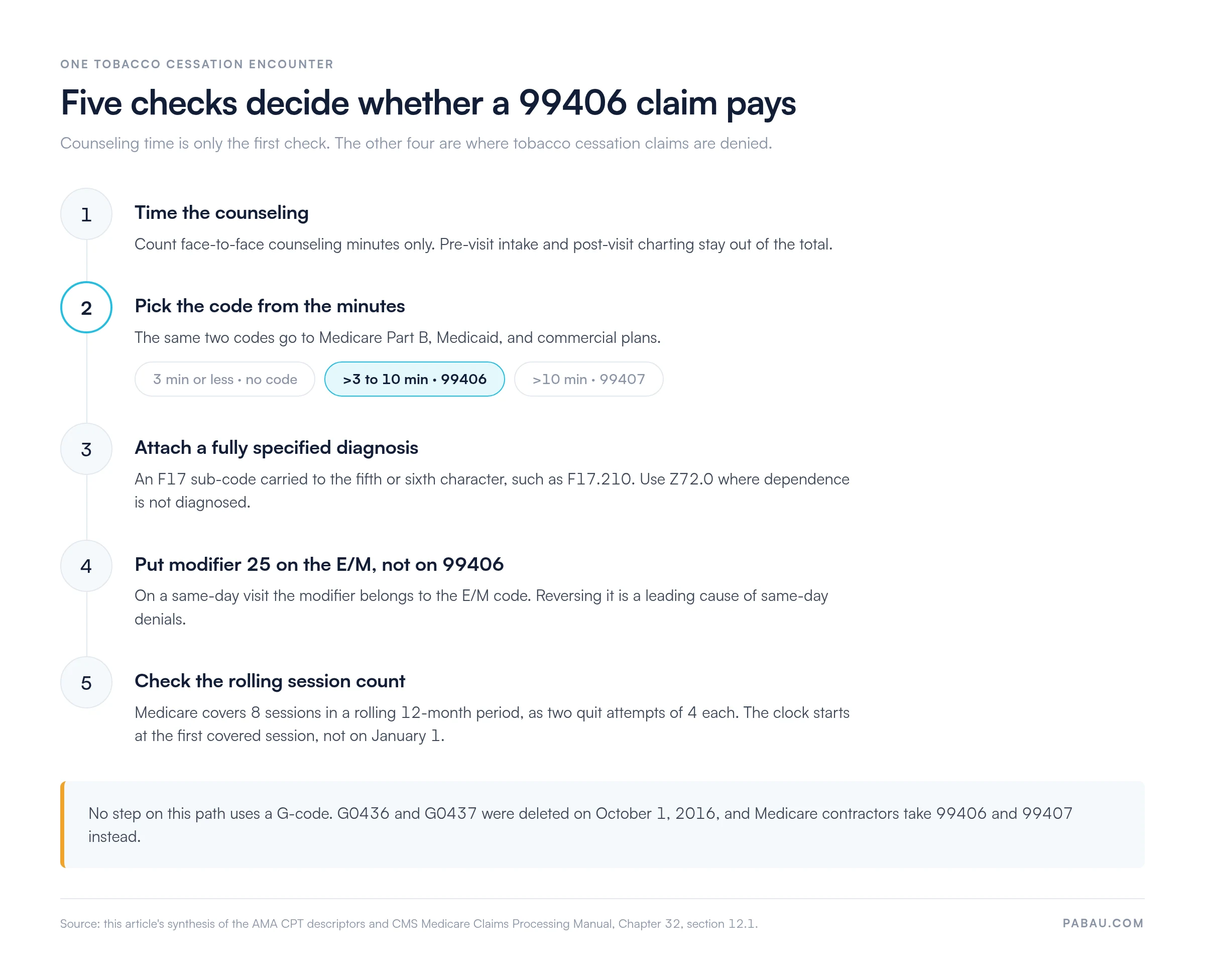
Medicare Part B pays CPT 99406 and 99407 directly, exactly as commercial and Medicaid payers do. CMS stopped paying the HCPCS G-codes G0436 and G0437 for dates of service on or after October 1, 2016.
Both were then deleted from HCPCS on January 1, 2017, and contractors were told to accept the CPT codes instead. That instruction still stands in the current Medicare Claims Processing Manual, Chapter 32, sections 12 and 12.1.
The old advice has a long half-life. G0436 and G0437 were live from 2011 through 2016, and plenty of billing cheat sheets never caught up. CMS revised section 12.1 in December 2025, effective January 20, 2026. It still names 99406 and 99407 as the codes to bill.
Today the retired G-code is the one that denies, not 99406. If your charge master, encounter form, or superbill still carries a G0436 or G0437 line, delete both entries this week.
Medicare covers up to 8 cessation counseling sessions, structured as two quit attempts of 4 sessions each. That cap runs over a rolling 12-month period, measured from the patient’s first covered session. It is not a calendar-year allowance, so it does not reset every January.
Beneficiaries pay no cost-sharing for this benefit, so no copay, coinsurance, or deductible applies when the claim is coded correctly. Record the date of the first covered session on the patient record. The ninth session inside that 12-month window will not be covered.
Reimbursement for CPT 99406 varies by payer, geographic locality, and the annual CMS Physician Fee Schedule update. The CMS Physician Fee Schedule publishes updated RVU values each October, effective the following January 1. Always pull current-year figures before quoting a rate to staff or building a revenue projection.
Medicare’s 2026 national non-facility payment is approximately $15.36 for 99406 and about $29 for 99407, and facility settings pay less. Commercial payers sit in a similar band for 99406, roughly $15 to $25 nationally. They often pay more than Medicare for 99407.
Check the fee schedule lookup for the Work, Practice Expense, and Malpractice RVU components in your own locality. These are small-dollar codes, so the money shows up in volume rather than in any single claim.
Payers with preventive care mandates, including most ACA-compliant commercial plans, must cover cessation counseling at no cost to the patient. That changes how the practice collects. Review your payer contracts to confirm whether 99406 is carved out as a zero-cost-share preventive service.
Run a quarterly report on 99406 and 99407 claim acceptance rates by payer. If any single payer is denying more than 5% of these claims, audit those notes for missing time documentation before filing an appeal batch.
Every claim for CPT 99406 requires a supporting diagnosis code from the ICD-10-CM code set. The F17 family (nicotine dependence) is the primary match. The code needs full sub-code specificity down to the fifth or sixth character.
Submitting F17 alone, without the sub-code, causes a rejection. Each sub-code identifies the tobacco product and whether withdrawal or another disorder complicates the dependence. Uncomplicated use has its own sub-code.
Always code to the highest specificity the clinical documentation supports. If the note documents cigarette smoking with withdrawal symptoms, F17.213 is correct. Choosing F17.210 in that scenario is under-coding, and it can affect risk adjustment and quality reporting.
Time documentation is the single most common reason tobacco cessation claims are denied on audit. The medical record must support every element of the code. Auditors look for specific time, not approximate ranges. “Approximately 5 minutes” is not sufficient. “10 minutes of face-to-face tobacco cessation counseling from 10:15 to 10:25” supports the claim.
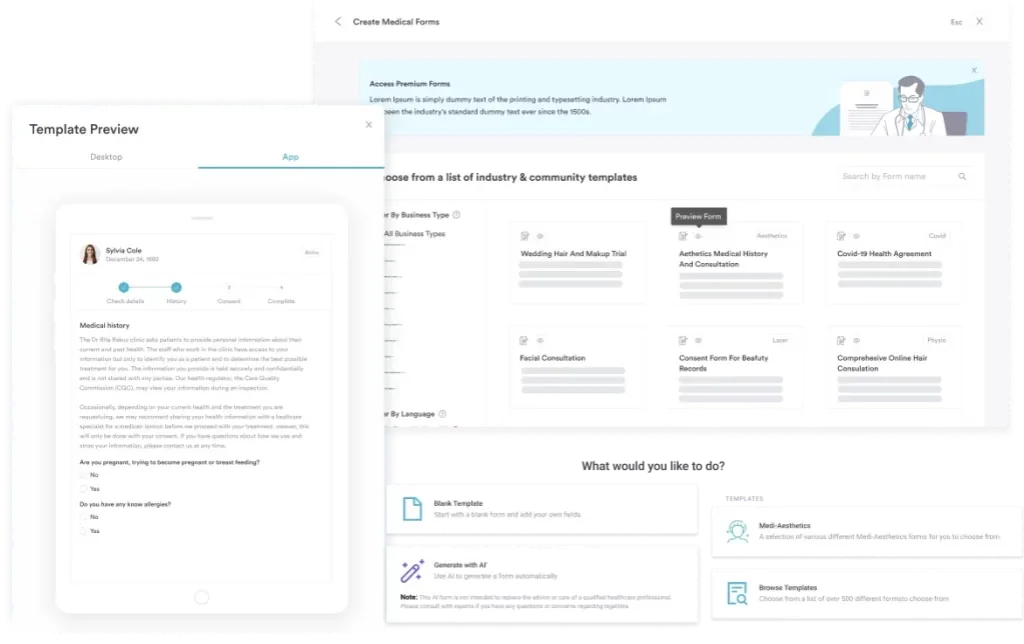
Digital clinical forms that prompt clinicians to capture these elements at the point of care cut down on documentation added after the fact. Pre-populated counseling templates tied to the visit type ask for the time entry and the counseling content automatically. That prevents the most common audit failures before they happen.
Yes, CPT 99406 can be billed on the same day as an Evaluation and Management (E/M) visit. Modifier placement is where this goes wrong, and it is a leading cause of same-day denials.
The rule: Modifier 25 attaches to the E/M code, not to 99406. The E/M service must represent a significant, separately identifiable service from the tobacco cessation counseling.
A patient who comes in for diabetes management and also receives cessation counseling generates both codes. The E/M captures the diabetes management and 99406 captures the counseling. Modifier 25 on the E/M tells the payer the two services were distinct.
Documentation must support both services independently. The cessation counseling note and the E/M note should be separate and distinct in the medical record. A same-day pairing without modifier 25 comes back as a bundled-service denial. Flag that combination for a modifier check before submission.
CPT 99406 is not restricted to physicians. The AMA’s behavior change intervention category allows a broad set of qualified providers to report the code, subject to payer-specific credentialing and supervision requirements.
Primary care, internal medicine, OB/GYN, oncology, and pulmonology practices are the most common settings for this code. Always confirm that the billing provider is credentialed with the specific payer before the claim goes out.
Category II codes are optional supplemental codes that report performance measures for quality programs. They do not affect payment, but they support clinical quality reporting and internal benchmarking. Two of them apply to a routine tobacco cessation encounter.
4004F is the active intervention code, drawn from CMS quality measure #226 (NQF 0028). Report 1036F instead when the screening identifies the patient as a current tobacco non-user.
Category II codes carry no relative value units and generate no additional reimbursement. Their value is in quality measure tracking for practices in the Merit-based Incentive Payment System (MIPS).
Older cheat sheets pair 99406 with 1000F, 1034F, and 4000F. Those three belong to a retired disease-specific measure. It applied only to patients with coronary artery disease, COPD, diabetes, or similar conditions. They are the wrong pairing for a routine cessation encounter.
Confirm current measure set inclusion in the AAPC Codify CPT lookup before adding either code to your billing workflow.
Tobacco cessation billing is low-complexity in theory and high-friction in practice. Code selection turns on a documented time threshold, ICD-10 sub-code specificity, and modifier logic on same-day visits.
Frequency limits add another layer. Each patient carries 8 Medicare sessions across 2 quit attempts, counted over a rolling 12-month window. A manual spreadsheet does not track that reliably at scale.
Three workflow changes cut the error rate. Put a running session counter on the patient record. Staff can then see how many of the 8 covered sessions remain in the current 12-month window.
Use structured note templates that ask for counseling time and content. Submit through an electronic clearinghouse that validates code combinations before they reach the payer.
Practice management software like Pabau does those three jobs in one place. Pabau’s claims management software handles the ICD-10 pairing and the claim formatting inside a single workflow.
Claims submit electronically through Claim.MD, Pabau’s integrated US clearinghouse partner, which reaches thousands of US payers. The clearinghouse validates CPT code combinations, modifier logic, and diagnosis specificity before each claim leaves the practice. That catches the most common 99406 denial triggers at the source.
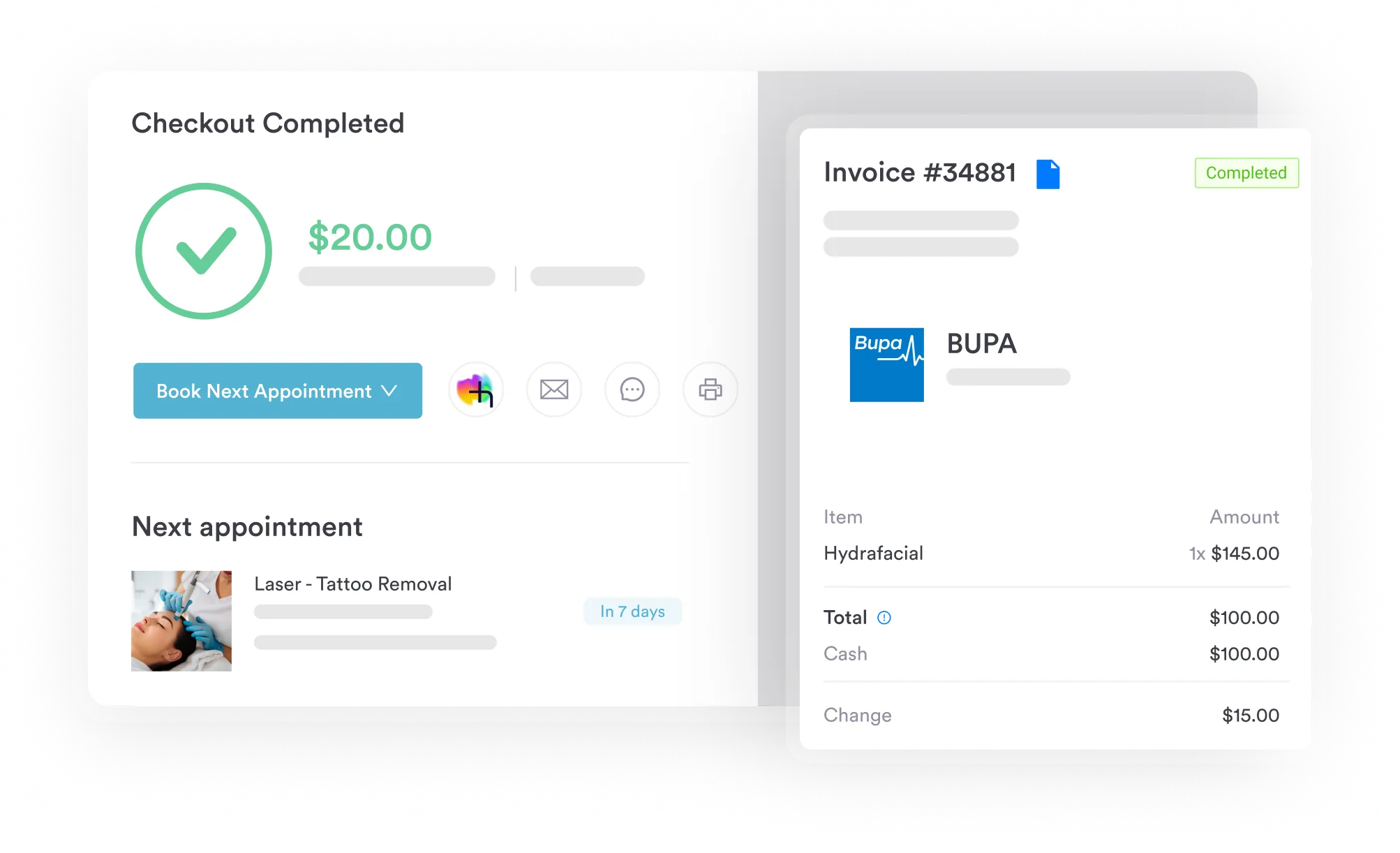
Superbills and claim files generate from the same encounter record, so each tobacco cessation visit produces one complete, accurate claim on the first pass. Practices running high volumes of preventive visits usually see the difference in first-pass acceptance rates within one billing cycle.
Start with an audit of your charge master for G0436 and G0437. CMS retired both in 2016 and deleted them from HCPCS in 2017. Any that survive in a superbill or encounter form will keep generating avoidable Medicare denials.

Pabau’s claims management software tracks time-based codes, pairs ICD-10 diagnosis codes automatically, and submits claims electronically. See how it handles preventive billing without the manual overhead.

Payer selection is no longer the hard part of tobacco cessation coding. One code set covers every payer, so 99406 and 99407 go to Medicare, Medicaid, and commercial plans alike. The retired G-codes belong nowhere except a cleanup list.
What is left is the part auditors test. They want a specific face-to-face minute count and a fully specified F17 sub-code. They want modifier 25 on the E/M rather than on 99406.
They also want a session count that respects Medicare’s limit of 8 sessions per rolling 12 months. Get those four right and the code pays without argument.
The trade-off worth remembering is scale. At roughly $15 a claim, no single 99406 is worth an appeal, so the money lives entirely in first-pass acceptance. Book a demo to see how Pabau validates cessation claims before they leave the practice.

Need the preventive counseling code for non-tobacco topics? CPT code 99401 covers preventive medicine counseling billed in 15-minute increments.
Billing cessation counseling alongside an office visit? CPT code 99213 is the established patient E/M level most often paired with 99406.
Need to understand how clearinghouse claims processing works? Medical claims clearinghouse overview explains how electronic claims move from practice to payer and where errors are caught.
Looking to reduce claim rejections across your billing workflow? Revenue cycle management fundamentals covers the end-to-end process from charge capture to payment posting.
Want to understand how denial patterns develop? Denial codes in medical billing breaks down common CARC denial reason codes and how to address them before resubmission.
CPT Code 99406 reports a smoking and tobacco use cessation counseling visit lasting more than 3 minutes but not more than 10 minutes. It sits in the AMA’s Behavior Change Interventions category. Commercial plans, Medicaid programs, and Medicare Part B all accept it.
The only difference is time. CPT 99406 covers counseling greater than 3 minutes up to 10 minutes, and CPT 99407 covers counseling greater than 10 minutes. Both require documented face-to-face time in the medical record. Neither can be reported more than once per encounter per day.
Yes. Medicare Part B pays CPT 99406 and 99407 directly, the same codes every other payer uses. Coverage runs to 8 cessation counseling sessions across a rolling 12-month period, structured as two quit attempts of 4 sessions each. The patient pays no cost-sharing.
No. CMS stopped paying HCPCS G0436 and G0437 for dates of service from October 1, 2016. Both codes left HCPCS on January 1, 2017, and contractors were instructed to accept CPT 99406 and 99407 instead. Submitting a G-code today is what triggers a denial. Remove both from any superbill or charge master that still lists them.
The F17 family of ICD-10-CM codes (nicotine dependence) is required. The most common is F17.210, nicotine dependence, cigarettes, uncomplicated. Sub-code specificity down to the fifth or sixth character is mandatory. Z72.0 (tobacco use) applies when dependence has not been formally diagnosed. Never submit F17 without the full sub-code.
Yes, CPT 99406 can be billed same-day with an E/M visit. Modifier 25 must be appended to the E/M code, not to 99406, to indicate a significant, separately identifiable service. The medical record must contain separate documentation supporting both the E/M service and the cessation counseling.
Medicare’s 2026 national non-facility payment is approximately $15.36 for 99406, with about $29 for 99407 and lower amounts in facility settings. Commercial payers typically land between $15 and $25 for 99406. Rates change each January 1, so verify current figures in the CMS fee schedule lookup before projecting revenue.
Required documentation includes the specific face-to-face counseling time in exact minutes, not an approximate range. It also needs the current tobacco use status and product type. Add the counseling content and techniques used, the patient response or barriers identified, and the clinician’s signature and credentials. The ICD-10 sub-code documented must match the clinical picture in the note.



