

CCSD code G5100: Bypass of duodenum billing guide
CCSD code G5100 bills a bypass that leaves the duodenum in place CCSD code G5100...

Last Updated: Oct 16, 2026
Q4133 is the HCPCS Level II code for Grafix Prime, GrafixPL Prime, Stravix and StravixPL, billed per square centimeter. It's a product-specific skin substitute code, so it covers these four placental tissue grafts and no others.
One unit equals one square centimeter of product applied. The application goes on its own claim line, with a CPT code from 15271 to 15278. From January 1, 2026, Medicare pays Q4133 in the office at a flat $127.14 per square centimeter. At that rate, one wrong unit count adds up quickly. This guide covers units, paired codes, documentation and the denials that stall these claims.
Let Pabau's smart automation suggest the right codes, reduce claim denials, and keep your practice compliant—effortlessly.
Automate repetitive tasks and focus on what matters most—your patients.
Reduce coding errors and ensure compliance with the latest regulations.
Clean claims, fewer denials, and faster reimbursements.
Powerful insights and reporting to help your practice thrive.
HIPAA compliant SOC 2 certified GDPR-compliant Trusted by 4,000+ clinics worldwide

HCPCS code Q4133 covers only Grafix Prime, GrafixPL Prime, Stravix and StravixPL, billed per square centimeter of product applied.
The application goes on a separate claim line, with a CPT code from 15271 to 15278 chosen by wound site and total wound area.
From January 1, 2026, Medicare pays skin substitutes in the office as incident-to supplies at $127.14 per square centimeter.
Medical necessity documentation must show wound duration and failed conservative care before each application.
Practice management software like Pabau pre-fills claims from the patient record and checks required fields before submission.
HCPCS code Q4133 is a Level II code for Grafix Prime, GrafixPL Prime, Stravix and StravixPL, billed per square centimeter.
The Centers for Medicare and Medicaid Services (CMS) maintains it. All four products are human placental tissue allografts made by Osiris Therapeutics and distributed by Smith+Nephew.
Skin substitute Q codes are product-specific by design. Each code maps to named commercial products, so Q4133 fits only when one of those four grafts was applied. A clinically similar graft from another brand needs its own code. Biodfence Dryflex, a dehydrated amniotic membrane allograft, bills under Q4138 instead.
That is why coders mix up Q4133 with its neighbors, Q4130 through Q4135. The products look alike on paper, and the wound type doesn’t settle the choice.
The product name on the box label does. Before you submit, match that label against the AAPC HCPCS code lookup or the payer’s covered product list.
The scope of Q4133 is narrow. Here is where the line sits, so claims that were never going to pay don’t go out.
Q4133 is for chronic wounds that haven’t healed with standard care. Three wound types qualify most often: diabetic foot ulcers (DFU), venous leg ulcers (VLU) and pressure injuries.
Each Medicare Administrative Contractor (MAC) sets its own coverage rules in a Local Coverage Determination (LCD). Most expect at least four weeks of standard care with no measurable progress.
Here is the sequence a clean claim follows, from the first visit to submission.
A Q4133 claim has two service lines, and each one counts something different. The Q4133 line counts the graft. One unit equals one square centimeter of product applied, so a 4 × 4 cm sheet used in full is 16 units.
The application goes on its own line with a CPT code from 15271 to 15278. Wound site and total wound area decide which one. A 12 sq cm calf ulcer, for example, starts with 15271 for the first 25 sq cm. The diagram below shows how the lines fit together.
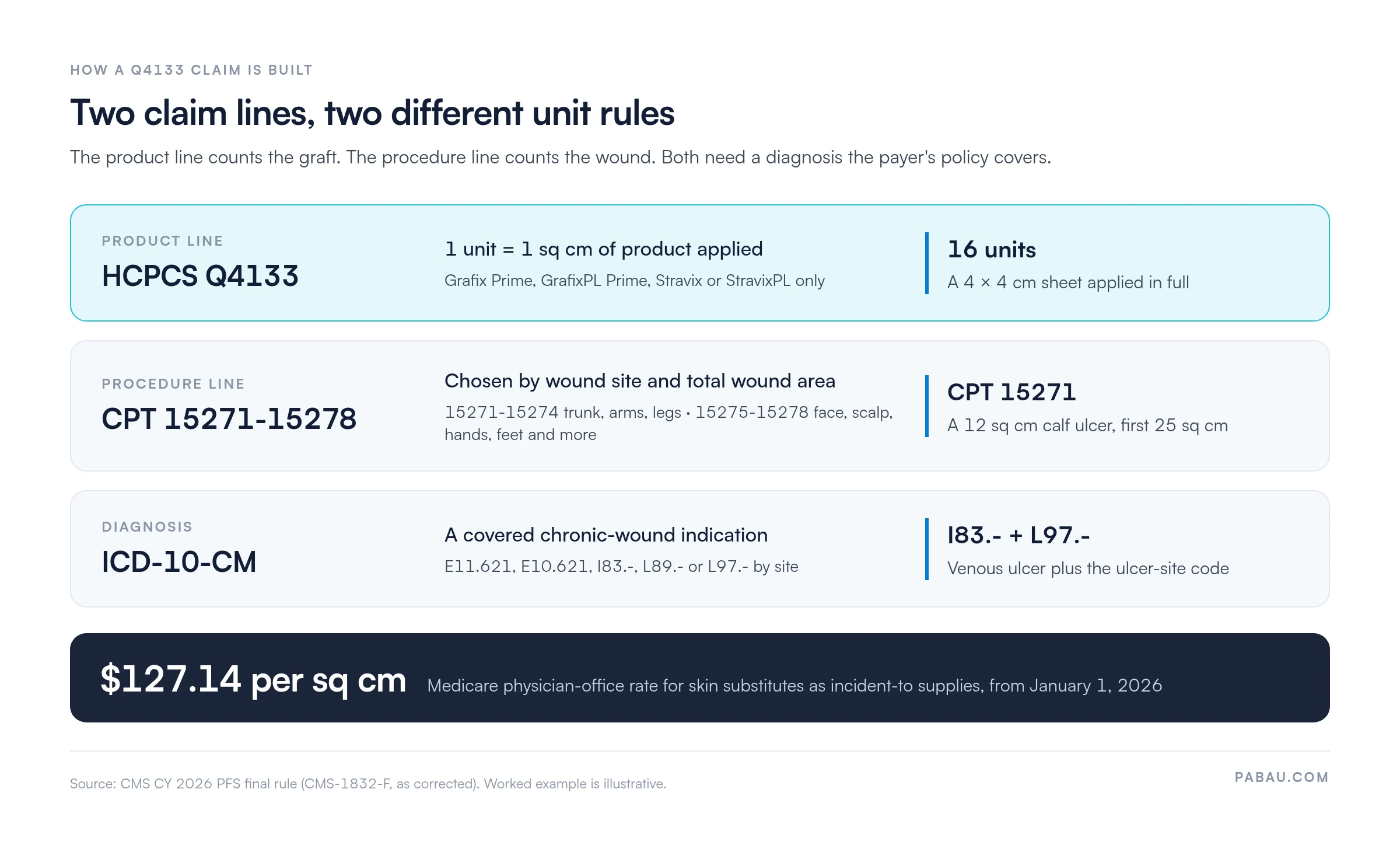
Units, modifiers and place of service all have to agree with the procedure note. The table covers the rules that trip claims up most often.
Don’t count on a clearinghouse to catch modifier errors. Most clearinghouse edits check code format, not clinical context, so the modifier has to be right before the claim leaves.
Every Q4133 claim needs an ICD-10-CM code that supports the wound indication. Payers deny the claim when the diagnosis doesn’t match a covered indication in the LCD. These are the pairings payers accept most often.
E11.621 and E10.621 carry a “use additional code” note, so add the L97.4- or L97.5- code for the foot ulcer site. Always code to the most specific level. An unspecified code such as L97.909, used where a specific one exists, points to thin documentation.
Your MAC’s LCD billing article lists the full set of covered codes, including payer-specific additions. For wound coding guidance, the CDC/NCHS ICD-10-CM web tool is the official reference.
Medical necessity for Q4133 rests on two facts: the wound is chronic, and conservative care has failed. Most MAC LCDs want at least four consecutive weeks of standard care first. That means moist wound therapy, debridement, offloading for a DFU or compression for a VLU.
The chart has to show no measurable progress over that period. Each visit note should capture these elements.
A note that only says “skin substitute applied” won’t support medical necessity on review. Keep wound records for the payer’s full audit lookback period, which is often seven years for Medicare. Building an accurate superbill with these fields ready at the point of care keeps missing details from slipping through.
So, does Q4133 need prior authorization? Often, but not always. Most Medicaid managed-care and commercial plans require it, while Medicare fee-for-service relies on LCD criteria instead.
The only reliable way to know is to verify eligibility and benefits before each application. Rules differ by plan and state, so confirm with each payer directly.
The Q4130 through Q4135 range covers several distinct skin substitutes. Picking the wrong code counts as improper billing, even when the products seem close. If the product applied doesn’t match a code’s descriptor, find the code that names it. Hyalomatrix, a hyaluronic acid-based substitute, sits outside that range at Q4117.
The AAPC code search and the annual CMS HCPCS file confirm which products each Q code covers. CMS adds and deletes skin substitute codes often, so check the file that applies to the date of service.
Run a product-to-code check at the start of each calendar quarter. CMS updates skin substitute Q codes every year and sometimes mid-year. Keep a simple sheet listing every product your practice stocks, its current HCPCS code and each payer’s coverage status. Review it when you add a product and after each quarterly HCPCS update.
Most Q4133 denials trace back to a handful of preventable errors. The patterns below come from MAC audit findings and published payer policies, including Centene plans and Healthy Blue. The denial codes on each rejection tell you which rule the claim broke.
Put the claim through this check before it leaves the practice. Each point matches a denial reason above, so a yes on all seven clears the common traps.
Medicare changed how it pays for Q4133 on January 1, 2026. Under the CY 2026 Physician Fee Schedule final rule, office skin substitutes are paid as incident-to supplies, not biologicals. CMS set one national rate of $127.14 per square centimeter, after correcting its first figure of $127.28.
For office claims, that flat rate replaces the old average sales price model. CMS now groups products by FDA pathway, but the 2026 rate is the same for each group. Rate sheets from before 2026 are out of date.
In many wound care practices, the claim is still built by hand. Someone copies the product, units and diagnosis from the chart onto the claim form. Someone else chases the authorization number, and one blank field sends the claim back.
Practice management software like Pabau pre-fills the claim from the patient record instead. The code attached to the service lands on the charge line, and ICD-10 slots are seeded from the recorded problem list. Built-in ICD-10-CM and CPT/HCPCS lookup libraries let coders confirm Q4133 without leaving the claim.
Before a claim goes out, Pabau checks that required fields such as membership numbers and authorization codes are complete. In the US, claims go through Claim.MD, with eligibility checks, ERA posting and claim-status tracking. You can see the whole workflow in Pabau’s claims management software.
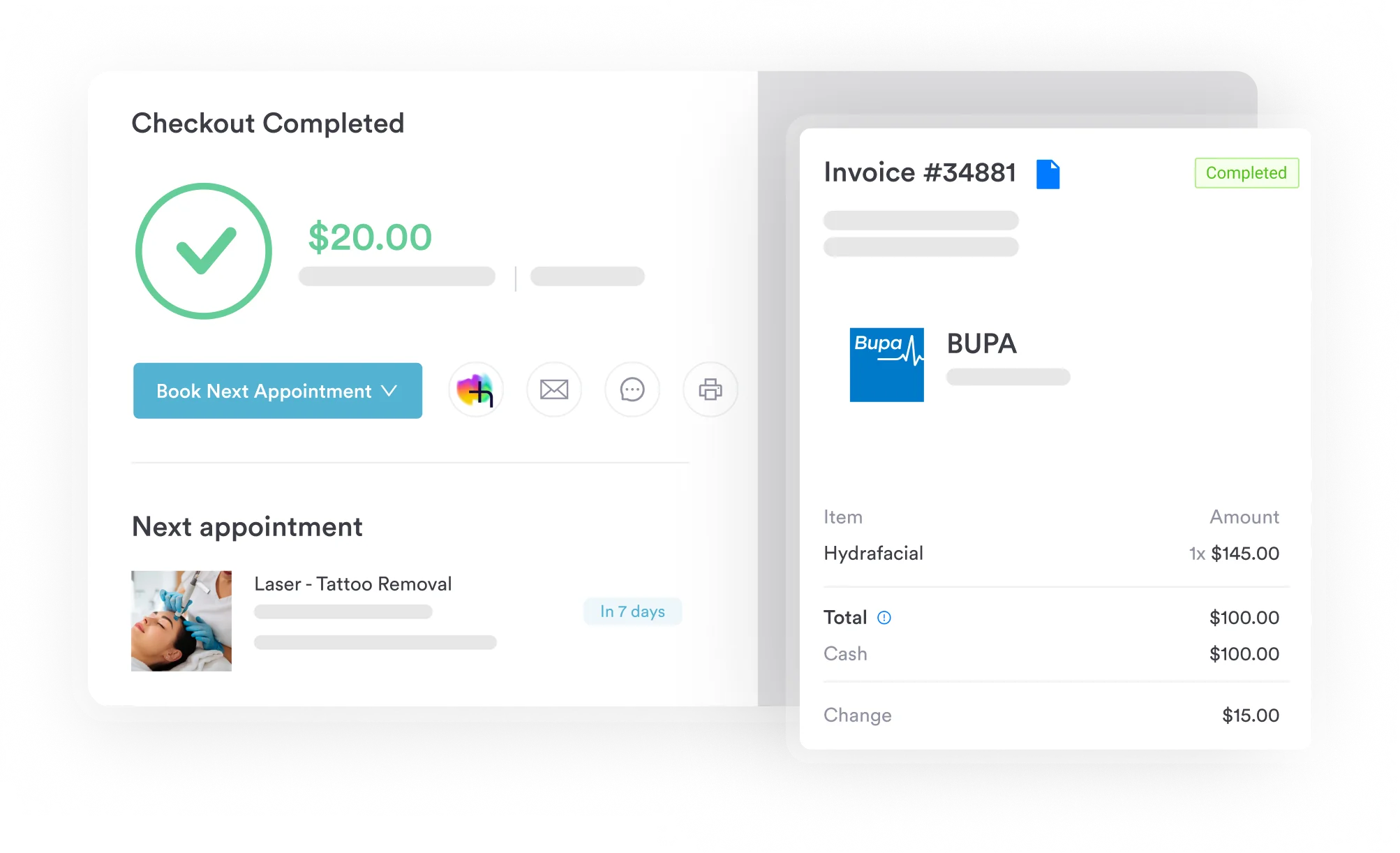

Pabau pre-fills claims from the patient record and gives coders built-in HCPCS and ICD-10 lookup libraries. It checks required fields before submission, then sends claims through clearinghouse integrations in the US, UK and Australia.

Q4133 rewards precision. Match the box label, count the graft, code the wound on its own line and record the failed care that came first. Do that on every application, and the flat 2026 rate turns into predictable income.
The trade-off is a few extra minutes at each wound visit. A standard template for measurements, lot numbers and applied area takes that time back when claims pay on the first pass.
If you want claim-field checks built into that routine, book a demo to see how Pabau prepares skin substitute claims for submission.

Billing the Grafix Core version instead? HCPCS code Q4132 covers Grafix Core and GrafixPL Core, the chorionic membrane grafts that sit next to Q4133.
Want every claim to pay on the first pass? What is a clean claim breaks down the fields and checks that keep a claim out of the rejection queue.
Need to reconcile what the payer sent back? Electronic remittance advice explains how to read ERA files and match payer adjustments to expected payment.
Seeing rejections you can’t explain? Understanding the 837 file covers the electronic claim format and where submission errors show up in it.
Comparing billing tools for a wound care practice? Best medical billing software for US practices compares the features that cut rework on complex code sets.
PL marks the lyopreserved version of each graft. Lyopreserved tissue is dried, so it’s shelf stable and easier to cut to shape. Grafix Prime and Stravix are the cryopreserved versions, which are stored frozen. Both forms bill under Q4133.
Stravix is made from umbilical tissue, the umbilical amnion and Wharton’s jelly of the cord. Grafix Prime is a placental amniotic membrane. They’re different grafts clinically, but CMS groups both under Q4133, so the code stays the same.
Osiris Therapeutics makes both product lines, and Smith+Nephew distributes them. Osiris became part of Smith+Nephew in 2019. Keep the manufacturer name from the box label on file, since payers may ask for it on review.
CMS added Q4133 on January 1, 2013. It remains an active Level II code for 2026 dates of service. Check the quarterly HCPCS update each year, because skin substitute codes are added and deleted often.



