

CCSD code G5100: Bypass of duodenum billing guide
CCSD code G5100 bills a bypass that leaves the duodenum in place CCSD code G5100...

Last Updated: Oct 16, 2026
HCPCS code Q4138 is the Level II code for Biodfence Dryflex, a dehydrated human amniotic membrane allograft, billed per square centimeter. It's an add-on code, so you always report it with a skin substitute application code from CPT 15271-15278.
Since January 1, 2026, Medicare pays Q4138 as an incident-to supply at a flat national rate of $127.14 per square centimeter. That makes an accurate unit count, the right application code and solid wound documentation the difference between prompt payment and a denial. Below, you'll find how to count units, pick the companion code, and keep claims clear of the errors that hit this code most.
Let Pabau's smart automation suggest the right codes, reduce claim denials, and keep your practice compliant—effortlessly.
Automate repetitive tasks and focus on what matters most—your patients.
Reduce coding errors and ensure compliance with the latest regulations.
Clean claims, fewer denials, and faster reimbursements.
Powerful insights and reporting to help your practice thrive.
HIPAA compliant SOC 2 certified GDPR-compliant Trusted by 4,000+ clinics worldwide

HCPCS code Q4138 reports Biodfence Dryflex, a dehydrated human amniotic membrane allograft, at one unit per square centimeter.
Every Q4138 line needs a companion application code from CPT 15271-15278, chosen by anatomic site and total wound area.
Since January 1, 2026, Medicare pays Q4138 as an incident-to supply at a flat national rate of $127.14 per square centimeter.
Coverage still depends on your MAC’s Local Coverage Determination, so documented prior treatment failure matters as much as the code.
Q4140 is plain Biodfence and Q4137 is AmnioExcel, so check the product label before you assign a code.
HCPCS code Q4138 identifies Biodfence Dryflex, a dehydrated human amniotic membrane allograft made by BioDLogics. It’s regulated as a human cell and tissue product (HCT/P). You bill it in per-square-centimeter units that match the wound area covered in one application.
The code sits in the Q4100 skin substitute series of HCPCS Level II, the code set CMS maintains. Its 2026 descriptor marks it as an add-on, so it always travels with an application procedure. Here’s the code at a glance.
Q4138 applies when Biodfence Dryflex goes on a chronic or acute wound in a covered outpatient setting. Medicare Part B covers it under Local Coverage Determinations (LCDs), which each Medicare Administrative Contractor (MAC) issues. That means the criteria can change from one MAC jurisdiction to the next.
Covered clinical contexts:
Common exclusions:
Pulling up the applicable LCD before the appointment is the most useful denial-prevention step you can take. It tells you which wound types qualify and how often the product can be applied.
Every Q4138 claim needs a clinical note, written at the time of service, that shows medical necessity. Miss one of these elements and you’re looking at a denial or a post-payment audit finding.
The simplest safeguard is a wound care form built around these five elements and completed at the point of care. Nobody then has to amend the chart before the claim goes out. A superbill that carries the lot number and wound dimensions beside the codes ties the note to the claim.
One Q4138 unit equals one square centimeter of wound surface covered. Miscounted units are the most common technical error on skin substitute claims. Usually, someone rounded down or measured the product instead of the wound.
Here’s how that works on four common wound sizes:
Always confirm your MAC’s rounding rule first. Billing 23 units where the MAC expects 22 can trip an automated edit. Pulling wound measurements straight into the claim form also removes the retyping step where errors creep in.
Q4138 can’t be billed alone. CMS expects a companion CPT application code from the 15271-15278 series on the same claim and date of service. All eight codes describe one service, applying a skin substitute graft.
They split only by anatomic site and total wound surface area, as the grid below shows.
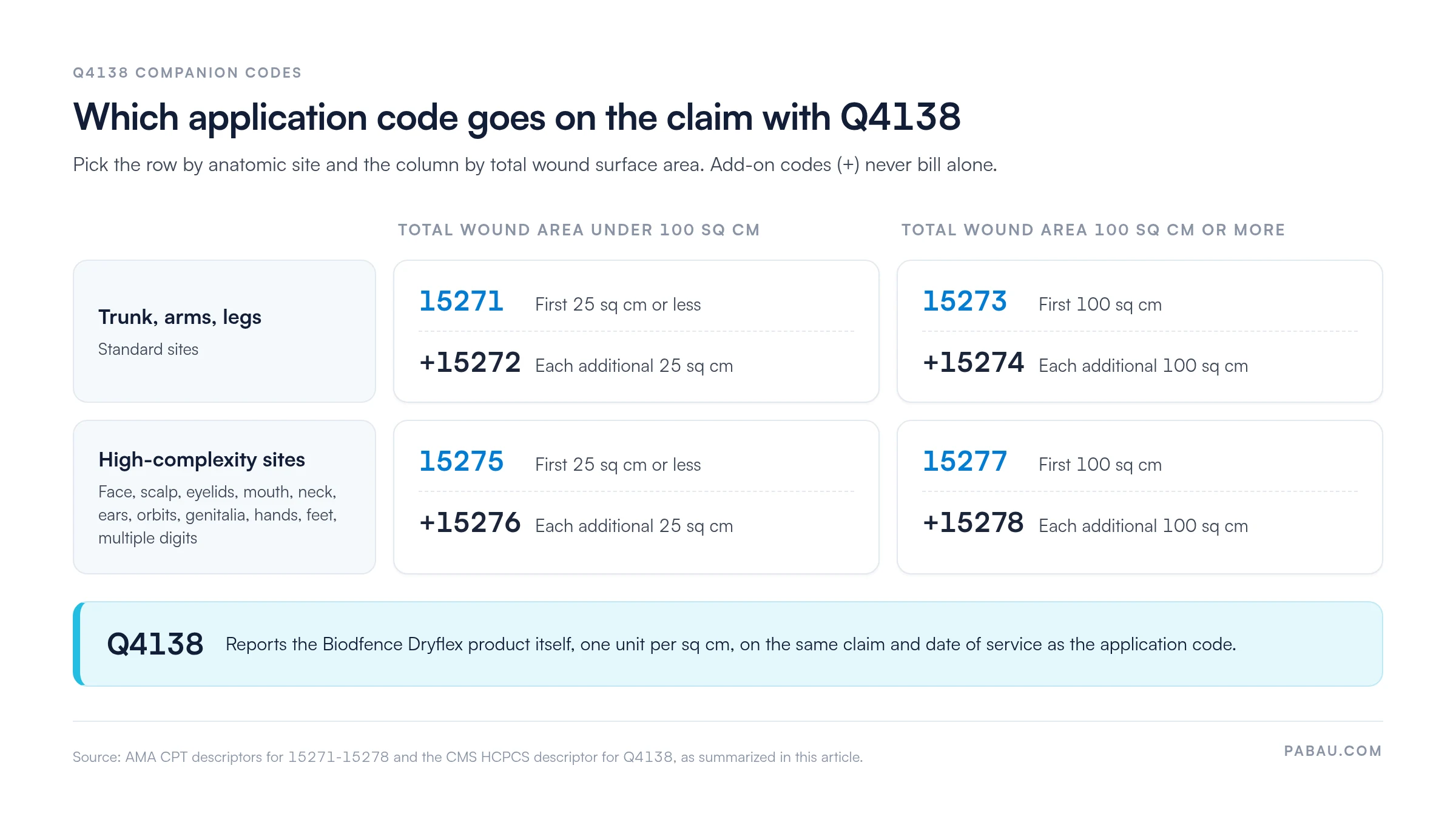
Codes marked with a plus sign are add-on codes. Report each one only with its primary code.
A Q4138 line without its companion CPT code fails as a clean claim. The AMA’s CPT Editorial Panel maintains the 15271-15278 series, and the AAPC HCPCS code lookup lists current descriptors. Make sure charge entry captures the Q-code and its CPT code on the same encounter before the claim is sent.
Neighboring codes in the Q4100 series describe unrelated products, so the number alone tells you nothing. Q4137 covers AmnioExcel, AmnioExcel Plus, or BioDExCel, an amniotic tissue product line. Q4138 covers Biodfence Dryflex only.
Billing a code that doesn’t match the product applied risks a false claim as well as a denial.
Assign the code from the full HCPCS descriptor, never from the code number. A Biodfence Dryflex package bills as Q4138, and plain Biodfence bills as Q4140. Neither product ever bills as Q4137. The CMS HCPCS overview explains how the code set is maintained and updated.
The same logic reaches beyond these four codes. A practice that also stocks Grafix Prime or Stravix bills those placental tissue grafts under Q4133, never under Q4138. Check the package label against the descriptor each time the product changes.
Build a product-to-code reference card that lists each skin substitute your practice stocks beside its full HCPCS descriptor. Neighboring codes such as Q4137, Q4138, and Q4140 describe different products, so staff should never guess from the number. Tie the card to product receiving, so each new product gets mapped to its code on delivery.
Since January 1, 2026, Medicare pays Q4138 as an incident-to supply at one flat national rate of $127.14 per square centimeter.
The change came in the CY2026 Physician Fee Schedule final rule (CMS-1832-F), with a parallel hospital outpatient (OPPS) rule. It covers the whole Q4100 skin substitute series and replaces ASP-based buy-and-bill pricing.
The rate is fixed for the calendar year, and only locality and wage index adjustments move it. Take the 4.5 cm by 5.0 cm wound from the unit table. At 23 units, the national allowed amount is $2,924.22 before those adjustments. The CMS Physician Fee Schedule lookup tool shows the figure for your locality.
A few other payment factors still apply to Q4138:
After each claim cycle, check the remittance advice on your Q4138 lines. It’s the quickest way to spot underpayment or a payer-specific adjustment pattern.
In most MAC jurisdictions, Medicare Fee-for-Service has no prior authorization step for Q4138. The LCD is the coverage gate instead, so an unauthorized claim still has to meet its criteria. Medicare Advantage plans and commercial payers, on the other hand, routinely require authorization before a skin substitute application.
There’s one Medicare exception to watch. CMS’s WISeR model adds prior authorization for skin substitutes in Arizona, New Jersey, Ohio, Oklahoma, Texas, and Washington, for services from January 15, 2026. It applies only where that state has an active skin substitute LCD.
To manage prior authorization for Q4138 across payers:
Checking eligibility before every wound care visit shows which payers need authorization. A missed authorization on a high-unit Q4138 claim is expensive, and preventing one is faster than appealing it.
Run through this list at charge entry, before the claim leaves the practice. Each item maps to a denial reason covered in the next section.
If an item fails, fix it at charge entry. Reworking a rejected claim takes far longer than catching the error here.
Q4138 denials cluster around a predictable set of billing and documentation failures. Once you know the pattern, prevention gets much easier.
Sorting Q4138 denials by reason code shows whether errors start in documentation, charge entry, or authorization. Each source needs a different fix. Our guide to decoding claim denial codes explains the adjustment and remark codes that show up on skin substitute remittances.
Audit Q4138 claims by denial reason code once a month. If missing-CPT denials make up more than 10% of rejections, review the charge entry process before looking at individual coders. A corrected workflow stops the same error repeating across the team.
In many wound care practices, staff copy wound measurements, lot numbers, and codes from the chart into a separate claim form. Each retyped figure is another chance to bill the wrong unit count or drop the companion CPT code.
Practice management software like Pabau joins those steps up with time-saving claims management software built into the platform. It pre-fills the claim from the patient record and includes CPT and HCPCS code lookup libraries. Before a claim can be sent, it checks that required fields, such as authorization numbers, are complete.
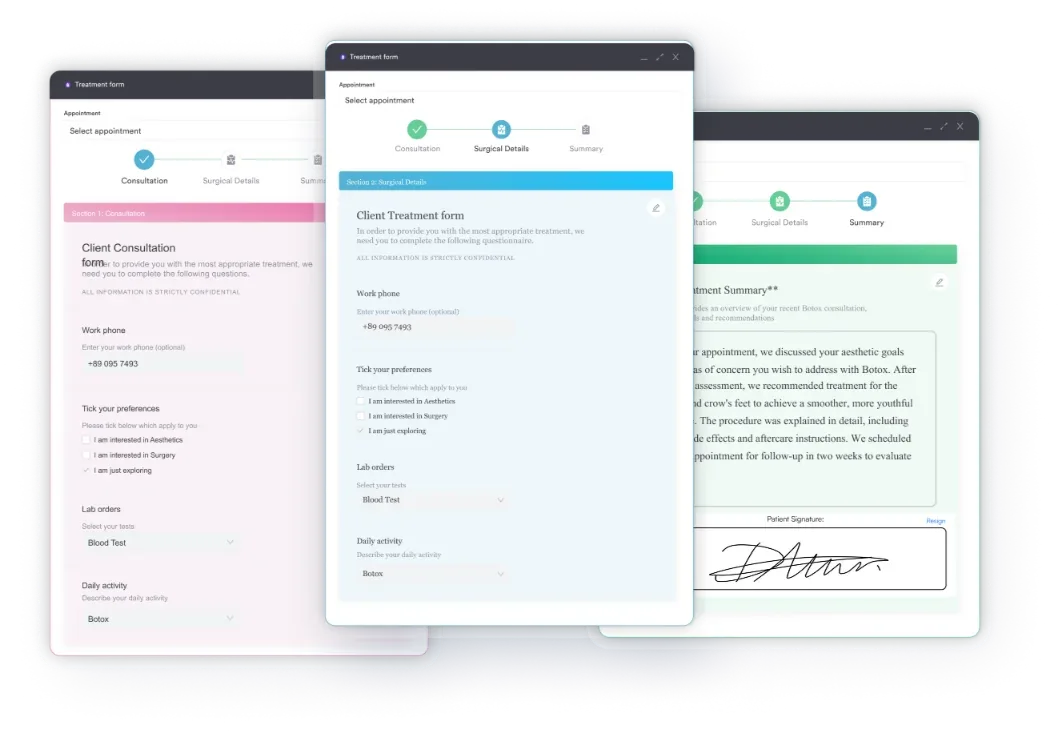
On the clinical side, customizable forms capture wound dimensions, lot numbers, and prior treatment history during the visit.
US practices can also submit claims through Claim.MD, check eligibility, post remittances, and track claim status in the same system. The result is fewer retyping errors and less time spent reworking Q4138 claims.

Pabau pre-fills claims from the patient record, checks required fields before submission, and tracks claim status. Your wound care team spends less time reworking Q4138 denials.

Q4138 pays reliably when the groundwork happens before anyone builds the claim. Measure the wound, pick the application code from the grid, and document failed prior care on the day. With those three in place, the flat 2026 rate makes payment predictable.
The trade-off is a few extra minutes at the point of care. That time costs far less than appealing a denied high-unit claim. Start with your MAC’s LCD and the pre-submission checklist, then review your denials every month.
Want to see how Pabau carries wound measurements and codes from the note to a complete claim? Book a demo and we’ll walk through the workflow for your wound care practice.

Billing plain Biodfence instead? HCPCS code Q4140 covers the Biodfence product without the Dryflex name, with its own coverage details.
Stocking other amniotic grafts? HCPCS code Q4159 explains how Affinity bills under the same 2026 flat-rate rules.
Comparing wound matrix products? HCPCS code Q4124 walks through Oasis Ultra units, CPT pairing, and 2026 payment.
Want fewer claims bounced back? What is a clean claim? sets out the fields and checks that get a claim paid on first submission.
Need a framework for tracking denials? Denial management in healthcare covers how to sort denials by cause and stop them repeating.
Medicare pays a flat national rate of $127.14 per square centimeter in 2026, as an incident-to supply. Locality and wage index adjustments change the final amount. A 23-unit claim comes to $2,924.22 before those adjustments.
BioDLogics makes Biodfence Dryflex. It’s a dehydrated human amniotic membrane allograft, regulated as a human cell and tissue product (HCT/P). Check the package label, because plain Biodfence from the same line bills under Q4140.
It means Q4138 is listed separately in addition to a primary procedure. You never report it on its own. It always appears with a skin substitute application code from CPT 15271-15278 on the same date of service.
That depends on the wound and on your MAC’s LCD. Diabetic foot ulcers usually pair a diabetes code, such as E11.621, with an L97 non-pressure chronic ulcer code. Venous leg ulcers use an I83.0 varicose vein with ulcer code.
Yes, Q4138 is an active HCPCS Level II code in 2026. Its descriptor now marks it as an add-on, and Medicare pays it as an incident-to supply.



