

CCSD code G5100: Bypass of duodenum billing guide
CCSD code G5100 bills a bypass that leaves the duodenum in place CCSD code G5100...

Last Updated: Oct 16, 2026
Q4111 is the HCPCS Level II code for Gammagraft, per square centimeter (add-on, list separately in addition to primary procedure). Gammagraft is a gamma-irradiated human skin allograft, and each unit is one square centimeter of product applied.
Q4111 is an add-on code, so it never stands alone on a claim. It always rides on a primary skin substitute application code from CPT 15271-15278, chosen by wound site and total wound area.
Let Pabau's smart automation suggest the right codes, reduce claim denials, and keep your practice compliant—effortlessly.
Automate repetitive tasks and focus on what matters most—your patients.
Reduce coding errors and ensure compliance with the latest regulations.
Clean claims, fewer denials, and faster reimbursements.
Powerful insights and reporting to help your practice thrive.
HIPAA compliant SOC 2 certified GDPR-compliant Trusted by 4,000+ clinics worldwide

Q4111 covers the Gammagraft skin allograft only, billed per square centimeter of product applied and documented.
It is an add-on code, so it always pairs with a primary CPT application code from the 15271-15278 series.
The primary code depends on wound site and total wound area, and leg wounds never use 15275-15278.
Medicare covers Q4111 for chronic non-healing lower extremity wounds, subject to your MAC’s LCD and a documented conservative care trial.
Billing more units than the documented area is the top audit trigger, so units must match the note exactly.
HCPCS Code Q4111 is a Level II Healthcare Common Procedure Coding System code that describes Gammagraft, per square centimeter. Gammagraft is a gamma-irradiated human skin allograft, and Q4111 covers the product supply cost only, not the clinician’s work of applying it.
It is an add-on code. Each claim pairs it with a primary skin substitute application code from CPT 15271-15278, and each unit is one square centimeter of product applied. CMS maintains the HCPCS Level II code set and updates the Q-series, its temporary codes, every year.
The descriptor’s “per square centimeter” language is the most operationally important detail. Each unit billed represents one square centimeter of Gammagraft actually applied to the wound. Billing more units than the documented wound measurement is the leading audit trigger for this code.
Q4111 covers the Gammagraft product itself, supplied and applied in the quantities documented in the clinical record. Coders frequently overbundle or underbundle Q4111 claims because the code’s scope is narrower than it appears.
Product-specificity is the critical rule. Codes in the Q4xxx skin substitute series are not interchangeable. If the product applied was Gammagraft, the code is Q4111. Coding Gammagraft under a different product’s Q code, even if similar, is a billing error that creates both denial and compliance exposure.
Q4111 must always be billed alongside a primary skin substitute application CPT code from the 15271-15278 series. That series splits application by wound location and surface area, and the same pairing rule governs other per-square-centimeter products such as Q4117. Submitting Q4111 without a primary procedure code generates an automatic denial because the claim lacks the required primary code relationship.
Two facts pick the code: the wound’s anatomic site and its total surface area. A leg wound always uses 15271-15274, even when it is a venous ulcer, while a foot wound uses 15275-15278. A venous leg ulcer under 100 cm², for example, bills 15271 for the first 25 cm² alongside Q4111.
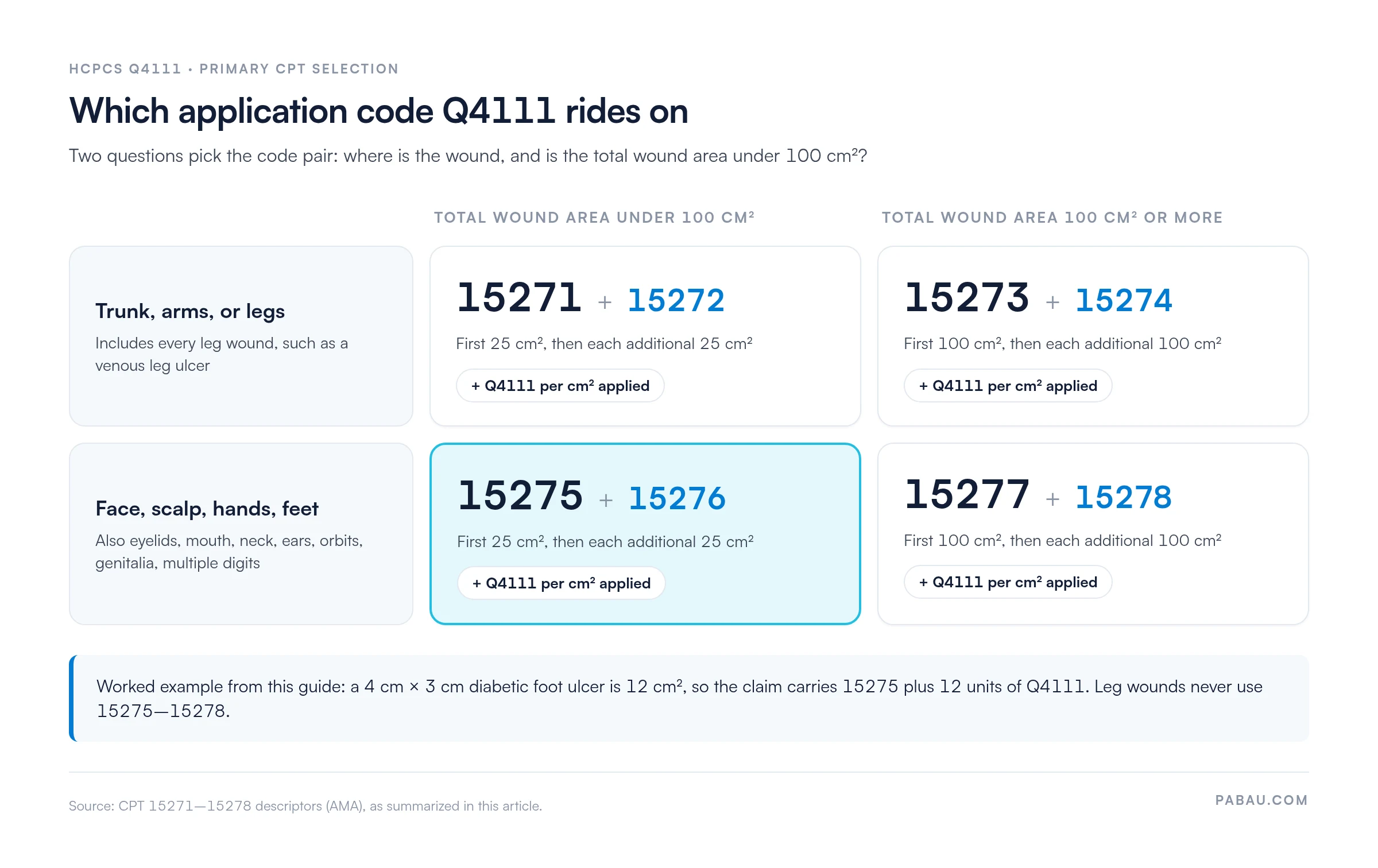
Verify exact CPT pairings against current CMS transmittals and your MAC’s local coverage article before submitting. Some MACs publish CPT-to-skin-substitute pairing tables in their LCDs. Debridement codes (97597/97598) may appear on the same claim when clinically performed. They are separate services, not the required primary code for Q4111.
Units for Q4111 equal the number of square centimeters of Gammagraft actually applied and documented. The calculation is straightforward, but errors at the measurement stage are the most common source of denials and audit findings.
A worked example: a diabetic foot ulcer measuring 4 cm x 3 cm is 12 cm². Bill 15275 for the application and 12 units of Q4111 for the product. If the claim shows 15 units but the note documents 12 cm², it fails medical review and triggers a recoupment request. Auditors compare billed units against the documented measurement, so the two must match.
Run a quick three-point check before finalizing the claim. First, units on the claim match the documented wound area in cm². Second, the product lot number is in the clinical note. Third, a primary CPT from the 15271-15278 series appears on the same claim. Missing any one of these three elements is enough to generate a denial or flag the claim for medical review.
Q4111 is product-specific. The Q4xxx series assigns a unique code to each approved skin substitute product. Coders cannot substitute one product’s code for another, even when the products look clinically similar. The table below covers the most commonly confused adjacent codes.
Q4110 and Q4111 are adjacent in numbering and cover products from the same clinical category, which is why they are frequently confused. The key differentiator is the product name in the clinical documentation. If the delivery note or product label says Gammagraft, the code is Q4111. If it says Primatrix, the code is Q4110. There is no crosswalk between them. For a comprehensive reference, see the AAPC’s HCPCS Level II code lookup for the full Q4xxx series.
The same documentation test settles the rest of the Q4xxx series. If the product label says hMatrix, an acellular human dermal matrix, the code is Q4134 rather than Q4111.
Medicare Part B covers Q4111 for beneficiaries with chronic non-healing lower extremity wounds, subject to the applicable MAC’s Local Coverage Determination (LCD). Coverage is not automatic, and the documentation has to satisfy the LCD before the claim goes out.
CMS’s coverage article on application of bioengineered skin substitutes to lower extremity chronic non-healing wounds (Article 54117) describes the framework most MACs use. Coverage criteria typically include:
Every Q4111 claim requires at least one ICD-10-CM diagnosis code that establishes medical necessity for the skin substitute application. Payers match the submitted diagnosis code against their LCD’s covered diagnosis list. A code outside the covered list generates a medical necessity denial, even when the clinical situation is appropriate.
These codes represent commonly accepted pairings. Each MAC publishes a covered diagnosis list in its active LCD. Use the CDC/NCHS ICD-10-CM tool to verify the specific code and its active status before submitting. For diabetic ulcer coding, the E10.x/E11.x codes require a secondary code identifying the laterality and location (L97.xxx series for foot ulcers). Omitting the required secondary code generates a specificity-related denial.
Prior authorization requirements for Q4111 vary by payer and cannot be stated as a universal rule. Confirm eligibility and authorization status with the payer before each application visit.
Build a standard prior auth checklist into the intake workflow. It stops the most common delay, where staff discover on the day of the procedure that authorization is missing.
The 2026 Medicare fee schedule rate for Q4111 is updated annually by CMS and varies by geographic locality. The table below shows representative national average rates for orientation. Confirm the current rate for your locality with the CMS Physician Fee Schedule lookup tool before quoting reimbursement to staff or leadership.
The 2026 rate per unit (per square centimeter) should be confirmed directly from the CMS fee schedule tool for your locality and practice setting. Rates published by third-party sources may lag the official CMS update cycle.
Incomplete documentation is the root cause of most Q4111 denials that survive the initial claims-editing scrub. Capture each element below at the point of care, because records rebuilt after the fact rarely hold up on review.
Build this checklist into the clinical note template. Missing elements then surface before the claim is generated, not during denial resolution.
Q4111 denials cluster around a predictable set of billing and documentation errors. Preventing them costs far less than appealing them, and the most frequent patterns are:
Scrub each Q4111 claim against these eight patterns before it goes to the clearinghouse. When one still comes back, the claim denial codes on the remittance show which pattern tripped it.
Place of service (POS) code affects how Q4111 is reimbursed under Medicare and whether the product is separately payable. Coders who treat POS as a formality, rather than a billing variable, regularly leave reimbursement on the table or trigger claim edits.
In hospital outpatient settings (POS 22), the physician typically bills only the professional component of the application procedure. The hospital submits the product cost (Q4111) on the facility claim under the Outpatient Prospective Payment System (OPPS). A physician practice that also bills Q4111 for a procedure performed in a hospital outpatient department creates duplicate billing exposure. Confirm who bills the product whenever the application takes place outside a physician office.
When Gammagraft is applied in a hospital outpatient setting, confirm in writing before the procedure who bills Q4111. It is either the hospital or the physician practice. A verbal understanding is not sufficient. Document the agreement and retain it with the billing file. Duplicate billing of the product under both a professional claim and a facility claim is a common post-payment audit finding.
In many wound care practices, the measurement sits in the EHR note and the lot number on a product log. The claim lives in a separate billing tool. A coder has to reconcile all three before each Q4111 claim goes out, and any unit mismatch becomes a denial or an audit finding.
Practice management software like Pabau keeps those pieces in one patient record. The wound measurement, photos, and product details live in the clinical note, and medical claims management submits and tracks the claim from that same record.
Your coder checks billed units against the documented area on one screen instead of three. Each denial stays attached to the claim it came from, so repeat errors are easy to spot.

Pabau keeps wound measurements, product lot numbers, and the claim in one patient record. Your team can check Q4111 units against the documentation before the claim is submitted.

Most Q4111 denials trace back to the record rather than the wound. Choose the primary code by wound site and total area, and bill units that match the documented square centimeters. Then record Gammagraft’s lot number in the note.
The trade-off is a minute of charting at the point of care against a recoupment request months later. Check your MAC’s active LCD before the first application, because frequency limits and covered diagnoses differ by jurisdiction.
Book a demo to see how Pabau keeps wound measurements, product details, and Q4111 claims in one patient record.

Need a reference for broader wound care billing codes? What is medical billing covers the foundational concepts behind how wound care claims move from encounter to payment.
Dealing with repeated claim denials? Denial management in healthcare outlines the systematic workflows practices use to identify, appeal, and prevent recurring denial patterns.
Want to understand the clearinghouse layer? Submitting a clean claim explains what claim scrubbing checks before a Q4111 claim reaches the payer.
Coding the application itself? CPT Code 15271 covers the first 25 cm² of skin substitute graft on the trunk, arms, or legs.
Billing a different skin substitute? HCPCS code Q4101 walks through Apligraf, another per-square-centimeter wound care product.
HCPCS Code Q4111 describes Gammagraft, a gamma-irradiated human skin allograft from Promethean LifeSciences, Inc., billed per square centimeter of product applied. It is an add-on Level II HCPCS code billed with a primary skin substitute application CPT code. It covers the product supply cost only, not the application procedure.
Q4111 is an add-on code. It must always be billed alongside a primary procedure code, typically from the CPT 15271-15278 skin substitute application series. A claim submitting Q4111 without a primary procedure code will be denied automatically.
Measure the wound area in square centimeters (length x width) and round to the nearest whole square centimeter. Bill one unit of Q4111 per square centimeter of Gammagraft applied. The unit count on the claim must match the documented wound measurement in the clinical note exactly.
Commonly accepted codes include E10.621 and E11.621 for type 1 and type 2 diabetes with foot ulcer. I83.009 (varicose veins with ulcer) and L97.xxx non-pressure chronic ulcer codes also appear. The specific covered diagnosis list is determined by your MAC’s active LCD, which must be verified before each claim submission.
Q4111 covers Gammagraft (Promethean LifeSciences, Inc.) and Q4110 covers Primatrix (Integra LifeSciences). Both are per-square-centimeter skin substitute codes in the Q4xxx series but are product-specific. They cannot be substituted for each other. The product applied and documented determines which code to bill.
Traditional Medicare does not universally require prior authorization for Q4111, but individual MACs may require it under their LCD. Medicare Advantage plans and commercial payers frequently do require prior authorization. Verify the requirement with the specific payer before each application visit, not based on a general assumption.



