CPT code 21011: Excision of soft tissue tumor of the face
CPT code 21011: Official descriptor and procedure overview CPT code 21011, as pu...

Last Updated: Oct 8, 2026
P9099 is the HCPCS Level II code for blood component or product not otherwise classified.
Since the CY2022 OPPS final rule, P9099 has carried an OPPS status indicator of R and been separately payable under APC 9537. CMS sets its rate at the lowest paid separately payable blood product in OPPS. That pricing rule is why P9099 is a last resort rather than a shortcut.
Let Pabau's smart automation suggest the right codes, reduce claim denials, and keep your practice compliant—effortlessly.
Automate repetitive tasks and focus on what matters most—your patients.
Reduce coding errors and ensure compliance with the latest regulations.
Clean claims, fewer denials, and faster reimbursements.
Powerful insights and reporting to help your practice thrive.
HIPAA compliant SOC 2 certified GDPR-compliant Trusted by 4,000+ clinics worldwide

HCPCS Code P9099 describes a blood component or product not otherwise classified, used when no specific P-series code fits the product administered.
P9099 sits in the HCPCS Level II P-series and is billed mainly in hospital outpatient settings under the Outpatient Prospective Payment System.
CMS pays P9099 under APC 9537 at the rate of the lowest paid separately payable blood product, so a specific code usually pays more.
Medicare Part B may cover P9099 when medical necessity is documented, and coverage varies by Medicare Administrative Contractor, so verify eligibility first.
Pabau’s claims management software supports HCPCS billing workflows, so outpatient billing teams can track blood product claims and reimbursements in one place.
P9099 belongs to the P-series of HCPCS Level II codes, which CMS maintains for pathology and laboratory services.
The P-series runs from P2028 through P9615 and covers red blood cells, platelets, plasma, and specialty components. P9099 sits among those blood product codes as the miscellaneous or “not otherwise classified” (NOC) entry.
The CMS HCPCS Level II code set lists P9099 as a permanent national code, and its descriptor has held steady across annual updates. Check the current-year CMS HCPCS release file before billing to confirm the code is still active.
The table below summarizes the key reference fields for HCPCS Code P9099 as maintained by CMS. Verify these details against the current-year HCPCS release file, since status and payment fields change with each annual update.
P9099 is billed under the Outpatient Prospective Payment System (OPPS), the CMS framework for hospital outpatient services. OPPS assigns each code to an Ambulatory Payment Classification (APC), which sets the reimbursement rate. P9099 maps to APC 9537, blood component or product NOC, and carries a status indicator of R.
CMS made P9099 separately payable in the CY2022 OPPS final rule. The rate is pegged to the lowest paid separately payable blood product in OPPS.
That follows the standing policy of paying NOC codes at the lowest available APC rate for their service category. AABB’s summary of the CY2022 rule records the objection from blood banking groups. They argued that a floor rate discourages adoption of new products.
Medicare Part B may cover P9099 for qualifying hospital outpatient services when medical necessity is documented. Coverage varies by Medicare Administrative Contractor (MAC) and is subject to the relevant Local Coverage Determinations.
Verify the patient’s eligibility and confirm that the documented diagnosis supports the blood product administered.
OPPS rates update annually through the final rule. Confirm the year’s figure against the CMS OPPS Addendum A and B updates rather than a rate carried over from a billing template. Never hard-code a payment rate without recording the year it applies to.
Check the CMS OPPS Addendum B each January for the current APC 9537 payment rate. The figure moves with the final rule, and billing from a prior year’s rate is a common error on outpatient blood product claims.
P9099 is a last-resort code. Use it only after confirming that no specific HCPCS P-series code describes the component administered. This check is what separates a clean claim submission from one that comes back for records.
Work through this sequence before reaching for P9099:
Modifier requirements for P9099 vary by payer and clinical setting. The modifiers below are the ones commonly appended to P-series blood product codes in hospital outpatient billing. Verify each against the payer’s own policy and the current-year CMS OPPS guidance.
CMS has required the JW modifier for discarded drug and biological amounts since January 1, 2017. The JZ modifier attests that no amount was discarded. It became mandatory on July 1, 2023, after a voluntary reporting period that opened on January 1, 2023.
For blood components billed under P9099, confirm whether your MAC applies these modifiers to HCPCS P-series codes. A missing wastage modifier is a frequent trigger for a denial.
Every P9099 claim needs at least one ICD-10-CM diagnosis code establishing medical necessity. The table below pairs common diagnoses with blood component administration. The right code follows the patient’s documented condition, not the blood product type.
Use the most specific code available. A confirmed diagnosis such as sickle cell disease or aplastic anemia is coded to that condition rather than to unspecified anemia. The full ICD-10-CM code set is the place to confirm the exact subcategory before the claim goes out.
Check these P-series codes before defaulting to P9099. A specific code says exactly what was administered, lowers audit risk, and avoids the extra documentation an NOC code carries. Washed red blood cells also have a specific code, so check HCPCS code P9022 before reaching for P9099.
For the full list of active P-series codes, use the AAPC HCPCS Level II code lookup, which reflects the current-year code set.
Billing P9099 instead of a specific code that fits usually pays less. APC 9537 sits at the floor of the separately payable blood product rates. A leukoreduced red cell unit billed as P9099 collects that floor rate rather than the P9016 rate.
The audit exposure comes on top of the shortfall. Payers know the P-series well, so an NOC code on a commonly administered product invites a request for clinical records. One question settles the choice, and the diagram below shows what follows from each answer.
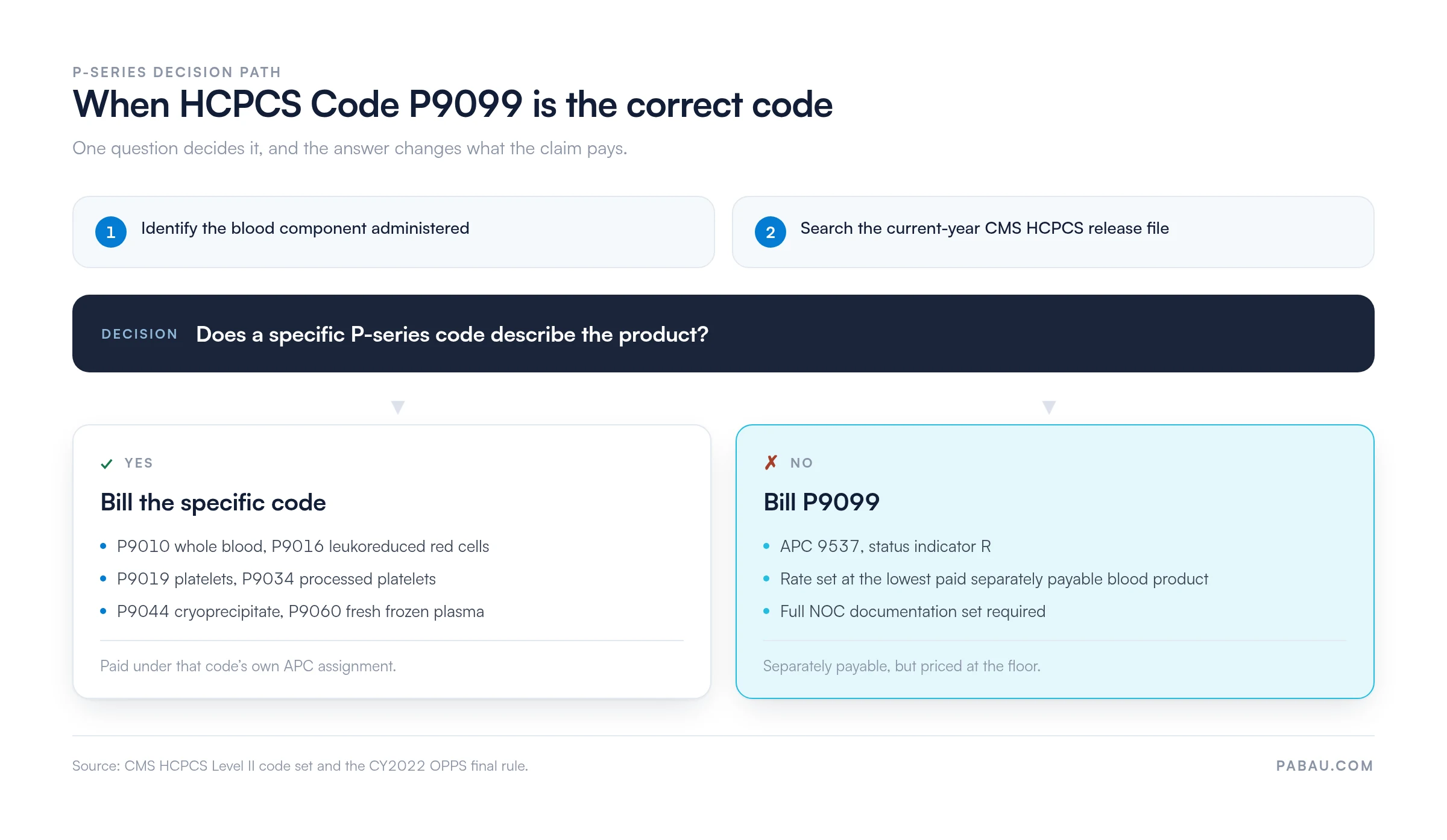
The scenarios below show where each answer lands in practice.
NOC codes attract more scrutiny than specific codes. Documentation for a P9099 claim has to answer the question a payer will ask. Why could no more specific code describe this product?
Beyond that core question, complete documentation for a P9099 claim generally includes the elements below. Verify the specifics against applicable LCD guidance and your MAC’s transmittals.
Build a P9099 documentation checklist into your blood bank intake workflow. Confirm the NDC (or document its absence), lot number, product name, and physician order before the transfusion begins. Chasing these details retrospectively adds hours to the billing cycle and increases denial risk.
Most outpatient billing teams assemble a P9099 claim from several places. The product name and lot number sit in the blood bank record. The signed order sits in the chart, and the diagnosis sits with the coder. Pulling those together after a denial arrives is slow work.
Practice management software like Pabau keeps the documentation and the claim in one record. Charting, coded diagnoses, and claim submission run off the same patient file, so the transfusion note and the ICD-10-CM code travel with the claim.
Pabau’s audit-ready claims management tracks each HCPCS submission from documentation through to remittance. Billing teams see which NOC claims are still open, which were denied, and which are missing a required field.
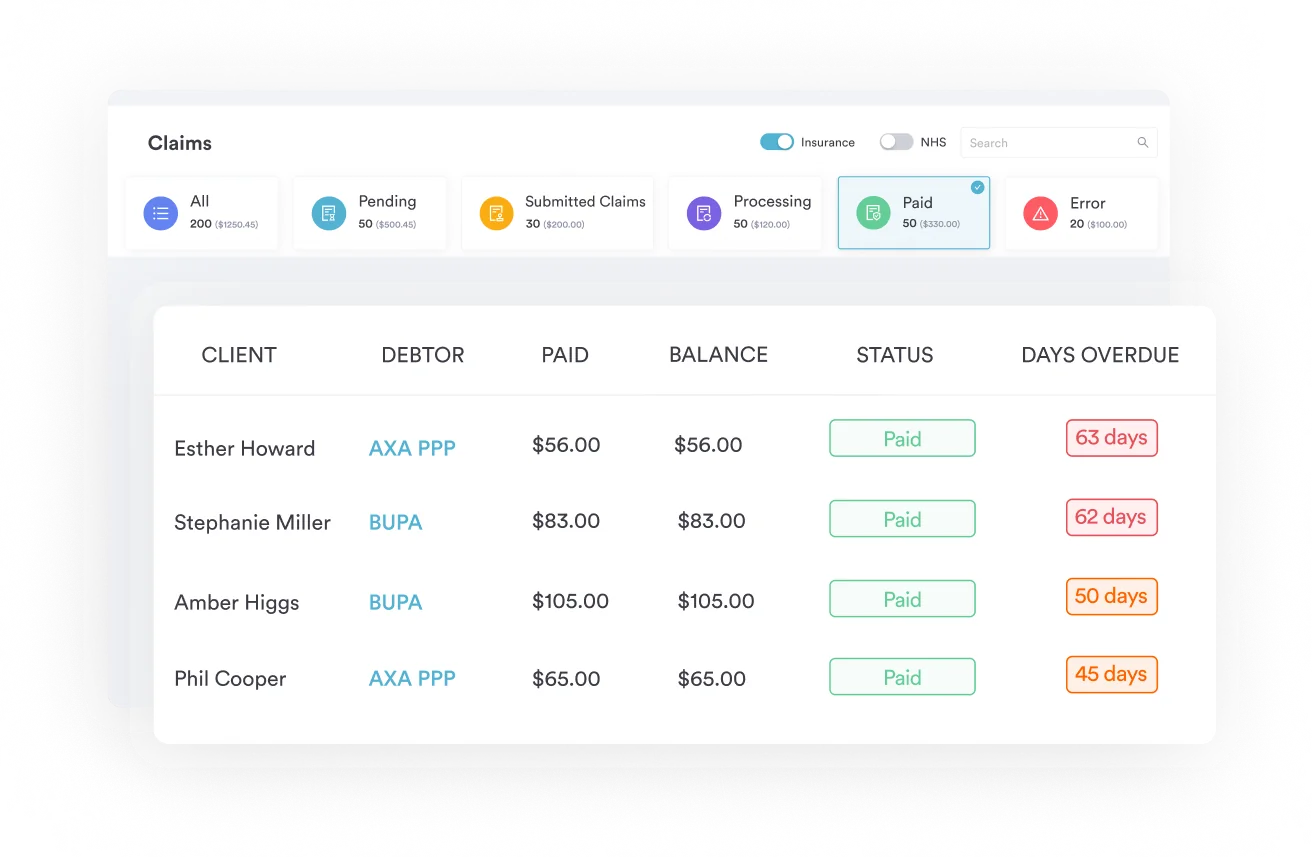

Pabau helps outpatient practices and billing teams manage claims, track HCPCS code submissions, and reduce denials with built-in compliance tools. See how it works for your team.

P9099 is a payment floor with an audit tail attached. It exists so that a genuinely unclassified blood product can still be reported and paid, and CMS priced it to match that narrow purpose.
So the discipline is narrow. Exhaust the specific P-series codes first, and reach for P9099 only when the product has no dedicated code. When it is the right code, capture the product name, lot number, NDC, and physician order at the point of administration.
Teams that document at the bedside rather than at the billing desk see fewer NOC denials. Book a demo to see how Pabau tracks blood product claims and their supporting documentation in one record.

Need help navigating HCPCS billing categories? Medical billing fundamentals covers the end-to-end claim workflow from service documentation to payment posting.
Seeing repeated denials on outpatient blood product claims? Denial management in healthcare walks through the most common denial triggers and how to resolve them systematically.
Want to understand the remittance side of HCPCS claims? Electronic remittance advice explains how ERAs map to submitted HCPCS codes and how to reconcile payment discrepancies.
Building an audit-proof coding process? Medical billing compliance sets out the documentation standards that hold up when a payer requests records.
Want the wider picture behind a single claim? Revenue cycle management maps every stage from patient registration through to final payment posting.
HCPCS Code P9099 is a Level II code with the descriptor “Blood component or product not otherwise classified.” It is a miscellaneous (NOC) code used in hospital outpatient billing. Coders reach for it when no specific P-series code exists for the blood product administered. CMS maintains it as part of the P-series pathology and laboratory code set.
Use P9099 only after confirming that no specific HCPCS P-series code (such as P9016, P9019, P9044, or P9060) accurately describes the blood component administered. Common situations include novel pathogen-reduced plasma products, experimental blood-derived products under clinical protocols, or specialty components without an assigned HCPCS code. Using P9099 when a specific code exists is a billing error that can trigger audits.
Medicare Part B may cover P9099 for qualifying hospital outpatient services when medical necessity is documented in the patient record. Coverage is subject to applicable Local Coverage Determinations (LCDs) issued by the relevant Medicare Administrative Contractor (MAC), so it can vary by region. Always verify eligibility and check for an applicable LCD before billing.
The most commonly applied modifiers are JW (drug amount discarded) and JZ (zero drug amount discarded). CMS has required JW since January 1, 2017. JZ became mandatory on July 1, 2023, after a voluntary reporting period that opened in January 2023. GY and GZ modifiers apply in specific Medicare denial scenarios. Modifier requirements vary by payer and setting, so verify applicability with your MAC before appending any modifier.
Common ICD-10-CM codes used with P9099 include D64.9 (anemia, unspecified), D69.6 (thrombocytopenia, unspecified), D65 (disseminated intravascular coagulation), and Z51.89 (encounter for other specified aftercare). The correct diagnosis code depends on the patient’s documented clinical condition. Always use the most specific code available to support medical necessity.
NOC blood product claims require the product’s full name, its NDC where applicable, and the volume administered. They also require the lot number, the signed physician order, the transfusion administration record, and a supporting ICD-10-CM diagnosis code. Some MACs and commercial payers additionally want a brief narrative explaining why no specific HCPCS code was available. Build this documentation at the point of administration, not retrospectively at billing.
Submit P9099 on a UB-04 claim form (CMS-1450) for hospital outpatient billing under OPPS. Include the appropriate revenue code for blood products, the ICD-10-CM diagnosis codes supporting medical necessity, applicable modifiers (JW or JZ), and all required documentation. Confirm the current-year OPPS APC assignment and payment rate from the CMS OPPS Addendum B before submitting.
P9099 is paid under APC 9537, blood component or product NOC, with an OPPS status indicator of R for separately payable. CMS sets the rate at the lowest paid separately payable blood product in the OPPS. The figure updates annually in the OPPS final rule. Check the current-year CMS OPPS Addendum B before billing, since a prior year’s rate should not be carried over.