

HCPCS Code L0472: Hyperextension TLSO billing guide
HCPCS code L0472: Official descriptor and device definition HCPCS code L0472 des...

Last Updated: Nov 5, 2026
P9054 is the HCPCS Level II code for whole blood or red blood cells, leukocytes reduced, frozen, deglycerol, washed, each unit.
In practice it describes a leukoreduced red cell unit that was frozen in glycerol, then thawed and washed free of it before issue. Blood banks hold these units for patients with rare red cell phenotypes or a history of severe allergic transfusion reactions. Without documented leukoreduction the unit is P9039, and an irradiated unit is P9057.
Let Pabau's smart automation suggest the right codes, reduce claim denials, and keep your practice compliant—effortlessly.
Automate repetitive tasks and focus on what matters most—your patients.
Reduce coding errors and ensure compliance with the latest regulations.
Clean claims, fewer denials, and faster reimbursements.
Powerful insights and reporting to help your practice thrive.
HIPAA compliant SOC 2 certified GDPR-compliant Trusted by 4,000+ clinics worldwide

P9054 covers leukoreduced red cells that were frozen in glycerol, then thawed, deglycerolized, and washed before transfusion, billed per unit.
The blood bank record must show every processing step. Without documented leukoreduction the unit is P9039, and an irradiated unit is P9057.
Medicare pays P9054 in hospital outpatient departments under OPPS, at $265.19 per unit for CY 2026 (APC 9527, status indicator R).
Freezing and thawing are built into P9054, so CPT 86930 to 86932 are not billed separately for a transfused unit.
Pabau keeps the order, the blood bank notes, and the coded charge on one patient record, so billers can check each P9054 line first.
HCPCS code P9054 is the Level II code for whole blood or red blood cells, leukocytes reduced, frozen, deglycerol, washed, each unit. CMS publishes the descriptor in its CMS quarterly HCPCS files, and the code is active in the October 2026 release.
In practice the product is a red cell unit. Glycerol protects the cells during frozen storage, and it has to be washed out before the unit can be transfused. The descriptor names four processing facts, and the blood bank record must support each one.
The storage and processing standards above come from the Circular of Information for the Use of Human Blood and Blood Components. AABB and the major US blood suppliers publish it jointly.
Deglycerolized red cells give the same physiologic benefit as standard red cells. Their use is usually limited to cases where standard components are inappropriate or unavailable. Three situations account for most orders.
Timing matters as much as the indication. A unit deglycerolized in an open system must be transfused within 24 hours of thawing. A closed-system unit can be stored at 1 to 6 °C and given within two weeks, following the manufacturer’s instructions.
The process carries a risk of its own. Inadequate deglycerolization can cause intravascular hemolysis, so the transfusion record should note any reaction and the unit number involved.
The red cell P-codes split on processing steps, and the code has to match the steps documented for the unit. The CY 2026 national rates below come from CMS OPPS Addendum B, October 2026 release.
Two points stand out. First, P9054 pays less than P9039 in CY 2026, so a longer descriptor does not mean a higher rate. Choose the code from the processing record, never from the rate table.
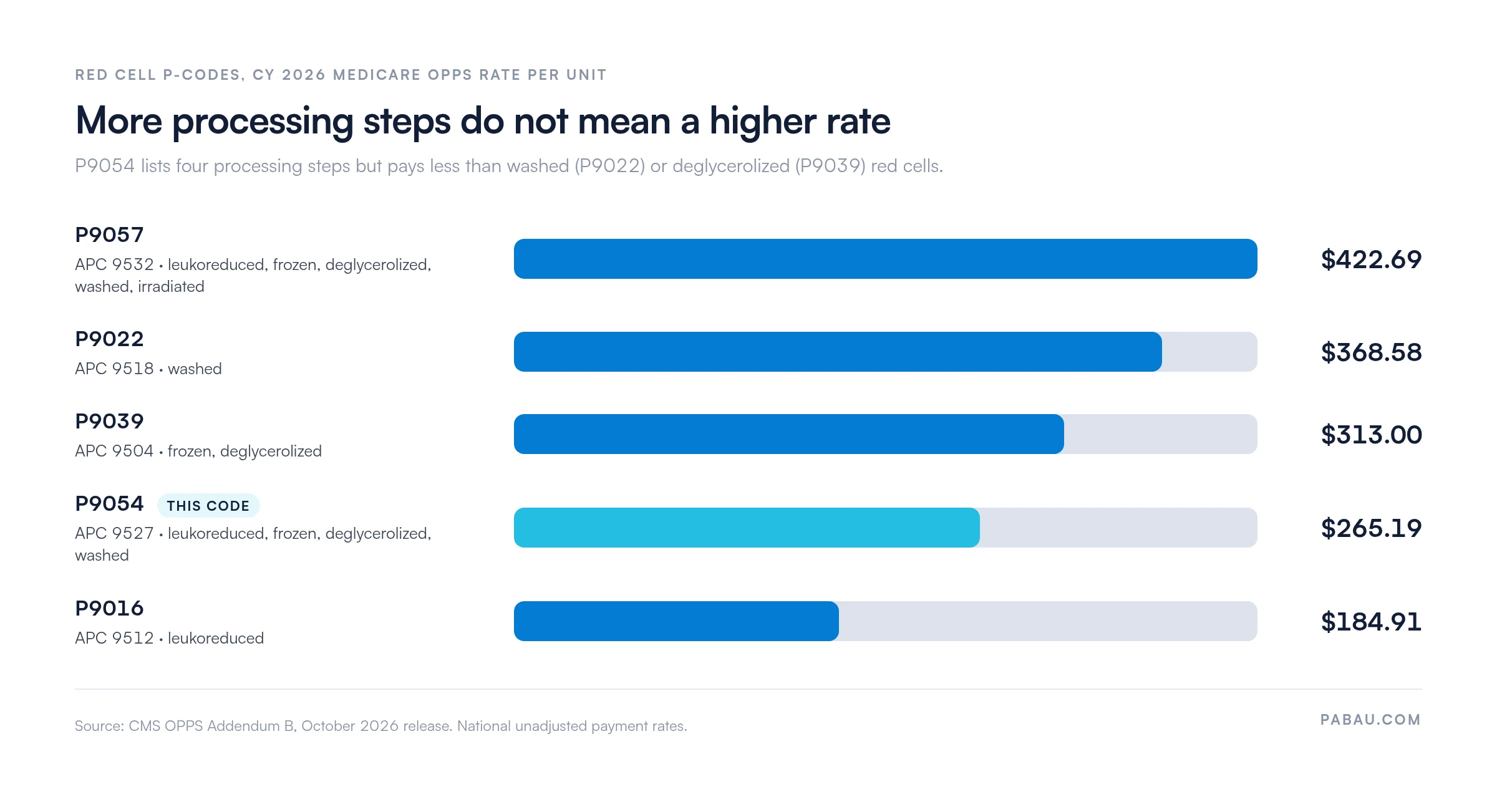
Second, irradiation moves the unit to HCPCS code P9057. Section 231.5 of the Medicare Claims Processing Manual, Chapter 4 says to bill the specific irradiated code when one exists. Adding CPT 86945 to a P9054 line is the wrong way to report it.
Bill P9054 for each red cell unit transfused, on the date of the transfusion, with units that match the blood bank issue log. Report the transfusion itself on its own line with CPT 36430 under revenue code 0391. CMS pays the transfusion APC once per day, however many units are given.
Most hospitals receive red cells from a community blood bank that charges only for processing and storage. Those claims follow §231.1 and carry no 038X line. The outpatient code editor returns any claim with a 038X blood line but no matching 039X processing line.
The blood deductible covers the first three units of whole blood or packed red cells in a calendar year. It applies to P9054 only when the hospital bought the unit or charged more than processing and storage. Units billed for processing and storage alone are not subject to it.
The deductible is reported with value codes on the institutional claim, not with a separate code beside P9054. Value code 06 carries the deductible amount, 37 the pints furnished, 38 the unreplaced deductible pints, and 39 the pints replaced. Value code 06 is dropped once the deductible pints have been replaced.
Ask the blood bank which supply model applies before the first P9054 claim goes out. A processing-only unit and a purchased unit need different revenue codes and line counts. The deductible also applies only to the purchased one.
Medicare pays P9054 in hospital outpatient departments under the Outpatient Prospective Payment System (OPPS), not the Physician Fee Schedule. For CY 2026, CMS assigns status indicator R and APC 9527, with a national payment rate of $265.19 per unit. The minimum unadjusted copayment is $53.04.
Addendum B also states that a payment rate does not mean a service is covered. The MAC decides whether each transfusion was reasonable and necessary, so the chart has to explain why a frozen, washed unit was needed.
Original Medicare does not require prior authorization for blood products. CMS has a general national coverage determination for blood transfusions (NCD 110.7), and MACs review medical necessity claim by claim. Medicare Advantage and commercial plans set their own rules, so confirm them at scheduling.
The diagnosis codes need to explain two things: why the patient needed red cells, and why a standard unit would not do. Pair the anemia code with a code for the reason behind the frozen, washed unit.
This list is illustrative, not exhaustive. Confirm each code against the current ICD-10-CM tabular list and the payer’s policy before release.
An auditor reviewing a P9054 line looks for proof of each processing step and of the clinical reason for it. These records answer both questions.
Match unit numbers, not just product names. Frozen inventories are small, so an auditor can trace one unit from the freezer log to the claim line. When the issue log and the administration record agree, the line is easy to support on review.
Most P9054 denials trace back to a record that does not match the claim. The table pairs each pattern with the typical claim adjustment reason code (CARC) and the fix.
Read the remittance advice remark codes alongside the CARC, because they name the missing element. Our guide to medical billing denial codes explains how the two work together. Denial management in healthcare covers the pre-bill checks that stop repeat denials.
Medicare appeals run through five levels, and each one has its own deadline.
Medicare Advantage and commercial plans run their own appeal processes and deadlines, so check the plan’s provider manual first.
In many facilities the transfusion order, the blood bank record, and the claim sit in separate systems. A biller reads the processing notes, keys the code by hand, and learns about a missing step from the remittance.
Pabau, the clinical and billing platform we build, holds the patient record, the clinical notes, and the invoice in one place. With Pabau’s claims management software, the coded charge sits beside the notes that support it. A reviewer checking a P9054 line can open the order and the transfusion note from the same record.
Claim status tracking then shows which lines are paid and which come back. If P9054 lines keep returning for the same reason, the pattern shows up while it can still be fixed.

Pabau keeps the order, the transfusion notes, and the coded charge on one patient record. Billers can check each P9054 line against its evidence before the claim goes out.

P9054 is a narrow code with a short clock. It fits one product: a leukoreduced red cell unit that was frozen, deglycerolized, and washed. Without leukoreduction the unit is P9039, and with irradiation it is P9057.
The billing risk sits in the record more than in the code book. A thawed unit has 24 hours, or up to two weeks in a closed system. Freezing and thawing are already in the rate, and an unused unit is never billed as P9054. Ask the blood bank to record each processing step and the post-thaw expiry on every unit, and the claim follows from the record.
Book a demo to see how Pabau keeps transfusion documentation and coded charges on one patient record, so each P9054 line has its proof.

Was the frozen unit also irradiated? HCPCS code P9057 covers frozen, deglycerolized, washed, leukoreduced, irradiated red cells.
No leukoreduction on the processing record? HCPCS code P9039 covers deglycerolized red blood cells billed per unit.
Washed, but never frozen? HCPCS code P9022 covers washed red blood cells billed per unit.
Billing standard leukoreduced red cells? HCPCS code P9016 covers leukocyte-reduced red blood cells with no further processing.
Want to see how blood product claims reach the payer? Medical claims clearinghouse guide explains how claims move from billing software to payers and where edits catch errors.
HCPCS code P9054 covers whole blood or red blood cells, leukocytes reduced, frozen, deglycerolized, and washed, billed per unit. In practice it is a leukoreduced red cell unit that was thawed and washed free of glycerol before transfusion.
Both codes describe frozen red cells that were deglycerolized before transfusion. P9054 also requires documented leukocyte reduction. When the processing record does not show leukoreduction, bill P9039 instead.
P9057 adds irradiation to the same frozen, deglycerolized, washed, leukoreduced red cell unit. Bill P9057 for an irradiated unit, rather than adding CPT 86945 to P9054.
Use revenue code 0390, 0392, or 0399 when the unit carries only processing and storage charges. When the hospital bought the unit, add a 038X product line, typically 0381, with modifier BL on both lines.
The blood deductible is reported with value codes 06, 37, 38, and 39 on the institutional claim, not with a code on the P9054 line. It applies only when the hospital bought the red cells or charged more than processing and storage.



