HCPCS Code L0472: Hyperextension TLSO billing guide
HCPCS code L0472: Official descriptor and device definition HCPCS code L0472 des...

Last Updated: Nov 5, 2026
P9045 is the HCPCS Level II code for infusion, albumin (human), 5%, 250 ml. One unit is 250 ml, so a 500 ml bottle bills as two units, and the infusion is billed separately with a CPT code.
Under OPPS status indicator K, Medicare pays P9045 separately in hospital outpatient departments. The same 5% albumin in 50 ml bottles is P9041, and 25% albumin is P9046 or P9047.
Let Pabau's smart automation suggest the right codes, reduce claim denials, and keep your practice compliant—effortlessly.
Automate repetitive tasks and focus on what matters most—your patients.
Reduce coding errors and ensure compliance with the latest regulations.
Clean claims, fewer denials, and faster reimbursements.
Powerful insights and reporting to help your practice thrive.
HIPAA compliant SOC 2 certified GDPR-compliant Trusted by 4,000+ clinics worldwide

HCPCS code P9045 covers albumin (human) 5%, billed one unit for every 250 ml infused.
A 500 ml bottle bills as two units, while 50 ml bottles of 5% albumin go on P9041.
Hospital outpatient departments are paid separately under OPPS status indicator K, at $53.079 per unit for October to December 2026.
The infusion itself is billed with a CPT administration code, such as 96365, on the same claim.
The chart has to show the indication, the volume given and the bottle sizes, because they drive coverage and units.
HCPCS code P9045 reports albumin (human) 5% in units of 250 ml. The CMS long descriptor reads infusion, albumin (human), 5%, 250 ml, and the short descriptor is “Albumin (human), 5%, 250 ml.”
The CMS HCPCS file lists January 1, 2002 as the date the code was added. P9045 is still active in the October 2026 file. That file gives it Medicare coverage code C, carrier judgment, so your Medicare Administrative Contractor (MAC) decides coverage.
A 5% solution holds 5 g of albumin per 100 ml, so each P9045 unit carries 12.5 g. Branded 5% products such as Flexbumin 5%, Plasbumin-5 and Albutein 5% all map to P9045 or P9041. The container volume decides which one, never the manufacturer.
Payers accept P9045 when the record ties the infusion to a labeled indication. The FDA prescribing information for Flexbumin 5%, for example, lists these uses:
Other 5% labels, such as Albutein 5%, also list therapeutic plasma exchange, where albumin replaces the plasma removed. The labels state that albumin is not indicated as an intravenous nutrient. A claim that documents nutritional support alone is unlikely to survive review.
CMS has no national coverage determination specific to albumin. With coverage code C, the MAC applies its own reasonable and necessary test. Check your MAC’s policy articles before billing an indication that sits outside the product label.
CMS splits albumin by concentration and container volume, and it codes plasma protein fraction separately. P9045 and P9047 carry the same 12.5 g of albumin per unit. One delivers it in 250 ml of 5% solution, the other in 50 ml of 25% solution.
Descriptors come from the October 2026 CMS HCPCS file, and payment from the OPPS Addendum B for the same quarter. Pick the concentration first, then the container. A 5% product in 250 ml or 500 ml bottles goes on P9045, and 50 ml bottles of 5% go on P9041.
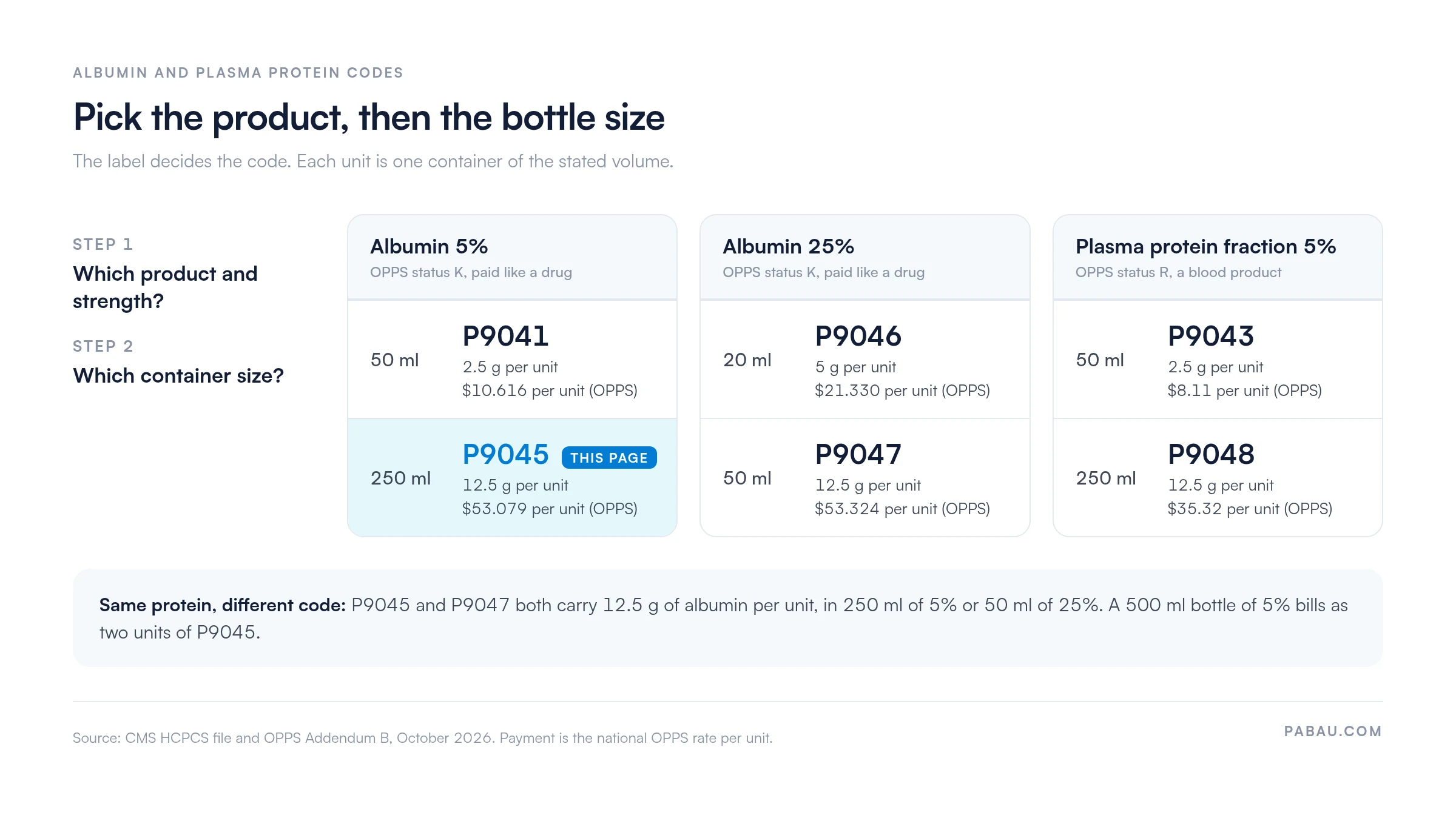
Plasma protein fraction is a different product, even at the same 5% strength. OPPS also treats it differently. It carries status R as a blood product, while the four albumin codes carry status K and are paid like drugs.
Divide the total milliliters of 5% albumin given by 250, and that is the unit count. Read the volume from the administration record, then check it against the bottles dispensed.
Plasma exchange is where high unit counts stop claims. Before you submit a large line, check P9045 against the medically unlikely edit (MUE) table CMS publishes for outpatient hospital services. Keep the exchange volume in the procedure note, so an appeal has the figures it needs.
The ICD-10-CM code on the claim has to explain why the patient needed volume or albumin replacement. The codes below match the labeled indications. Each one still needs the treating clinician’s documentation behind it.
ICD-10-CM changes every October, so confirm each code in the CDC ICD-10-CM browser tool before you submit. A diagnosis outside the product label needs a fuller clinical note explaining why albumin was chosen.
P9045 codes the albumin only. Giving it is a separate CPT line, usually 96365 for the first hour of an IV infusion. Leaving that line off loses the administration payment.
When albumin is given inside a surgical case, such as cardiopulmonary bypass, the surgery and anesthesia codes cover the service. Only the product units go on the P9045 line.
Medicare pays P9045 three different ways, depending on where the albumin is given. In every case the payment covers the product, and the administration is paid on its own line.
In the outpatient department, the October 2026 Addendum B sets $53.079 per unit, with a minimum unadjusted copayment of $10.62. P9045 is not packaged into the infusion APC, so each unit pays.
For a physician office, the CMS Part B payment limit file lists the same $53.079 per 250 ml for October 1 to December 31, 2026. The file prices P9045 in its blood column at 95% of average wholesale price, rather than at average sales price plus 6%.
Both rates change every quarter, so treat these figures as a reference point and recheck them each January, April, July and October. At the October 2026 rate, the 12-unit plasma exchange above pays $636.95 before coinsurance.
OPPS pays P9045 as a drug rather than as a status R blood product. Hospitals therefore generally report it under revenue code 0636, drugs requiring detailed coding, rather than the 038X blood codes. Confirm the pairing your MAC expects.
Pull the albumin rows from the OPPS Addendum B and the Part B payment limit file each quarter. File them with the date you checked, so a later payment dispute has the rate that applied on the date of service.
No modifier is specific to P9045, and most lines carry none. Three situations can add one:
EA, EB and EC do not belong on an albumin line. They identify erythropoiesis-stimulating agents given for anemia, and they say nothing about a blood product’s attributes.
Each element of a P9045 claim needs a matching entry in the record. An auditor checks that the order, the administration record and the claim line agree on product and volume.
Volume is the field most likely to disagree across records. Reconcile the pharmacy dispense, the administration record and the charge line before the claim leaves, not after the remittance comes back.
Original Medicare does not require prior authorization for albumin. Medicare Advantage plans, Medicaid programs and commercial payers set their own rules, so check each plan at eligibility verification.
Record any authorization number on the claim. Emergent infusions for shock or bypass are rarely delayed for authorization, so document the urgency in the clinical note.
Most P9045 denials trace back to concentration, volume or setting. The table pairs each pattern with the check that stops it. For the remittance codes behind them, see our guide to medical billing denial codes.
Track denials by code rather than in aggregate. A repeated pattern on P9045 usually points to one broken handoff, and denial management works best when it fixes that handoff first.
Albumin claims fail when the volume lives in three places. The dispensing log, the infusion note and the charge line are often kept apart, and someone has to reconcile them by hand.
Pabau, the practice management and EHR platform we build, keeps the order, the treatment note and the invoice on one patient record. Charge entry works from what the clinician documented, so nobody rekeys a volume off a printout.
For US practices, Pabau’s claims management software builds the claim from data already on the record and submits it through Claim.MD. Your team still chooses the code and the units. Pabau carries those choices onto the claim and tracks it until payment posts.

Pabau keeps the order, treatment note and invoice on one patient record, then submits US claims through Claim.MD. Your billing team spends less time rekeying volumes and reworking denials.

P9045 turns on two facts from the chart: the concentration and the volume. Confirm the product is 5%, split the bottles by size, and divide by 250.
The trade-off sits in plasma exchange. Those cases produce the largest unit counts, and a 12-unit line that fails an edit costs more staff time than the bedside check. Reconcile the volume while the infusion record is still open.
Book a demo to see how Pabau keeps clinical records and US claim submission on one patient record.

Want to see how a claim reaches the payer? Medical claims clearinghouse explains payer routing, edit checks and how rejected claims come back.
Need a system for repeat denials? Denial management in healthcare covers how to track, appeal and prevent denials by reason code.
Checking what the payer actually paid? Electronic remittance advice shows how to read 835 files and spot contractual adjustments.
HCPCS code P9045 describes an infusion of albumin (human) 5%, billed in units of 250 ml. It covers the product only. The infusion service is billed separately with a CPT administration code such as 96365.
A 500 ml bottle of 5% albumin bills as two units of P9045. Divide the total milliliters infused by 250 to get the unit count. Bottles of 50 ml go on P9041 instead.
Both codes carry 12.5 g of albumin per unit. P9045 is the 5% solution in 250 ml, and P9047 is the 25% solution in 50 ml. The concentration on the product label decides the code.
For October 1 to December 31, 2026, Medicare pays $53.079 per unit in hospital outpatient departments and in physician offices. Inpatient use is included in the MS-DRG payment. Both outpatient rates update every quarter.
No. OPPS gives the albumin codes status indicator K and pays them separately, like drugs. The plasma protein fraction codes P9043 and P9048 carry status R as blood products.
Original Medicare does not require prior authorization for albumin. Medicare Advantage, Medicaid and commercial plans set their own rules. Check the plan at eligibility verification and record any authorization number on the claim.
No modifier is specific to P9045. GA or GZ applies when a denial is expected, depending on whether an ABN was issued. Ask your MAC whether it expects JW or JZ. EA, EB and EC are anemia drug modifiers and do not apply.