HCPCS code J7311: Retisert implant units and billing guide
HCPCS code J7311 covers one implant, Retisert HCPCS code J7311 is the Level II c...

Last Updated: Nov 10, 2026
J7110 is the HCPCS Level II code for infusion, dextran 75, 500 ml. Dextran 75 is a colloid plasma volume expander, and one billing unit equals one 500 ml bag.
J7110 is not dextrose 5% in water, which bills as J7060 or J7070. CMS publishes no Part B payment limit for J7110, so confirm the product and your MAC's pricing before you bill.
Let Pabau's smart automation suggest the right codes, reduce claim denials, and keep your practice compliant—effortlessly.
Automate repetitive tasks and focus on what matters most—your patients.
Reduce coding errors and ensure compliance with the latest regulations.
Clean claims, fewer denials, and faster reimbursements.
Powerful insights and reporting to help your practice thrive.
HIPAA compliant SOC 2 certified GDPR-compliant Trusted by 4,000+ clinics worldwide

HCPCS code J7110 reports dextran 75 infusion, 500 ml, a colloid plasma volume expander, not dextrose 5% in water.
One billing unit equals one 500 ml bag, so a 1,000 ml infusion goes on the claim as two units.
D5W bills as J7060 (500 ml) or J7070 (1,000 cc), and dextran 40 bills as J7100.
CMS lists no Part B payment limit and no crosswalked NDC for J7110 in its October 2026 drug files.
Pair J7110 with a shock or volume diagnosis, such as R57.1 or E86.1, and check the Excludes1 notes first.
HCPCS code J7110 is the Level II code for “Infusion, dextran 75, 500 ml.” Its short descriptor is “Dextran 75 infusion.” It reports a high-molecular-weight dextran given intravenously to expand plasma volume, historically sold under brand names such as Gentran 75.
The code has been in effect since January 1, 1997, and it’s still active in the 2026 HCPCS set. It sits with the other IV solutions in the J7000 range, right next to J7100 for dextran 40. You can browse those neighbors in our HCPCS code library. Its coverage code is D, which means special coverage instructions apply.
Dextran is a glucose polymer, and the number tells you its average molecular weight. Dextran 75 sits around 75,000 daltons. Molecules that size stay in the bloodstream and pull fluid in, which is what makes it a colloid volume expander.
Clinically, it was used as an adjunct for shock, or impending shock, after hemorrhage, burns, surgery or trauma when blood products weren’t immediately available. Dextran 75 was typically given as a 6% solution in 0.9% sodium chloride or 5% dextrose. So a bag carries salt or sugar plus a colloid, not free water and calories.
That’s why the old “J7110 is D5W” shortcut causes trouble. Dextrose 5% in water is a crystalloid with its own codes, J7060 and J7070. Treating the two as interchangeable puts the wrong drug, the wrong unit and the wrong diagnosis on one claim line.
A DailyMed search in November 2026 returned no Gentran 75 label and no ready-to-hang dextran 75 infusion. The one current dextran infusion label is Hospira’s LMD, and LMD is dextran 40.
So when J7110 turns up on a charge sheet, check it before you bill it. Read the NDC and the product name off the bag or the pharmacy record, then match the code to what was infused.
If your practice does stock a dextran 75 product, keep a copy of its label with the claim file. A payer reviewing a rarely billed code will ask what was given.
Units for J7110 follow the descriptor. One unit covers 500 ml, so count bags of dextran 75, not milliliters or doses.
Most payers expect one unit when the amount given is less than the descriptor’s 500 ml. Confirm your MAC’s rule before you bill a partial bag, and never bill units from the ordered volume alone.
A plasma expander answers a volume problem, so the diagnosis on the claim should describe one. These ICD-10-CM codes match the clinical uses of dextran 75. Use them as examples, and always code from the documented diagnosis.
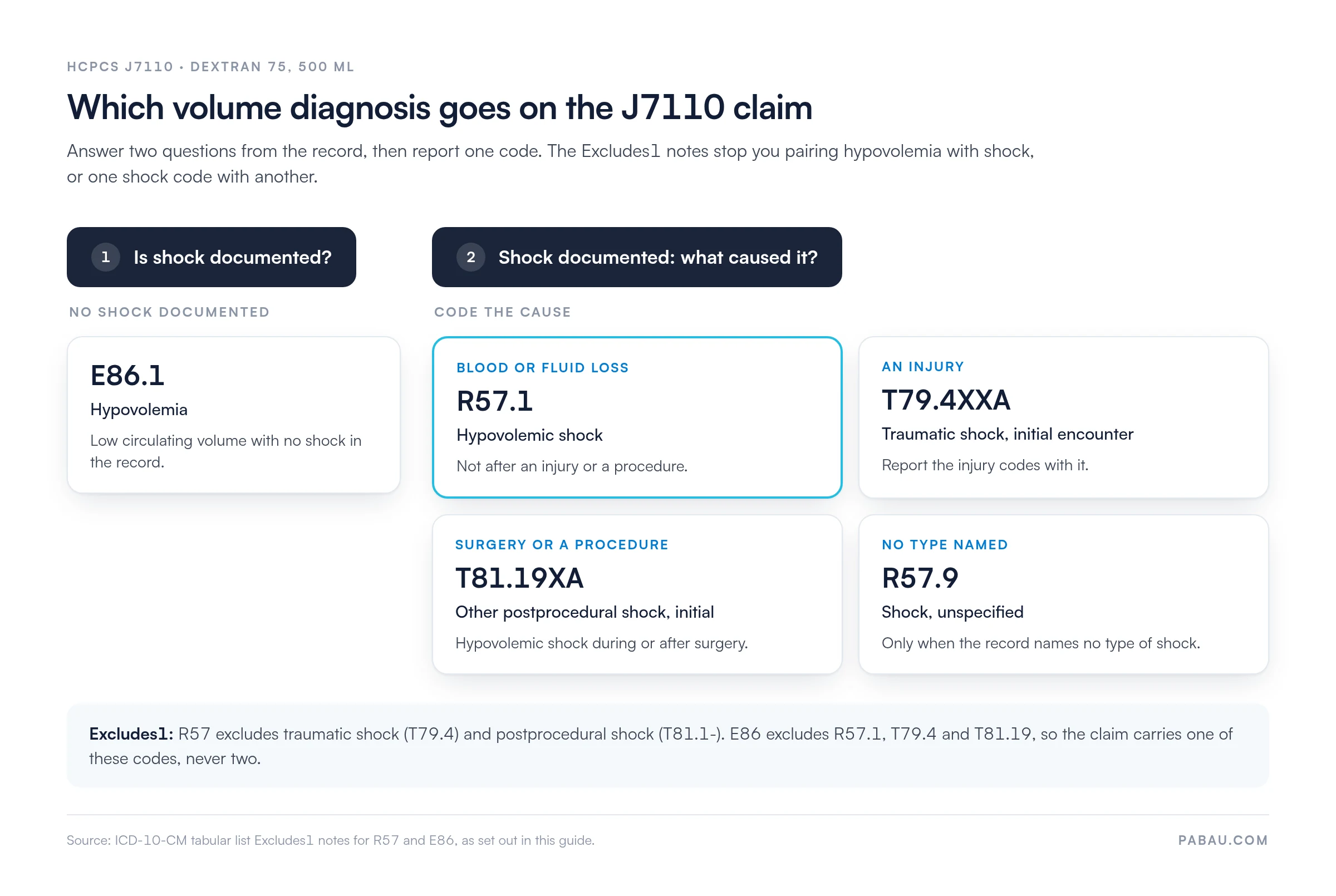
Watch the Excludes1 notes. The R57 category excludes traumatic shock (T79.4) and postprocedural shock (T81.1-), so pick the one shock code that matches the cause. E86 also excludes hypovolemic shock NOS (R57.1), traumatic hypovolemic shock (T79.4) and postprocedural hypovolemic shock (T81.19), so E86.1 fits only when no shock is documented.
For burn shock, report the burn site codes (T20-T25) and the extent code (T31) alongside the shock code. The choice comes down to two questions about the record.
J7110 pays for the drug only. The infusion service goes on its own line. On a physician office claim, that’s usually CPT code 96365 for the first hour of a therapeutic IV infusion. Add 96366 for each additional hour.
Hydration codes 96360 and 96361 describe prepackaged fluid and electrolytes. A colloid plasma expander isn’t that, so most coders don’t report it as hydration. Check your MAC’s guidance if a payer treats it differently.
In an emergency department or inpatient setting, the hospital bills the dextran on its facility claim. A physician’s professional claim from that setting doesn’t carry J7110.
CMS’s Medicare Part B payment limit file for October to December 2026 doesn’t list J7110. The same file prices its crystalloid neighbors, which shows how different the two cases are.
Absence from the file doesn’t mean Medicare never covers the drug. CMS says coverage is decided by the local contractor, and with coverage code D in play, your MAC sets the terms. Expect manual pricing, and expect to send the invoice and the product details.
Hospital outpatient claims follow OPPS instead, so check J7110’s status indicator in the current Addendum B before you assume separate payment. Medicaid and commercial plans set their own rules, and many want an NDC on every drug line.
CMS’s JW and JZ policy covers separately payable Part B drugs from single-dose containers. JW reports the discarded amount, and JZ says nothing was discarded. Whether a dextran bag falls in scope depends on how your MAC pays J7110.
So ask before you build a rule. If your MAC wants JW, put the discarded volume on its own line and record it in the chart. If the drug isn’t separately payable in that setting, neither modifier applies.
Run through these six checks before the claim leaves your practice. Each one heads off a common denial on rarely billed J-codes.
A code billed this rarely is easy to get wrong from memory. The biller often works from a charge sheet that says “dextran” or “D5,” and the record that settles it sits elsewhere.
Pabau, the practice management platform we build, keeps the order, the administration note and the claim in one patient record. Its claims management software pre-fills the claim from that record. Its HCPCS and ICD-10-CM lookup libraries let you confirm a descriptor before you pick a code.
Pabau also checks that the claim’s required fields are complete before it goes out. In the US, claims submit through Claim.MD, with eligibility checks and remittance posting built in. Your team spends less time chasing missing details and more time confirming the drug was right.

Pabau builds claims from the patient record, checks required fields before submission and tracks each claim through to payment, so J7110 lines go out complete.

J7110 is a code to prove before you bill it. DailyMed lists no dextran 75 infusion today. The bag in front of you is far more likely to be dextran 40 or a dextrose solution.
When it is dextran 75, bill it by the 500 ml bag and pair it with a shock or volume diagnosis. Then expect your MAC to price it by hand. That extra step on the front end costs minutes, while a wrong J-code costs an appeal.
Book a demo to see how Pabau keeps your infusion records and claims in one place, so every drug line matches what you gave.

Billing the dextran your pharmacy stocks? HCPCS code J7100 covers dextran 40 infusion, 500 ml, including LMD.
Was the bag D5W after all? HCPCS code J7070 explains units and billing for 1,000 cc of dextrose 5% in water.
Reporting a crystalloid for resuscitation? HCPCS code J7120 covers lactated Ringer’s infusion.
Coding the infusion service itself? CPT code 96365 sets out the first-hour therapeutic infusion rules.
Giving albumin as the colloid instead? HCPCS code P9041 covers albumin (human), 5%, 50 ml.
The number is the average molecular weight, in thousands of daltons. Dextran 40 is low molecular weight and is used mainly to improve blood flow in small vessels. Dextran 75 is a larger molecule that stays in circulation longer, so it was used for volume expansion.
Dextran is a colloid. Its large molecules stay in the blood vessels and draw fluid in. Crystalloids such as normal saline, D5W and lactated Ringer’s spread into the tissues more quickly.
Yes, dextran can interfere with blood typing and crossmatch tests. Draw any samples you need before the infusion starts, and note that in the record.
Albumin has its own P codes, billed by strength and volume. P9041 covers albumin (human), 5%, 50 ml, and P9045 covers the 250 ml size. The 25% strength bills as P9046 or P9047.