

HCPCS Code L0472: Hyperextension TLSO billing guide
HCPCS code L0472: Official descriptor and device definition HCPCS code L0472 des...

Last Updated: Nov 5, 2026
M1003 is the HCPCS Level II code for TB screening done before a first course of biologic therapy. It reports that the screening was performed and the results interpreted within the 12 months before therapy started.
M1003 is the Performance Met code for MIPS Quality ID #176, tuberculosis screening prior to first course of biologic and/or immune response modifier therapy. It carries no Medicare payment. Each M1003 case counts in the measure's numerator and raises the clinician's performance rate.
Let Pabau's smart automation suggest the right codes, reduce claim denials, and keep your practice compliant—effortlessly.
Automate repetitive tasks and focus on what matters most—your patients.
Reduce coding errors and ensure compliance with the latest regulations.
Clean claims, fewer denials, and faster reimbursements.
Powerful insights and reporting to help your practice thrive.
HIPAA compliant SOC 2 certified GDPR-compliant Trusted by 4,000+ clinics worldwide

HCPCS Code M1003 reports that TB screening was performed and the results interpreted within 12 months before a first course of biologic therapy.
M1003 is the Performance Met code for MIPS Quality ID #176, with M1004 for a medical exception and M1005 for screening not done.
The measure counts patients aged 18 and older starting a first-time biologic or immune response modifier, identified by G2182.
M1003 carries no Medicare payment, but each case it reports raises the clinician’s measure #176 performance rate.
The chart must show the test type, the test date, the result and the clinician’s interpretation, all before the biologic prescription.
HCPCS Code M1003 is a quality data code, not a billable service. It tells CMS that a patient starting a first course of biologic therapy was screened for tuberculosis (TB) beforehand. The screening counts only if a clinician interpreted the result within the 12 months before therapy began.
The Centers for Medicare and Medicaid Services (CMS) maintains M1003 in the HCPCS Level II M-code series. The figures below come from the October 2026 alpha-numeric file in the CMS HCPCS release.
M1003 sits in the M1000 block of quality data codes, and its two siblings follow it directly. M1004 reports a documented medical reason for skipping the screening. M1005 reports a screening that was not done, with no reason given.
M1003 belongs to one measure and one clinical moment. Quality ID #176 asks whether a patient was tested for TB before starting a biologic that carries a warning about reactivating latent infection.
Agents such as TNF inhibitors and Janus kinase (JAK) inhibitors can wake a dormant TB infection. Screening first lets the clinician treat latent TB before the immune system is suppressed.
The 2026 measure specification defines who counts and what qualifies.
The agent list in the specification covers drugs such as adalimumab, etanercept, infliximab, ustekinumab, secukinumab, tofacitinib and upadacitinib. CMS notes that newly approved agents requiring TB testing also qualify, even before the list is updated.
M1003 does not apply in these cases.
Ask your registry or EHR vendor which biologic list it uses to flag first-time therapy. A practice prescribing a newly approved agent can lose M1003 cases if the vendor list lags the FDA. CMS says newly approved agents still count.
Auditors judge M1003 by what the chart shows. Someone reading the record should find the screening, its result and the interpretation without asking anyone.
An outside result counts if it is in the record and interpreted. A patient screened by a dermatologist eight months earlier does not need a second test from the rheumatologist. The rheumatologist still documents the result and their interpretation.
Measure #176 has no diagnosis criteria in its denominator, so no ICD-10-CM code switches M1003 on or off. The diagnoses on the claim still support the encounter and explain why a biologic was started. The codes below are common examples, verified against the FY2026 ICD-10-CM code set.
Code the underlying condition to the highest specificity the note supports. The unspecified codes above are starting points, not defaults.
Every denominator-eligible case gets exactly one of the three codes. The table shows what separates them.
The decision rule is short. Screened and interpreted inside the window is M1003. A documented TB treatment history is M1004. Everything else, including a refused test, is M1005.
Take a psoriasis patient with a negative QuantiFERON from four months ago. The dermatologist notes the negative result and starts risankizumab. That encounter is M1003, with L40.0 as the supporting diagnosis.
For 2026, CMS offers measure #176 only through the MIPS clinical quality measure (CQM) collection type. That usually means reporting through a registry or a qualified clinical data registry (QCDR). It is not a Medicare Part B claims measure.
The 2026 specification says CQM submitters do not have to send the quality data codes at all. Registries may still read M1003 from claims when they build the measure from Medicare Part B claims data. Ask your registry which route it uses before you add the code to claims.
Take a practice with 40 first-course patients in 2026. Two have documented past TB treatment and are reported with M1004. If 34 of the other 38 are M1003, the rate is about 89%, and the chart below shows where each case lands.
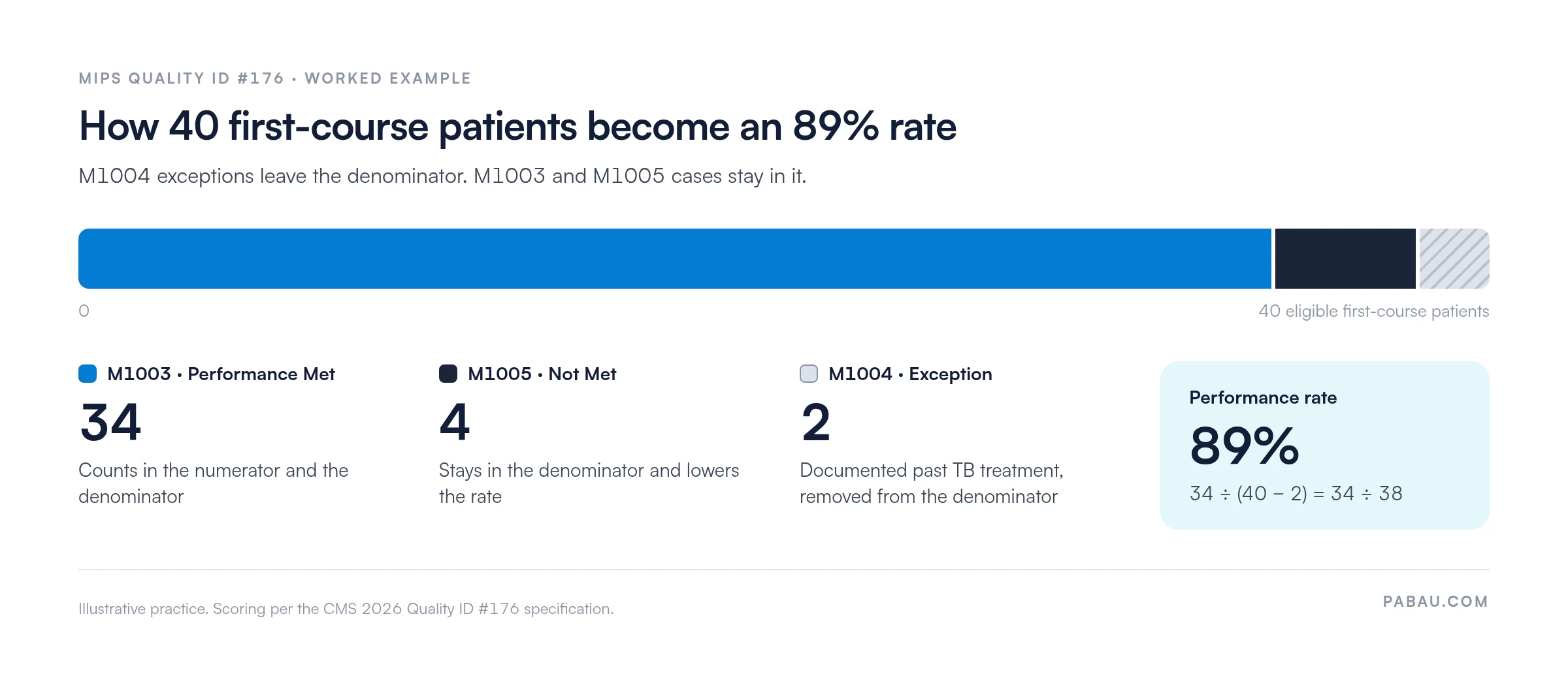
The quality category carries 30% of the 2026 MIPS final score. Performance in 2026 sets the payment adjustment applied to Medicare Part B claims in 2028. Check the current measure details in the QPP Explore Measures tool before each performance year.
M1003 has no fee schedule amount. The HCPCS file gives it pricing indicator 00, so Part B never prices it separately. The payable work sits on other lines.
Medicare typically denies a quality data code line with remark code N620, which marks it as informational. That denial is expected and needs no appeal. Commercial payers vary, and some reject M-codes outright, so strip the line where a payer does not accept it.
Read the first remittance from each new payer after you add M1003. A line-level rejection tells you that payer does not recognize M-codes. Remove the code from that payer’s claim template and let the registry carry the measure.
Most M1003 problems start in the chart before anyone builds the claim. The table lists the errors that undercount or overstate the measure.
The denial codes in medical billing guide covers how to read CARC and RARC codes on a remittance. The medical billing compliance guide explains how quality reporting interacts with audits.
Reporting M1003 correctly is mostly a record-keeping job. The clinician already made the decision. What remains is getting the test, the interpretation and the code into one place.
Pabau, the practice management and billing platform we build, assembles the claim from the patient record rather than a separate billing form. Encounter details and treatment notes pre-fill the claim, so the billing team does not retype what the clinician wrote.
A built-in code lookup sits beside the claim, so whoever is coding can add M1003 on its own line. Required-field checks flag an incomplete claim before Pabau’s claims management software sends it to your clearinghouse.
Those checks confirm the claim is complete. Whether the note supports M1003 is still a judgment for your clinician or compliance lead.

Pabau pre-fills claims from the patient record and checks required fields before submission. Your team adds codes like M1003 without retyping the visit.

M1003 answers one question: was this patient screened for TB before their first biologic? The answer only counts when the chart shows the test, the date, the result and the clinician’s reading of it.
Treat the interpretation line as the step that earns the code. Practices that make it a habit at the prescribing visit rarely lose a screened patient from the measure #176 numerator.
Pabau keeps the code, the encounter and the note in one record. Book a demo to see how that fits your billing workflow.

Coding a documented TB history instead? M1004 covers the medical-reason exception for measure #176.
Screening never happened? M1005 explains the Performance Not Met code and how it lowers the rate.
Reporting rheumatoid arthritis measures too? M1006 covers disease activity not assessed under Quality ID #177.
Want fewer rejected claim lines? Clean claim standards explains what gets a claim through initial payer edits.
M1003 reports that TB screening was performed and the results interpreted within 12 months before first-time biologic or immune response modifier therapy. It is the Performance Met code for MIPS Quality ID #176.
No. M1003 reports TB screening before a first course of biologic therapy. It has no link to diabetes, HbA1c or glycemic control measures.
No. M1003 has pricing indicator 00 and no fee schedule amount. Bill the visit and the TB test on their own lines. M1003 affects payment only through the MIPS adjustment two years later.
A tuberculin skin test, an interferon-gamma release assay such as QuantiFERON or T-SPOT.TB, or another appropriate method. The result must be documented and interpreted within 12 months before the biologic prescription.
Yes. The measure asks whether screening was performed and interpreted, not whether it was negative. Document the follow-up workup and any latent TB treatment plan in the record.
Patients aged 18 and older with a qualifying encounter who start a biologic or immune response modifier. They must have no such prescription in the prior 15 months. G2182 flags the first-time therapy.



