CCSD Code K2542: Revision replacement of mitral valve
What CCSD code K2542 covers CCSD code K2542 is the UK private healthcare code fo...

Last Updated: Oct 22, 2026
M1006 is the HCPCS Level II code for disease activity not assessed, reason not given. It reports that an eligible rheumatoid arthritis patient had no disease activity score documented, and no reason was recorded.
M1006 is a Performance Not Met numerator code for MIPS Quality ID #177, which tracks how often clinicians assess RA disease activity. It carries no Medicare payment, but each M1006 lowers the clinician's #177 performance rate.
Let Pabau's smart automation suggest the right codes, reduce claim denials, and keep your practice compliant—effortlessly.
Automate repetitive tasks and focus on what matters most—your patients.
Reduce coding errors and ensure compliance with the latest regulations.
Clean claims, fewer denials, and faster reimbursements.
Powerful insights and reporting to help your practice thrive.
HIPAA compliant SOC 2 certified GDPR-compliant Trusted by 4,000+ clinics worldwide

HCPCS Code M1006 reports that a rheumatoid arthritis patient’s disease activity was not assessed, and no reason was documented.
It is a Performance Not Met numerator code for MIPS Quality ID #177, alongside M1007 (met) and M1008 (assessed at under 50% of encounters).
M1006 carries no separate Medicare payment, so its cost shows up in the clinician’s quality score rather than in reimbursement.
Scoring disease activity with CDAI, DAS28, PAS-II, RAPID3 or SDAI at RA visits is what moves a patient from M1006 to M1007.
Pabau, the practice software we build, can flag deleted codes and missing RA diagnosis codes before a claim leaves the practice.
HCPCS Code M1006 is the Level II code for “Disease activity not assessed, reason not given.” It reports that an eligible rheumatoid arthritis (RA) patient had no disease activity assessment documented, and the record gives no reason why.
The code belongs to MIPS Quality ID #177, Rheumatoid Arthritis: Periodic Assessment of Disease Activity. The Merit-based Incentive Payment System (MIPS) uses it to check whether clinicians score RA disease activity at half or more of a patient’s RA visits. M1006 is one of three numerator outcomes, and it counts as performance not met.
The Centers for Medicare and Medicaid Services (CMS) maintains the code. The table below sums up its classification, so cross-check it against the current CMS HCPCS release file.
Codes one digit away report different measures. M1003 to M1005 cover tuberculosis screening before biologic therapy, and M1004 is the medical-exception code in that set. Our HCPCS code reference lists the neighboring descriptors side by side.
M1006 applies only to patients in the Quality ID #177 denominator. The measure counts each eligible patient once per performance year, based on the share of RA visits that included a disease activity score.
In scope for M1006 reporting:
Excluded from M1006 reporting:
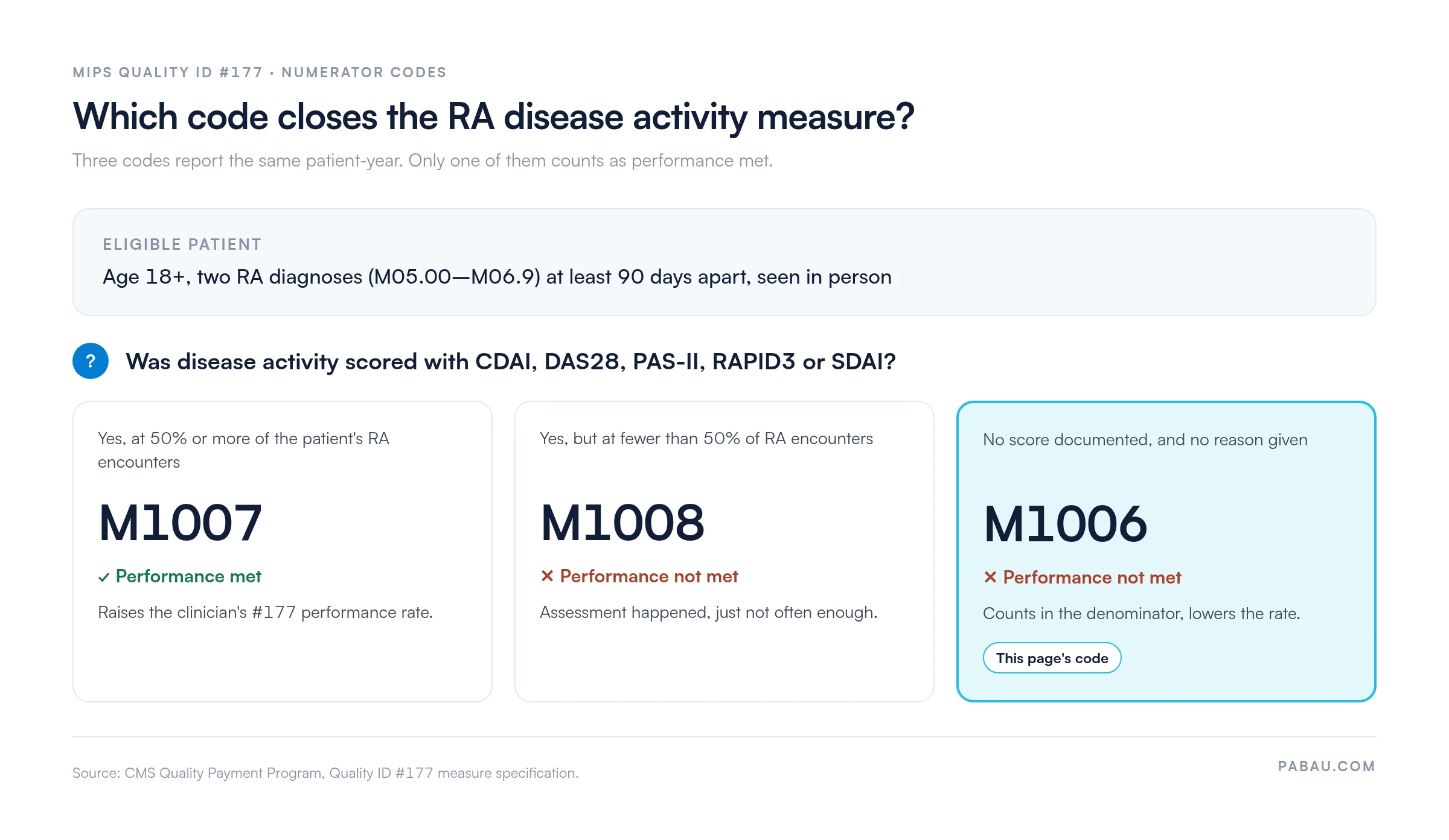
The three outcomes split on one question, shown below: was an accepted score recorded, and at how many visits?
Use the AAPC Codify HCPCS lookup to compare descriptors across the M1006-M1014 group before you pick a code.
Run a quick audit of your quality measure reporting codes each January when CMS publishes the new HCPCS file. Pull every M-series code your practice reported in the prior year and cross-reference each one against the updated release. Deleted codes that carry through on claims generate automatic rejections, and catching them before the first submission of the new year saves significant rework.
Even a performance-not-met code needs a record behind it. For M1006, the documentation proves the patient was eligible and shows that no score or reason was charted.
Quality ID #177 defines its denominator with RA diagnosis codes, so the pairing is narrower than for most M-series codes. The table below shows what qualifies and what to check.
Quality ID #177 has three numerator codes, and each reports a different result for the same patient-year. Picking the wrong one misstates the clinician’s performance.
Read each descriptor against the documented visits before you choose. The PGM Billing HCPCS lookup tool offers a free search of CMS data for quick descriptor checks.
Medicare does not pay for M1006. The code reports quality data rather than a service, so it has no price under the Medicare Physician Fee Schedule. Confirm its current status in the CMS Physician Fee Schedule lookup tool.
Key coverage considerations for billing staff:
Quality ID #177 is a process measure. Its performance rate is the share of eligible patients reported with M1007, so every M1006 patient pulls the rate down.
The measure follows American College of Rheumatology (ACR) guidance. The ACR recommends a treat-to-target approach, with disease activity measured at most RA encounters. The specification accepts five ACR-recommended tools:
Specifications are updated every year, and CMS can revise or retire a measure. Download the current #177 specification before each performance period starts.
When M1006 rides on a claim, it gets rejected for a handful of predictable reasons. Most come down to code status, missing documentation or diagnosis pairing.
When you appeal, include the visit notes, the #177 specification page showing the code was active, and the corrected RA diagnosis code. Keeping visit notes and claims in one system makes those records quick to pull.
Build a quality measure code checklist at the start of each performance year. List every M-series code your practice reports and confirm each one is active in the new CMS HCPCS file. Note the accepted ICD-10 pairings, and flag any code whose measure specification has changed. This 30-minute exercise at the start of January prevents months of denied claims.
Tracking #177 by hand means checking every RA visit for a score, then matching the result to M1006, M1007 or M1008. On a spreadsheet, a missed CDAI entry only surfaces when the performance rate comes back low.
Pabau, the practice management platform we build, keeps the visit note and the claim in one patient record. Its claims management software covers the usual M1006 failure points:
The result is fewer M1006 reports to explain, and a #177 rate that reflects the care your clinicians give.

Pabau’s claims management tools validate HCPCS codes, flag missing RA diagnosis codes and track denials by reason code. See how it works for practices reporting MIPS quality codes.

An M1006 is a documentation problem before it’s a coding problem. If the visit note has no disease activity score, the code is correct, and the clinician’s #177 rate takes the hit.
So fix it upstream. Build an accepted score into every RA visit template, and audit a sample of RA charts each quarter. M1006 then becomes the rare exception, and M1007 becomes the default.
Book a demo to see how Pabau keeps RA visit notes, quality codes and claims in one record for your practice.

Need to understand how denial codes work across claim types? Denial codes in medical billing explains the most common CARC and RARC reason codes and how to respond to each.
Want to strengthen your medical record documentation before an audit? Medical billing compliance covers the documentation standards that support clean claim submission and audit defense.
Exploring a clearinghouse to streamline HCPCS claim submission? Medical claims clearinghouse guide outlines how clearinghouses validate code combinations and route claims to payers.
HCPCS Code M1006 means disease activity was not assessed, and no reason was given. It reports that an eligible rheumatoid arthritis patient had no disease activity score documented. It’s a Performance Not Met code for MIPS Quality ID #177.
No. Medicare does not separately price M1006, so it carries a $0 payment amount. The code exists to report quality data for MIPS. Confirm its current status in the CMS Physician Fee Schedule lookup tool each year.
The record must show a patient aged 18 or older with two RA diagnoses at least 90 days apart. It must also show no disease activity score and no documented reason at the qualifying visits. Vague or undated entries won’t hold up in a payer audit.
The most common causes are a deleted or invalid code (CO-181) and a missing or unaccepted RA diagnosis code (CO-16). An ineligible patient, or a payer that won’t accept M-series codes, accounts for most of the rest. Check the remittance advice reason code before you appeal.
Yes. M1006 is reported with the visit’s evaluation and management code, such as 99213 or 99214. It adds no payment, only quality data. Confirm any code-combination edits with the payer before you submit.
All three report the result of MIPS Quality ID #177. M1007 means disease activity was assessed at 50% or more of RA encounters, which counts as performance met. M1008 means fewer than 50%, and M1006 means no assessment and no reason given. Both of those count as performance not met.