CCSD code F3070: Suture of palate billing guide
CCSD code F3070 covers stitching a wound in the palate CCSD code F3070 is the co...

Last Updated: Oct 12, 2026
86480 is the CPT code for tuberculosis test, cell mediated immunity antigen response measurement; gamma interferon. It reports the QuantiFERON-TB Gold blood test, not T-SPOT.TB (86481) or the tuberculin skin test (86580).
Medicare prices 86480 on the Clinical Laboratory Fee Schedule at one national rate of $61.98 for 2026. Coverage still turns on documented medical necessity, so a missing or unapproved ICD-10 pairing will trigger a denial.
Let Pabau's smart automation suggest the right codes, reduce claim denials, and keep your practice compliant—effortlessly.
Automate repetitive tasks and focus on what matters most—your patients.
Reduce coding errors and ensure compliance with the latest regulations.
Clean claims, fewer denials, and faster reimbursements.
Powerful insights and reporting to help your practice thrive.
HIPAA compliant SOC 2 certified GDPR-compliant Trusted by 4,000+ clinics worldwide

CPT Code 86480 reports a tuberculosis IGRA test that measures interferon-gamma release. It covers QuantiFERON-TB Gold assays, not T-SPOT.TB (86481) or the tuberculin skin test (86580).
Medicare prices 86480 on the Clinical Laboratory Fee Schedule at one national rate of $61.98 for 2026. No geographic or facility adjustment applies to it.
Medicare covers 86480 when medical necessity is documented. Z11.1 (encounter for TB screening) and Z86.19 (personal history of infectious disease) are the codes most often paired with it.
Modifier 91 applies when the same IGRA test is repeated on the same day. Modifier QW applies in CLIA-waived settings, and misapplying either one is a top denial trigger.
Practice management software like Pabau automates ICD-10 pairing and modifier checks, so 86480 errors surface before the claim is submitted.
CPT Code 86480 covers tuberculosis testing via cell-mediated immunity antigen response measurement. The American Medical Association’s official descriptor reads: “Tuberculosis test, cell mediated immunity antigen response measurement; gamma interferon.” In practice, this code maps to the QuantiFERON-TB Gold (QFT-Plus) assay manufactured by QIAGEN.
The assay measures T-cell release of interferon-gamma in response to Mycobacterium tuberculosis antigens in a whole-blood specimen. That mechanism is what separates 86480 from the other two TB testing codes, and it is the detail payers check first.
Per the AMA’s CPT code set, 86480 is a qualitative or semiquantitative result code. A positive result indicates TB infection, but it does not distinguish latent from active disease. Laboratories processing QuantiFERON-TB Gold through Quest Diagnostics or LabCorp commonly submit this code for single-tube whole-blood collections.
Medicare pays CPT Code 86480 under the Clinical Laboratory Fee Schedule (CLFS), not the Physician Fee Schedule. The code is excluded from the PFS by statute. In the 2026 PFS relative value file it carries status indicator X, with work, practice expense, and malpractice RVUs all set to 0.00. No facility or non-facility amount is attached to it.
The 2026 CLFS national payment amount for 86480 is $61.98. That one figure covers every state, every locality, and every site of service. CLFS rates have carried no geographic adjustment since PAMA pricing took effect on January 1, 2018. A Manhattan laboratory and a rural Texas practice are paid the same amount for the same test.
Pull the current figure from the CMS Clinical Laboratory Fee Schedule before you quote a rate. CMS republishes the file each year and issues quarterly revisions within it. Commercial payers set their own laboratory rates. Some benchmark to the Medicare CLFS amount, while others publish a schedule with no link to it.
Searching for 86480 in the CMS Physician Fee Schedule Look-Up Tool returns no payment amount. The blank result is the right answer, because the code sits on the Clinical Laboratory Fee Schedule. Point your billers at the CLFS file, and drop the locality and GPCI step from your 86480 rate estimates. One national figure covers every site of service.
Medicare covers CPT 86480 when the ordering provider documents medical necessity. Coverage is governed by applicable Local Coverage Determinations (LCDs) published by each Medicare Administrative Contractor (MAC). The documentation has to establish why IGRA testing is clinically indicated for this particular patient.
Accepted clinical indications for Medicare coverage include:
Some MAC jurisdictions require prior authorization for IGRA testing in certain patient populations. CGS Administrators (J15) and Noridian Healthcare Solutions (JF/JE) have both published billing guidance on this code. Check the patient’s benefits and your own jurisdiction’s LCD before you submit.
Every CPT 86480 claim must carry a supporting ICD-10-CM diagnosis code that establishes medical necessity. Missing or mismatched diagnosis codes are among the top three denial reasons for IGRA claims, per CGS Medicare billing guidance.
Z11.1 is the most frequently used code for occupational and pre-employment screening scenarios. When a patient has a documented exposure, Z20.1 is the more precise pairing.
Confirm accepted codes against your MAC’s LCD before filing, as some jurisdictions maintain specific lists of approved ICD-10 codes for IGRA testing. The AAPC ICD-10-CM lookup provides a useful cross-reference for verifying code applicability.
Modifier selection for 86480 claims depends on setting, payer, and clinical circumstance. Applying the wrong modifier, or omitting a required one, generates denial codes that take weeks to resolve through appeals. The three modifiers most relevant to CPT 86480 are:
Modifier 91 is the most misapplied. It covers a same-day repeat of the IGRA test that the record shows was clinically necessary. A rerun to resolve an equivocal or indeterminate result does not meet that bar, and neither does routine quality-control retesting. Always confirm payer-specific modifier policies before applying 91, because some Medicare MACs will deny without documentation explaining the repeat.
The three TB testing codes are frequently confused, and each mix-up surfaces weeks later as a denied claim. Each one maps to a distinct test methodology, with its own specimen requirements, manufacturer assays, and clinical indications.
The CDC and USPSTF guidelines do not express a preference between IGRA and TST for most screening populations. IGRA is preferred for BCG-vaccinated individuals, because BCG cross-reactivity causes false-positive TST results. Which of the two IGRA codes you bill depends on the assay your laboratory runs, not on why the test was ordered.
Billing 86480 for a T-SPOT.TB result, or 86481 for a QuantiFERON-TB Gold result, is a coding error that payers catch during adjudication. So the coding decision starts with the laboratory report. The chart below runs that decision, plus the three checks that follow it.
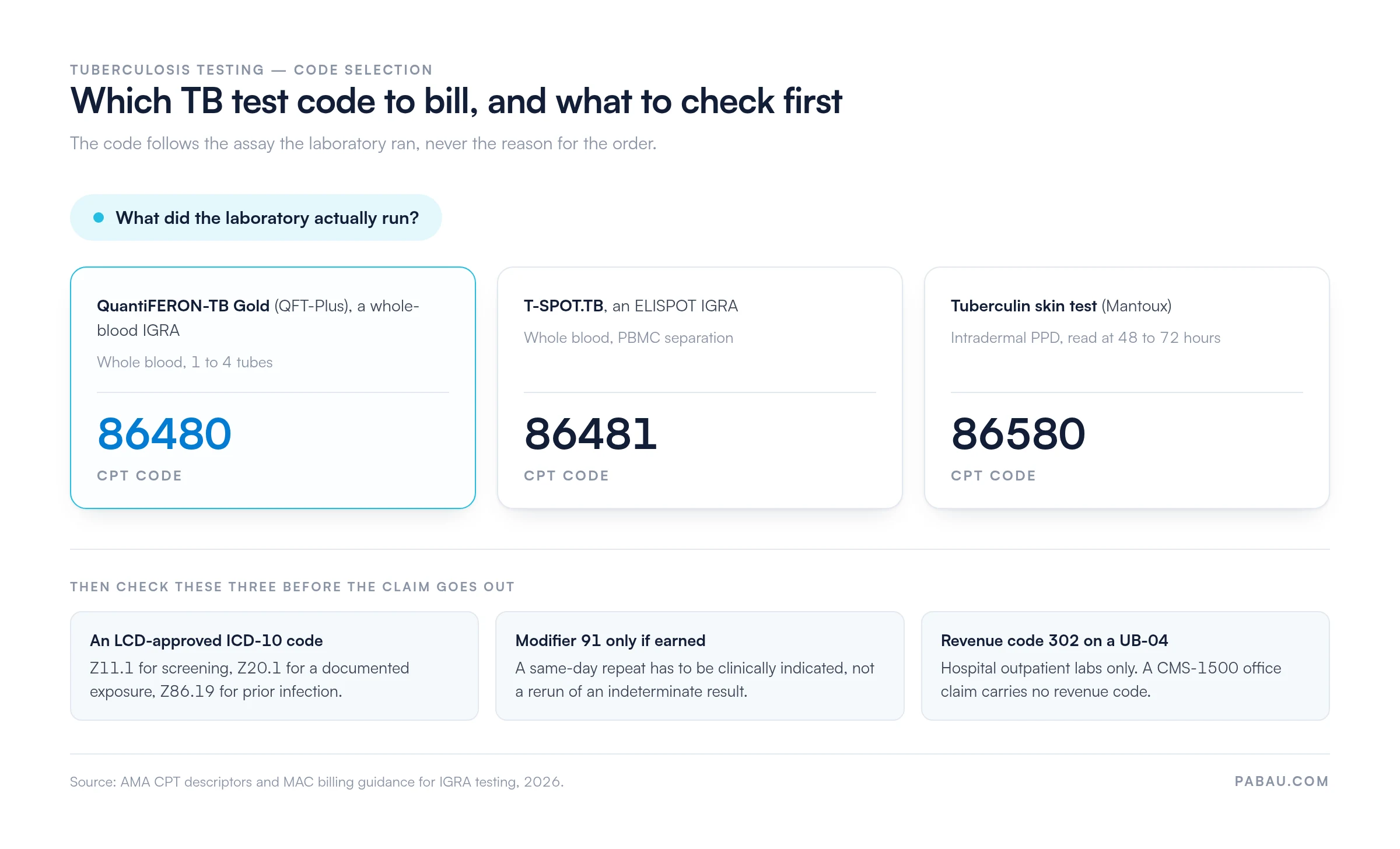
Revenue code 302 is the hospital outpatient laboratory revenue code linked to CPT 86480 when billing on a UB-04 claim form. Revenue code 302 designates laboratory/immunology services in hospital outpatient department settings.
When a hospital outpatient lab performs QuantiFERON-TB Gold testing, the facility submits a UB-04 pairing revenue code 302 with CPT 86480 in the service line.
Both the revenue code and the CPT code have to appear on the same claim line. A UB-04 missing the revenue code is rejected at the front end, before the claim reaches adjudication at all. Individual payer edits still vary, so check yours.
Physician office labs billing on a CMS-1500 form do not use revenue codes at all. That difference trips up billers when a practice moves between the two claim form types.
CPT 36415 (routine venipuncture) is separately billable with CPT 86480 under some payer policies. The answer varies more from payer to payer than any other part of IGRA billing. Blood collection for QuantiFERON-TB Gold testing requires a venipuncture, and 36415 describes that collection service.
Whether 36415 is separately reimbursable alongside 86480 depends on the payer:
Check your payer contract and the applicable Medicare LCD before routinely billing 36415 alongside CPT Code 86480. Assuming venipuncture is always separately billable leads to systematic overbilling, and that is the kind of pattern a payer audit finds quickly.
A payable 86480 claim needs a chart that shows why the test was ordered, who ordered it, and which assay the laboratory ran. On review, most MACs will not accept the diagnosis code on its own. The record has to carry the clinical story behind it.
For each 86480 claim, the record should contain:
Keep the order and the laboratory report in the same patient record. Auditors ask for both together. A record holding only the result cannot show that the test was ordered for a covered reason.
A clean pre-submission checklist for CPT 86480 should verify:
Billing tuberculosis IGRA tests cleanly comes down to documentation, code sequencing, and payer-specific rules. Teams handling high volumes of infectious disease labs should build 86480-specific claim edits into their pre-submission workflow rather than their appeals queue.
The most common denial reasons for CPT Code 86480 claims include:
Reading the remittance advice against a list of denial codes in billing helps billers spot a pattern before it compounds. For 86480, the two to watch are CARC 50 (not deemed a medical necessity) and CARC 96 (non-covered charge).
Both usually point to a missing LCD-required ICD-10 code or thin documentation. CARC 4 turns up as well, and it means something different. The procedure code is inconsistent with the modifier used, or a required modifier is missing. On an 86480 claim that almost always points at modifier 91 or QW.
A clean claim leaves the practice with the code, the diagnosis, the modifier, and the documentation already in agreement. Our guide to submitting a clean claim sets out the checks that apply to every lab line, not only to IGRA testing.
Manual claim preparation for high-volume lab codes like CPT Code 86480 is where systematic errors accumulate. A biller working from a superbill template that predates the current year’s LCD may pair the wrong ICD-10 code for months. The pattern only surfaces once denials pile up in the reports.
Practice management software like Pabau catches those errors at the claim-build stage instead of the denial-management stage. Claims route to Claim.MD, our US clearinghouse partner, which validates CPT and ICD-10 pairings against more than 4,000 payers before transmission.
ERA and 835 remittance files then post back to patient accounts automatically, so your billing staff stop reconciling payments by hand. Pabau’s claims management software flags a rejected 86480 line for correction in the same system that scheduled and documented the test.
Build a payer-specific billing rule for CPT 86480 inside your practice management system. Have it flag any claim that lacks Z11.1, Z20.1, or another LCD-approved ICD-10 code before submission. Applied consistently, that one edit heads off the most common denial reason for IGRA claims. Review the rule each quarter against current MAC LCD updates, since approved code lists change with the fiscal year.

Pabau’s built-in claims management tools validate codes and pair ICD-10 diagnoses automatically. Claims route through the Claim.MD clearinghouse, so billing errors get caught before submission.

Two decisions carry almost every 86480 denial. The first is whether the code matches the assay the laboratory actually ran. The second is whether the chart, and not just the diagnosis code, shows why the test was ordered.
Get those two right at the point of claim creation and the rest of this code’s rules are routine. One national CLFS rate removes the locality math, and a modifier only enters the picture on a same-day repeat. Leave either one to the denial queue and a $61.98 test turns into an appeal.
The practical move is to set both checks once, in the system that already holds the order, the result, and the claim. Book a demo to see how Pabau validates lab codes and ICD-10 pairings before an 86480 claim reaches the payer.

Need to understand how claims move through a clearinghouse? How a medical claims clearinghouse works explains the full submission lifecycle from practice to payer.
Want to reduce front-end billing errors before claims leave your system? Medical billing fundamentals covers the workflow steps where most errors originate.
Curious how 86480 denials compare to other lab code patterns? Claim.MD clearinghouse overview outlines how automated payer edits catch code-level errors before adjudication.
CPT Code 86480 is the billing code for a tuberculosis IGRA test, which measures cell-mediated immunity. It reports QuantiFERON-TB Gold testing for latent TB infection screening. It is distinct from CPT 86481 (T-SPOT.TB) and 86580 (tuberculin skin test).
CPT 86480 covers QuantiFERON-TB Gold assays (QIAGEN), which use a whole-blood tube method. CPT 86481 covers T-SPOT.TB assays (Oxford Immunotec), which use an ELISPOT method requiring peripheral blood mononuclear cell separation. Billing the wrong code for the assay actually performed is a coding error.
Medicare prices CPT 86480 on the Clinical Laboratory Fee Schedule, not the Physician Fee Schedule. The 2026 national rate is $61.98. CLFS amounts carry no geographic adjustment and no facility or non-facility split, so that figure applies in every locality.
The most commonly paired ICD-10-CM codes are Z11.1 (encounter for TB screening), Z20.1 (exposure to tuberculosis), and Z86.19 (personal history of infectious disease). Always confirm accepted codes against your MAC’s current LCD before filing.
Yes, CPT 86480 is the billing code used to report QuantiFERON-TB Gold and QuantiFERON-TB Gold Plus (QFT-Plus) assays. The code’s official CPT descriptor specifies gamma interferon measurement via cell-mediated immunity antigen response, which is the exact mechanism the QuantiFERON-TB Gold test uses.
The leading denial reasons are missing medical necessity documentation and incorrect code assignment, such as using 86480 for a T-SPOT result. ICD-10 codes outside the MAC’s approved list come next. Modifier 91 misuse and UB-04 revenue code errors follow.