ICD-10 Code J81.1: Chronic pulmonary edema
ICD-10 Code J81.1: Definition and code details ICD-10 code J81.1 is the billable...

Last Updated: Nov 16, 2026
Billable Code Specific Code
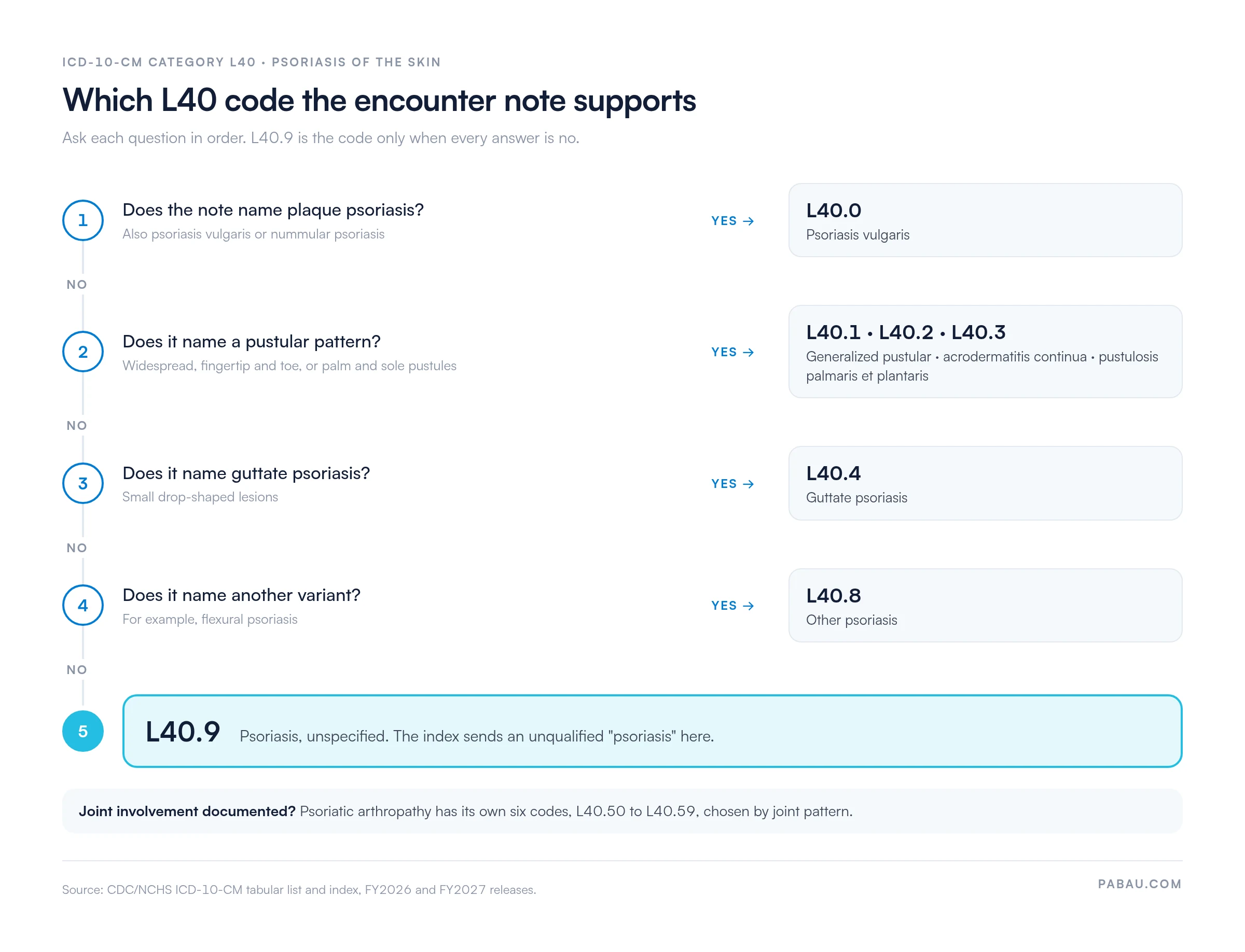
L40.9 is the billable ICD-10-CM code for psoriasis, unspecified. It applies when the record confirms psoriasis but names no subtype, such as plaque, guttate or pustular.
The ICD-10-CM index sends an unqualified "psoriasis" to L40.9. Once the note names a subtype, that subtype's own code applies, so plaque psoriasis or psoriasis vulgaris is L40.0.
Let Pabau's smart automation suggest the right codes, reduce claim denials, and keep your practice compliant—effortlessly.
Automate repetitive tasks and focus on what matters most—your patients.
Reduce coding errors and ensure compliance with the latest regulations.
Clean claims, fewer denials, and faster reimbursements.
Powerful insights and reporting to help your practice thrive.
HIPAA compliant SOC 2 certified GDPR-compliant Trusted by 4,000+ clinics worldwide

L40.9 is the billable ICD-10-CM code for psoriasis when the encounter note confirms the diagnosis but names no subtype.
A named subtype always moves the claim to its own code, so plaque psoriasis or psoriasis vulgaris is L40.0, never L40.9.
The FY2026 tabular list puts no Excludes note on L40.9, L40.5- or the L40 category. A rejected L40.9 and L40.5- pairing comes from payer edits.
Medicare Part D plans and most commercial plans require prior authorization for biologics, and many payers ask for BSA or PASI scores.
Pabau, the practice management platform we build, submits US claims through Claim.MD and tracks prior authorization codes on the patient’s case.
ICD-10 code L40.9 is the billable diagnosis code for psoriasis, unspecified. It sits in Chapter 12 (Diseases of the skin and subcutaneous tissue), block L40-L45 (Papulosquamous disorders). The code is unchanged in CDC’s FY2027 ICD-10-CM release, which applies to services from October 1, 2026.
The table below shows the core reference facts coders need before building a claim.
“Unspecified” does not put the diagnosis in doubt. It means the note describes psoriasis without naming its morphological subtype. When a subtype is documented, the guidelines require the more specific code.
The L40 category has eight subcategories and 13 billable codes. L40.5- expands to six of them, one per psoriatic arthropathy pattern. L40.9 is the residual code, so it applies only when the note supports none of its more specific siblings.
Read the table as a run of questions about the note. The path ends at L40.9 only when every answer is no.
The CDC/NCHS ICD-10-CM web tool shows the official tabular list and index for each of these codes. It includes inclusion notes and revision history by fiscal year.
L40.9 carries no notes of its own in the FY2026 tabular list. It has no inclusion terms and no Excludes1 or Excludes2 note. The L40 category and the L40.5 arthropathy subcategory carry none either, and the FY2027 tabular addenda add none.
When psoriatic arthritis is documented with skin psoriasis, pick the L40.5- code that matches the joint pattern first. Then decide whether the skin disease needs its own code, based on what the provider addressed. No tabular note forbids the pair, but payer edits can still question it.
Before you send L40.9 with an L40.5- code, check the current tabular Excludes notes and the payer’s own edits. The FY2026 tabular has no note on that pair. If the payer still rejects it, report the condition the provider addressed at that visit.
An unspecified code still needs specific documentation. ICD-10-CM Official Guidelines Section I.B.2 require each code to reach the highest level of specificity documented in the medical record.
To support ICD-10 code L40.9, the encounter note should contain the following:
The American Academy of Dermatology (AAD) coding resources add specialty guidance for psoriasis encounters. That includes severity scoring and treatment-stage documentation that supports medical necessity.
Medicare, Medicaid and most commercial payers accept L40.9 for routine dermatology office visits. The picture changes when high-cost treatments enter the claim.
Biologics: Medicare Part D plans and most commercial plans require prior authorization for biologic therapy, such as adalimumab, secukinumab and ixekizumab. The request usually needs L40.9 or a more specific psoriasis code. It also needs documented failure of conventional therapy, such as topicals, phototherapy or systemic drugs. Some local coverage determinations (LCDs) list the psoriasis codes that qualify, so check the applicable LCD first. Older psoriasis claims may still carry deleted code S0162, which described efalizumab, a biologic withdrawn from the US market in 2009.
Phototherapy: CPT codes 96900, 96910, 96912 and 96913 usually pair with L40.9 on phototherapy claims. Medicare requires each phototherapy visit to meet medical necessity criteria. Some jurisdictions also ask for documented topical therapy failure before they approve a course.
Medicaid: State Medicaid programs vary widely. Biologics are often non-covered or need step therapy through preferred agents first. Verify coverage at the state plan level before you discuss costs with patients.
A missing authorization is easier to catch before the visit than after the denial. Claims management software that keeps the auth code, dates and approved sessions on the patient’s case can warn staff when a session has none. Payer LCDs change each fiscal year, so review your billing compliance requirements for psoriasis annually.
Denials on L40.9 claims share a small set of root causes. The table below maps each one to its fix.
Tracking denials by reason code and payer shows which of these patterns repeat, so the billing team fixes each cause once. Denial management sets out that workflow, and the medical billing denial codes reference explains each reason code.
The procedure code paired with L40.9 drives the reimbursement. These CPT and HCPCS codes are commonly billed with ICD-10 code L40.9 in dermatology, with notes on medical necessity.
Tar and UVB courses have billing rules of their own, which the 96910 guide covers. For office visits, medical billing fundamentals help clinical staff document the decision-making behind each E/M level. That cuts downcoding on L40.9 claims.
Plaque psoriasis is the most common subtype, and most estimates put it at over 80% of cases. That makes L40.9 and L40.0 the pair coders confuse most often.
The decision rule has two branches:
The choice changes payment on biologic claims. Some payer LCDs list specific L40 codes as qualifying diagnoses, and L40.9 may not be on that list. A claim coded L40.9 when the note supports L40.0 can then be denied for a non-qualifying diagnosis.
Psoriatic arthritis (PsA) codes, L40.50 through L40.59, describe joint involvement in psoriatic disease. They need their own documentation. That means the joint distribution, the pattern (distal interphalangeal, mutilans, spondylitic, juvenile or other) and clinical evidence of inflammatory arthropathy.
Whether L40.9 and an L40.5- code go on the same claim depends on the reason for the visit and the payer’s edits:
L40.9 has not changed in the FY2026 or FY2027 ICD-10-CM release. The descriptor is still “Psoriasis, unspecified,” the code is still billable, and neither update added an Excludes note or inclusion term. The FY2027 release took effect on October 1, 2026, and no crosswalk or revalidation is needed.
The rest of the L40 category is unchanged too, at 13 codes. You can confirm this in the FY2027 addenda files listed on the CMS ICD-10 codes page. Existing claims and superbills that use L40.9 need no change.
Add L40.9 to your annual code review even though it rarely changes. Codes that clinicians pick by habit cause the most trouble. A 10-minute tabular review each October catches new notes before they cause denials.
Entering ICD-10 code L40.9 correctly in the EHR keeps the code on the claim in line with the clinical note. The standard dermatology workflow has five steps.
Checking the diagnosis-procedure pairing before submission is what gets you a clean claim on the first pass.
In many dermatology practices, the diagnosis travels by hand. The clinician writes psoriasis in the note, and the billing team picks a code days later. A plaque description can then become L40.9 on the claim, or a biologic session can run without an authorization on file.
Pabau records the visit, the diagnosis and the insurance case in one patient record. US claims go out as CMS-1500 claims through Claim.MD, with eligibility checks and ERA remittances handled in the same place.
Prior authorization sits on the case too. Staff record the auth code, its dates and the approved sessions, and Pabau warns them when one is missing. So the team spots a missing authorization before the patient sits down for phototherapy or a biologic dose.

Pabau keeps the diagnosis, the authorization and the claim in one patient record. US claims go through Claim.MD, so your billing team spends less time on rework.

Treat L40.9 as the code for a note that names no subtype, not as the default for psoriasis. A well-documented psoriasis chart will carry L40.0 or another specific code far more often.
The biggest payoff comes before the claim is built. Ask clinicians to name the subtype when they see it, and check biologic orders for an authorization before the visit. Those two habits head off the denial patterns in the table above.
Book a demo to see how Pabau keeps psoriasis diagnoses, authorizations and claims in one record for your dermatology practice.

Need to track denial patterns across your dermatology claims? Denial management in healthcare covers how to categorize and address recurring denial reason codes before they compound into revenue loss.
Submitting claims electronically for the first time? Claim.MD clearinghouse overview explains how the clearinghouse validates claims, routes 837P files and returns ERAs for psoriasis and other dermatology claims.
Screening a patient before a biologic starts? HCPCS code M1003 covers how to bill TB screening before biologic therapy.
ICD-10 code L40.9 is the billable diagnosis code for psoriasis, unspecified. It means psoriasis is clinically confirmed, but the note names no subtype such as plaque, guttate or pustular. It sits at the end of the L40 category in Chapter 12 and is valid, unchanged, in FY2026 and FY2027.
Use L40.9 only when the note confirms psoriasis but does not name or clearly describe the subtype. If the note documents plaque psoriasis, use L40.0. If it documents guttate psoriasis, use L40.4. Guidelines Section I.B.2 requires the most specific code the record supports, so L40.9 is never a shortcut for an incomplete note.
L40.0 is psoriasis vulgaris, which includes plaque and nummular psoriasis. L40.9 is psoriasis with no subtype documented. The note alone decides between them. Plaque psoriasis accounts for over 80% of cases, so a well-documented chart should carry L40.0 far more often than L40.9.
Five patterns cover most L40.9 denials. The payer may find the diagnosis inconsistent with, or not covered for, the procedure (CO-11 or CO-167). Medical necessity may be unproven without BSA or PASI documentation (CO-50). The CPT code may fall outside the payer’s crosswalk (CO-11). A biologic or phototherapy session may lack authorization (CO-15). An L40.5- code billed with L40.9 can trip a payer edit, returned as CO-16 or the payer’s edit-specific code.
No. L40.9 is unchanged in the FY2026 and FY2027 ICD-10-CM releases. The descriptor is still Psoriasis, unspecified, the code is still billable, and no Excludes notes or inclusion terms were added. Confirm it each October in the addenda files on the CMS ICD-10 codes page.
No. Psoriatic arthritis is coded L40.50 through L40.59, and L40.9 covers skin psoriasis only. The two can go on one claim when both conditions received attention and the note supports both. The FY2026 tabular has no Excludes note on that pair, but check the current tabular Excludes notes and payer edits before you dual-code.