CPT code 59618: Cesarean after attempted VBAC billing guide
CPT code 59618 bills a cesarean after a VBAC attempt CPT code 59618 is the globa...

Last Updated: Nov 4, 2026
L2132 is the HCPCS Level II code for a soft, prefabricated femoral fracture cast orthosis. The brace is a knee ankle foot orthosis (KAFO), and the code includes fitting and adjustment.
It is the soft stock brace that holds a healing femur and crosses the knee, ankle and foot. Billers most often confuse it with L2134 and L2136, its semi-rigid and rigid siblings. A soft brace for a tibial fracture stops below the knee and bills under L2112, not L2132.
Let Pabau's smart automation suggest the right codes, reduce claim denials, and keep your practice compliant—effortlessly.
Automate repetitive tasks and focus on what matters most—your patients.
Reduce coding errors and ensure compliance with the latest regulations.
Clean claims, fewer denials, and faster reimbursements.
Powerful insights and reporting to help your practice thrive.
HIPAA compliant SOC 2 certified GDPR-compliant Trusted by 4,000+ clinics worldwide

HCPCS code L2132 covers a soft, prefabricated femoral fracture cast orthosis that spans the knee, ankle and foot, with fitting and adjustment included.
L2134 and L2136 are the semi-rigid and rigid versions of the same stock brace, so the brace’s rigidity decides which of the three you bill.
L2126 and L2128 are the custom-fabricated codes in the family, and the tibial fracture codes such as L2112 cover a different, below-knee brace.
Under LCD L33686, Medicare covers a KAFO for patients who walk, qualify for an ankle-foot orthosis, and need added knee stability.
From October 15, 2026, CMS’s probationary prior authorization list includes L2132, so newly enrolled Medicare suppliers need approval before delivery.
In Pabau’s practice software, the written order, fitting record and delivery receipt stay attached to the L2132 claim they support.
The Centers for Medicare & Medicaid Services (CMS) publishes the official descriptor for HCPCS code L2132.
It reads: Knee ankle foot orthosis (KAFO), fracture orthosis, femoral fracture cast orthosis, soft, prefabricated, includes fitting and adjustment. The short descriptor is “Kafo femoral fx cast soft”.
The code took effect on January 1, 2001, and sits in the orthotics section of the HCPCS procedure codes. It describes a fracture brace for the thigh bone that also crosses the knee and ankle and supports the foot.
Each phrase in the descriptor narrows the choice. “Femoral fracture cast orthosis” names the job: holding a healing femur, the way a cast would, while the patient starts to move again. “Soft” is the lowest of three rigidity levels in this family.
“Prefabricated” means the supplier starts from a stock brace instead of building one over a model of the limb. “Includes fitting and adjustment” folds the trimming, strapping and fine-tuning into the code, so that work carries no separate charge.
L2132 is not an ankle-foot orthosis, and it has no spring-wire or dorsiflexion-assist parts. Those features belong to other code families, covered further down.
The descriptor draws a tight boundary. Use the two lists below to check the delivered brace against it before you pick the code.
Audit risk: CMS Policy Article A52457 lists L2132 among the custom-fitted prefabricated codes. Those items need more than minimal self-adjustment, and a qualified practitioner has to do that work. The fitting record should show who fitted the brace and what they adjusted.
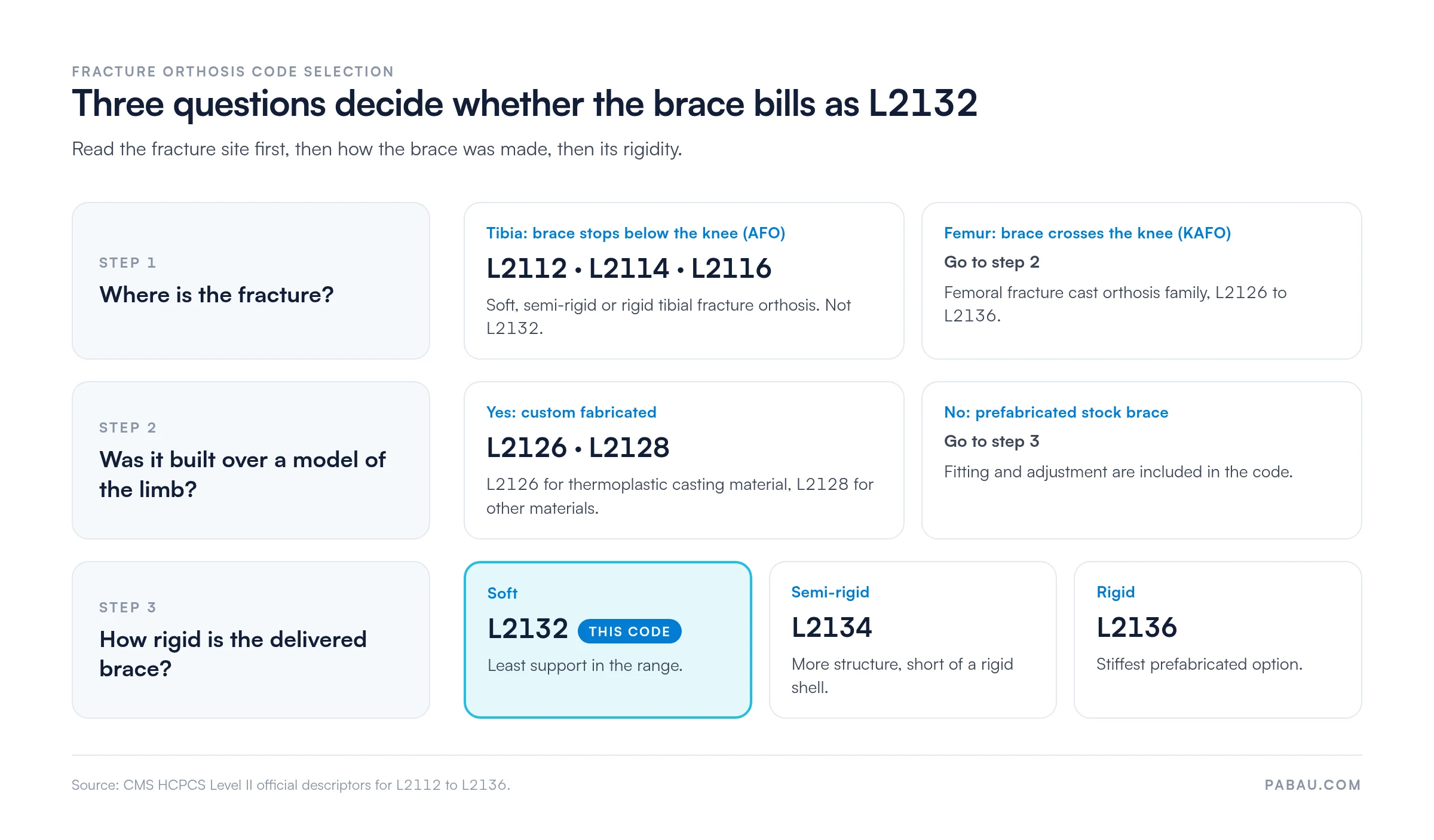
L2132 sits in a five-code range of femoral fracture cast orthoses. Two codes are custom fabricated and three are prefabricated. Among the prefabricated three, only rigidity changes, so match the code to the brace you delivered.
There is no L2130 in this family, so a claim under L2130 rejects as an invalid code. Rigidity is the only line between L2132, L2134 and L2136, and the manufacturer’s product listing states it.
The tibial fracture orthoses sit just below this family in the code set, and their descriptors read almost the same. The difference is anatomy. A tibial fracture brace is an ankle-foot orthosis, while L2132 crosses the knee to hold the femur.
Read the fracture site before you read the rigidity. A soft brace for a tibial shaft fracture bills under L2112, even though “soft, prefabricated” matches L2132 word for word.
L2132 is prefabricated, so the product itself carries the coding decision. Once the fracture site points to the femur, two questions settle it. Was the brace built over a model of the limb, and if not, how rigid is it? The diagram runs all three checks in order.
PDAC stands for the Pricing, Data Analysis and Coding contractor. It reviews manufacturer products and confirms which HCPCS code a supplier may bill for each one. For a stock brace, that listing is the strongest evidence that the product is soft.
Check the product against the PDAC listing before you bill it under L2132. Record the product name, model number and verified code in the patient file. Where no verification exists, confirm the payer’s rules first.
Medicare Part B covers L2132 under the brace benefit, and the claim goes to the DME MAC for the patient’s region. LCD L33686 governs coverage for ankle-foot and knee-ankle-foot orthoses.
Its KAFO test has two halves, and the record has to support both.
Confirm coverage before the brace goes out. Insurance eligibility verification at the ordering stage catches a lapsed plan or a Medicare Advantage plan with its own rules.
The ICD-10-CM codes below commonly support L2132 claims. A diagnosis code alone does not establish coverage. The record must also show why the knee needs added stability.
Always use the most specific fracture code the record supports. Laterality has to match across the diagnosis, the order and the claim line.
Bill the initial encounter fracture code (7th character A) at supply. If the brace is still in use at a later visit, the diagnosis moves to the subsequent encounter code (7th character D). A mismatch between the encounter character and the date of service is an easy audit flag.
CMS Policy Article A52457 sets out what a KAFO claim needs. A stock brace needs no model or fabrication notes, but the file has to prove which product was fitted. That proof gets recorded at the fitting, when the product and its rigidity are in front of the fitter.
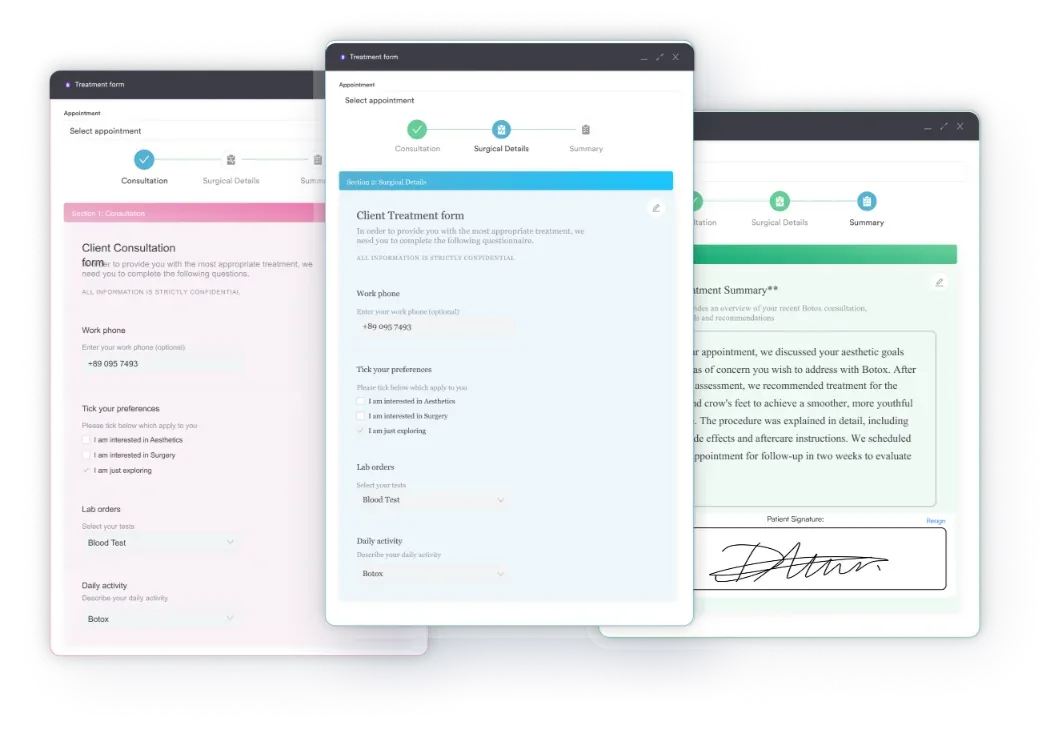
Pabau’s digital intake forms can standardize this checklist, so each L2132 file is complete before billing.
L2132 denials cluster around wrong code selection, incomplete documentation and modifier errors. Each one has a distinct fix, and a pre-billing check catches most of them.
Track the reason code on every returned claim. Denial management workflows feed that data back into the pre-billing checklist.
Policy Article A52457 requires RT or LT on every orthosis base code. It also says a KAFO claim line with no KX, GA or GZ modifier rejects as missing information.
A bilateral supply goes on two claim lines, one with RT and one with LT, each for one unit. Apply KX only when the documentation is complete.
Medicare Fee-for-Service DME MACs can require prior authorization for L2132 under CMS’s DMEPOS probationary prior authorization list. The listing took effect on October 15, 2026, and covers L2134 and L2136 too. It applies to newly enrolled suppliers and to suppliers going through certain changes of ownership.
Where the requirement applies, obtain prior authorization before you deliver the brace for any Medicare Fee-for-Service date of service on or after October 15, 2026. CMS can update the list, so check the current version and your DME MAC’s guidance first. Medicare Advantage plans set their own rules, and many review KAFO codes before supply.
Commercial and Medicaid managed-care payers vary by plan and contract year. Verify eligibility and authorization before fitting, because a fracture brace is usually needed within days.
Medicare prices L2132 from the DMEPOS fee schedule, not from the physician fee schedule. Allowables vary by state and change every January 1. Download the current CMS DMEPOS fee schedule and read the allowable for your state.
The patient generally owes 20% of the allowable once they meet the Part B deductible, unless a supplemental plan covers it. Medicaid rates are set by each state, so check the state fee schedule before billing.
A clean claim on the first pass avoids the appeal cycle that a missing modifier or receipt sets off.
Suppliers billing fracture braces carry a documentation load that grows with claim volume. The written order, fitting record, product listing and delivery receipt all have to be in place first. Most teams hold them across a shared drive, an email thread and the billing system.
In Pabau, those records sit in the same patient file as the claim. Its claims management software runs eligibility checks before the appointment and pulls denial reasons off remittance advice for follow-up.
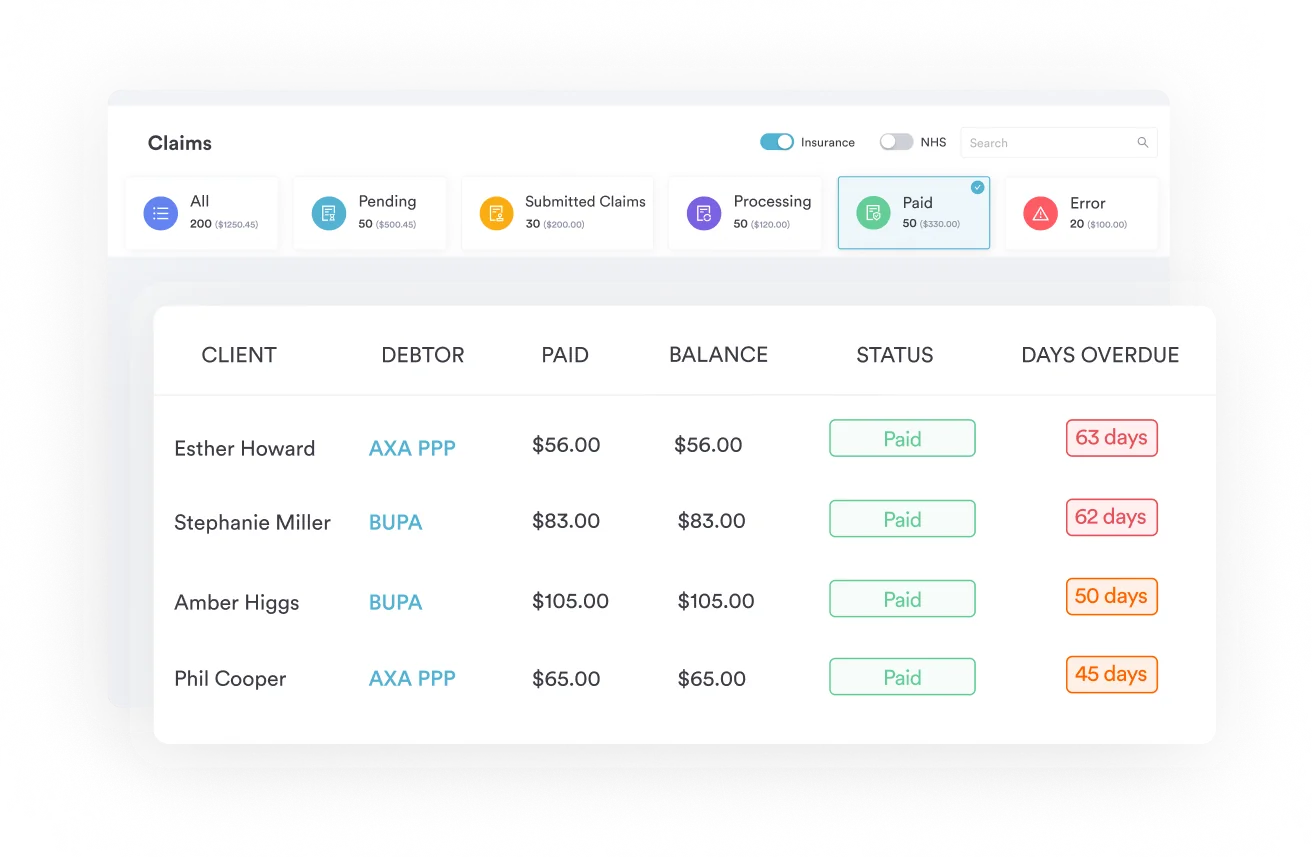
Capturing the HCPCS code, modifiers and diagnosis in one structured record cuts transcription errors at submission. Pabau’s denial tracking then flags unresolved L2132 claims while there is still time to appeal.

Pabau’s claims management tools help suppliers and billing teams capture orthosis documentation, run eligibility checks, and track denial reasons in one place. See how it fits an L-code billing workflow.

L2132 is a narrow code: A soft, stock femoral fracture brace that crosses the knee, fitted and adjusted by the supplier. Its errors come from neighbors that read almost the same. Rigidity separates it from L2134 and L2136, and fracture site separates it from L2112.
So the claim stands on the product record as much as on the clinical note. Name the model and its rigidity in the fitting notes, and keep the order and delivery receipt beside them. A newly enrolled Medicare supplier also needs the prior authorization decision on file before the brace goes out.
Get those records right once and every L2132 claim after it follows the same path. To see how Pabau keeps HCPCS L-code paperwork attached from order to payment, book a demo.

Billing the semi-rigid version of this brace? HCPCS code L2134 covers the semi-rigid prefabricated femoral fracture cast orthosis.
Billing the rigid version? HCPCS code L2136 explains the rigid stock brace and why custom-fabrication criteria do not apply.
Billing a brace built over a model of the limb? HCPCS code L2128 covers the custom-fabricated femoral fracture cast orthosis.
Working with thermoplastic casting material? HCPCS code L2126 explains when a custom thermoplastic fracture brace bills under its own code.
Checking coverage before the brace goes out? Insurance eligibility verification walks through the checks that catch a lapsed plan before fitting day.
HCPCS code L2132 covers a soft, prefabricated femoral fracture cast orthosis that spans the knee, ankle and foot. The code includes fitting and adjustment by the supplier. A semi-rigid brace bills under L2134, a rigid one under L2136, and a custom-fabricated brace under L2126 or L2128.
No. L2132 is a knee-ankle-foot orthosis (KAFO) for a femoral fracture, so it crosses the knee. The soft prefabricated brace for a tibial fracture is an ankle-foot orthosis and bills under L2112.
All three are prefabricated femoral fracture cast orthoses that include fitting and adjustment. They differ only by rigidity. L2132 is soft, L2134 is semi-rigid, and L2136 is rigid, so the product listing for the delivered brace decides the code.
Yes, Medicare Part B covers L2132 under the brace benefit when the record meets LCD L33686. The patient must be able to walk, qualify for an ankle-foot orthosis, and need added knee stability. Medicare Advantage plans set their own coverage and authorization rules.
It can. Since October 15, 2026, CMS lists L2132 on its DMEPOS probationary prior authorization list, which covers newly enrolled suppliers and certain ownership changes. Medicare Advantage, Medicaid and commercial plans set their own rules, so check each plan before delivery.
Every L2132 claim line needs RT or LT for the leg fitted. It also needs KX when the coverage criteria are met, or GA or GZ when they may not be. A bilateral supply goes on two lines, each for one unit.
No. The L2132 descriptor includes fitting and adjustment, so that work is part of the code. Billing it separately is an unbundling error that payers deny or recoup.