HCPCS Code L0472: Hyperextension TLSO billing guide
HCPCS code L0472: Official descriptor and device definition HCPCS code L0472 des...

Last Updated: Nov 5, 2026
L2000 is the HCPCS code for a custom-fabricated, single-upright knee ankle foot orthosis (KAFO) with a free knee and a free ankle. Its solid stirrup attaches to the shoe, and thigh and calf bands or cuffs hold it to the leg.
Medicare covers L2000 under LCD L33686 for ambulatory patients who qualify for an ankle-foot orthosis and need additional knee stability. The record must also justify custom fabrication, and each claim line carries RT or LT plus KX, GA or GZ.
Let Pabau's smart automation suggest the right codes, reduce claim denials, and keep your practice compliant—effortlessly.
Automate repetitive tasks and focus on what matters most—your patients.
Reduce coding errors and ensure compliance with the latest regulations.
Clean claims, fewer denials, and faster reimbursements.
Powerful insights and reporting to help your practice thrive.
HIPAA compliant SOC 2 certified GDPR-compliant Trusted by 4,000+ clinics worldwide

HCPCS code L2000 is a custom-fabricated knee ankle foot orthosis (KAFO) with one upright, a free knee joint, a free ankle and a solid stirrup.
Medicare covers L2000 under LCD L33686 for ambulatory patients who qualify for an ankle-foot orthosis and also need additional knee stability.
Because L2000 is custom fabricated, the record must also meet one of five LCD criteria showing why a prefabricated orthosis would not do.
Policy Article A52457 lists no covered ICD-10 codes for L2000, so coverage rests on documented function rather than a diagnosis list.
Every L2000 line needs RT or LT plus KX, GA or GZ, and a line without one of those three is rejected.
HCPCS code L2000 describes a custom-fabricated knee ankle foot orthosis (KAFO) built on one upright bar, with a free knee and a free ankle. A solid stirrup fixes it to the shoe, and thigh and calf bands or cuffs hold it to the leg.
CMS calls it a single bar ‘AK’ orthosis, and it opens the L2000-L2038 KAFO range of the HCPCS Level II code set.
Medicare pays for L2000 under the braces benefit. The DME MACs set coverage in LCD L33686 and Policy Article A52457. The patient must walk, qualify for an ankle-foot orthosis and need extra knee stability. The record must also justify a custom-fabricated device over a prefabricated one.
Each phrase in the descriptor names a component the delivered orthosis must have. When one of them differs, a neighboring code usually describes the device better.
Evaluation, measurement, casting and fitting are part of the L2000 allowance. Policy Article A52457 allows no separate payment for those services.
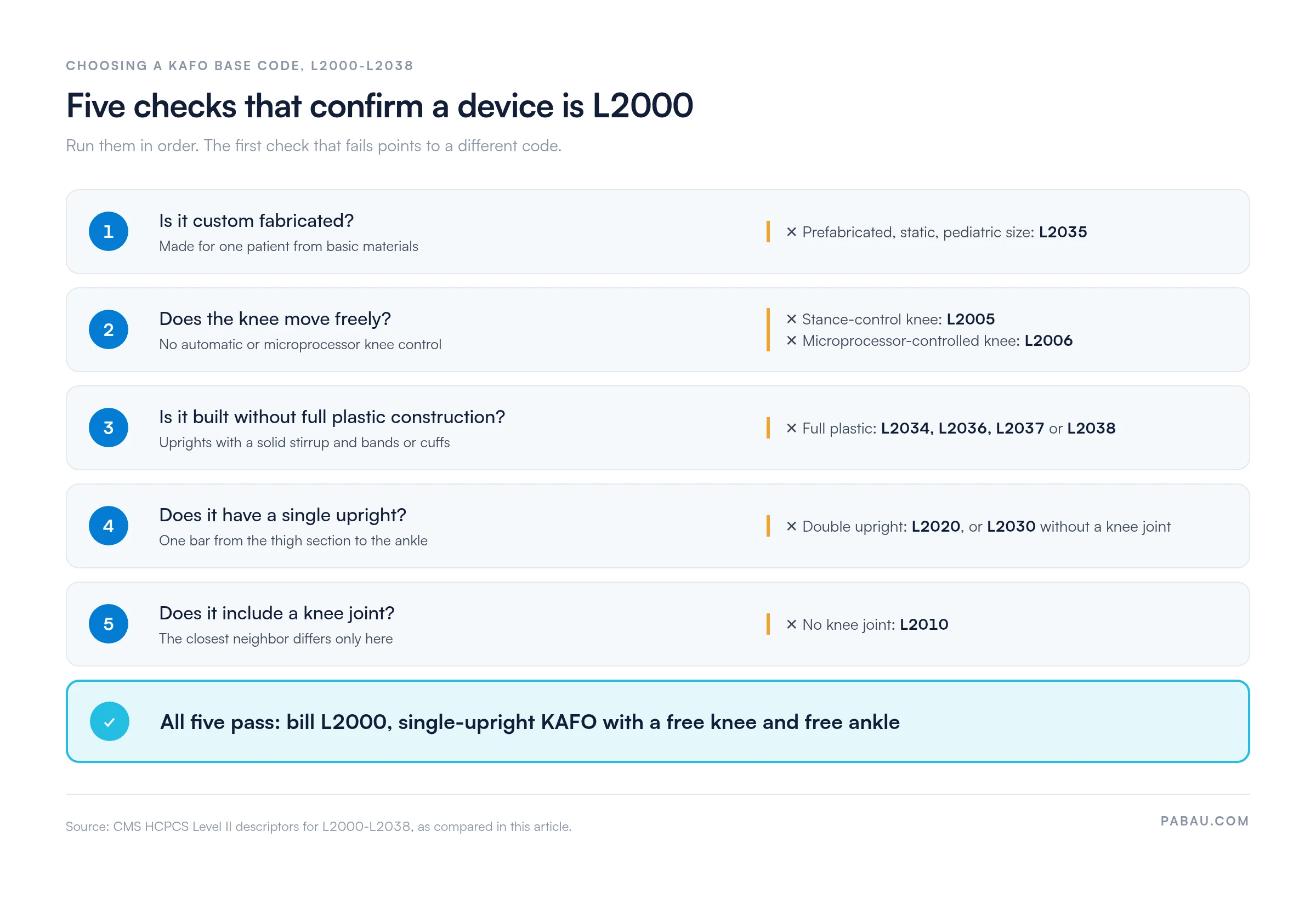
The L2000-L2038 codes split on four features: uprights, knee joint, material and fabrication. Check the delivered device against each before choosing a code.
The closest neighbor is L2010. Both share the single upright, solid stirrup, cuffs and custom fabrication, but only L2000 has a knee joint. A stance-control knee points to L2005, whose descriptor already includes the knee mechanism and an ankle joint.
Check the device in a fixed order. The first check it fails names the code to bill instead.
LCD L33686 covers a KAFO for an ambulatory patient who qualifies for an ankle-foot orthosis and needs additional knee stability. The ankle-foot orthosis test has three parts:
When those basic criteria are not met, the LCD denies the orthosis as not reasonable and necessary.
Because L2000 is custom fabricated, the record must also meet one of these five LCD criteria:
A custom orthosis that meets the basic criteria but none of these five is still denied. The treating practitioner’s notes carry the justification, and the orthotist’s functional evaluation should corroborate it.
Policy Article A52457 does not list covered ICD-10 codes for L2000. Its diagnosis groups apply only to L4392, L4396, L4397 and L4631. For every other code, it states that diagnoses are not specified.
Coverage therefore rests on function. The claim still carries the ICD-10 code for the condition behind the weakness or instability. The record then has to show how that condition affects walking, the ankle and the knee.
Treat any third-party table of covered L2000 diagnoses with caution, because neither the LCD nor the policy article publishes one.
LCD L33686 and Policy Article A52457 set out what must exist before the claim goes out. Medical billing compliance for DME claims starts with this file:
General rules for every DME MAC claim sit in the Standard Documentation Requirements Article, A55426. The KAFO-specific rules sit in A52457.
Policy Article A52457 requires two modifiers on every L2000 line: a side modifier and a coverage-status modifier.
A line without KX, GA or GZ is rejected as missing information. For a pair, bill two lines with one unit each, one with RT and one with LT. A single line with RTLT and two units is rejected as incorrect coding.
The same RT and LT rule covers additions and replacement parts. Bill every orthosis code for the same date of service on one claim.
Medicare pays L2000 from the DMEPOS fee schedule, which CMS updates each year and publishes by state. After the Part B deductible, Medicare pays 80% of the allowed amount and the patient owes 20% coinsurance.
Policy Article A52457 also folds payment into a hospital or Part A skilled nursing facility stay in some situations. Check its timing rules when the orthosis is delivered around an inpatient admission or discharge.
Repairs have their own codes. L4205 covers repair labor in 15-minute units, and it covers adjustments only when they happen more than 90 days after delivery.
Most L2000 denials trace back to the coverage file rather than the device. Denial management works best when you sort them by cause:
Recovery Audit Contractors run complex reviews of AFO and KAFO claims under approved RAC topic 0013. The topic covers L1900 through L4631, so L2000 is in scope. Reviewers test medical necessity and documentation against LCD L33686 and A52457.
The first appeal level is a redetermination by the DME MAC, filed within 120 days of the initial determination. A reconsideration by a Qualified Independent Contractor follows, filed within 180 days of the redetermination decision.
Rebuild the file around the stated denial reason before you file. For a coverage denial, show where the record meets each LCD criterion. For a coding denial, map the delivered device to each part of the L2000 descriptor. The denial codes reference guide explains the CARC and RARC codes on your remittance.
Check the fabrication notes against the L2000 descriptor before the claim goes out. Single upright, free knee, free ankle, solid stirrup, thigh and calf cuffs and custom fabrication should each appear. If the notes can’t support one of them, a different KAFO code probably fits the device.
Orthotic claims usually stall on paperwork spread across systems. The order arrives in one inbox, the casting notes sit in another, and the delivery receipt is scanned weeks later.
Pabau, the practice management and billing platform we build, keeps those records on the patient file. Its medical billing software opens each claim pre-filled from the invoice, using the insurer details stored on the patient record.
Before submission, Pabau scrubs the claim for missing or invalid details and flags any claim that needs correcting. US claims go out as CMS-1500s through the Claim.MD clearinghouse, and the dashboard tracks each one from pending to paid.
Your team still chooses the code, the modifiers and the diagnosis. Pabau makes sure what they chose reaches the payer complete, so fewer L2000 claims come back for missing information.

Pabau pre-fills each claim from the invoice and patient record, checks it for missing details, and tracks it until it is paid.

L2000 fits one device: a custom-fabricated, single-upright KAFO with a free knee and a free ankle. Once the descriptor matches the device, the claim turns on two questions.
Does the record show an ambulatory patient who needs knee stability beyond an AFO? Does it show one of the five reasons for custom fabrication? Answer both in the treating practitioner’s notes before fabrication starts, and the KX modifier becomes a statement you can defend.
Book a demo to see how Pabau keeps orthotic claims complete from the first order to the final payment.

Need help understanding orthotic billing compliance requirements? Medical billing compliance for DME claims covers the documentation and regulatory standards that keep HCPCS claims audit-ready.
Want to decode the denial codes on your remittance? Denial codes in medical billing explains CARC and RARC codes and how to use them to build stronger appeals.
Looking for a broader overview of how medical billing works? What is medical billing covers the full revenue cycle from claim creation to payment posting.
Is the device missing a knee joint? HCPCS code L2010 covers the single-upright KAFO built without one.
Does the KAFO have two uprights and no knee joint? HCPCS code L2030 explains when the double-upright version applies.
HCPCS code L2000 describes a custom-fabricated knee ankle foot orthosis with a single upright, a free knee and a free ankle. It attaches to the shoe with a solid stirrup and to the leg with thigh and calf bands or cuffs. CMS calls it a single bar ‘AK’ orthosis.
L2000 includes a free knee joint, and L2010 has no knee joint. Otherwise the two descriptors match: single upright, free ankle, solid stirrup, thigh and calf bands or cuffs, custom fabricated. Bill the code that matches the knee on the delivered device.
Yes, when LCD L33686 criteria are met. The patient must be ambulatory, qualify for an ankle-foot orthosis and need additional knee stability. Because L2000 is custom fabricated, the record must also meet one of five custom-fabrication criteria.
Yes, when every LCD coverage criterion is met and the evidence is in the supplier’s file. If the criteria are not met, use GA with a valid ABN or GZ without one. A line with none of the three is rejected, and RT or LT is required as well.
No. Policy Article A52457 lists covered diagnoses only for L4392, L4396, L4397 and L4631. For L2000 it states that diagnoses are not specified, so coverage depends on documented function.