CPT Code 26410: Hand extensor tendon repair billing guide
CPT code 26410: Official descriptor and procedure overview CPT code 26410 report...

Last Updated: Nov 24, 2026
K0672 is the HCPCS Level II code for an addition to lower extremity orthosis, removable soft interface, all components, replacement only, each. It covers a new removable liner and padding set for an orthosis the patient already uses, such as a molded plastic ankle-foot orthosis (AFO).
CMS added K0672 on April 1, 2008, as a temporary code for durable medical equipment (DME) claims. It is billed only when a worn or damaged interface is replaced. It is not a knee orthosis code, because knee orthoses carry their own L-codes. Each claim names the component, the reason for replacement, and the base orthosis code.
Let Pabau's smart automation suggest the right codes, reduce claim denials, and keep your practice compliant—effortlessly.
Automate repetitive tasks and focus on what matters most—your patients.
Reduce coding errors and ensure compliance with the latest regulations.
Clean claims, fewer denials, and faster reimbursements.
Powerful insights and reporting to help your practice thrive.
HIPAA compliant SOC 2 certified GDPR-compliant Trusted by 4,000+ clinics worldwide

HCPCS code K0672 bills a replacement removable soft interface, with all its components, for a lower extremity orthosis the patient already uses.
It is a temporary DME MAC code, added on April 1, 2008, and it is never billed at the initial delivery of an orthosis.
K0672 is not a knee orthosis code. Knee orthoses are billed with L-codes in the L1810 to L1860 range.
Each claim names the component, the reason for replacement, and the base orthosis code, with an RT or LT modifier on the line.
Pabau, a practice management and billing platform, keeps the base orthosis, the replacement history, and the treated side on one patient record.
HCPCS code K0672 is the code for an addition to lower extremity orthosis, removable soft interface, all components, replacement only, each. CMS Transmittal 1534 (Change Request 6075) added it to the HCPCS file on April 1, 2008, as a code for replacement interface material.
The soft interface is the removable liner and padding that sits between the patient’s skin and the rigid shell of the brace. On a molded plastic ankle-foot orthosis (AFO) or knee-ankle-foot orthosis (KAFO), it cushions pressure-sensitive areas of the limb. Liners wear out long before the shell does, so K0672 lets a supplier replace the interface alone.
K-codes are temporary HCPCS Level II codes that CMS assigns for DME Medicare Administrative Contractor (DME MAC) use. K0672 has no termination date, so it remains valid for current dates of service. Claims go to the DME MAC for the beneficiary’s state of residence.
K0672 covers one complete removable soft interface for a lower limb orthosis the patient already has. “All components” means the liner and every piece of padding that makes up that interface. They are billed together as one unit, never piece by piece.
The code does not cover the following items:
Several HCPCS codes describe a soft interface, and the right one depends on two questions. Is this the first interface or a replacement? And which device does it fit? The decision path below answers both, and the table after it gives each descriptor from the CMS HCPCS file.
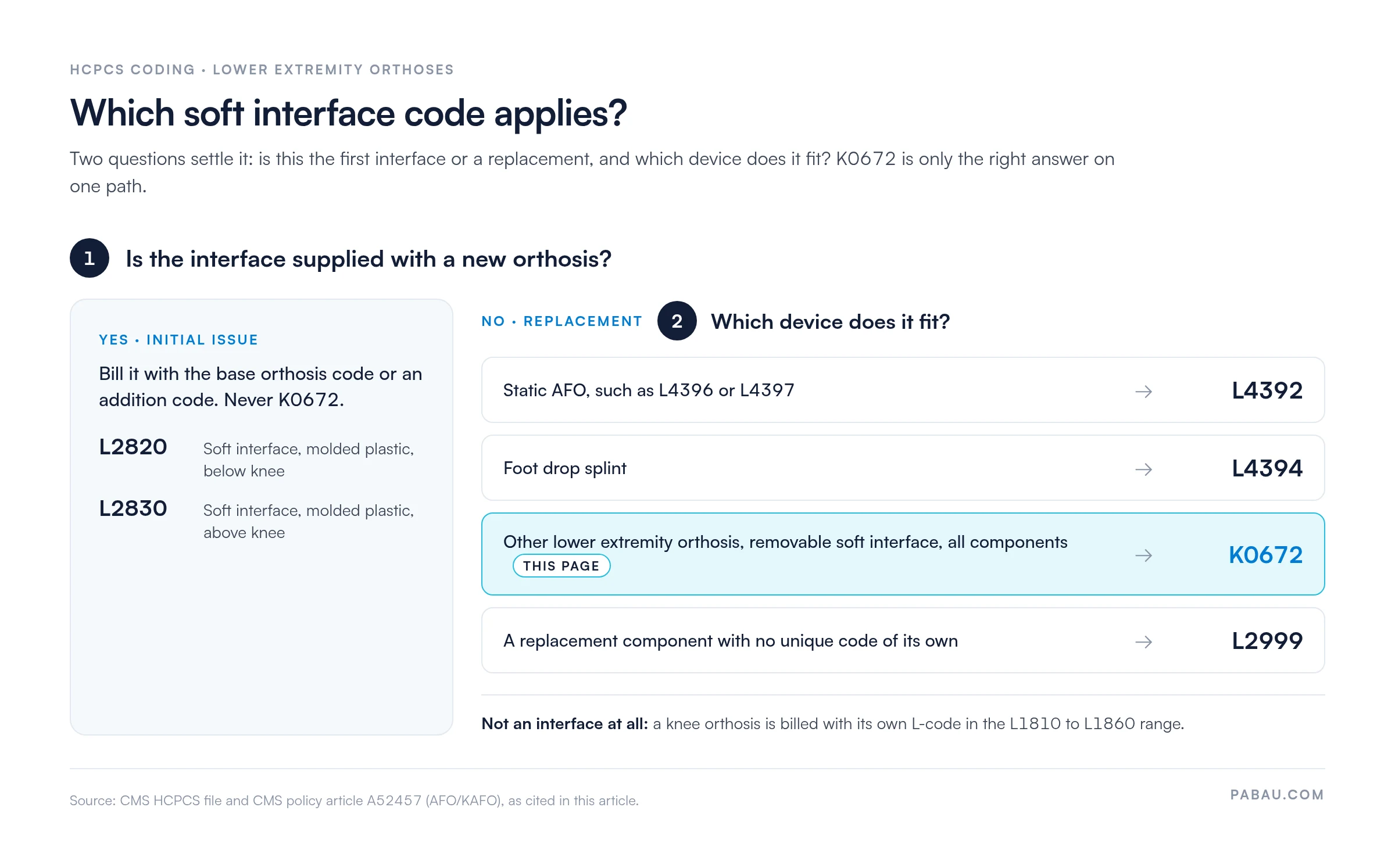
The AFO/KAFO policy article (A52457) says replacement component codes are not payable at the initial issue of a base orthosis. Billed at that point, they are rejected as incorrect coding. The same article sends components without a unique code to L2999, and bars a NOC code for items that have one.
Medicare pays for K0672 only when the orthosis it fits is itself covered. A replacement interface inherits its medical necessity from the base device. If the AFO or KAFO would not meet the coverage criteria in its LCD, the liner for it will not pay either.
The replacement also needs its own reason. Policy article A52457 covers repairs to a covered orthosis needed because of wear or accidental damage. It requires the reason to be documented in the supplier’s record. Payment stops at the cost of a whole new orthosis.
Payers generally limit routine replacement. Noridian’s Orthoses: Replacement of Components Clarification does not cover components swapped on a schedule when the original is not worn out. Frequency limits differ by payer and device. Confirm the current rule with your DME MAC before billing another unit for the same limb.
Record the condition of the old interface before you dispense the new one. Note the wear you found, such as compressed padding or a torn liner. That note is the reason for replacement the payer will look for. A photo in the patient record backs it up if the claim is ever reviewed.
A K0672 claim is defensible when the record ties the new interface to a specific covered orthosis and a specific reason. Strong medical billing compliance habits mean the record holds these items before the claim goes out:
Keep the replacement history together with the original orthosis record. When an auditor asks why a second interface was supplied, the answer should sit next to the first one.
Billing K0672 cleanly comes down to seven checks before the claim goes out.
Medicare pays K0672 from the DMEPOS fee schedule. When the code launched, DME MACs paid it on an individual consideration basis for April through June 2008. Local fee schedule amounts applied from July 1, 2008, under the same CMS transmittal.
Rates change every year, so pull the current allowable from the CMS DMEPOS fee schedule for your state before quoting a patient. Building that annual check into your billing calendar keeps old rates off new claims.
Most K0672 denials trace back to the wrong code for the device, or a claim that never explains the replacement. The denial codes in medical billing reference lists the adjustment reason codes you will see on the remittance.
Medicare has five levels of appeal for a denied fee-for-service claim, and each one has a strict filing deadline. The denial management workflows you use for other claims apply here too.
A K0672 appeal turns on two facts: A covered base orthosis and a documented reason for replacement. Lead the cover letter with both, and point to the page in the packet where each one is recorded.
A replacement claim depends on facts recorded months apart. The base orthosis was delivered at one visit, and the worn liner turns up at another. When those records live in different places, the billing team has to rebuild the history before the claim can go out.
In Pabau’s claims management software, the claim is built from the same patient record that holds the original device. The base orthosis, the treated side, and each replacement sit in one timeline. Your team can check the last replacement date and the documented reason before submitting.
The result is a claim that agrees with the chart it came from. You spend less time chasing notes when a payer asks why a second interface was supplied.

Pabau keeps the base orthosis, each replacement, and the reason for it on one patient record, so your K0672 claims match the documentation behind them.

K0672 is a narrow code with one job: Replacing the removable soft interface on a lower limb orthosis the patient already wears. Treat it as a knee brace, bill it at initial delivery, or leave the reason off the claim, and it will not pay. Get the device, the side, and the documentation right, and it is a routine claim.
Pabau keeps the orthosis history and the claim in the same record, so a payer’s question about a replacement already has its answer on file. To see how that works for your orthotics and DME billing, book a demo with the Pabau team.

Need to understand how claims move through the system? Medical billing fundamentals explains the end-to-end process from encounter to remittance posting.
Seeing recurring denials you can’t pin down? Denial management in healthcare covers how to categorize, appeal, and prevent the most common claim rejection patterns.
Building an audit-ready billing process? Medical billing compliance outlines the documentation standards and audit-readiness checks that keep claims defensible.
Replacing the interface on a static AFO? HCPCS code L4397 covers the static or dynamic AFO whose replacement interface takes L4392 rather than K0672.
Billing the molded plastic AFO itself? HCPCS code L1960 explains coding for a posterior solid ankle plastic AFO, a base orthosis with its own L-code.
HCPCS code K0672 is the code for an addition to lower extremity orthosis, removable soft interface, all components, replacement only, each. It bills a new removable liner and padding set for an orthosis the patient already uses. CMS added it on April 1, 2008.
No. K0672 bills only a replacement soft interface for a lower extremity orthosis, not the orthosis itself. Knee orthoses, such as off-the-shelf L1833 and custom fitted L1832, are billed with L-codes in the L1810 to L1860 range.
K0672 is billed when a removable soft interface on a covered lower limb orthosis is replaced because of wear or damage. It is not payable at the initial issue of the orthosis. Routine replacement while the old interface still works is generally not covered.
L4392 is the replacement soft interface code for a static AFO, such as L4396 or L4397. L4394 covers a foot drop splint. K0672 is used for a removable soft interface on other lower extremity orthoses.
Add RT or LT to show the side, because the AFO/KAFO policy article requires them on base codes, additions, and replacement parts. Bill bilateral items on separate lines with one unit each. Confirm with your DME MAC whether it expects KX on the line.
The claim names the component supplied, the reason for replacement, and the HCPCS code or description of the base orthosis. The supplier’s record should document the wear or damage and hold a signed proof of delivery.
K0672 claims go to the DME MAC for the beneficiary’s state of residence. Noridian administers Jurisdictions A and D, and CGS administers Jurisdictions B and C.