CPT Code 90961: ESRD monthly capitation billing guide
CPT Code 90961: Definition and official descriptor CPT Code 90961 is the monthly...

Last Updated: Oct 21, 2026
L1980 is the HCPCS Level II code for a custom-fabricated, single-upright ankle foot orthosis (AFO). Its official descriptor reads: ankle foot orthosis, single upright free plantar dorsiflexion, solid stirrup, calf band/cuff (single bar 'bk' orthosis), custom fabricated.
The device must be built from raw materials to the patient's measurements, so prefabricated and custom-fitted braces fall outside the code. Its closest twin is L1990, the same metal AFO with double uprights. Molded plastic AFOs such as L1960 and L1970 are coded separately, by ankle design and fabrication method.
Let Pabau's smart automation suggest the right codes, reduce claim denials, and keep your practice compliant—effortlessly.
Automate repetitive tasks and focus on what matters most—your patients.
Reduce coding errors and ensure compliance with the latest regulations.
Clean claims, fewer denials, and faster reimbursements.
Powerful insights and reporting to help your practice thrive.
HIPAA compliant SOC 2 certified GDPR-compliant Trusted by 4,000+ clinics worldwide

HCPCS code L1980 covers custom-fabricated AFOs only. Prefabricated and custom-fitted devices use different codes and are denied if billed under L1980.
The KX modifier is required on every Medicare claim when all LCD coverage criteria are met. Omitting it is one of the most common denial triggers.
L1980’s twin is L1990, the same custom-fabricated metal AFO with double uprights, so the upright count decides the code. Plastic AFOs (L1960, L1970, L1971, L1972) form a separate category.
Pabau’s claims management software holds the HCPCS code, modifiers and linked ICD-10 codes on one claim, then routes it through your clearinghouse.
HCPCS code L1980 covers a custom-fabricated ankle foot orthosis with one upright, free plantar dorsiflexion, a solid stirrup and a calf band or cuff. The code sits in the L-code orthoses section of the CMS HCPCS Level II code set.
That set covers durable medical equipment, prosthetics, orthotics, and supplies (DMEPOS). Claims are processed by the Durable Medical Equipment Medicare Administrative Contractor (DME MAC), not the A/B MAC.
The descriptor packs six requirements into one line, and the delivered device must meet every one of them for L1980 to apply. When one fails, our HCPCS codes library covers the neighboring L-codes.
L1980 covers a narrow device configuration. All six descriptor elements must apply at once, so a brace that meets five of them belongs under another code. The exclusion that decides the most claims is fabrication method.
CMS separates three fabrication categories, and only one of them qualifies for L1980.
Beyond fabrication, the device needs a single metal upright, not two. Its ankle must allow free plantar dorsiflexion, with no dorsiflexion stop or limited-motion joint. It also needs a solid stirrup rather than a split stirrup, a calf band or cuff, and a below-knee extent.
If the delivered device has double uprights, bill L1990 instead. A molded plastic AFO falls under the plastic codes, such as L1960 or L1970. If ankle motion is restricted, a different code applies.
L1980 has one close twin: L1990. Both describe the same custom-fabricated metal brace, and the only difference is one upright versus two. Plastic AFO codes also get confused with L1980, but they describe a different kind of device. Each one is a molded plastic orthosis, not a metal-upright brace with a calf band.
The most common selection error is billing L1980 for a double-upright brace, or L1990 for a single-upright one. Casting records, orthotist notes and the delivery receipt show the upright count on audit, and a mismatched claim is recouped.
A plastic AFO never goes under L1980 or L1990, however it was fitted. Choose among L1960, L1970, L1971 and L1972 by ankle design and fabrication method instead. For a metal brace, run the four checks below in order, ending with an upright count on the physical device.
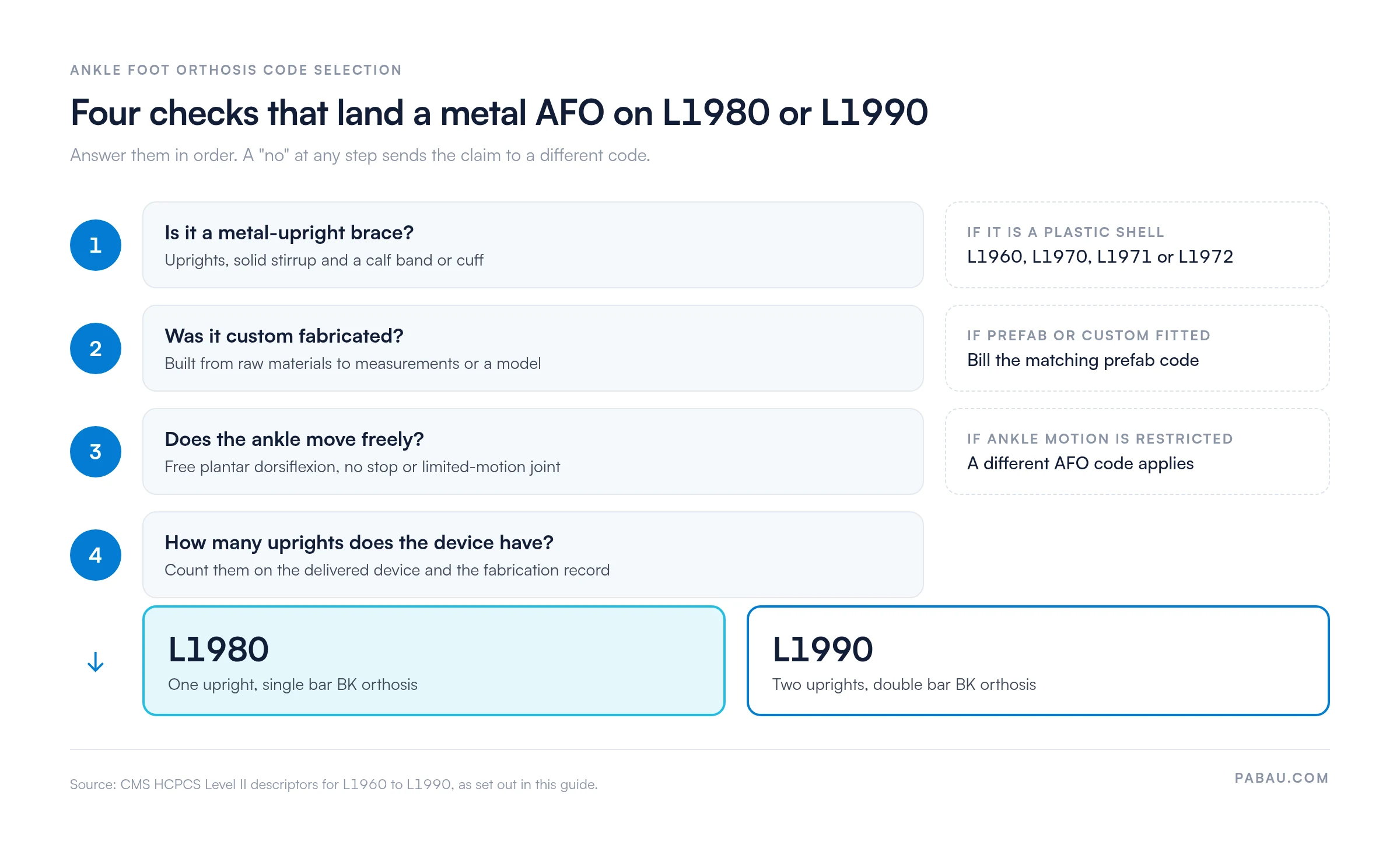
Medicare covers L1980 under the Part B DMEPOS benefit when the device meets the criteria in LCD L33686 and CMS Policy Article A52457. Following medical billing compliance requirements means satisfying four core conditions before the claim goes out.
State Medicaid programs may cover L1980, but coverage criteria, prior authorization requirements, and reimbursement rates vary significantly by state. Never generalize Medicare rules to Medicaid without checking the relevant state policy.
The LCD lists the ICD-10 diagnosis codes that support medical necessity for an ankle foot orthosis. A diagnosis code not on the covered list needs an Advance Beneficiary Notice of Noncoverage (ABN) on file.
This Medicare waiver is signed before delivery, and the claim then carries modifier GA. Common supporting diagnoses include the following.
This table is illustrative, not exhaustive. Always verify the current covered-diagnosis list in LCD L33686 directly. The list is subject to revision, and a code covered in a prior year may have been removed.
A complete L1980 claim file requires five document categories. Missing any one of them is enough for the DME MAC to deny or reopen the claim. Building toward a clean claim submission means collecting all five before the claim goes out.
Modifiers communicate claim context to the DME MAC. A wrong or missing modifier triggers automatic edits or denials.
KX and RT or LT modifiers are the pair most frequently missing on denied L1980 claims. Append both before submission when the device is delivered to a single identified limb and all coverage criteria are documented.
L1980 is not currently on CMS’s mandatory prior authorization list for DMEPOS, but this can change and DME MAC jurisdiction policies vary. Before assuming no prior auth is required, check the current policy for the patient’s DME MAC jurisdiction.
CGS Administrators (Jurisdictions B and C) and Noridian Healthcare Solutions (Jurisdictions A and D) each publish coverage articles that may add requirements.
Some private payers and Medicaid managed care organizations do require prior authorization for custom-fabricated AFOs. Submit the written order, clinical notes, and any supporting assessment documentation with the PA request. Record the PA reference number and keep it in the claim file.
CMS’s voluntary pre-claim review program (where active) allows suppliers to submit documentation before delivery and receive a provisional finding on coverage. This reduces recoupment risk on high-value custom devices. Check with the applicable DME MAC for current pre-claim review availability and submission procedures.
The Medicare national allowable for L1980 is updated annually through the CMS DMEPOS fee schedule. That schedule applies Consumer Price Index for All Urban Consumers (CPI-U) adjustments each calendar year. A dollar amount hard-coded in internal documentation goes stale, because the 2025 rate may differ from the 2026 rate.
Retrieve the current 2026 national allowable directly from the CMS DMEPOS fee schedule lookup tool on cms.gov. Enter code L1980 and select the relevant fee schedule year and state. The tool returns the fee schedule amount for both non-competitive bidding areas (non-CBAs) and, where applicable, competitive bidding areas (CBAs) where rates may differ.
Medicare pays 80% of the fee schedule amount for covered DMEPOS items. The patient or secondary insurer covers the remaining 20% coinsurance after the Part B deductible. In competitive bidding areas, only contract suppliers may bill Medicare for items included in the program. Check whether L1980 is on the current competitive bidding product list before relying on a CBA rate.
Bookmark the CMS DMEPOS Fee Schedule lookup tool and check it each January. The allowable for L1980, like every other L-code, resets at the start of each calendar year. Billing the prior year’s rate after a CPI-U adjustment can create small but recurring claim discrepancies that accumulate across a high-volume supplier.
L1980 denials concentrate around a short list of predictable errors. Strong denial management workflows start by addressing these before the claim goes out, not after the remittance comes back.
An L1980 claim goes through cleanly when the code, the modifiers and the paperwork stay in step. Pabau’s claims management software lets you enter the HCPCS code and its modifiers, link the ICD-10 diagnosis, and route the claim through your clearinghouse. Validation flags missing or invalid details before the claim leaves Pabau, so fewer claims come back for re-entry.
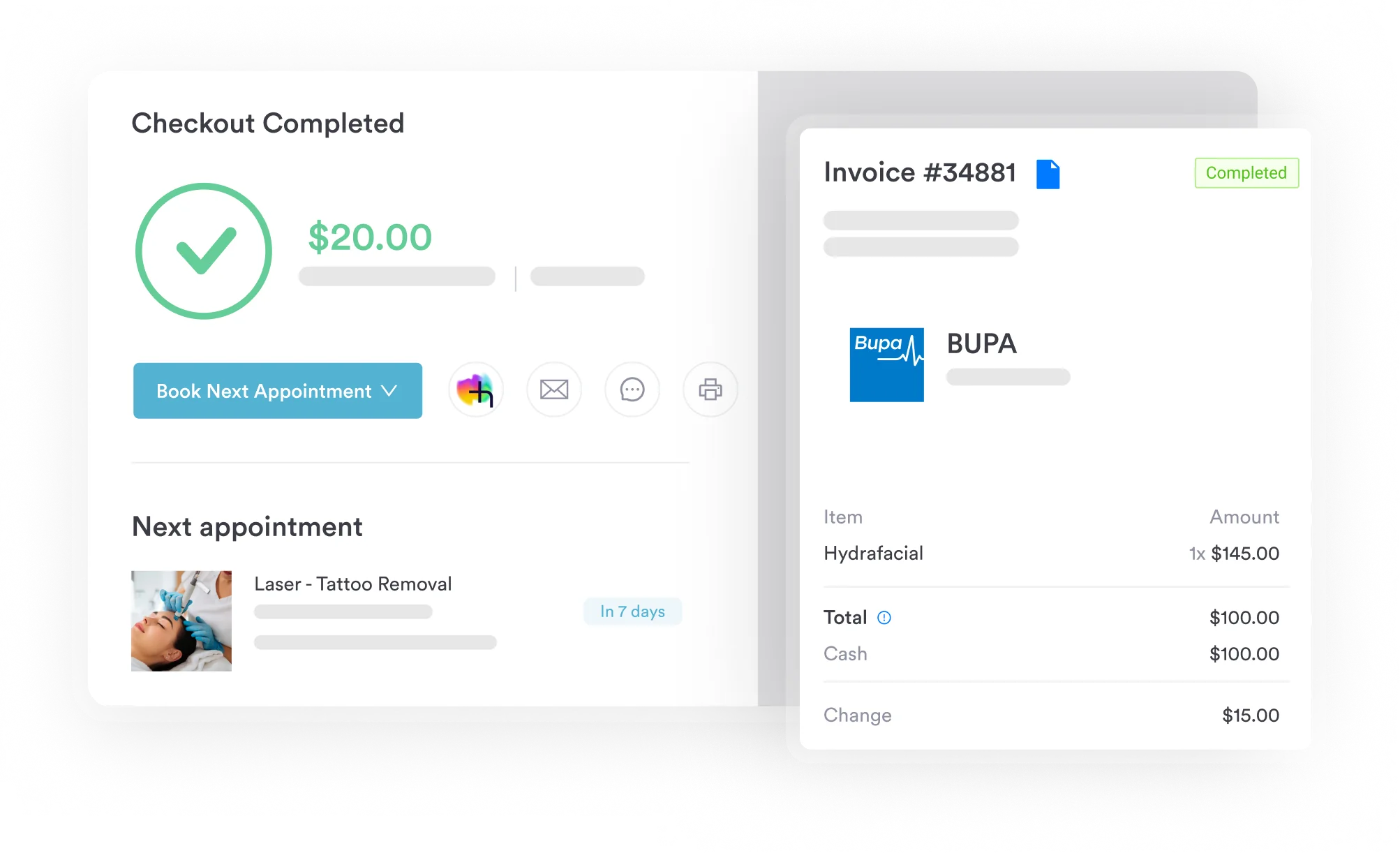
Physical therapy practices and orthotics suppliers juggle orders, fabrication records, and delivery receipts for many patients at once. Pabau tracks each claim from Pending to Paid and reconciles the electronic remittance advice (ERA) when payment lands. Prior authorizations sit on the same patient record, so your team can see which payers still need one.

Enter L1980 with its modifiers and ICD-10 codes, then route the claim through your clearinghouse. Pabau tracks it to payment and reconciles the remittance.

L1980 rewards suppliers who code from the delivered device. Treat the fabrication record and the upright count as the deciding evidence, and check both before anyone keys the code.
The trade-off is a few minutes of checking per claim against a recoupment that can arrive months after delivery. Build the SWO, the LCD diagnosis check, and the KX and RT or LT modifiers into intake, and appeals become the exception. Book a demo to see how Pabau keeps your orthotic claims and their paperwork together until payment lands.

Supplying a prefabricated AFO instead? HCPCS code L1971 explains how to bill a prefabricated ankle-foot orthosis that is customized to fit.
Does the brace extend above the knee? HCPCS code L2010 walks through knee-ankle-foot orthosis billing under the same Medicare coverage policy.
Want cleaner claim submissions? Clean claim submission explains what makes a claim pass the payer’s front-end edits on first submission.
HCPCS Code L1980 bills a custom-fabricated ankle foot orthosis with a single upright, free plantar dorsiflexion, a solid stirrup, and a calf band or cuff. It applies only when the device was constructed from raw materials to patient-specific measurements or a cast. It does not cover a prefabricated or custom-fitted device.
L1980 is exclusively a custom-fabricated code. Prefabricated and custom-fitted (modified prefab) ankle foot orthoses use different HCPCS codes. Billing a prefab device under L1980 is a common audit finding and will result in recoupment.
L1980 has a single upright, and L1990 has double uprights. Both are custom-fabricated metal AFOs with free plantar dorsiflexion, a solid stirrup, and a calf band or cuff. The upright count on the delivered device decides the code, so verify it from the fabrication records before billing. Plastic AFOs such as L1970 and L1971 are a separate category.
A complete L1980 claim file starts with a standard written order (SWO) from the treating practitioner that describes the device in detail. It also needs clinical notes establishing medical necessity, custom fabrication records (casting or CAD/CAM measurements), and a patient-signed delivery receipt. Missing any of these is sufficient grounds for denial or recoupment on audit.
L1980 is not currently on CMS’s mandatory prior authorization list for DMEPOS, but jurisdiction-specific DME MAC policies and individual private payer requirements can impose PA. Always verify the current policy for the patient’s DME MAC jurisdiction and any applicable commercial payer before delivering the device.
The most common denial reasons are a wrong fabrication category (prefab billed as custom fabricated) and a missing or incomplete SWO. Others include a diagnosis outside the LCD covered list with no ABN on file, and a missing KX or laterality (RT/LT) modifier. Each of these can be prevented before submission with a pre-billing documentation checklist.
Append KX when all LCD coverage criteria are documented and met, plus RT or LT for the affected limb. If the diagnosis falls outside the LCD covered list and an ABN is on file, use GA instead of KX. GY applies when the item is non-covered and no ABN was obtained.