

CCSD code G5100: Bypass of duodenum billing guide
CCSD code G5100 bills a bypass that leaves the duodenum in place CCSD code G5100...

Last Updated: Oct 16, 2026
L1990 is the HCPCS Level II code for a custom-fabricated metal ankle foot orthosis. Its official descriptor reads: ankle foot orthosis, double upright free plantar dorsiflexion, solid stirrup, calf band/cuff (double bar 'BK' orthosis), custom fabricated.
Billers most often confuse it with the plastic custom AFO codes beside it, and with the prefabricated codes lower in the same range. That confusion is the single most common reason L1990 claims come back denied.
Let Pabau's smart automation suggest the right codes, reduce claim denials, and keep your practice compliant—effortlessly.
Automate repetitive tasks and focus on what matters most—your patients.
Reduce coding errors and ensure compliance with the latest regulations.
Clean claims, fewer denials, and faster reimbursements.
Powerful insights and reporting to help your practice thrive.
HIPAA compliant SOC 2 certified GDPR-compliant Trusted by 4,000+ clinics worldwide

HCPCS code L1990 is a custom-fabricated ankle foot orthosis with two metal uprights, a solid stirrup and a calf band or cuff.
Medicare treats a device as custom fabricated only when it is built from an individual cast, mold or digital scan of the patient.
No prefabricated HCPCS code mirrors the double upright metal design, so a device that was not cast has no cheaper L1990 equivalent.
The KX modifier attests that the LCD documentation is already on file, and omitting it is the most common cause of L1990 denials.
CMS retired the Certificate of Medical Necessity in January 2023, so the medical record now has to carry the necessity evidence on its own.
HCPCS code L1990 is the Level II code for a custom-fabricated metal ankle foot orthosis. Its official descriptor reads: ankle foot orthosis (AFO), double upright free plantar dorsiflexion, solid stirrup, calf band/cuff (double bar ‘BK’ orthosis), custom fabricated. Each phrase in it decides whether the code fits the device you supplied.
That last phrase is the one billers misread most often. Because the ankle joint is free, L1990 controls the foot through side-to-side stability from the uprights, not through a stop that limits motion. A device that assists or blocks dorsiflexion belongs to a different code.
The code sits within the HCPCS L-code range maintained by CMS’s HCPCS Level II code set. L-codes cover orthoses and prostheses billed under the DMEPOS benefit. L1990 covers ankle foot orthoses rather than knee-ankle-foot orthoses (KAFOs), which begin at L2000. L1990 also excludes a custom-fabricated supramalleolar orthosis, which codes to HCPCS code L1907.
The table below summarizes the core billing attributes billers need before submitting a claim.
L1990 covers one device configuration. Billing it for anything outside that configuration is miscoding, whatever the clinical intent was. The exclusion list matters more than the inclusion list, because almost every L1990 denial starts as a device that belonged in a neighboring code.
Medicare and most commercial payers require a covered diagnosis to support L1990. The table below lists commonly accepted ICD-10-CM codes. Payers may cover more or fewer diagnoses, so verify against the applicable Local Coverage Determination (LCD) and your payer’s policy. Our searchable ICD-10-CM code library carries the full descriptor and coding notes for each one.
Payers do not accept every neuromuscular diagnosis automatically. The ordering physician’s notes have to connect the diagnosis to a functional gait deficit that the AFO is designed to address. A diagnosis code with no clinical context in the chart is a denial waiting to happen.
The L1900 to L1990 range contains more than a dozen AFO codes, separated by fabrication method, material, and ankle design. The table below shows the codes most often confused with HCPCS code L1990. Check the full current descriptor on the AAPC ankle-foot orthotics code range before you bill.
Critical distinction: L1960 is the code most often billed by mistake in place of L1990, and the difference is material rather than motion control. L1960 is a plastic shell with a posterior solid ankle. It has no uprights and no stirrup at all. L1990 is a metal double upright construction with a free-motion ankle. If the orthotist’s note describes a plastic shell, L1990 is the wrong code regardless of how the physician worded the order.
The same logic runs down the whole range. Fabrication method decides which half of the range applies, and construction picks the code inside it. A custom plastic shell with a rigid anterior tibial section codes to HCPCS code L1945. That design uses floor reaction to push the knee into extension.
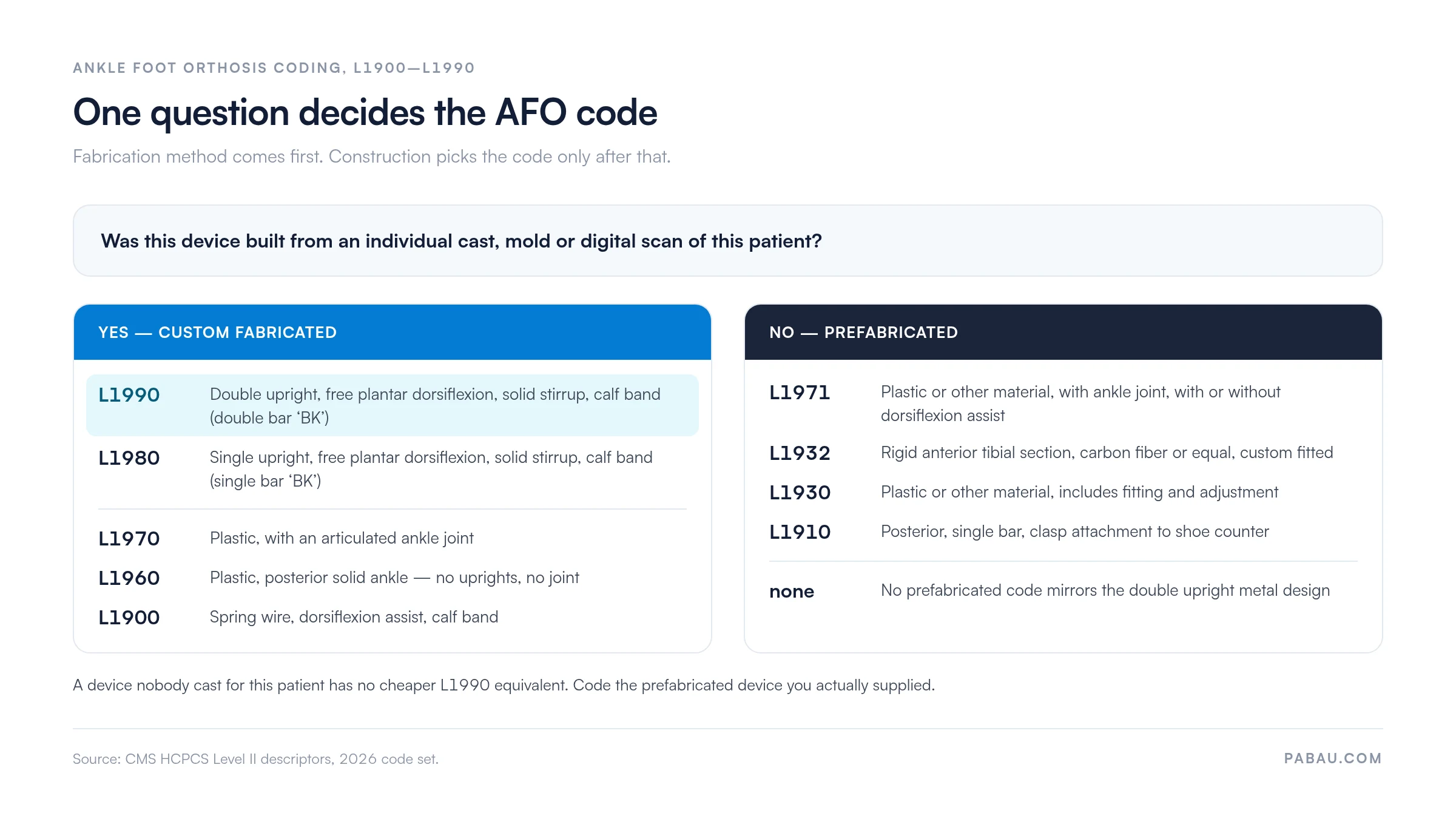
L1990 is a custom-fabricated code, and that distinction carries specific documentation obligations. CMS LCD L33686 (Ankle-Foot and Knee-Ankle-Foot Orthoses) sets the test. A device qualifies as custom fabricated only when it is individually constructed for one patient. That construction starts from a cast, mold, or digital scan of the body part.
The three-step custom fabrication test Medicare applies:
Submitting L1990 for a prefabricated device that was adjusted at the point of sale is a compliance violation. The correct codes in that scenario sit in the prefabricated half of the same AFO range:
Here is the part that catches suppliers out. No prefabricated code mirrors the double upright metal construction, so there is no discounted version of L1990 to fall back on. A device nobody cast for this patient has to be coded as the prefabricated device it actually is, and the allowed amount will reflect that. The reimbursement difference is large, which is why auditors look for it.
Document the specific casting or scanning method in the orthotist’s fabrication note. Include the date of casting, the technique used (plaster, foam box, or digital scan), and the lab or in-house fabrication reference. This single record is the first thing a MAC auditor looks for when reviewing an L1990 claim.
Incomplete documentation is the leading cause of L1990 claim denials. The records below must be complete and retained on file before billing. None of them is submitted with the claim, but every one of them has to be produced on request.
CMS discontinued Certificates of Medical Necessity and DME Information Forms for dates of service on or after January 1, 2023, in MLN article SE22002. Claims that still carry CMN information are rejected rather than paid.
The underlying evidence did not go away with the form. The ordering physician’s records still have to establish the diagnosis, the functional deficit, and why a custom-fabricated orthosis is needed. What changed is where that evidence lives. It sits in the medical record and is produced on request, rather than being summarized on a form the supplier files.
42 CFR 410.38 lists what the standard written order has to carry. That is the beneficiary’s name or Medicare Beneficiary Identifier, the order date, and a description of the item. It also needs the treating practitioner’s name, NPI and signature. The item description may be a general description, the HCPCS code, the code narrative, or a brand and model number.
Naming L1990 or its narrative on the order is therefore optional under the rule, but it is still the safer habit. DME MACs deny claims where the item delivered does not match the item ordered. An order that reads only “custom AFO” gives a reviewer room to argue.
The governing Medicare policy for L1990 is CMS Local Coverage Determination L33686 (Ankle-Foot and Knee-Ankle-Foot Orthoses), administered by the DME MACs. The LCD sets out both covered and non-covered indications, and it defines what the ordering physician’s records must establish.
The supplier cannot generate the clinical documentation independently. The ordering physician has to record the functional need. That leaves the supplier one job before the claim goes out: check that the record says what the LCD requires.
A wrong modifier, or a missing one, routes the claim straight to the denial queue. The table below covers every modifier that applies to L1990 billing.
KX attestation note: appending KX to the claim is a compliance statement. It tells the MAC that every document the LCD requires is in the supplier’s file and that the device meets coverage criteria. Adding KX without confirming the documentation is complete is a false statement on a Medicare claim. Train billing staff to work through the checklist before adding KX, not after.
The patterns below recur across MAC jurisdictions and commercial payers. Each one is preventable before submission rather than after.
When a denial does arrive, the remittance advice carries a CARC and a RARC that name the reason. Reading those two codes before resubmitting is what separates a corrected claim from a second denial on the same line.
L1990 is not currently subject to mandatory Medicare prior authorization under the DMEPOS Prior Authorization Program. CMS has expanded that program to cover certain power wheelchairs and other high-cost equipment. Custom-fabricated AFOs are not on the required list as of 2026. Verify current requirements with your MAC before billing, because the list does grow.
Commercial payer requirements vary a great deal. Many private insurers do require prior authorization for custom-fabricated AFOs whatever the HCPCS code. Check the payer’s provider portal or call provider services before fabrication begins.
The workflow failure worth guarding against is starting fabrication before authorization is confirmed. By the time the payer’s pre-approval requirement surfaces, the device has been cast, built and fitted to one patient. It cannot be sold to anyone else.
Build a payer-specific prior authorization matrix for the top 10 payers you bill. Note whether each requires prior auth for L1990, the submission method (portal, fax, phone), and the typical turnaround time. Review it quarterly. This one document saves more rework than any other step in the L1990 billing workflow.
An L1990 claim depends on five records created by four different people, at four different moments. The physician writes the order and the face-to-face note. The orthotist writes the casting note and the delivery note. The biller then has to confirm all of it exists before appending KX. In most practices those records live in three systems, so the biller’s job starts with a search.
Practice management software like Pabau keeps them on one patient record instead. The order, the evaluation note, the casting details and the signed delivery confirmation attach to the same chart. The documentation check becomes a scroll rather than an email thread.
Pabau’s DMEPOS claims management software then submits the claim and tracks what comes back. Your billers still decide which modifiers a line carries. Pabau surfaces the status of every submitted claim, so a rejected L1990 line is picked up the same week rather than at month end.

Pabau keeps the order, the casting note and the delivery confirmation on one patient record, then tracks every submitted claim through to the remittance. Your billers stop chasing documents and start clearing the queue.

L1990 rewards a supplier who settles two questions before anyone touches a keyboard. Was this device cast for this patient, and does it have two metal uprights on a solid stirrup? Answer those from the orthotist’s note rather than from the physician’s wording, and the code stops being a judgment call.
The documentation side has moved in the supplier’s favor since the CMN was retired, but only on paper. There is no form to chase now, and also no form that prompts anyone to check the physician’s record. Practices that replaced the CMN with a written checklist have kept their denial rate flat. Practices that simply stopped filing the form have not.
Keeping the order, the casting note and the delivery confirmation on one record is what makes that checklist quick enough to actually run. Book a demo to see how Pabau handles DMEPOS documentation and claim tracking for orthotics practices.

Need to understand how clean claims reduce your denial rate? Submitting a clean claim walks through the components Medicare and commercial payers check before processing a DMEPOS claim.
Want to decode ERA remittance codes faster? Reading electronic remittance advice explains how to match CARC and RARC codes to denial reasons and corrected claim actions.
Looking for a full denial code reference? Denial codes in medical billing covers the most common claim adjustment reason codes that appear on DMEPOS remittances.
HCPCS code L1990 covers a custom-fabricated ankle foot orthosis. It has two metal uprights, a solid stirrup, a calf band or cuff, and a free-motion ankle joint. The device must be individually constructed from a patient-specific cast, mold, or digital scan. Prefabricated AFOs, single-upright designs, and plastic shells with no uprights all code elsewhere.
The Medicare allowed amount for L1990 comes from the DMEPOS fee schedule, not the physician fee schedule, and it is updated annually. Verify the current figure directly in the CMS DMEPOS fee schedule file, because third-party figures may not reflect mid-year updates or your state’s adjusted rate.
No, L1990 is not currently on the Medicare DMEPOS mandatory prior authorization list. Commercial payers frequently do require prior authorization for custom-fabricated AFOs regardless of code. Always verify the specific payer’s requirements before fabricating the device, because Medicare’s list can expand and commercial policies vary widely.
The most common reasons are a missing KX modifier and a non-covered ICD-10 diagnosis. Close behind are a medical record that does not establish the functional need and a prefabricated device miscoded as custom fabricated. Missing RT or LT laterality rounds out the list. Since CMS retired the Certificate of Medical Necessity in 2023, a written pre-submission checklist is what catches these before the claim is transmitted.



