HCPCS code K0552: Non-insulin infusion pump cartridge guide
HCPCS code K0552: Definition and code description HCPCS code K0552 describes sup...

Last Updated: Nov 23, 2026
L0861 is the HCPCS Level II code for addition to halo procedure, replacement liner/interface material.
It bills a new inner liner or interface for the jacket vest or body jacket of a halo the patient already wears. The halo base codes L0810, L0820 and L0830 include the original vest, jacket or rigid orthosis. The original interface material is part of that base item, so L0861 covers replacement material only. It does not cover the ring, pins or rods.
Let Pabau's smart automation suggest the right codes, reduce claim denials, and keep your practice compliant—effortlessly.
Automate repetitive tasks and focus on what matters most—your patients.
Reduce coding errors and ensure compliance with the latest regulations.
Clean claims, fewer denials, and faster reimbursements.
Powerful insights and reporting to help your practice thrive.
HIPAA compliant SOC 2 certified GDPR-compliant Trusted by 4,000+ clinics worldwide

HCPCS Code L0861 is an add-on in the halo family: it bills a replacement liner or interface for a halo jacket vest or body jacket.
The halo base codes L0810, L0820 and L0830 include the original vest, jacket or rigid orthosis. That covers the original interface material, so L0861 is for replacement material only.
Halos are usually fitted in the hospital, so check the inpatient and SNF timing rules before billing the DME MAC.
Pabau, a practice management platform, keeps the order, proof of delivery and claim for each L0861 liner on one patient record.
HCPCS Code L0861 is the Level II code for “addition to halo procedure, replacement liner/interface material.”
The joint DME MAC and PDAC article on halo coding describes it as replacing the inner liner or interface of the halo vest or jacket.
A halo holds the cervical spine still with three parts. A metal ring is pinned to the skull, rods or bars connect it to the torso, and a vest or body jacket carries the load. The liner is the padded interface between that vest or jacket and the patient’s skin.
L0861 bills a new liner or interface for a vest or jacket the patient already wears. It does not cover the ring, the pins or the rods. The Centers for Medicare and Medicaid Services maintains the HCPCS Level II code set and publishes updates to it each year.
The halo codes split into base procedures and additions. A base code bills the complete halo, including the original vest, jacket or rigid orthosis. An addition code bills a component on top of that base. The descriptors below come from the HCPCS code set and the AAPC L0861 listing.
The base code already pays for the original vest, jacket or rigid orthosis, and the original interface material is part of that base item. So L0861 belongs on a later claim, when the original liner has to be replaced while the halo stays on. Adding L0861 to a new base code for that first liner bills the same material twice.
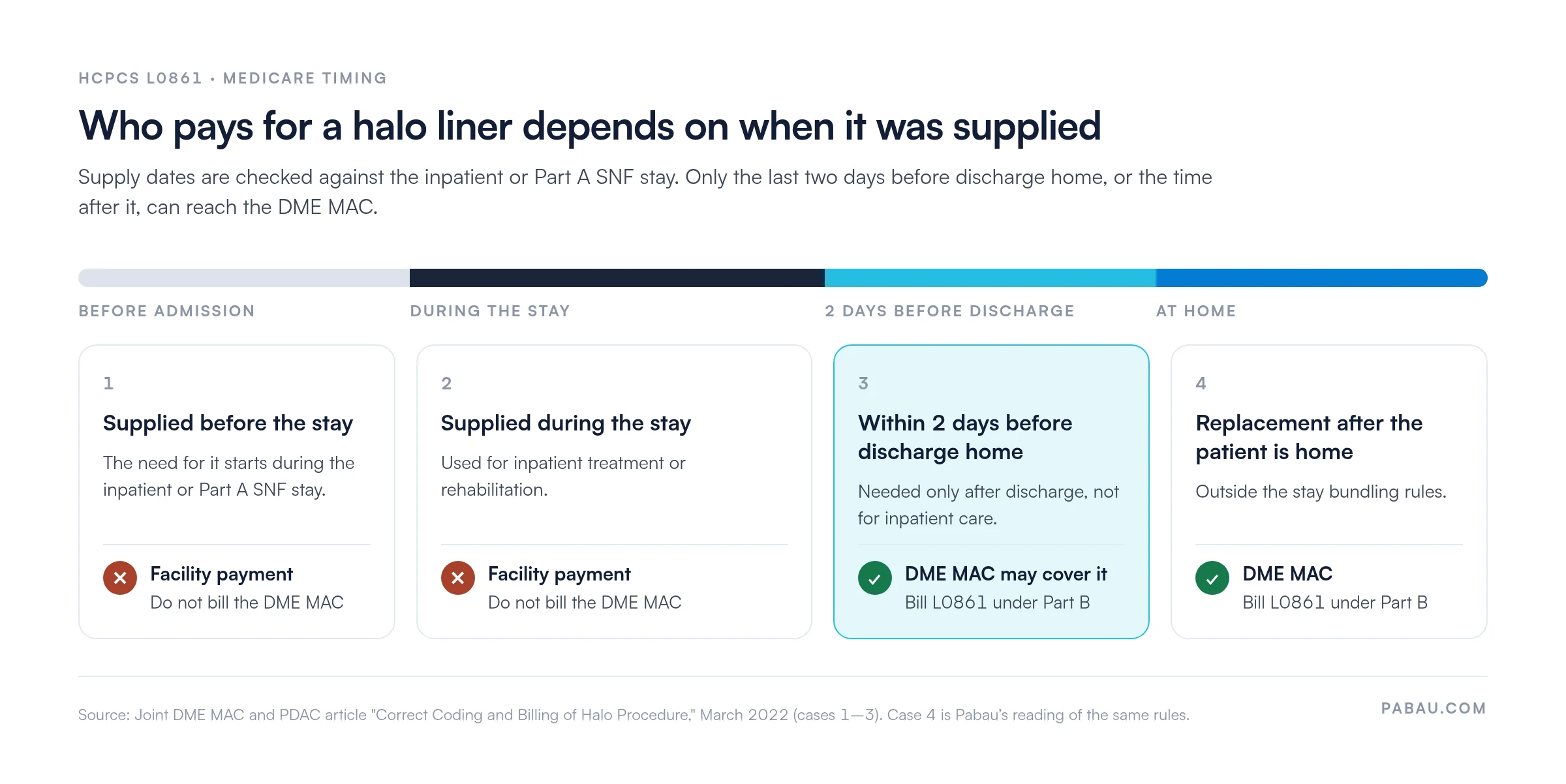
Medicare Part B covers orthoses, including halo systems, as a DMEPOS benefit billed to the DME MAC. The halo article from the DME MACs and the PDAC sets out a timing rule that matters for halo patients. Most halos are applied during a hospital admission, so the date and setting of each item decide who pays.
The article describes three situations:
A replacement liner supplied after the patient is home falls outside these bundling rules and goes to the DME MAC. The timeline below sets all four cases against the hospital or SNF stay. Check the dates on the delivery record against the admission and discharge dates before you submit.
Coding questions about a halo component go to the PDAC HCPCS Helpline at (877) 735-1326, 9:30 am to 5:00 pm ET, Monday to Friday. Under CMS rules, only CMS and the DME MACs set HCPCS Level II coding guidance for these items.
A halo gives the most rigid external immobilization of the upper cervical spine. The StatPearls halo brace review names C1 and C2 fractures among the injuries it treats definitively, with C1 fractures the most common. No DME MAC policy publishes a covered-diagnosis list for L0861, so code the diagnosis the treating practitioner documented.
A liner replacement happens during healing, after the initial fracture care. That is why the table shows the 7th character D, subsequent encounter. Use the more specific fracture code whenever the record names the vertebra and fracture type.
Every claim to a DME MAC rests on the same core records. Good medical billing workflows collect them before the replacement liner goes out.
The SWO must reach the supplier before the claim is submitted, under the Medicare Program Integrity Manual, chapter 5. A claim sent without a signed and dated order on file carries modifier EY, and Medicare denies it.
Medicare does not require prior authorization for L0861. The code is not on the CMS Required Prior Authorization List, last updated July 29, 2026. The spinal orthoses on that list are TLSO and LSO codes, not halo codes.
Medicaid plans and commercial insurers set their own rules, and some require authorization for orthotic replacements. Check the patient’s plan before the liner is supplied, and follow your medical billing compliance process for each payer.
Most L0861 claims need no modifier at all. The three below apply to any DME MAC claim, L0861 included.
Do not add KX by habit. KX tells Medicare that the requirements of a specific medical policy are met. Use it only where a DME MAC policy for the item calls for it.
Medicare pays L0861 from the DMEPOS fee schedule, which CMS updates each year. The schedule lists allowable amounts by state. The CMS DMEPOS fee schedule page links to the current files, where suppliers can look up the L0861 amount for their state.
Medicare Part B pays 80% of the allowed amount after the annual deductible. The patient or their supplemental insurer covers the remaining 20%. Medicaid and commercial rates are set by each payer, so confirm them before quoting the patient a cost.
Submitting a clean claim for a replacement halo liner follows a fixed order. Step 2, the date check, decides whether the DME MAC is the right payer at all.
The denial codes in medical billing on a remittance tell you what the payer decided. For L0861, the reason behind that decision is usually one of the six causes below.
Before each L0861 claim goes out, check four points. Is the SWO signed, does the delivery date fall outside any inpatient or SNF stay, and is the base halo code on record? Finally, is proof of delivery on file?
Most suppliers check halo liner paperwork by hand today. Someone pulls the order, the clinical notes, the discharge date and the delivery receipt, then compares them before the claim leaves. A missed date only shows up weeks later as a denial on the remittance.
In Pabau, the order, clinical notes and proof of delivery sit on the patient record next to the claim. US claims go out as CMS-1500 or 837P through the Claim.MD clearinghouse, with eligibility checks before submission. For payers that need authorization, the code, dates and sessions are tracked on the case, and Pabau warns the team when one is missing.
ERA remittances flow back into the same record, so a denial lands next to the documents needed to fix it. Your billers spend less time chasing paperwork and more time on claims management that needs judgment.

Pabau helps orthotics practices and DME suppliers keep orders, delivery records and claims for codes like HCPCS Code L0861 in one place. See how it works in a quick demo.

Treat L0861 as what its descriptor says: a replacement part for a halo the patient already wears. If the claim cannot show the original halo and the reason for a new liner, it is not ready to go.
The date check matters most. A liner supplied before or during an inpatient or SNF stay belongs to the facility payment, however clean the rest of the claim is. Matching the delivery date to the discharge date takes a minute and saves a denial.
Your team can run that check inside the system that sends the claim. Book a demo to see how Pabau holds halo liner orders, delivery records and claims together.

Need a framework for managing denied DME claims? Denial management in healthcare covers the end-to-end workflow for identifying, appealing, and preventing recurring denials.
Want to understand how the billing process fits together? What is revenue cycle management explains every stage from eligibility check to payment posting.
Billing an MRI-compatible halo? HCPCS Code L0859 covers the halo addition for MRI-compatible rings, pins and components.
HCPCS Code L0861 is the Level II code for addition to halo procedure, replacement liner/interface material. It bills a new inner liner or interface for the jacket vest or body jacket of a halo the patient already wears.
No. L0861 belongs to the cervical halo procedures range, L0810 to L0861. Lumbar-sacral orthoses (LSOs) bill under separate L-codes outside the halo range.
Not for the original liner. Each base code includes the original vest, jacket or rigid orthosis, and its original interface material is part of that base item. L0861 is for a replacement liner supplied later, while the halo is still in use.
L0859 is an addition for MRI-compatible halo systems, covering the rings, pins and related components. L0861 covers only replacement liner or interface material for the vest or jacket. L0860 was deleted on January 1, 2006.
Not under Medicare. L0861 is not on the CMS Required Prior Authorization List updated July 29, 2026. Medicaid plans and commercial insurers set their own rules, so check the patient’s plan first.
Usually not. An item supplied before or during an inpatient or Part A SNF stay is part of the facility payment. A supplier may bill the DME MAC for an item supplied within two days before discharge home, when it is needed only after discharge.