CCSD Code D1010: Radical mastoidectomy including meatoplasty
CCSD Code D1010: Definition and clinical scope CCSD Code D1010 is the UK private...

Last Updated: Nov 25, 2026
L0621 is the HCPCS Level II code for a flexible sacroiliac orthosis, the prefabricated, off-the-shelf SI belt that supports the pelvis. It reduces motion at the sacroiliac joint and has no rigid panels or thoracic extension.
Medicare covers it under the braces benefit only when the belt is made mainly of nonelastic material, such as canvas, cotton or nylon. That's reported with the CG modifier, and an elastic belt is coded A4467 instead.
Let Pabau's smart automation suggest the right codes, reduce claim denials, and keep your practice compliant—effortlessly.
Automate repetitive tasks and focus on what matters most—your patients.
Reduce coding errors and ensure compliance with the latest regulations.
Clean claims, fewer denials, and faster reimbursements.
Powerful insights and reporting to help your practice thrive.
HIPAA compliant SOC 2 certified GDPR-compliant Trusted by 4,000+ clinics worldwide

HCPCS code L0621 is a prefabricated, off-the-shelf flexible sacroiliac orthosis, an SI belt with no rigid panels and no thoracic extension.
Medicare pays for it under the braces benefit only when the belt is made mainly of nonelastic material, reported with the CG modifier.
An SI belt made mainly of elastic or neoprene is coded A4467 and denied as noncovered, whatever the diagnosis.
The Spinal Orthoses LCD (L33790) has no covered diagnosis list, so the medical record must show one of its four indications.
L0621 isn’t on the CMS prior authorization list, while L0631 and several other rigid lumbar-sacral codes are.
HCPCS code L0621 covers a flexible sacroiliac orthosis, the off-the-shelf SI belt that wraps the pelvis below the waist. The CMS Spinal Orthoses policy article lists it beside L0622 to L0624 and limits it to belts made mainly of nonelastic material. A device with rigid panels, or one that climbs the back, belongs under another code.
Here’s the official long descriptor, word for word:
Sacroiliac orthosis, flexible, provides pelvic-sacral support, reduces motion about the sacroiliac joint, includes straps, closures, may include pendulous abdomen design, prefabricated, off-the-shelf.
CMS HCPCS Level II long descriptor for L0621, effective January 1, 2014
Three phrases in it decide whether a belt fits the code.
Coding errors on L0621 come from two directions. One is panel type inside the sacroiliac family. The other is confusing an SI belt with a lumbar or lumbar-sacral brace.
A quick test at the fitting chair. First, check where the back edge sits. An SI belt sits across the pelvis, while a back panel reaching L1 or higher means a lumbar code. Next, press over the sacrum. A rigid or semi-rigid panel points to HCPCS code L0623. Last, read the fabric label, then confirm against the manufacturer’s coding information.
The flow below puts those checks in order, along with the maternity and material tests covered later.
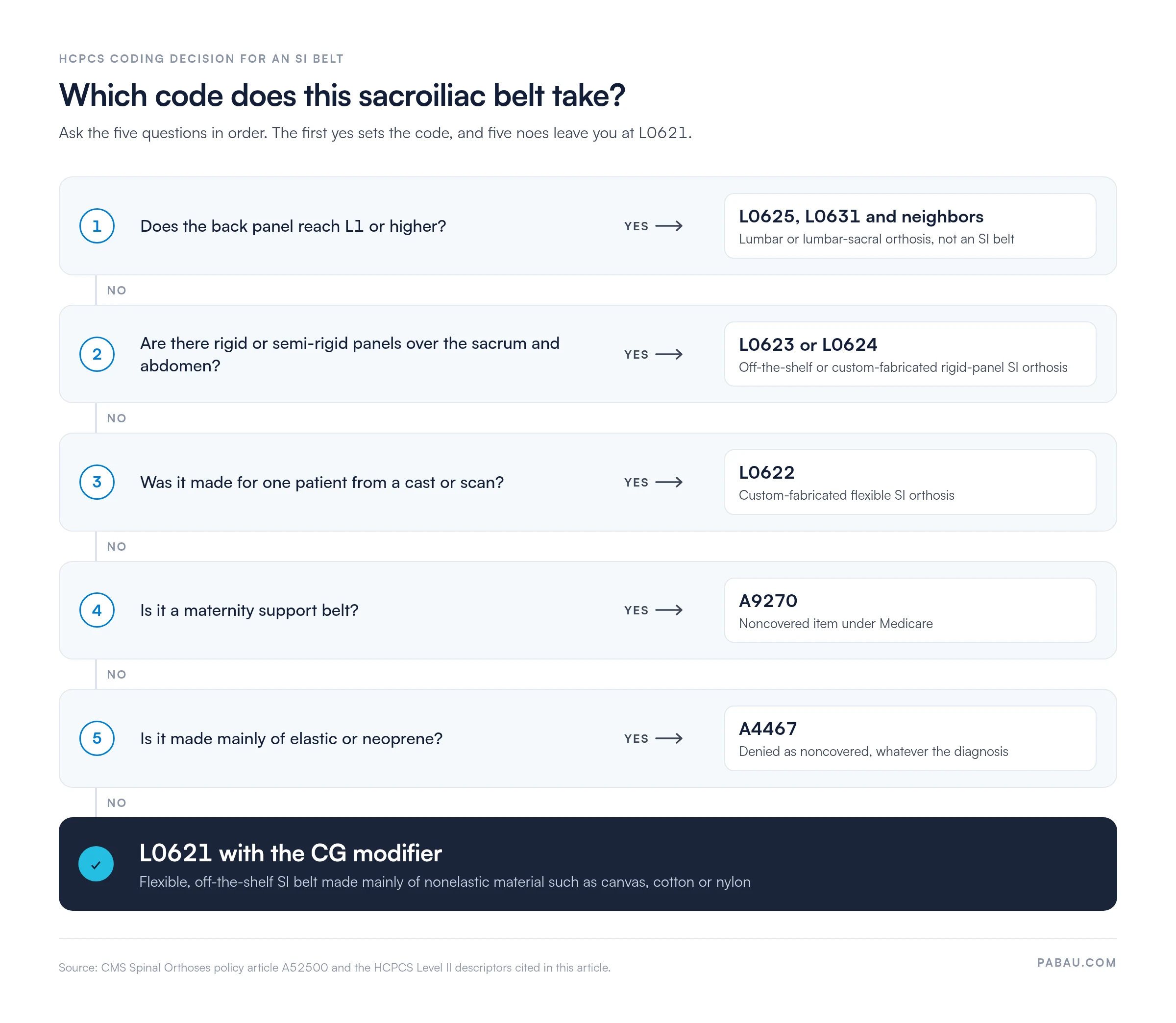
Reporting HCPCS code L0631 for an SI belt is incorrect coding. L0631 describes a different device, a lumbar-sacral orthosis with rigid front and back panels that reaches T9. Someone with expertise custom fits it, and Medicare requires prior authorization. Neither the belt nor its medical record can support that code.
Medicare pays for L0621 under the braces benefit, so the belt must meet the definition of a brace. The rules sit in the Spinal Orthoses: TLSO and LSO LCD (L33790). It covers L0621 to L0624 when the orthosis is ordered for one of four reasons:
The LCD has no covered diagnosis list. Its ICD-10 sections read N/A, so no single code unlocks payment. The treating practitioner’s notes have to show which of the four reasons applies.
Material is the second test. The policy article allows L0621 only for orthoses made primarily of nonelastic material, such as canvas, cotton or nylon. Belts made mainly of elastic or neoprene, with or without stays, are coded as HCPCS code A4467 and denied as noncovered. A product that can’t immobilize or support the joint goes to A9270.
Two DME MACs process these claims. Noridian runs Jurisdictions A and D, and CGS runs Jurisdictions B and C across the remaining states. Each claim goes to the DME MAC for the patient’s state of residence.
Payment comes from the DMEPOS fee schedule, which sets state-level amounts for orthotics. CMS updates it each January and revises it during the year, so check the current file before quoting a patient’s share.
Before you stock an SI belt, ask the vendor for its HCPCS coding information and a material composition sheet. A spec that says neoprene or elastic blend means Medicare won’t pay for that belt as L0621, however well it fits.
L0621 isn’t on CMS’s list of items needing a face-to-face encounter and a written order prior to delivery, as of the October 28, 2026 update. The general DMEPOS documentation rules still apply. Build the file in this order.
Orthotist notes count, too. Under the Social Security Act, documentation created by an orthotist supports the treating practitioner’s record, though it can’t stand in for it. Keeping both together is basic medical billing compliance.
Take an illustrative patient with sacroiliac joint pain after a fall. The physician documents the exam findings and orders a belt to restrict motion and reduce pain. The practice fits a canvas belt, and the patient tightens the straps at delivery.
That claim goes out as L0621 with the CG modifier, and the order, delivery receipt and notes are on file. Now fill the same order with a neoprene belt. It’s coded A4467 and Medicare denies it as noncovered, so tell the patient before delivery that they’ll pay for it themselves.
A clean claim for L0621 is settled before it leaves the practice. Answer yes to each question first.
When a denial does arrive, look up its reason code in our guide to medical billing denial codes before deciding how to respond.
Was the line rejected or denied? A rejected line, often for missing information, has no appeal rights. Correct it and resubmit.
What’s the first appeal step? A redetermination, filed within 120 days of receiving the initial determination. Send the order, delivery proof, product material sheet and practitioner notes.
What comes next? Reconsideration by a Qualified Independent Contractor within 180 days. After that come an ALJ hearing, the Medicare Appeals Council and federal district court, each within 60 days. The ALJ hearing and federal court review each require a minimum amount in controversy.
A shared denial management process keeps those deadlines visible, so recoverable claims don’t get written off.
Traditional Medicare doesn’t require prior authorization for L0621. It isn’t on the CMS Required Prior Authorization List, last updated July 29, 2026. Several lumbar-sacral codes are, including L0631, L0637, L0639, L0648, L0650 and L0651.
Medicare Advantage and commercial plans set their own rules. Check the plan’s portal before delivery, and record any approval number in the patient file.
A belt claim often scatters across a fax tray, a billing spreadsheet and a clearinghouse portal. Staff then check each claim by hand to see what was paid.
Pabau, a practice management platform with built-in insurance billing, sends US claims electronically through Claim.MD. Your team checks eligibility, submits CMS-1500/837P claims and posts ERA remittances from the patient record.
Each claim’s status stays visible in one list, so a rejection gets corrected before its deadline. Clinical notes and signed forms sit on the same record, ready when an appeal needs them. See how claims software for practices fits your billing workflow.

Pabau sends US insurance claims through Claim.MD, checks eligibility and tracks each claim’s status. Rejections surface while there’s still time to correct them.

L0621 pays when three facts line up. The device is a flexible SI belt, it’s built from nonelastic material, and the record names a covered reason. Settle those at the fitting chair and the billing step becomes routine.
The trade-off is product choice. A cheaper neoprene belt may suit a self-pay patient, but Medicare won’t pay for it as L0621. Stock the belt your payer mix needs.
Book a demo to see how Pabau submits and tracks insurance claims, so L0621 rejections get fixed while there’s still time.

Dispensing an SI belt with rigid panels? HCPCS code L0623 covers the off-the-shelf sacroiliac orthosis with rigid or semi-rigid panels over the sacrum and abdomen.
Fitting a belt made from a cast or scan? HCPCS code L0622 explains the custom-fabricated version of the flexible sacroiliac orthosis and the records it needs.
Stocking neoprene or elastic supports? HCPCS code A4467 shows how Medicare codes elastic belts and garments, and why they come back noncovered.
Billing rigid lumbar-sacral braces as well? HCPCS code L0631 walks through the rigid-panel LSO code and its prior authorization step.
Want a system for working DME denials? Denial management in healthcare covers tracking, sorting and appealing denied claims before deadlines pass.
Yes, when it’s a nonelastic flexible belt billed as L0621 with the CG modifier. The record must also support one of the LCD’s four indications. Elastic or neoprene belts are coded A4467 and aren’t covered.
No. Maternity support garments, designed to support the abdomen during pregnancy, don’t meet Medicare’s brace definition. The policy article codes them as A9270, a noncovered item, and rules out L-codes for them.
No. L0621 isn’t on the policy article’s coding verification review list, so a product doesn’t need a PDAC listing to be billed under it. Codes such as L0625 and L0631 do.
Both are flexible sacroiliac orthoses. L0621 is prefabricated and off-the-shelf, while L0622 is custom fabricated for one patient. L0622 needs detailed records showing why a prefabricated belt wouldn’t work.
Medicare pays L0621 as a lump-sum purchase under the DMEPOS fee schedule. The allowed amount varies by state, so check the current fee schedule file for the patient’s state.
The billing entity must be enrolled with Medicare as a DMEPOS supplier and bills the DME MAC. Most suppliers also need accreditation, though physicians, physical therapists and some other professionals are exempt.