

CCSD code G5100: Bypass of duodenum billing guide
CCSD code G5100 bills a bypass that leaves the duodenum in place CCSD code G5100...

Last Updated: Oct 16, 2026
K0072 is the HCPCS Level II code for front caster assembly, complete, with semi-pneumatic tire, replacement only, each.
The tire decides the code here, not the position. A front caster carrying a pneumatic tire is billed under K0071 instead. A repair order that says only "front caster" will not tell you which of the two applies.
Let Pabau's smart automation suggest the right codes, reduce claim denials, and keep your practice compliant—effortlessly.
Automate repetitive tasks and focus on what matters most—your patients.
Reduce coding errors and ensure compliance with the latest regulations.
Clean claims, fewer denials, and faster reimbursements.
Powerful insights and reporting to help your practice thrive.
HIPAA compliant SOC 2 certified GDPR-compliant Trusted by 4,000+ clinics worldwide

HCPCS Code K0072 describes a front caster assembly, complete, with semi-pneumatic tire, replacement only, each, on manual wheelchair bases.
A front caster with a pneumatic tire belongs to K0071, so confirm the tire type before you pick the code.
Medicare reimbursement varies by DME MAC locality, so check the current CMS DMEPOS fee schedule for your region.
Append modifier KX only when the medical necessity documentation is already on file, and use GA or GZ when coverage is uncertain.
Practice management software like Pabau helps DME billing teams organize documentation and submit and track claims from one record.
HCPCS Code K0072 describes a front caster assembly, complete, with semi-pneumatic tire, replacement only, each. The Centers for Medicare and Medicaid Services (CMS) maintains it under HCPCS Level II, in the K-series section for wheelchair accessories and replacement components.
The front caster assembly is the complete front wheel unit on a manual wheelchair. It takes in the caster fork, the caster stem, and the caster wheel. Once the assembly wears beyond repair, the supplier swaps the whole unit rather than its individual parts.
The tire type is written into the descriptor, so it decides which code the claim carries. K0072 is the semi-pneumatic version. A front caster fitted with a pneumatic tire is billed under K0071 instead.
This code is active for 2026. It applies to manual wheelchair bases only, not to power wheelchairs, which use separate K-series codes.
The table below provides the quick-reference code attributes coders and suppliers need before submitting a claim.
Medicare reimburses K0072 through the DMEPOS fee schedule. Four DME MAC jurisdictions administer it, and two contractors run those four. Noridian holds Jurisdictions A and D, and CGS holds Jurisdictions B and C.
Rates vary by locality. The amount a supplier receives for a front caster assembly in rural Montana differs from the rate in metropolitan New York. Per the CMS DMEPOS fee schedule, the fee is set as a purchase price (NU modifier) or a rental rate (RR modifier).
CMS updates the fee schedule annually and locality-specific rates move with it, so no dollar amounts are hardcoded here. Verify the current reimbursement for your DME MAC jurisdiction directly from CMS before submitting. The table below outlines the rate categories you will meet.
Pulling the locality rate before submission, rather than after the remittance advice arrives, is the most reliable way to prevent underpayment on K0072 claims.
Medicare covers K0072 when the front caster assembly is medically necessary for the beneficiary’s wheelchair and the supplier holds the documentation on file. CMS Policy Article A52504 governs coverage for wheelchair options and accessories, front caster assemblies included.
Four requirements decide whether the claim is paid, and each one has to be satisfied before submission.
PDAC (the Pricing, Data Analysis, and Coding contractor), run by Palmetto GBA, issues coding advice on K-series products. Checking your regional DME MAC policy article before billing a disputed replacement is the safer route.
Before billing K0072, confirm the patient’s primary wheelchair is on a covered K-code base (K0001 through K0009 for manual chairs). A front caster accessory billed without a verified base can result in automatic denial. Run eligibility and base-code verification at the time of order, not after delivery.
Modifier selection is where many K0072 claims go wrong. Each modifier signals a different transaction type or coverage status to the DME MAC. The wrong one produces a denial, an overpayment, or compliance exposure.
KX is the most critical modifier for K0072. Without it, the claim will deny. The supplier must hold documentation supporting medical necessity before appending KX, and appending it without those records is a compliance violation. Auditing KX use against the documentation at set intervals catches the error before a payer does.
K0072 is billed per caster assembly, not per wheelchair. If a wheelchair requires two front casters replaced, bill two units of K0072. Two errors account for most of the rework on these claims: a miscounted unit of service, and a purchase or rental modifier submitted without KX.
Claims management software gives a billing team one place to prepare, submit, and track DME claims, with the supporting records attached to the patient’s file. The code and modifier choice still belongs to the coder. Making that check a standing step in the order process, rather than a corrective one, is what keeps repeat denials down.
Choosing the wrong K-code is a common audit trigger for wheelchair accessory billing. Two attributes separate the codes in this family. The first is where the assembly sits on the chair, and the second is the tire it carries.
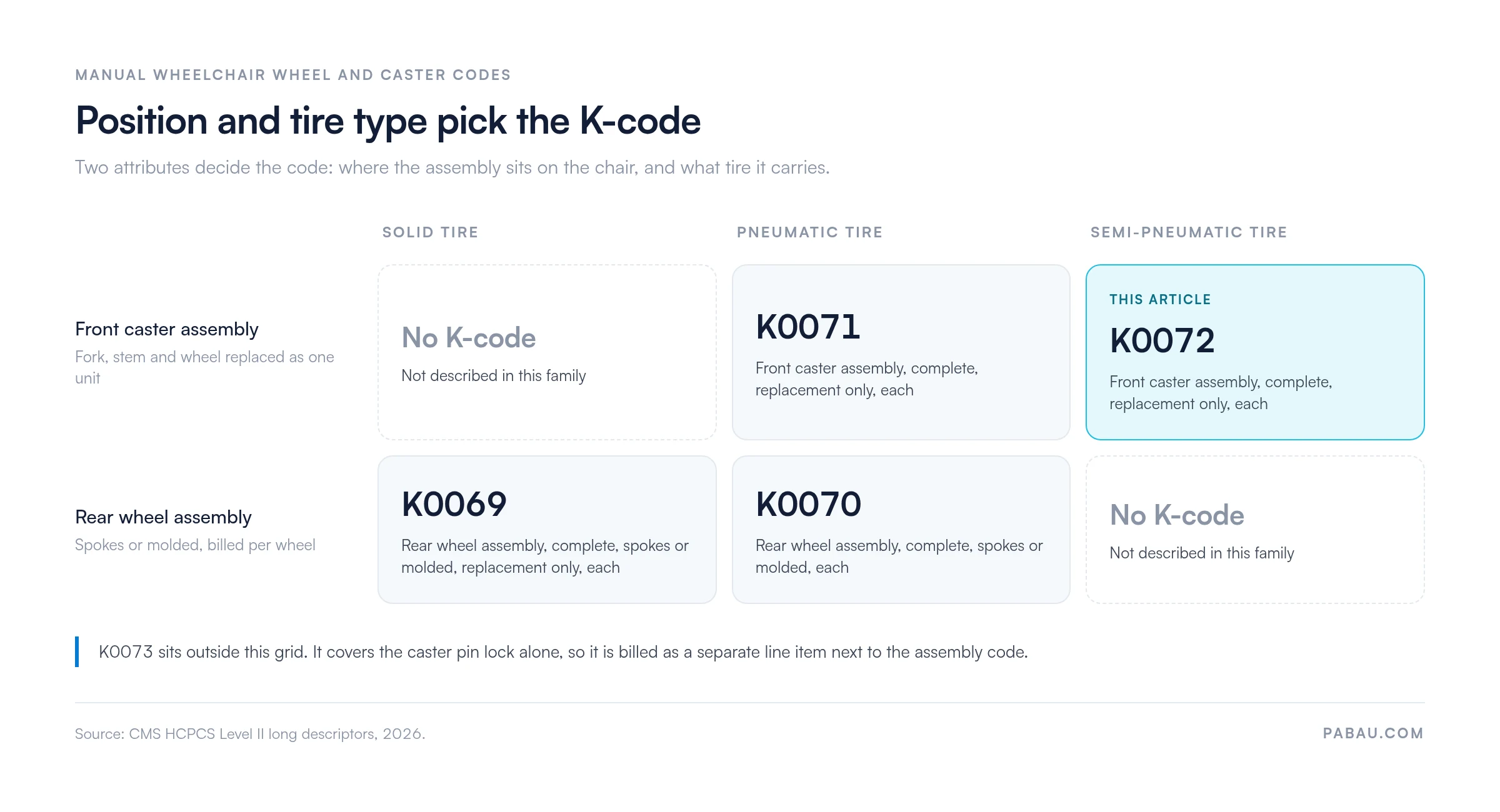
The table adds the two codes that sit outside that grid, with the distinction each one turns on. Getting the choice right on the first submission also cuts the hours spent reading medical billing denial codes on returned claims.
K0073 (caster pin lock) and K0072 (front caster assembly) are frequently billed together when a caster replacement includes a new locking pin. Bill them as separate line items on the claim. Bundling them under a single code, or billing K0108 when K0072 applies, leaves legitimate reimbursement on the table.
Medicare governs the core coverage framework for K0072, but many patients hold Medicaid as a secondary payer or rely on it as the primary. Those rules diverge from Medicare and vary by state, which is where a supplier working across state lines gets caught.
Medicaid DME coverage is state-administered. Some states mirror Medicare’s K-code framework closely, while others use state-specific codes or require prior authorization for any wheelchair accessory replacement.
Before billing K0072 to a state Medicaid program, check that state’s DME fee schedule and prior authorization rules through its Medicaid portal. Carrying Medicare’s coverage logic into a Medicaid claim is a steady source of denials for multi-state suppliers.
Commercial payers generally follow Medicare’s HCPCS coding structure for DME, then apply their own coverage criteria and prior authorization rules. Some plans require a letter of medical necessity from the prescribing physician rather than the treating practitioner alone. Others cap replacement frequency by calendar year regardless of clinical need.
Always check plan-specific DME benefits before billing K0072 to a commercial payer. The AAPC HCPCS code lookup confirms current code status across payer systems.
Workers’ compensation programs that cover durable medical equipment typically use the HCPCS code set, K0072 included. Reimbursement rates are state-regulated and may differ substantially from Medicare’s allowable. Prior authorization is almost universal for workers’ comp DME, and the claim is billed to the carrier’s designated fee schedule rather than the Medicare rate.
In most DME operations the repair order, the physician’s documentation, and the claim itself live in three separate places. When a payer questions a K0072 replacement months later, someone has to reassemble that trail by hand before anyone can answer.
Practice management software like Pabau keeps the patient record, the supporting documentation, and the claim in one system. Billing staff submit from the record they are already working in, then track what happens to the claim without switching tools or re-keying details.
Coding decisions stay with the coder, and no software substitutes for reading the descriptor. What changes is the time spent hunting for the paperwork behind a claim. A payer query gets answered from records that are already attached.
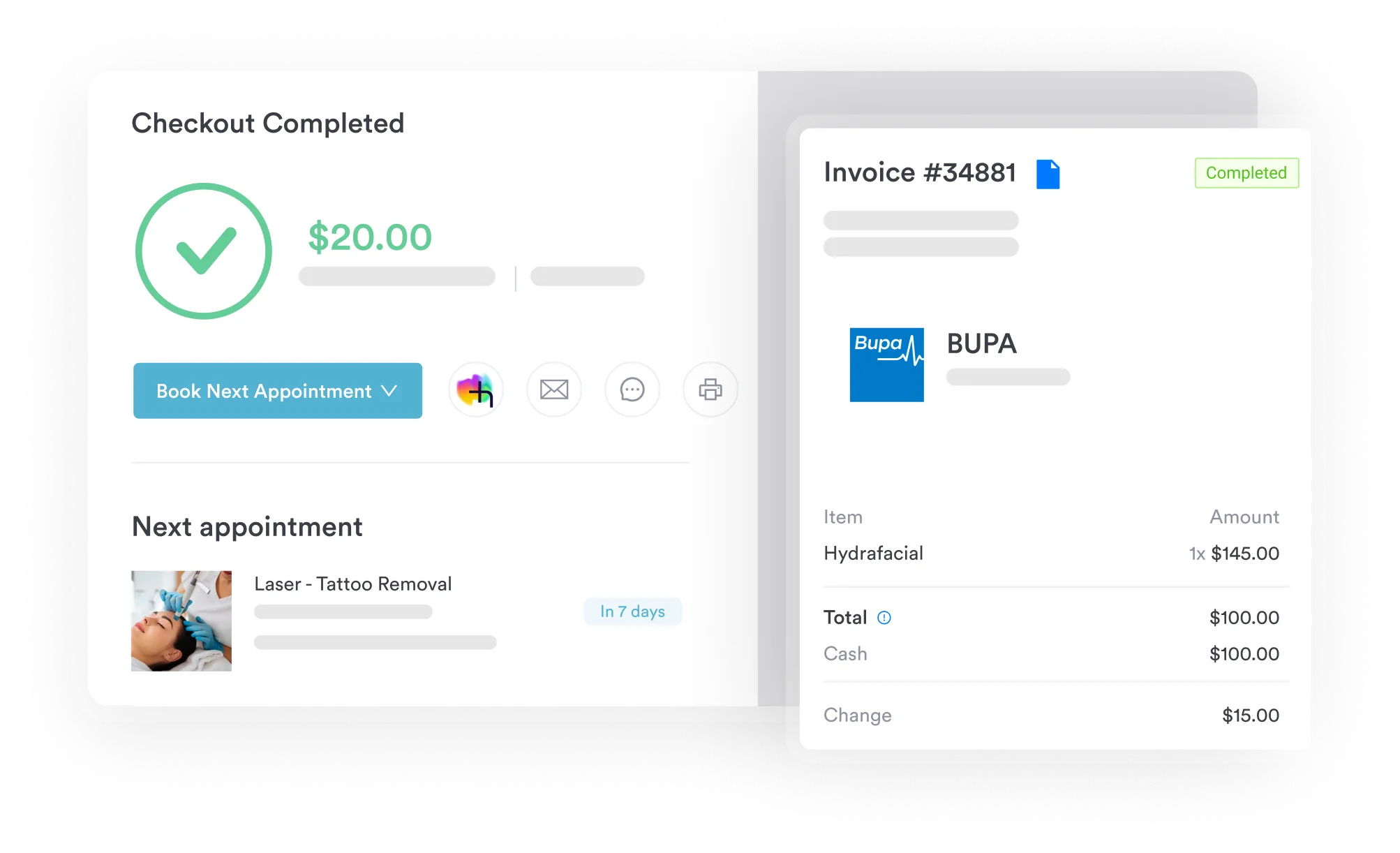

Pabau holds the patient record, the supporting documentation, and the claim in one place. A DME billing team can submit and track a replacement claim without rebuilding the paper trail. See how it works for your team.

Front caster billing rewards the coder who reads the descriptor before the repair order. The tire type decides between K0071 and K0072, and nothing later in the claim corrects that choice for you.
Move the base-wheelchair check and the KX documentation check to the order step rather than the appeal step. Suppliers who do that spend their week on new orders instead of resubmissions, and their audit exposure drops with it.
To see how Pabau keeps DME documentation and claim submission inside one patient record, book a demo with the team.

Need to understand how claim denials are classified? Denial codes in medical billing breaks down the most common payer denial categories and how to respond to each.
Want a cleaner submission process end to end? Submitting clean claims covers the pre-submission validation steps that reduce DME denial rates.
Looking for a broader billing compliance overview? Medical billing compliance outlines the documentation and workflow standards Medicare expects from DME suppliers.
HCPCS Code K0072 covers a front caster assembly, complete, with semi-pneumatic tire, replacement only, billed per each unit. It applies to manual wheelchair bases and captures replacement of the whole front caster unit rather than its individual parts. A front caster with a pneumatic tire is billed under K0071 instead.
The 2026 Medicare DMEPOS fee schedule rate for K0072 varies by DME MAC locality. Purchase (NU), rental (RR), and used equipment (UE) rates differ. Verify the exact rate for your jurisdiction directly from the CMS DMEPOS fee schedule files before submitting, as rates are updated annually.
The primary modifiers for K0072 are NU (new purchase), RR (rental), and UE (used equipment), which describe the transaction type. Add KX when medical necessity criteria are met and documentation is on file. Use GA when the beneficiary has signed an ABN, and GZ when denial is expected without one.
Required documentation includes a physician or treating practitioner order establishing medical necessity. You also need records confirming the patient’s covered base wheelchair, plus evidence that the existing caster assembly is damaged beyond repair. Append modifier KX only when all of that is on file with the supplier.



