CCSD Code V1730: Extraoral fixation of mandible
CCSD Code V1730: Definition and clinical description CCSD Code V1730 describes e...

Last Updated: Nov 24, 2026
J7637 is the HCPCS Level II code for dexamethasone, inhalation solution, compounded product, administered through DME, concentrated form, per mg. It reports compounded dexamethasone dispensed as a multi-dose solution for a home nebulizer, billed one unit per milligram. Medicare denies J7637 as not reasonable and necessary, whatever the diagnosis.
The main billing error is expecting Medicare to pay. Each line still needs GA with a signed ABN, or GZ without one, and units equal to the total milligrams dispensed. Coders also confuse J7637 with J7638 (unit dose), J1100 (injection) and J1095 (intraocular suspension, per 1 mcg).
Let Pabau's smart automation suggest the right codes, reduce claim denials, and keep your practice compliant—effortlessly.
Automate repetitive tasks and focus on what matters most—your patients.
Reduce coding errors and ensure compliance with the latest regulations.
Clean claims, fewer denials, and faster reimbursements.
Powerful insights and reporting to help your practice thrive.
HIPAA compliant SOC 2 certified GDPR-compliant Trusted by 4,000+ clinics worldwide

HCPCS Code J7637 is dexamethasone, inhalation solution, compounded product, administered through DME, concentrated form, per mg.
Report one unit per mg dispensed, so 0.5 mg twice daily for 30 days is 30 units.
Medicare denies J7637 as not reasonable and necessary, and no diagnosis, order, or DME MAC routing changes that outcome.
Bill the line with GA when a signed ABN is on file, or GZ when it is not, so liability lands in the right place.
Commercial and Medicaid plans set their own rules for compounded inhalation drugs, so verify coverage before you dispense.
HCPCS Code J7637 is the Level II code for dexamethasone, inhalation solution, compounded product, administered through DME, concentrated form, per mg. The code is active, but CMS nebulizer compliance guidance denies compounded inhalation solutions like J7637 as not reasonable and necessary. That single fact shapes every billing decision on this page.
Dexamethasone is a glucocorticoid that reduces airway inflammation. Here a compounding pharmacy prepares it for use in a home nebulizer. CMS maintains the code within the HCPCS Level II code set.
The descriptor says compounded product. The solution is mixed by a pharmacy rather than supplied as an FDA-approved inhalation product. The descriptor also says concentrated form, which separates J7637 from its unit dose sibling.
Reported with J7637:
Not reported with J7637:
The last point comes from the DME MAC policy article A52466. It states that J7999 does not apply to compounded nebulizer drugs. Claims billed that way deny as incorrect coding.
Both codes describe the same compounded dexamethasone, billed per mg. The difference is the form the pharmacy dispenses.
Pick the code from the dispensing record, not the order. Medicare treats both the same way, so the choice changes accuracy rather than payment.
J7637 is a per-milligram code. The units billed equal the total milligrams of dexamethasone dispensed for the billing period.
Step-by-step calculation:
Rounding: when the total lands on a fraction, follow the rounding instruction in the payer’s billing guidance. Never bill more units than the order and the dispensing record support.
Recalculate J7637 units from the order on every claim, even one you expect Medicare to deny. A denied line with 300 units in place of 30 still sits in your claim history, and a secondary payer will price from it.
Medicare does not cover J7637. CMS states it plainly on its nebulizer compliance page. Compounded inhalation solutions, J7637 and J7638 among them, are denied as not reasonable and necessary.
The same position sits in the DME MAC nebulizer LCD L33370 and its policy article. A52466 lists J7637 and J7638 with all ICD-10 codes as diagnoses that do not support medical necessity.
The denial rests on medical necessity, so better paperwork will not reverse it. It also changes how the rest of the claim behaves.
Medicare sets inhalation drug payment limits through the CMS ASP pricing files, not the Physician Fee Schedule search. For J7637 that lookup is moot. A line denied as not reasonable and necessary pays nothing, whatever a pricing file shows.
Issue the ABN before the solution leaves the pharmacy, not after the denial arrives. An ABN signed after delivery does not shift liability, so the cost stays with the supplier.
The nebulizer policy article requires one of three liability modifiers on these claim lines. Lines billed without KX, GA, or GZ are rejected as missing information. Read the CMS ABN instructions before you use the form.
GA and GZ do not change the outcome. They tell the DME MAC you expect a denial and decide who pays for it. The diagram traces each payer route to the party that ends up carrying the cost.
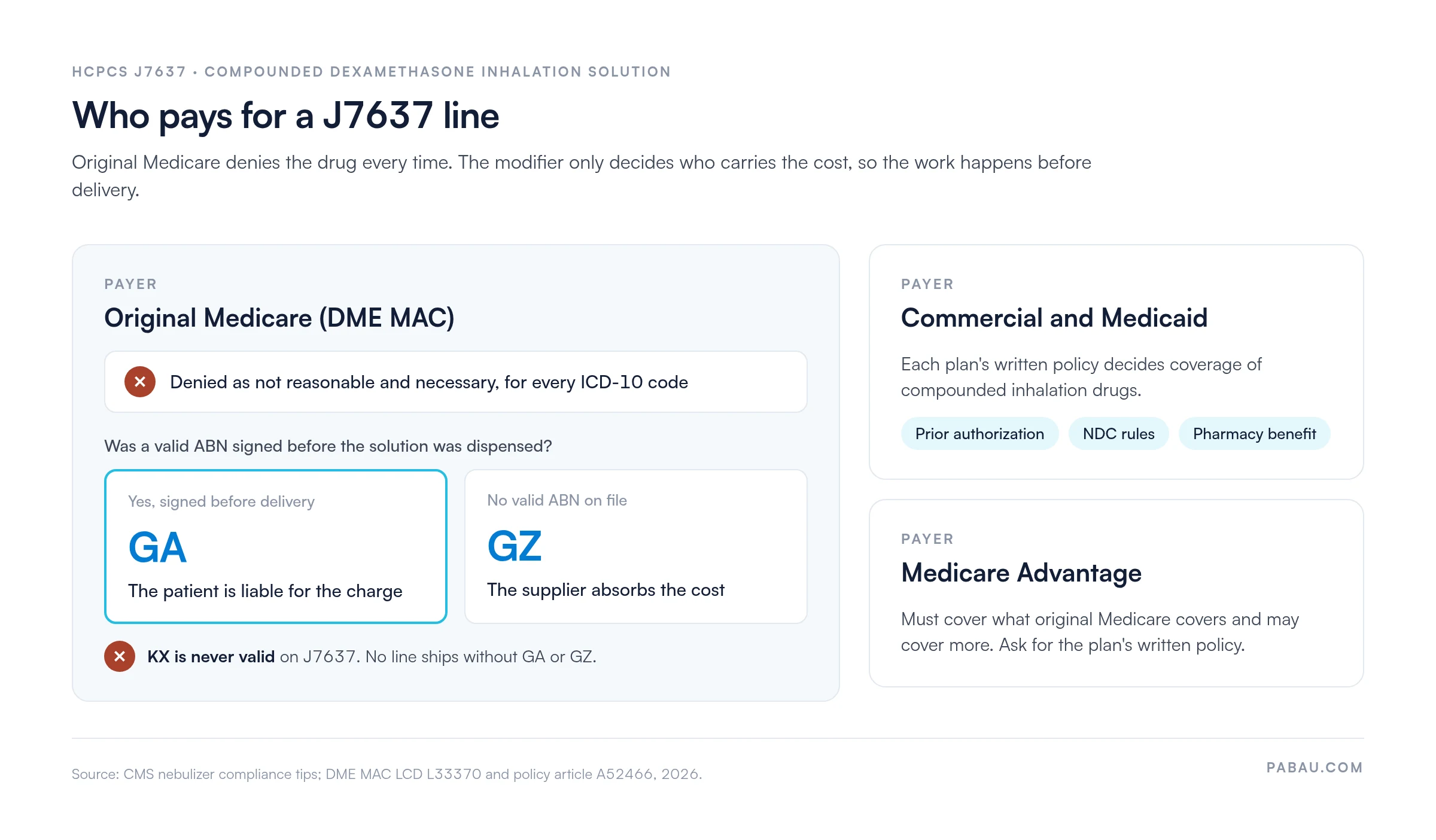
Since Medicare will not pay, the practical question is which route the patient and prescriber choose. Four options are open.
Never recode J7637 as J7699 or J7999 to get around the denial. The policy article treats both as incorrect coding for this drug.
Outside original Medicare, coverage of compounded inhalation drugs depends on each payer’s written policy. Check it before you dispense.
Record the payer’s answer, the policy reference, and any authorization number in the patient record before delivery.
Under original Medicare, no ICD-10 code supports J7637. The policy article lists all ICD-10 codes as not supporting medical necessity for J7637 and J7638.
Diagnosis codes still matter for commercial and Medicaid plans that review the clinical picture. The codes below are common documentation examples, not a coverage guarantee. Confirm current code status before you submit.
A diagnosis on this list will not turn a Medicare denial into a payment. Use it to describe the patient accurately for the payer that may cover the drug. Accurate medical billing keeps the diagnosis, the order, and the code consistent.
Original Medicare offers no prior authorization path for J7637. The LCD denies the drug for every diagnosis, so a request would have no coverage to unlock.
Commercial plans and Medicaid programs are where prior authorization applies. When a payer requires it, expect to send:
Get the authorization number on file before delivery. A payer that requires authorization usually denies a claim without one.
Documentation will not win Medicare payment for J7637. It still keeps the claim valid, shifts liability correctly, and supports any payer that does cover the drug.
NDC rules come from the payer, not the HCPCS code. State Medicaid programs require NDC reporting on drug claims to support the federal drug rebate program. Many commercial payers ask for it too.
A compounded product has no NDC of its own. Ask the payer which ingredient NDC it wants, or whether it bills compounds through its pharmacy benefit.
When NDC reporting is required, the claim line must include:
Confirm NDC requirements with each payer individually before the first claim.
Dexamethasone appears under several HCPCS codes, split by route and form. The table maps the neighbors that cause the most confusion in medical billing compliance reviews.
J1100 and J7637 share the drug but little else. J1100 is an injection billed per 1 mg to the A/B MAC. J7637 is a home inhalation drug billed per mg to the DME MAC. A claim sent to the wrong contractor is rejected and must be resubmitted to the correct one.
This workflow assumes the prescriber has ordered compounded dexamethasone for a home nebulizer. The aim is to settle liability before delivery, not after the denial.
Most J7637 problems start from one assumption: that Medicare covers the drug when the paperwork is right. The denial codes reference explains the remittance codes behind these outcomes.
A denial management workflow that tracks J7637 outcomes by payer shows quickly whether the ABN step is being skipped.
A drug Medicare will not pay creates work at the front desk rather than in the claim. Someone has to quote a price, collect an ABN signature, and take the payment. Pabau, a practice management platform, keeps those steps on one patient record.
Pabau’s claims management submits the claim to the payer and tracks its status. When a secondary plan needs the Medicare denial first, you can see when it comes back.
Digital forms hold the written order and the signed ABN against the patient. Checkout then records the self-pay balance, so the charge stops aging in accounts receivable.
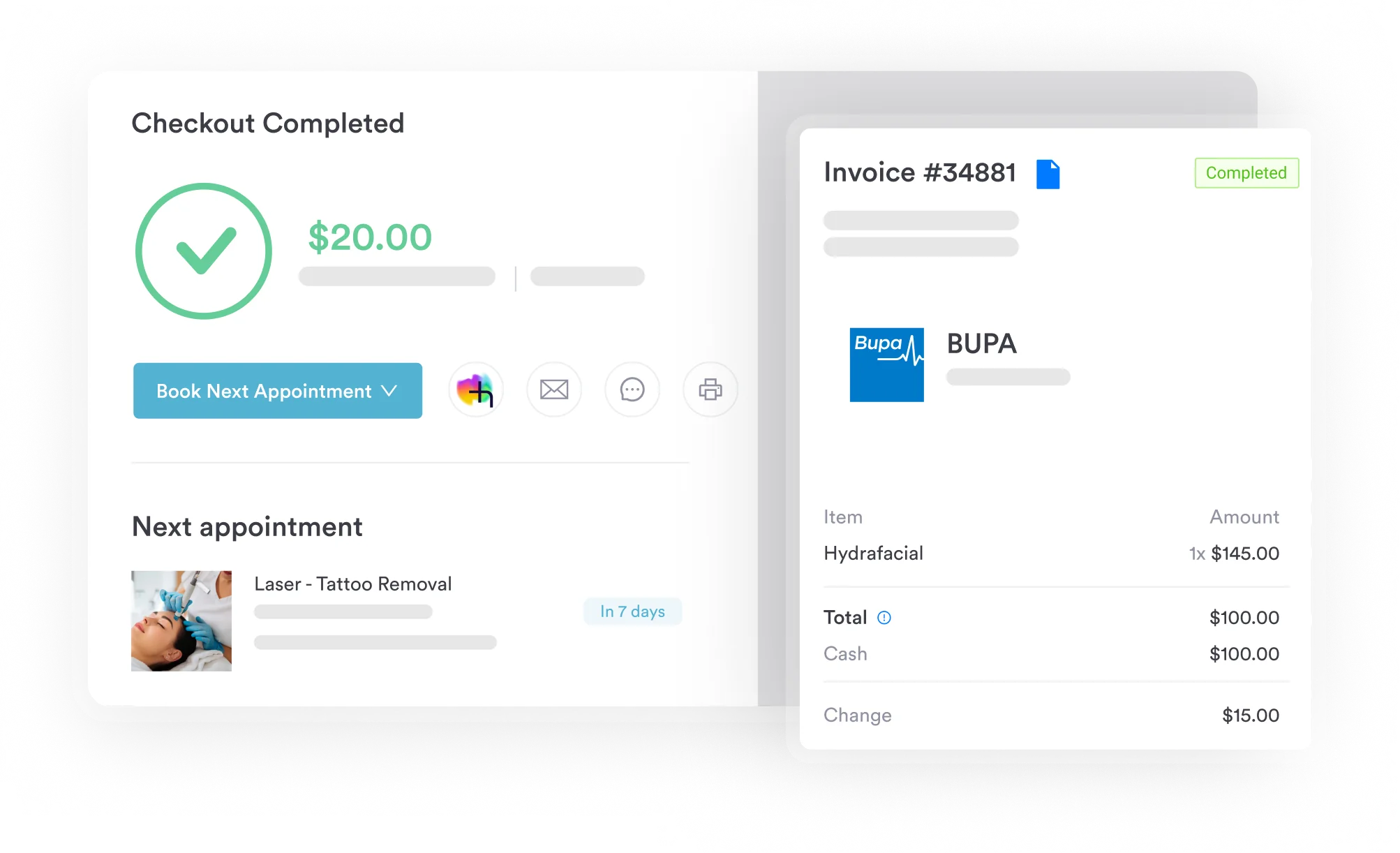

Pabau keeps the written order, the signed ABN, and the patient payment on one record. Our claims management submits your claims and tracks their status, so a J7637 denial and the balance behind it stay visible.

Report J7637 accurately, and expect Medicare to pay nothing on it. CMS denies compounded dexamethasone inhalation solution as not reasonable and necessary, and no diagnosis or order changes that.
So the work moves before delivery. Offer the covered alternative, check commercial and Medicaid policies, and collect the ABN that lets you bill GA and charge the patient.
Book a demo to see how Pabau keeps the order, the ABN, and the payment behind a non-covered drug on one record.

Need a full breakdown of medical billing denials by code type? Denial codes in medical billing maps the most common remittance advice remark codes to their root causes and corrections.
Looking for best practices on managing drug claims across the revenue cycle? What is revenue cycle management explains how inhalation drug billing fits into the end-to-end claims process.
Want to understand the clearinghouse layer behind your claims? Medical claims clearinghouse covers how 837P files route to DME MACs and what happens when a claim is rejected at the payer gateway.
Switching the patient to a covered nebulizer steroid? HCPCS Code J7626 covers non-compounded budesonide and its billing rules.
Billing dexamethasone as an injection instead? HCPCS Code J1100 explains the per 1 mg injection code.
HCPCS Code J7637 reports dexamethasone, inhalation solution, compounded product, administered through DME, concentrated form, per mg. It is billed per milligram dispensed for a home nebulizer. Unit dose vials of the same drug use J7638, and injected dexamethasone uses J1100.
The units equal the total milligrams of dexamethasone dispensed in the billing period. Multiply the dose per treatment by the number of treatments. For example, 0.5 mg twice daily for 30 days is 60 treatments, which is 30 mg and 30 units.
No. CMS and the DME MAC nebulizer LCD (L33370) deny compounded inhalation solutions, J7637 and J7638 among them, as not reasonable and necessary. No diagnosis, order, or MAC routing changes that. Bill GA with a signed ABN so the patient is liable, or GZ without one.
Not under original Medicare, because there is no coverage to authorize. Commercial plans and Medicaid programs may require prior authorization for compounded inhalation drugs. Expect to send the written order, the diagnosis, and the reason a compounded product is needed over an FDA-approved one.
J7637 is compounded dexamethasone inhalation solution, concentrated form, billed per mg to the DME MAC. J1100 is dexamethasone sodium phosphate injection, billed per 1 mg outside the DME benefit. A claim sent to the wrong contractor is rejected and must be resubmitted to the correct one.