CCSD code H4430: Examination of rectum under anaesthetic
CCSD code H4430 pays for the examination alone CCSD code H4430 is the UK private...

Last Updated: Oct 20, 2026
J7517 is the HCPCS Level II code for mycophenolate mofetil, oral, 250 mg. CMS terminated it with effect from 30 September 2026, so it is no longer valid for claims after that date.
The drug is sold as CellCept and as a generic. It prevents organ rejection after kidney, liver, and heart transplants. Medicare Part B covers it when a provider dispenses it, rather than a retail pharmacy.
Let Pabau's smart automation suggest the right codes, reduce claim denials, and keep your practice compliant—effortlessly.
Automate repetitive tasks and focus on what matters most—your patients.
Reduce coding errors and ensure compliance with the latest regulations.
Clean claims, fewer denials, and faster reimbursements.
Powerful insights and reporting to help your practice thrive.
HIPAA compliant SOC 2 certified GDPR-compliant Trusted by 4,000+ clinics worldwide

HCPCS code J7517 covers mycophenolate mofetil, oral, 250 mg per unit, sits in the J7500-J7599 immunosuppressive range, and is active for 2026.
One billing unit equals one 250 mg dose, so a patient taking 1,000 mg daily needs 4 units per day.
Medicare Part B covers J7517 for post-transplant patients, and the standalone immunosuppressive benefit reaches only kidney recipients whose sole coverage is Medicare.
J7518 is a different drug and J7519 is the 10 mg injectable, so neither one is a strength variant of J7517.
Pabau supports structured HCPCS code entry and tracks each J7517 submission through to the remittance.
J7517 sits in the J7500-J7599 immunosuppressive drug subsection of HCPCS Level II. The Centers for Medicare and Medicaid Services (CMS) maintains the code set and updates it quarterly. The code is active and valid for 2026.
Important disambiguation: Myfortic is mycophenolate sodium, which HCPCS lists as mycophenolic acid under J7518. It is a different drug and it is not billed under J7517. If your practice dispenses Myfortic, switch the code before you submit.
Mycophenolate mofetil (MMF) is an immunosuppressant that inhibits the proliferation of T and B lymphocytes, which reduces the immune response that causes organ rejection. The FDA approved it for rejection prophylaxis after kidney, liver, and heart transplants. Both brand-name CellCept and generic MMF 250 mg oral capsules are billed under J7517.
The drug is dispensed orally in 250 mg capsules or 500 mg tablets. Because J7517 is built on the 250 mg unit, billers convert every dose size into 250 mg increments before counting claim units. The 500 mg tablet is common clinically, but the billing unit does not change.
Post-transplant immunosuppressants fall under Medicare Part B when a provider dispenses or supplies them, rather than a retail pharmacy. Retail pharmacy claims go through the Part D benefit instead. Provider-dispensed MMF billed to Part B uses J7517 on a CMS-1500 or 837P claim, not a pharmacy benefit claim.
Medicare Part B covers J7517 for post-transplant patients who need ongoing immunosuppressive therapy. The criteria vary by transplant type and by how the patient is enrolled. Checking eligibility before the visit costs far less than appealing a denial after it.
Note on the 2023 kidney transplant benefit: The standalone immunosuppressive drug benefit came from the Consolidated Appropriations Act of 2021. It reaches kidney transplant recipients who lose Part A coverage after 36 months and hold Medicare as their only health insurance. Liver and heart transplant recipients are not covered under this benefit category. Verify the enrollment status before billing.
Each unit of J7517 equals 250 mg. Divide the total milligrams dispensed by 250 to get the unit count for the claim line. Unit errors cause more underpayments and overpayments on J7517 than any other mistake.
Bill only the quantity actually dispensed, not the maximum prescribed dose. If the patient received 90 days of therapy, bill the units dispensed across that supply period.
On an 837P electronic claim, J7517 goes in the procedure code field and the calculated count goes in the quantity field. A superbill that records total mg dispensed lets billing staff work out the units without calling the dispensing clinician.
Bill J7517 units on the quantity dispensed, not the quantity prescribed. A 30-day supply at 1,000 mg per day is 120 units. Auditors compare dispensing records against claim unit counts, and a mismatch flags either undercoding or overbilling.
Medicare prices J7517 from the Average Sales Price (ASP) methodology, which CMS refreshes every quarter. Part B drugs are generally paid at ASP plus 6%. Pull the figure from the CMS ASP drug pricing files for the quarter the date of service falls in. The physician fee schedule lookup does not carry payment allowances for Part B drugs.
Rates move every quarter, so treat any dollar figure in a reference guide, including this one, as a baseline rather than a quote. The remittance advice after adjudication tells you what the payer allowed per unit and flags any downward adjustment.
Medicare Administrative Contractors (MACs) may apply local coverage determinations that change J7517 payment in specific regions. Check your MAC’s published drug fee schedule and its LCD database before you submit high-volume claims.
Every J7517 claim needs at least one ICD-10 code establishing the clinical reason for immunosuppressive therapy. Transplant status codes from the Z94 category are the primary pairings. Rejection codes from the T86 series may be required when the drug is managing an active rejection episode. The wider Z94 and T86 families are listed in our ICD-10-CM code index.
These pairings reflect the combinations reported across coding references. Verify each code against your MAC’s local coverage determination for the transplant type. Some MACs want the Z94 status code and the T86 complication code together when you bill rejection management. Standard maintenance therapy usually takes the Z94 status code on its own.
Most Medicaid programs and many commercial payers require National Drug Code (NDC) reporting alongside J7517. Medicare Part B does not universally require it for oral drugs. Confirm your MAC’s rule before submission, because payer requirements differ more on this field than on almost any other.
When NDC reporting is required, the NDC goes in the drug-quantity field of the CMS-1500 (Box 24) or in loop 2410 of the 837P. Format it as 11 digits with no dashes, in 5-4-2 order for the manufacturer, product, and package codes. The unit of measure qualifier is required too.
Always take the NDC from the package you dispensed, not from a reference guide. Generic manufacturers change package NDCs, and an NDC that does not match the dispensed product is a compliance risk.
Modifiers add specificity to J7517 claims, and certain payers or coverage scenarios require them. Using the wrong modifier, or leaving out a required one, is one of the fastest paths to a denial.
A note on the JW modifier (drug wastage): JW exists for injectable drugs where a vial is opened but not fully used. CMS ties that policy to single-dose vials. Oral capsules are dispensed in exact quantities, so JW does not normally apply to J7517. Check with your MAC before appending it to an oral drug J-code.
Code lookup pages describe what J7517 is. The five errors below are the ones that stop a J7517 claim from being paid, and each maps to a field a biller controls.
A pre-submission checklist catches these before the payer does. Build it around the three fields that fail most often on this code. Those are the unit count, the Z94 diagnosis, and the NDC where the payer requires one.
When a J7517 claim is denied, the remittance advice carries the reason code. Denial management for immunosuppressive drug claims usually means pulling the dispensing record, confirming the transplant documentation is in the chart, and resubmitting a corrected claim. Getting the units, the diagnosis, and the NDC right the first time avoids that cycle.
J7517 sits inside the J7500-J7599 immunosuppressive range. Adjacent codes share a drug name without sharing a billing unit, and that is where miscoding starts. The CMS HCPCS quarterly update file carries the current long descriptors, and the AAPC HCPCS lookup gives a searchable index.
Sorted by code number, the units look arbitrary. Grouped by drug, the pattern shows where the sibling codes actually diverge.
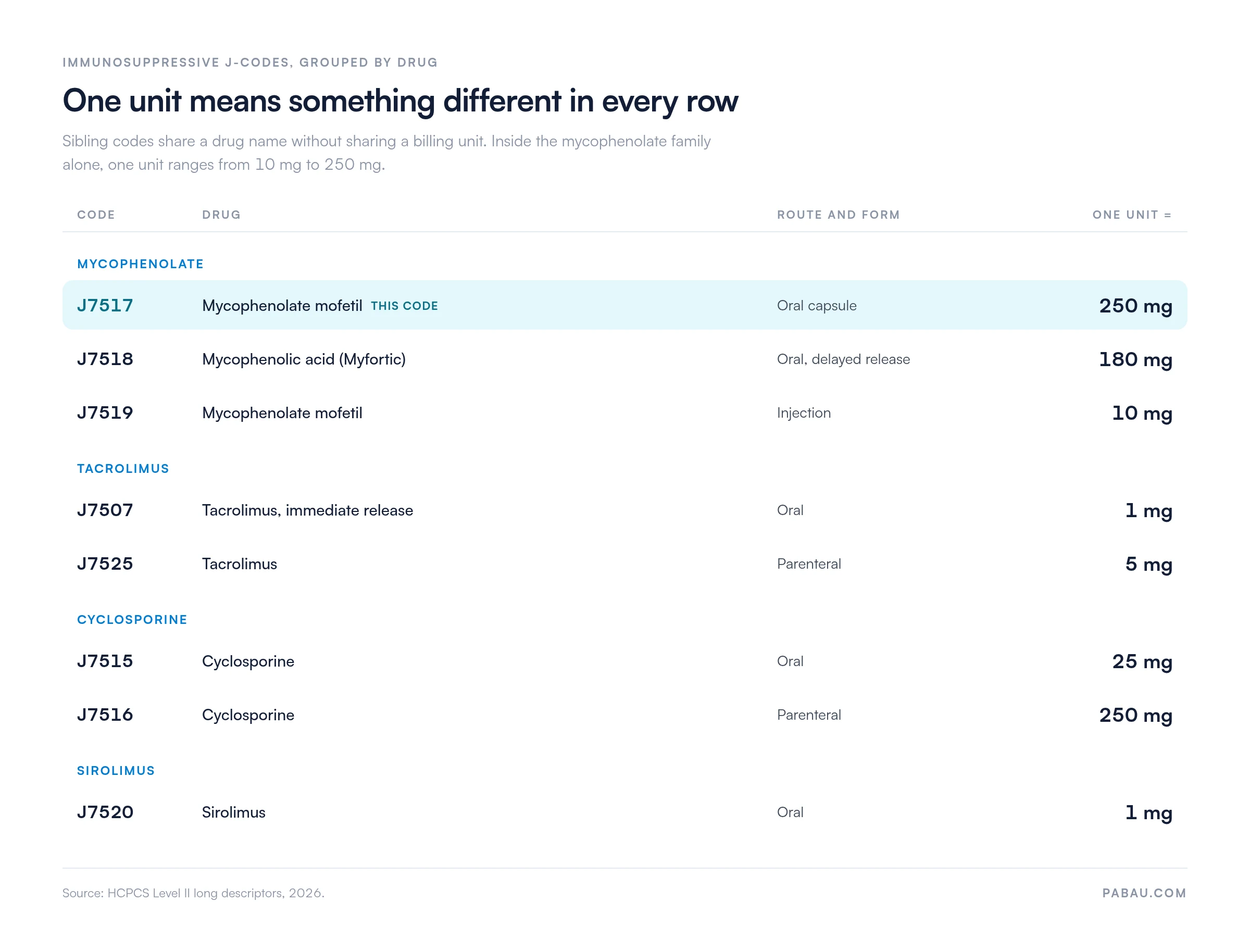
J7517 and J7518 are different drugs, not two strengths of one drug. J7518 covers mycophenolic acid, the delayed-release salt sold as Myfortic. J7519 is the injectable form of mycophenolate mofetil, and its unit is 10 mg rather than 250 mg. Picking the wrong sibling is common when a patient’s formulation changes mid-course.
A practice billing J7517 today usually works across three systems. The dispensing record sits in one place, the transplant documentation in the chart, and the claim in a billing tool or a clearinghouse portal. Unit counts get retyped somewhere along that path.
Practice management software like Pabau holds the encounter, the documentation, and the claim in one patient record. Codes go in through structured fields rather than free text, so the J7517 line carries the unit count and diagnosis you recorded at the visit. Pabau’s medical claims management then tracks each submission through to the remittance.
The result is fewer numbers retyped between systems and a shorter trail to follow when a payer questions a J7517 line. Your billers work from the record instead of rebuilding it.

Pabau gives specialty and transplant practices structured HCPCS code entry, dispensed-quantity records, and submission tracking for complex drug codes like J7517.

J7517 is a narrow code with a short list of ways to get it wrong. The unit math, the Z94 diagnosis, the transplant documentation, and the NDC account for most of the denials the code attracts.
Fixing those four before submission, rather than after a remittance comes back short, is where transplant and specialty practices protect their margin on immunosuppressive billing. It also cuts the appeals your billing team has to write.
Book a demo to see how Pabau handles HCPCS claim entry and submission tracking for specialty practices.

Need to see how claims move through a clearinghouse? Medical claims clearinghouse guide explains the adjudication pathway from submission to payment posting.
Want fewer rejections on complex drug codes? Claim.MD clearinghouse overview covers how electronic claims validation catches errors before they reach the payer.
Not sure what a clean claim has to contain? What makes a clean claim lists the fields payers check first on a drug line.
Building a superbill for dispensed drugs? Superbill guide shows what to record so unit counts can be calculated later.
Wondering where J7517 errors sit in the wider billing process? Revenue cycle management fundamentals walks through the end-to-end claim lifecycle for specialty practices.
HCPCS code J7517 is the Level II billing code for mycophenolate mofetil, oral, 250 mg. It bills immunosuppressive drug therapy for organ transplant recipients under Medicare Part B and most commercial payers. It covers brand-name CellCept and generic mycophenolate mofetil in the 250 mg oral capsule form.
Yes, Medicare Part B covers J7517 for post-transplant patients when a provider dispenses the drug and it is medically necessary for rejection prophylaxis. Kidney transplant recipients whose only coverage is Medicare also qualify under the standalone immunosuppressive drug benefit from the Consolidated Appropriations Act of 2021. Liver and heart transplant recipients are covered under standard Part B criteria.
The most common ICD-10 codes paired with J7517 are Z94.0 for kidney transplant status, Z94.1 for heart transplant status, and Z94.4 for liver transplant status. Z94.81 applies when the drug is used after a bone marrow transplant for graft versus host disease. For an active rejection episode, T86.11 or T86.41 may be added alongside the status code.
The HCPCS code for CellCept is J7517, covering mycophenolate mofetil, oral, 250 mg per unit. Generic mycophenolate mofetil 250 mg capsules use the same code. Myfortic contains mycophenolate sodium, which HCPCS lists as mycophenolic acid under J7518, so it must not be billed under J7517.