HCPCS code J7110: Dextran 75 infusion billing guide
HCPCS code J7110: Official descriptor and code details HCPCS code J7110 is the L...

Last Updated: Nov 10, 2026
J7311 is the HCPCS Level II code for the Retisert fluocinolone acetonide intravitreal implant, billed per 0.01 mg. One implant holds 0.59 mg, so the claim line carries 59 units, not 1.
Retisert treats chronic non-infectious uveitis affecting the posterior segment of the eye, and a surgeon places it with CPT 67027. Iluvien and Yutiq have their own codes, J7313 and J7314, so neither belongs on this line.
Let Pabau's smart automation suggest the right codes, reduce claim denials, and keep your practice compliant—effortlessly.
Automate repetitive tasks and focus on what matters most—your patients.
Reduce coding errors and ensure compliance with the latest regulations.
Clean claims, fewer denials, and faster reimbursements.
Powerful insights and reporting to help your practice thrive.
HIPAA compliant SOC 2 certified GDPR-compliant Trusted by 4,000+ clinics worldwide

HCPCS code J7311 bills one product, the Retisert fluocinolone acetonide intravitreal implant, at 0.01 mg per unit.
One Retisert implant holds 0.59 mg, so the drug line carries 59 units, never 1.
Iluvien bills under J7313 and Yutiq under J7314, so check the brand on the carton before you code.
The hospital usually buys and bills the implant, while the surgeon bills CPT 67027 with RT or LT.
Pair J7311 with a posterior segment uveitis code, and add JZ on Medicare Part B claims.
HCPCS code J7311 is the Level II code CMS assigns to the Retisert fluocinolone acetonide intravitreal implant. Its descriptor reads “Injection, fluocinolone acetonide, intravitreal implant (Retisert), 0.01 mg.”
Bausch + Lomb makes Retisert. Each implant holds 0.59 mg of fluocinolone acetonide, so one implant bills as 59 units.
Retisert is a surgical implant, unlike the injectable steroid implants. A surgeon places it through a pars plana incision and sutures it in place. It releases the steroid for about 30 months.
J7311 sits in the HCPCS J-code range, which covers drugs given other than by mouth. Our HCPCS code library lists the codes around it, and the table below keeps this one’s claim facts in one place.
Three fluocinolone acetonide implants are on the US market, and each one has its own J-code. Billing the wrong brand under J7311 is the costliest error on this code.
Iluvien bills under J7313 at 19 units. Yutiq bills under J7314 at 18 units. Ozurdex is a dexamethasone implant and bills under J7312.
The anti-VEGF drugs sit in a separate group altogether. Aflibercept, for example, bills under J0178 per 1 mg, and it never substitutes for a steroid implant code. Once the carton says Retisert, the unit count is the next number to get right.
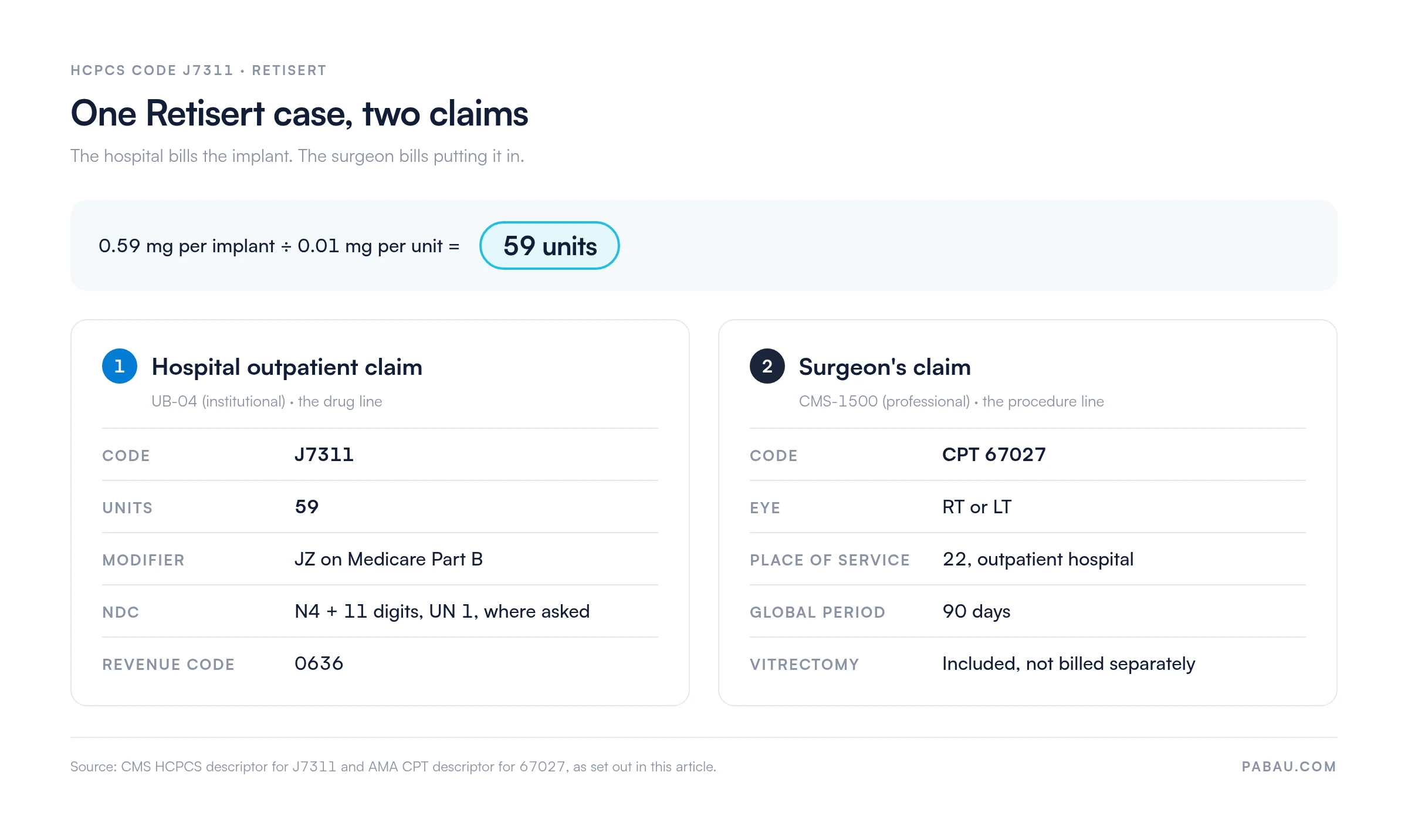
The descriptor sets the unit at 0.01 mg, so units equal the dose divided by 0.01. For Retisert, 0.59 mg divided by 0.01 mg gives 59 units on the J7311 line.
Reporting 1 unit is the classic mistake. The claim still pays, just at one fifty-ninth of the implant price, and the shortfall often goes unnoticed until reconciliation.
For a Medicare patient, the finished drug line reads J7311-JZ with 59 in the units field. Add the NDC wherever the payer asks for it.
Some Medicaid plans publish their own unit limits for drug codes. If a plan rejects 59 units, ask the plan how it wants the implant reported before you resubmit.
The FDA approved Retisert for chronic non-infectious uveitis affecting the posterior segment of the eye. That is its only labeled use, so a J7311 claim needs a matching uveitis diagnosis.
Payer policies add conditions on top of the label. Aetna, for example, covers Retisert when uveitis hasn’t responded to conventional corticosteroid or immunosuppressive therapy, or the patient can’t tolerate it. An active ocular infection rules the implant out.
Code to the eye being implanted, and avoid the unspecified-eye codes where the chart names a side. Payer coverage lists are narrower than the label, so check the plan’s drug policy before you book surgery.
Diabetic macular edema codes don’t support J7311. That indication belongs to Iluvien under J7313, never to Retisert.
The surgeon bills CPT 67027 for the procedure. The AMA descriptor reads “Implantation of intravitreal drug delivery system (eg, ganciclovir implant), includes concomitant removal of vitreous.”
Because the descriptor includes removal of vitreous, the vitrectomy isn’t coded separately. CPT 67027 carries a 90-day global period, and RT or LT on the line identifies the eye.
Retisert is implanted in an operating room, usually in a hospital outpatient department (POS 22) or as an inpatient (POS 21). It isn’t an office procedure, so POS 11 doesn’t fit a Retisert claim.
In a hospital outpatient department, the facility usually buys the implant and reports J7311 on its own claim. The surgeon then bills 67027 at the facility rate.
On an inpatient stay, Medicare generally pays for the implant within the hospital’s inpatient payment, not as a separate line. If the case goes to an ambulatory surgical center, confirm with the payer how that center should report the implant.
The implant runs out after about 30 months, and the label allows replacement if uveitis recurs. A replacement is a new J7311 line at 59 units with a new 67027.
Payers differ on whether removal of the old implant in the same session is separately reportable. Check the plan’s policy before you add a removal code such as 67121.
With the procedure line settled, two details decide whether the drug line goes through on the first pass.
Since July 1, 2023, Medicare has required JW or JZ on separately payable Part B drugs from single-dose containers. From October 1, 2023, a line that omits the modifier can come back unprocessable.
Medicaid programs require the National Drug Code on claims for physician-administered drugs, because drug rebates depend on it. Many commercial payers require it too.
Medicare Part B doesn’t make the NDC a general requirement on these claims. Report it anyway when your MAC or the plan asks for it.
Enter the N4 qualifier, the 11-digit NDC, the unit qualifier UN, and a quantity of 1. Read the NDC off the carton you used instead of copying it from an old claim.
Traditional Medicare Part B generally doesn’t require prior authorization for J7311. Medicare Advantage plans and commercial insurers often do. Run insurance eligibility verification when surgery is first discussed, so the authorization is in hand before the OR date.
A typical request includes the uveitis diagnosis, the treatment history and response, intraocular pressure readings, and the surgeon’s statement of medical necessity.
Confirm who is buying the implant before you book the OR date. When the hospital orders Retisert, its drug authorization and your surgical authorization can be separate requests with separate reference numbers.
Medicare Part B pays separately payable drugs at average sales price plus 6%. CMS republishes the ASP pricing file every quarter, so the J7311 allowance moves four times a year.
Check the current quarter before the implant is ordered. Commercial plans may pay from their own fee schedules instead, so read each remittance line against the contract.
Put those pieces in order and a Retisert case runs on two claims. The hospital files a UB-04, and the surgeon files a CMS-1500 claim form. Here’s the sequence a billing team follows, start to finish.
The split between the two claims is easier to see side by side.
Each check below matches one of the six errors in the next section, so it stops that denial before the claim leaves.
A denial management workflow that sorts denials by reason code shows which of these keeps recurring. Fix the cause at the front desk or in the template, not only on the returned claim.
Check the current descriptor in the AAPC HCPCS lookup before each annual code update.
Practices billing physician-administered drugs often keep stock, the clinical note and the claim in three places. Each handoff is a chance to drop a unit or mistype a lot number.
Pabau, the practice management platform we build, keeps them on one patient record. Stock records hold the lot number and expiry date of each item, so the implant used is traceable from the note.
Eligibility checks and prior authorization tracking sit on the same record, so the team sees approval status before surgery. In the US, claims management software in Pabau submits claims through Claim.MD and posts the responses back.
Pabau won’t choose the code, the units or the modifier for you. A biller who has read the payer policy still makes those calls.

Pabau tracks stock lot numbers and expiry dates, runs eligibility checks, tracks prior authorizations and submits claims through Claim.MD.

J7311 is a narrow code, and that works in your favor. One product, one unit count and one indication leave little room for judgment calls.
The money goes missing at the edges instead. A 1 sits on the units line, an Iluvien carton gets coded as Retisert, or the wrong party files the drug line.
Settle who buys the implant before the OR date, and the rest of the claim follows from the carton and the chart. To see how Pabau keeps stock lot numbers, authorizations and claims on one patient record, book a demo.

Billing Iluvien rather than Retisert? HCPCS code J7313 covers the Iluvien implant, which has its own units and indication.
Coding an office injection instead of surgery? CPT code 67028 explains intravitreal injection billing, with its modifiers and common denials.
Chasing approvals before surgery? The prior authorization process walks through each step from request to approval.
Need to understand what payers check before they accept a drug claim? Submitting a clean claim walks through the checks that decide acceptance.
Looking for the full revenue cycle behind drug reimbursement? Revenue cycle management explained covers the process from eligibility through payment posting.
Retisert bills under HCPCS code J7311. Each unit is 0.01 mg, so one 0.59 mg implant goes on the claim as 59 units.
Hospitals usually report J7311 under revenue code 0636, drugs requiring detailed coding, on the UB-04. Some commercial contracts set their own rules, so check yours.
Part B covers it when the implant goes in at a hospital outpatient department. On an inpatient stay, the hospital’s Part A payment covers it. Part D doesn’t apply to it.
Usually not. Vision plans cover routine eye exams and eyewear, not surgery for uveitis. Bill the patient’s medical insurance, and confirm its drug policy before surgery.
Regular eye pressure checks and cataract monitoring, because the steroid can raise intraocular pressure. Nearly all eyes with a natural lens develop cataracts after the implant.
Routine post-op visits fall inside the 90-day global period of CPT 67027. Later cataract or glaucoma surgery is a separate procedure with its own codes.