CCSD code XR320: Nasolacrimal duct stenting billing guide
CCSD code XR320 is the UK private insurance code for dilatation or stenting of t...

Last Updated: Nov 24, 2026
27030 is the CPT code for arthrotomy, hip, with drainage (eg, infection). The surgeon opens the hip joint capsule through an incision to drain and wash out an infected joint, most often for septic arthritis.
It differs from closed needle aspiration (CPT 20610) and from open arthrotomy for exploration or loose or foreign body removal (CPT 27033). Because 27030 carries a 90-day global period and 13.31 work RVUs, payers read the operative note closely. Clean claims come down to three checks: the open approach, the side of the body and the global window.
Let Pabau's smart automation suggest the right codes, reduce claim denials, and keep your practice compliant—effortlessly.
Automate repetitive tasks and focus on what matters most—your patients.
Reduce coding errors and ensure compliance with the latest regulations.
Clean claims, fewer denials, and faster reimbursements.
Powerful insights and reporting to help your practice thrive.
HIPAA compliant SOC 2 certified GDPR-compliant Trusted by 4,000+ clinics worldwide

CPT code 27030 reports an open hip arthrotomy to drain an infected joint, such as septic arthritis.
Open exploration or loose or foreign body removal is CPT 27033, and needle aspiration is CPT 20610.
The 90-day global period bundles routine post-op visits, wound checks and suture removal into the surgical payment.
The 2026 Medicare fee schedule gives 27030 13.31 work RVUs and 25.77 facility RVUs, about $861 nationally.
Pabau, a practice management platform, submits claims through Claim.MD with eligibility checks and ERA remittance posting.
CPT code 27030 reports an open arthrotomy of the hip joint to drain an infection. CMS’s 2026 relative value file lists it as “Arthrotomy hip w/drainage,” with a 90-day global period. The full descriptor from the American Medical Association reads Arthrotomy, hip, with drainage (eg, infection).
In practice, the surgeon cuts through the hip capsule, drains pus or infected fluid and irrigates the joint space. The code sits in the Pelvis and Hip Joint subsection (26990-27299), under the Incision codes (26990-27036).
The word that matters is drainage. If the operative note describes exploring the joint or removing a loose or foreign body, CPT 27033 fits instead.
Payers expect 27030 when an infected hip needs open surgical access to clear it. The diagnosis on the claim has to match that indication, so read the findings before you pick an ICD-10 code.
A retained loose or foreign body isn’t a 27030 indication. Removing one through an open arthrotomy is coded 27033.
The operative note must also name the pathology, such as septic arthritis or abscess, and confirm the capsule was entered. “Drainage of hip joint” on its own doesn’t support the code.
Every 27030 claim needs an ICD-10-CM code that shows medical necessity. Check each one against the current fiscal year’s tabular list before you submit, because codes change every October.
For a prosthetic hip, the side-specific codes T84.51XA (right hip) and T84.52XA (left hip) are more precise than T84.50XA. The side in the diagnosis should also agree with the -RT or -LT modifier. A right-hip diagnosis on a left-side claim invites a denial or a records request.
The operative note decides whether a 27030 claim survives review. Auditors look for specific elements, and one missing item can sink a medically necessary surgery. A strong note is also the starting point for clean claim submission.
CPT 27033 is arthrotomy, hip, including exploration or removal of loose or foreign body. Both codes open the hip joint, so the documented operative intent separates them. 27030 drains infection, while 27033 covers exploring the joint or removing a loose or foreign body.
Code what the operative note supports, in either direction. If a surgeon drains an infection and also removes a foreign body, check NCCI edits before billing both on the same hip.
CPT 20610 covers aspiration or injection of a major joint, including the hip, without ultrasound guidance. It’s a closed, needle-based procedure with a 0-day global and 0.77 work RVUs. Payers expect it whenever closed aspiration is clinically appropriate.
Escalating to 27030 needs a documented reason. The usual ones are:
State the reason plainly in the operative note. Without it, a reviewer may decide the open procedure wasn’t necessary.
Hip surgery coders work across several codes in the same range, and the operative note is what tells them apart. A superbill that lists them side by side helps staff pick the right one under time pressure.
The chart below lines them up by what the surgeon documented.
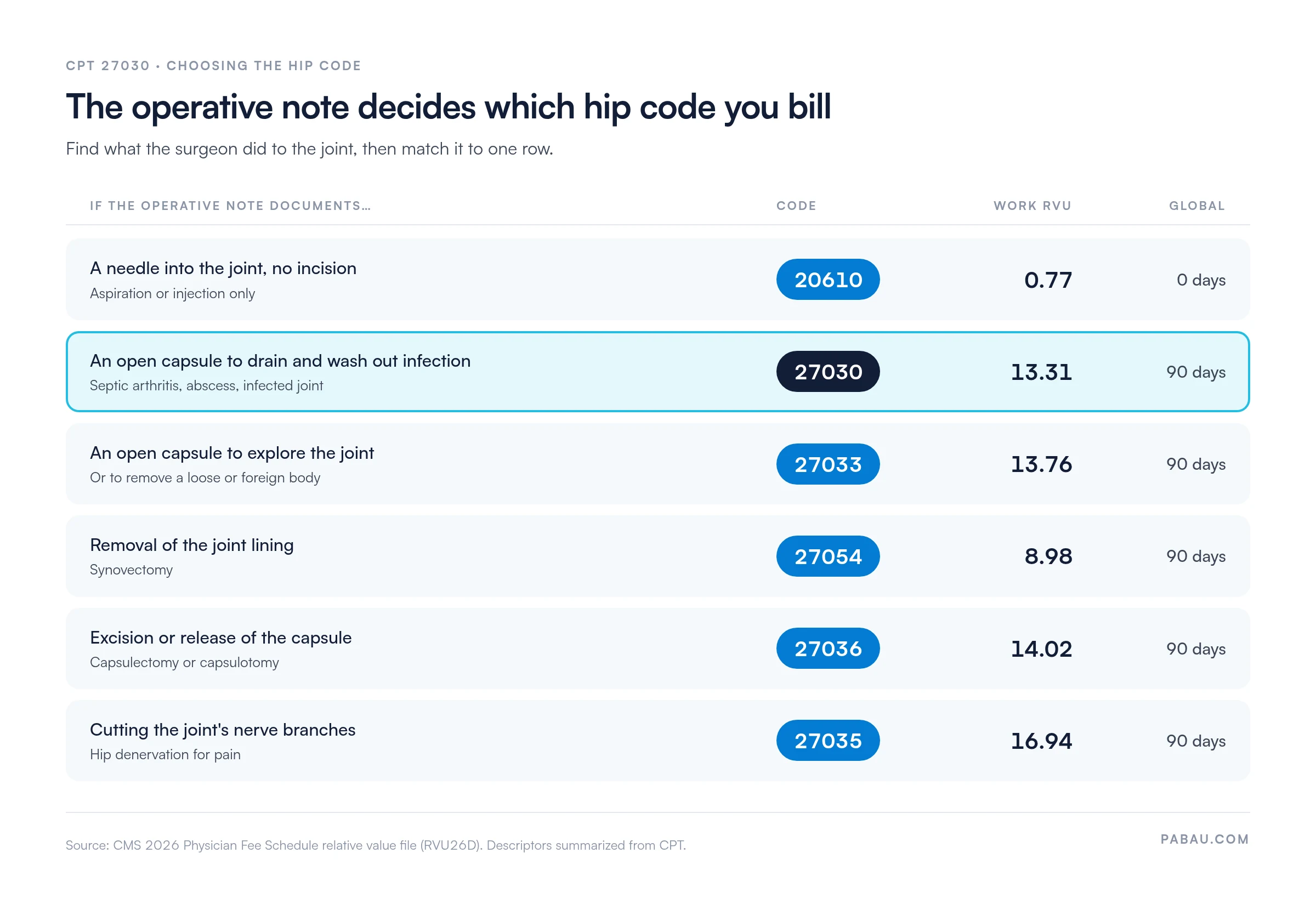
A septic hip is usually an urgent case, so the billing work often starts after surgery. Here’s the path a clean claim takes.
Steps one and two shape the rest of the claim. Every later edit checks the code against the note, so a mismatch there follows the claim to the end.
Modifiers tell the payer which side was treated and whether the surgery differed from the standard case. A missing or wrong one leads to a rejection or reduced payment. These are the ones that come up with 27030.
Common modifier error: Some practices append -51 to 27030 when it’s billed with other procedures. Medicare applies the multiple-procedure reduction automatically, so don’t append -51 unless the payer requires it. Sequence the highest-valued procedure first.
CMS assigns 27030 a 90-day global surgical package. The surgical payment covers routine post-operative care for 90 days, plus the preoperative visit the day before or the day of surgery.
Bundled within the global period (not separately billable):
Separately billable within the global period:
Audit every E&M visit billed within 90 days of a 27030 claim. A visit for the hip surgery itself falls inside the global package and can’t be billed separately. A visit for an unrelated problem needs modifier -24, or the payer may recoup the payment later.
Medicare’s payment for 27030 comes from the CMS Physician Fee Schedule, which values the code in relative value units (RVUs). The national figure below is a starting point. Payment in your area moves with your locality’s geographic practice cost indices (GPCI).
Check the current year’s values with the FastRVU lookup tool or the CMS search before you set fees. CMS updates RVUs every year in the fee schedule final rule, so never use last year’s figures for this year’s claims.
Traditional Medicare (Parts A and B) doesn’t require prior authorization for CPT 27030. That matters because septic arthritis of the hip is an orthopedic emergency, and waiting for approval risks permanent joint damage. Medicare Advantage plans work differently.
Run insurance eligibility verification as early as you can to confirm whether the patient is on a Medicare Advantage plan. Some plans require authorization or prompt notification even for urgent procedures. A missing authorization can be a valid denial reason, whatever the medical necessity.
Documentation typically requested for authorization:
Most 27030 denials trace back to a handful of errors you can catch at the documentation or billing stage. Building denial management workflows around them cuts rework. To match each denial to its CARC for appeals, use this list of common denial codes.
Review 27030 denials every quarter in your denial report. Filter by CARC 4 (modifier missing or inconsistent) and CARC 15 (authorization number missing or invalid). Both point to fixes you can make before the next claim goes out.
Surgical billing teams often juggle the operative note, a billing spreadsheet and a clearinghouse portal. Each hand-off is another chance to drop a modifier or an authorization number.
Pabau’s claims management software builds the claim from the patient record. The CPT code on the service lands on the charge line, and the ICD-10 slots draw on the recorded problem list. The claim can’t be sent until required fields, such as membership and authorization numbers, are complete.
US practices submit through Claim.MD, with real-time eligibility checks, claim-status tracking and ERA remittance posting. Your coder still chooses 27030 and its modifiers, while Pabau handles the submission and follow-up steps.

Pabau builds claims from the patient record, checks required fields before sending and submits through Claim.MD with eligibility checks and ERA remittance posting.

CPT 27030 is a narrow code. It pays for opening the hip to drain infection, and the operative note has to say so in plain words. Once the approach, findings, side and reason for open surgery are on paper, the coding decision is simple.
The trade-off to remember is the 90-day global. A well-valued procedure brings three months of bundled follow-up, so track that window as carefully as the claim itself.
Book a demo to see how Pabau carries a 27030 claim from the patient record to Claim.MD and posts the remittance when it comes back.

Need a full framework for submitting clean claims electronically? Pabau’s Claim.MD clearinghouse guide explains how the integration handles 837P submission, real-time eligibility, and ERA remittance for US surgical practices.
Want to understand the full revenue cycle behind surgical billing? What is revenue cycle management breaks down each stage from patient registration through final payment posting.
Looking for a reference on how denial codes map to billing errors? Medical billing compliance covers CARC and RARC code interpretation, appeal timelines, and documentation standards for surgical claims.
Planning ahead for Medicare Advantage cases? Prior authorization process walks through how requests are submitted, tracked and appealed.
Yes. Report 27030 with modifier 50 when both hips are drained in the same session. Medicare gives the code a bilateral indicator of 1, so it pays 150% of the single-side amount. Some commercial payers prefer two lines with -RT and -LT instead.
No. 27030 requires an open arthrotomy. Arthroscopic hip procedures use the 29860-29863 range, and a scope washout that no listed code describes is usually reported with unlisted code 29999.
Yes, under Medicare. The 2026 fee schedule gives 27030 an assistant-at-surgery indicator of 2, so an assistant can be paid. Use modifier 80 for a physician, or AS for a physician assistant or nurse practitioner.
Yes. The code has no age limit, and septic arthritis of the hip is a classic reason for urgent surgery in young children. The documentation and modifier rules are the same as for adults.
About $861 nationally in 2026, based on 25.77 facility RVUs and the $33.4009 conversion factor. Your locality’s GPCI moves that figure up or down.