CCSD code XR320: Nasolacrimal duct stenting billing guide
CCSD code XR320 is the UK private insurance code for dilatation or stenting of t...

Last Updated: Nov 24, 2026
21899 is the CPT code for unlisted procedure, neck or thorax. Coders use it for neck soft-tissue or chest wall surgery when no listed code in the 21501-21899 range describes the work.
Because the code has no fixed value, a payer prices each claim by hand. Three items decide whether it pays: a special report, a named comparison code and, where the payer asks, prior authorization. These are the requirements most payers expect. The sections below cover choosing the code, writing the report, pricing, modifiers and the mistakes that stall a claim.
Let Pabau's smart automation suggest the right codes, reduce claim denials, and keep your practice compliant—effortlessly.
Automate repetitive tasks and focus on what matters most—your patients.
Reduce coding errors and ensure compliance with the latest regulations.
Clean claims, fewer denials, and faster reimbursements.
Powerful insights and reporting to help your practice thrive.
HIPAA compliant SOC 2 certified GDPR-compliant Trusted by 4,000+ clinics worldwide

CPT code 21899 reports a neck or thorax procedure only when no listed code in the 21501-21899 range describes it accurately.
Every 21899 claim needs a special report, and claims without one are commonly denied or returned for documentation.
Payers price 21899 by hand against the comparison code you name, because Medicare publishes no RVU for it.
Spine work goes to 22899 and arthroscopic work to 29999. External rib fixation has reported as 21899 since 21810 was deleted in 2015.
Pabau, a practice management platform, tracks prior authorization codes, dates and sessions on the case and warns when one is missing. It also sends claims electronically through Claim.MD.
CPT code 21899 reports a surgical procedure on the neck soft tissues or thorax that no listed CPT code describes.
AAPC’s Codify listing for 21899 places it at the end of the 21501-21899 neck and thorax range. That range sits inside the musculoskeletal system section (20100-29999). The official descriptor is short: Unlisted procedure, neck or thorax.
The AMA keeps unlisted codes in the CPT set because new techniques arrive faster than the annual code update. When a neck or chest wall procedure has no accurate descriptor, 21899 is the legitimate way to bill it. It gets paid only when the claim carries full supporting documentation.
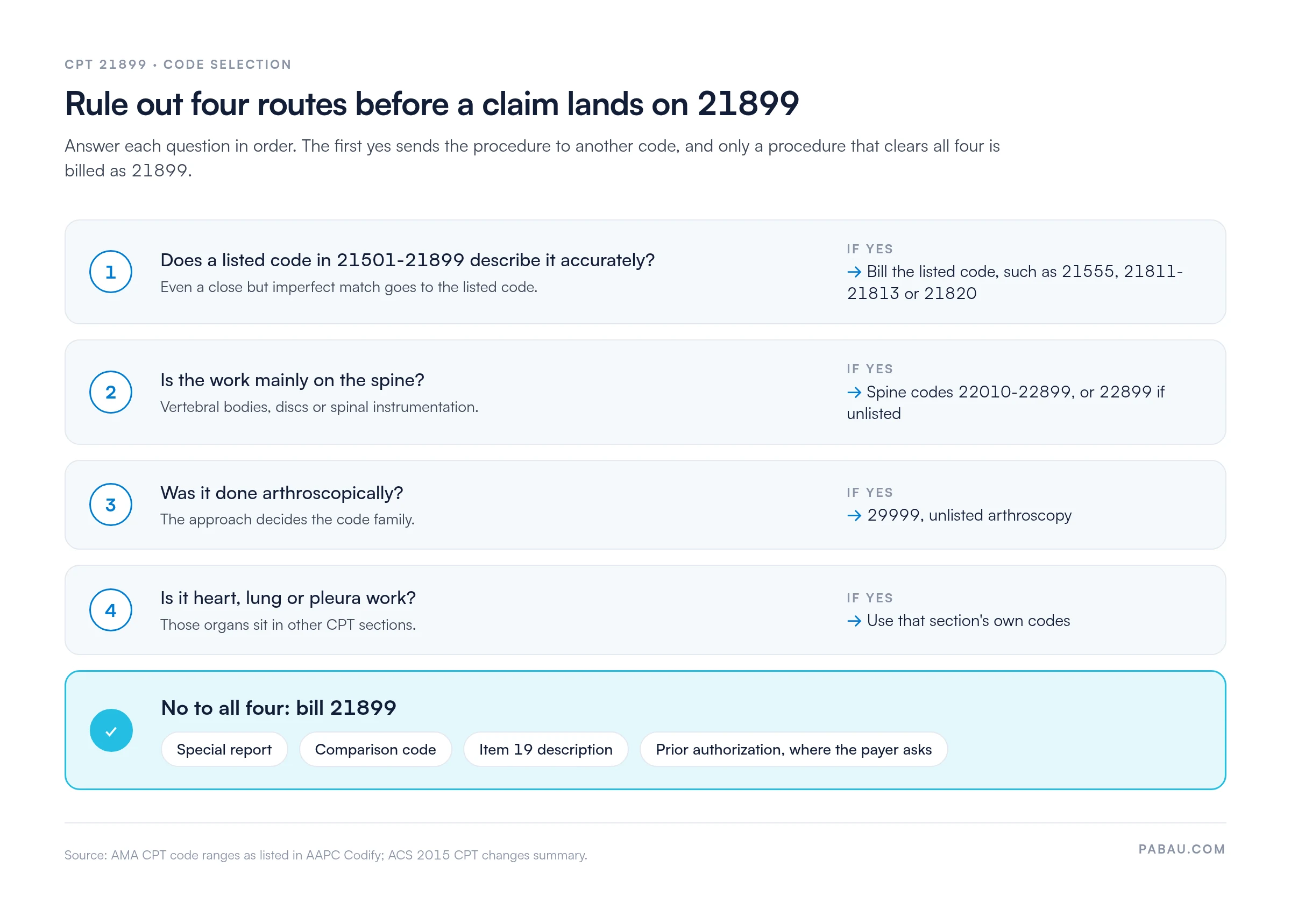
Use 21899 for neck or thorax surgery that no listed descriptor matches accurately. That word carries the weight. If a listed code is close but imperfect, coders still use the listed code.
Typical candidates include novel soft-tissue reconstruction in the neck, emerging chest wall techniques, and combined neck-thorax work no single code covers. External fixation of rib fractures belongs here too. Its old code, 21810, was deleted in the 2015 CPT update, so that work now reports as 21899.
What 21899 does not cover:
Most 21899 mix-ups involve a handful of neighbors. Pick the wrong one and the claim is either underpaid or denied because a specific code exists.
The 21899 versus 22899 split causes the most payer queries. Work that mainly involves the vertebral column goes to 22899. Keep 21899 for chest wall and neck soft-tissue work that sits apart from the spine.
Run the four checks below in order, because the first yes sends the procedure to another code.
CPT guidelines say a rare, unusual, variable or new service may need a special report. Payers treat every 21899 claim that way. Claims without a special report are commonly denied or returned for documentation.
The report travels with the operative note but does a different job. The operative note records what happened. The special report explains it to a reviewer who wasn’t there, and shows why no listed code fits.
What the special report must include:
Write for a reviewer who has never seen the technique. Payer reviewers are often nurses or non-surgical clinicians, so plain language usually lands better than dense operative shorthand. Good medical billing compliance habits from the start also cut revision requests on appeal.
On the claim itself, put a short description in Item 19 of the CMS-1500 or its electronic equivalent. American College of Surgeons coding guidance says that statement must be 80 characters or less. Attach the full report as well, since Item 19 can’t carry the case on its own.
Here’s how the pieces fit on an illustrative claim. A surgeon stabilizes a flail chest with an external fixator, work that lost its own code in 2015.
The payer then prices the claim against 21811, adjusted by that percentage. The ACS recommends this percentage method, because it gives the reviewer a concrete anchor. Without a named comparison code, the reviewer has nothing to price against.
CPT code 21899 accepts standard surgical modifiers. Four come up most often, and each depends on payer policy.
Modifier 51 can apply when 21899 is one of several procedures in a session. Medicare does not require modifier 51, though, since its contractors apply multiple-procedure reductions automatically. Commercial payers vary, so check each payer’s policy and modifier 51 exempt list first.
Many commercial payers and Medicare Advantage plans want prior authorization before a 21899 procedure. Unlisted work falls outside routine fee schedule processing, so they review it before the service rather than after.
Original Medicare (Parts A and B) has no standard prior authorization step for surgical codes. The claim still goes to manual medical review after submission. So prepare the special report before the procedure date, whoever the payer is.
Prior authorization checklist for 21899:
Timelines vary by payer, so confirm the turnaround with each one. Build that time into scheduling talks with the patient, so no procedure goes ahead without confirmed coverage.
CPT code 21899 has no published relative value unit (RVU) in the Medicare Physician Fee Schedule. Payers can’t price it automatically. Instead, they price it by hand, using the comparison code you name.
That comparison code drives what the practice gets paid. Pick one with too low an RVU and you leave money unclaimed. Pick one far above the work performed and you invite down-coding or an audit.
How to pick the comparison code:
Payers rarely call to ask for a missing comparison code. They usually deny the claim instead.
Name the comparison code in Item 19 of the CMS-1500 and again in the special report. Payers usually deny a 21899 claim without one as administratively incomplete. That’s fixable on appeal, but it slows payment.
Medicare sends 21899 claims to manual review by a Medicare Administrative Contractor (MAC). The reviewer checks the special report, the operative note and any Local Coverage Determination (LCD) that applies.
LCDs for neck and thoracic procedures vary by MAC jurisdiction. Before you submit, check whether one covers this procedure in your region. If an LCD excludes the procedure, expect a coverage denial that’s hard to overturn.
Medicare requirements for 21899 claims:
Work through these steps in order. Skipping or reordering them causes the most common 21899 denials.
Run this list at the point of claim creation. Catching a missing item now takes minutes, while finding it after a denial takes an appeal.
A 21899 claim takes a longer path than a priced code. It leaves the practice, passes the clearinghouse edits and reaches the payer. A reviewer then reads the attachments and prices the claim against your comparison code.
Common mistakes along that path:
Denials on 21899 run higher because the billing requirements are heavier. Read the stated reason first, since each one needs a different fix and different appeal wording.
Sort denials by root cause with denial management workflows, so each one reaches the right fix fast. Tracking the medical billing denial codes on your 21899 claims shows the pattern. Within a few months, one or two repeat denial types usually stand out.
Billing 21899 by hand means tracking the special report, comparison code, authorization and attachments across email and spreadsheets. When one piece goes missing, the claim stalls.
Pabau’s simpler claims management keeps the authorization on the patient’s case. The prior authorization code, its dates and its sessions are tracked there, and Pabau warns you when one is missing.
When the claim is ready, it goes out electronically through Claim.MD as an 837P claim. Eligibility checks, ERA remittances and secondary claims run through the same connection. That leaves your team more time for the special report itself.
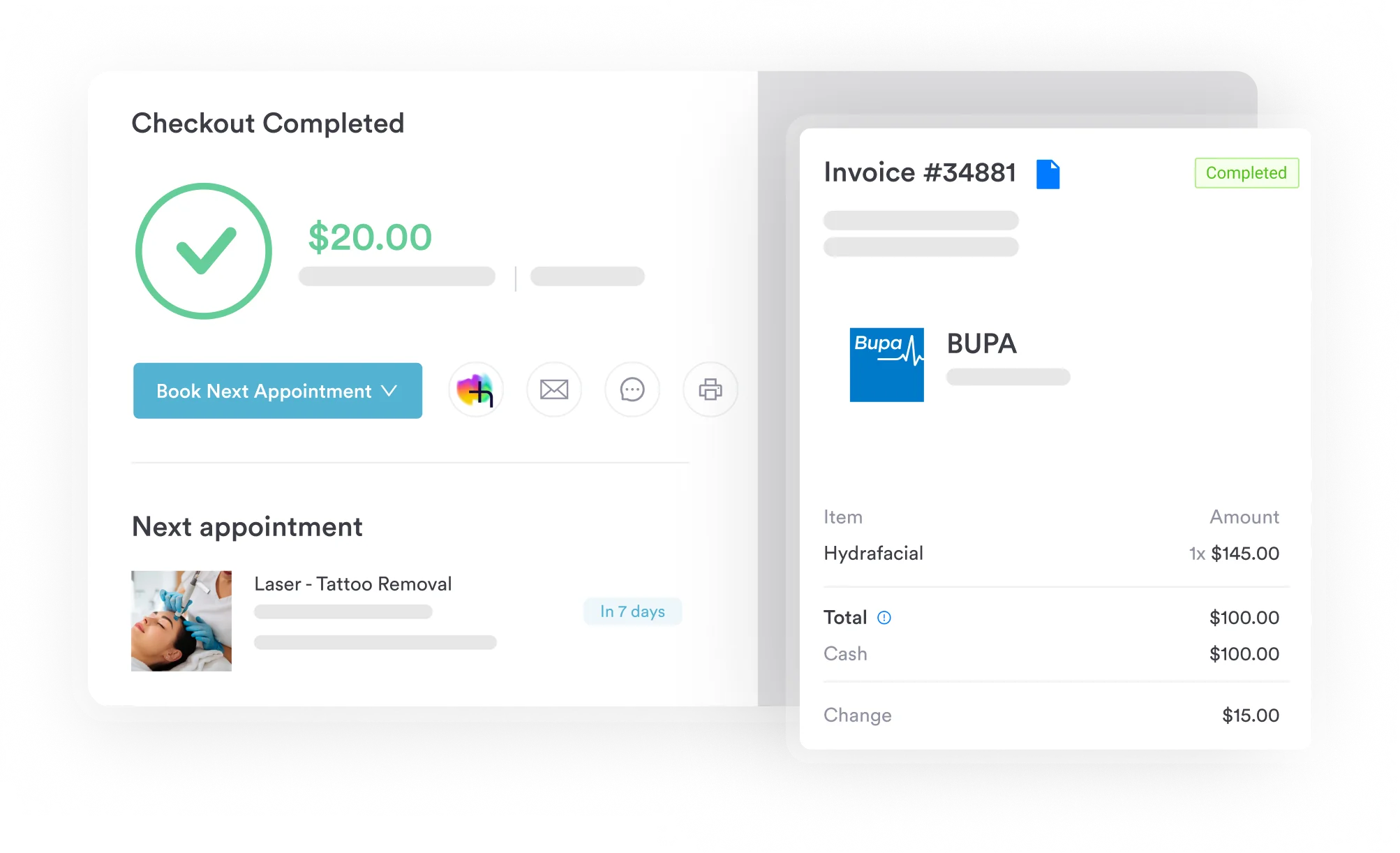

Pabau tracks prior authorization codes, dates and sessions on the case and warns when one is missing. Claims then go out electronically through Claim.MD.

21899 is the last code you check, so rule out the listed codes, 22899 and 29999 first. Once a procedure clears those checks, payment depends on paperwork you can prepare before the operation.
So write the special report and pick the comparison code before the procedure date. Get authorization in writing where the payer asks. That order costs a few hours up front and spares you rework on appeal.
Book a demo to see how Pabau tracks authorizations on each case and sends your unlisted-code claims through Claim.MD.

Want to see what happens to a claim after it leaves the practice? How the Claim.MD clearinghouse works explains how clearinghouse validation catches errors before claims reach the payer.
Billing an unlisted spine procedure instead? CPT code 22899 covers the spinal counterpart to 21899 and how payers handle it.
Coding external rib fixation? CPT code 21810 explains the deleted flail chest code and why that work now reports as 21899.
Looking for the broader billing picture? What is revenue cycle management covers the full workflow from patient encounter to collected payment.
Pick the listed code closest to your procedure in work, anatomy, complexity and time, then explain the choice in the special report. Codes from the 21501-21899 range (neck soft tissues and thorax), such as 21555 or 21811, are common reference points.
It can, when 21899 is one of several procedures in the same session. Medicare does not require modifier 51, because its contractors apply multiple-procedure reductions automatically. Commercial payers vary, so check each payer’s policy.
Original Medicare has no standard prior authorization step for surgical codes, but the claim still goes to manual review. Medicare Advantage plans often do require it. Either way, prepare the special report before the procedure.
Yes. If a Category III code describes the procedure, CPT rules say to report it instead of an unlisted code. Medicare assigns no value to Category III codes either, so send the same documentation.
A concise description of the procedure, 80 characters or fewer, plus the comparison code where space allows. Attach the special report and operative note too, because Item 19 can’t carry the full case.