

CCSD code G5100: Bypass of duodenum billing guide
CCSD code G5100 bills a bypass that leaves the duodenum in place CCSD code G5100...

Last Updated: Oct 16, 2026
J3262 is the HCPCS Level II code for injection, tocilizumab, 1 mg. It bills intravenous Actemra for rheumatoid arthritis, giant cell arteritis, two forms of juvenile idiopathic arthritis, cytokine release syndrome and hospitalized COVID-19.
Units follow the milligrams infused, so a 280 mg dose bills 280 units. Subcutaneous Actemra is mostly self-injected and covered under Part D instead. Each biosimilar has its own code: Q5133 for Tofidence, Q5135 for Tyenne and Q5156 for Avtozma.
Let Pabau's smart automation suggest the right codes, reduce claim denials, and keep your practice compliant—effortlessly.
Automate repetitive tasks and focus on what matters most—your patients.
Reduce coding errors and ensure compliance with the latest regulations.
Clean claims, fewer denials, and faster reimbursements.
Powerful insights and reporting to help your practice thrive.
HIPAA compliant SOC 2 certified GDPR-compliant Trusted by 4,000+ clinics worldwide

J3262 bills intravenous tocilizumab (Actemra) per 1 mg, so units equal the milligrams infused, not the vials opened.
RA starts at 4 mg/kg every 4 weeks, so a 70 kg patient’s 280 mg dose bills 280 units.
Medicare Part B pays J3262 at ASP plus 6%, and every single-dose vial line needs the JZ or JW modifier.
Biosimilars bill under their own Q-codes: Q5133 for Tofidence, Q5135 for Tyenne and Q5156 for Avtozma.
Claims software such as Pabau pre-fills the claim form from the patient record and checks required fields before submission.
HCPCS code J3262 is the Level II drug code for injection, tocilizumab, 1 mg. Practices use it to bill intravenous Actemra, the IL-6 receptor antagonist from Genentech, a member of the Roche Group. One unit equals one milligram administered, for Medicare, Medicaid and most commercial plans.
Actemra won FDA approval in January 2010. J3262 took effect on January 1, 2011, replacing C9264, the temporary code used during 2010.
J3262 sits in the HCPCS Level II J series, which covers drugs administered other than by mouth. CMS maintains the HCPCS Level II code set and publishes updates every quarter.
Payers match the diagnosis on a J3262 claim against the FDA label and their own clinical policy. IV tocilizumab has six approved indication groups, and each one maps to its own ICD-10 codes.
Seronegative polyarticular disease codes to M08.3. The M08.4- codes describe pauciarticular disease, so they do not support a PJIA claim.
Off-label use is not covered by every commercial payer. Coverage varies by plan and policy year, so confirm the payer’s criteria before you infuse for an unlisted indication.
J3262 is billed per 1 mg, so the unit count equals the total milligrams administered. The dose comes from the patient’s weight and the indication’s schedule on the FDA label:
The calculation itself takes three steps:
The cap matters for heavier patients. A 110 kg RA patient at 8 mg/kg calculates to 880 mg, but the label limits the infusion to 800 mg. That claim carries 800 units.
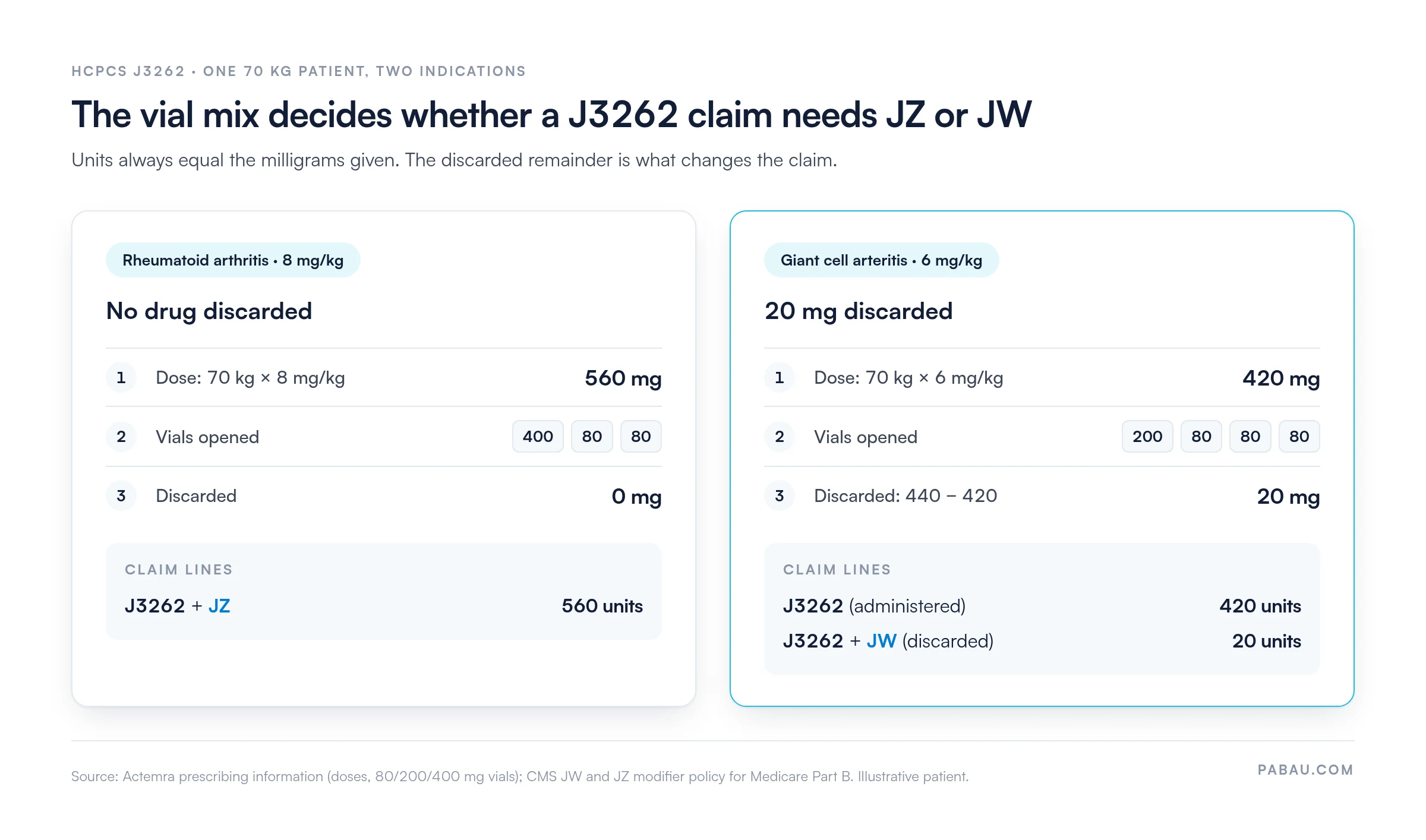
Actemra IV comes in 80 mg, 200 mg and 400 mg single-dose vials. Medicare Part B wants a waste modifier on every single-dose vial drug line. Use JZ when no drug was discarded.
When some drug is discarded, bill the administered milligrams on one line. Then bill the discarded milligrams on a second J3262 line with JW, and record the discarded amount in the note. The vial mix decides which case applies, as these two infusions show.
Document the patient’s weight, the prescribed dose in mg/kg, and the calculated total mg in the infusion note on every encounter. If the clinical record and the billed unit count cannot be reconciled in 30 seconds during an audit, expect a recoupment demand.
J3262 covers the drug only, so the infusion service goes on its own line with a CPT administration code. CPT guidelines let the chemotherapy administration codes report monoclonal antibody infusions. That is why tocilizumab infusions are often billed with 96413, timed against the start and stop times in the note.
Do not bill IV hydration (96360/96361) on the same date unless it is a clinically distinct service with its own documented reason. Bundling edits reject a standalone hydration line attached to a tocilizumab infusion claim.
Medicare Part B pays J3262 at the average sales price (ASP) plus 6%. That holds in the physician office and in the hospital outpatient department, where tocilizumab is separately payable under OPPS. CMS updates ASP payment limits every quarter, so the rate changes four times a year.
Tocilizumab is a high-cost biologic, so a small ASP change still moves revenue. Pull the current limit from the CMS ASP pricing files at the start of each quarter. Part B drug payment comes from that file, not from the Physician Fee Schedule.
Medicare does not require the NDC on most Part B claims, except for patients who are dually eligible for Medicaid. Medicaid and many commercial payers do require it.
They expect the N4 qualifier, the 11-digit NDC, a unit qualifier such as UN and the quantity. A missing or malformed NDC is one of the most common reasons these claims bounce.
Most infusion practices buy tocilizumab and bill it themselves. Under buy-and-bill, the practice purchases the drug, administers it and bills the payer for both the drug and the infusion.
340B covered entities buy tocilizumab at the 340B ceiling price, well below ASP. After the Supreme Court ruled in AHA v. Becerra in 2022, CMS restored payment for 340B-acquired drugs to ASP plus 6% from 2023.
Since January 1, 2025, every 340B covered entity reports modifier TB on 340B-acquired drug lines, and JG is retired. CMS uses the modifier to keep 340B units out of Part B inflation rebates.
Most commercial payers and many Medicare Advantage plans require prior authorization (PA) before the first J3262 infusion.
Traditional Medicare does not require PA for office-administered drugs, but Medicare Advantage plans set their own rules. Completing insurance eligibility verification before scheduling shows which plan type applies and whether PA is needed.
Published payer policies for RA and GCA commonly ask for the following:
PA criteria differ by payer and change with each plan year. Confirm current requirements with the payer’s PA department or provider portal before you submit.
J3262 claims in practice cover IV infusions. Subcutaneous Actemra comes as a 162 mg prefilled syringe and autoinjector, and patients mostly inject it at home. Medicare covers self-administered doses under Part D, so they rarely reach a medical claim.
An SC dose billed with IV infusion codes is a route mismatch, and payers deny or return it. Payer remark codes vary, so read the ERA before you correct and resubmit.
Three tocilizumab biosimilars are FDA-approved in the United States. Each one bills under its own HCPCS Level II code, and each is billed per 1 mg, so the unit math stays the same. The NDC on the vial tells you which code belongs on the line.
Billing a biosimilar under J3262 sends the wrong product to the payer and skews ASP data. CMS adds new Q-codes through its quarterly HCPCS updates, so check the file whenever a new product reaches your shelf.
A clean J3262 claim is built across five handoffs. Each one feeds the next, so an error early on shows up as a denial weeks later.
J3262 claims fail for a predictable set of reasons. Structured denial management that tracks remark codes by denial type shows which issue drives volume, so you can fix the cause once.
Any J3262 claim can be pulled for post-payment review, and audit-ready records cost less than rebuilding them later. Practices that build medical billing compliance habits around infusion claims tend to see fewer recoupments.
The infusion note needs each of these to support a J3262 claim:
A clean claim submission for J3262 depends on the note and the claim form agreeing field by field. A gap between the documented dose and the billed units is the most common trigger for an individual claim audit.
Run a monthly reconciliation report comparing billed J3262 units against documented infusion weights and doses. A spreadsheet that cross-checks the documented dose against the claim line takes 30 minutes to build. It catches calculation errors before they become audit findings.
Run through this list on every tocilizumab claim before it leaves the practice:
A J3262 claim usually breaks where data gets retyped. The dose comes from the infusion note, the diagnosis from the chart and the PA number from a payer portal.
Pabau, the practice platform we build, includes billing software for rheumatologists and other infusion teams. It pre-fills the claim form from the patient record, so recorded diagnoses and service codes land on the claim. Staff can search ICD-10 and CPT/HCPCS code libraries without leaving the claim screen.
Required fields, such as the member ID and authorization number, must be complete before the claim can be sent. US claims go out through Claim.MD with real-time eligibility checks, and ERA remittances post back against each claim. Your team spends its time checking units and modifiers instead of copying data between screens.

Pabau pre-fills the claim form from the patient record and checks required fields before you send it. US claims go through Claim.MD with eligibility checks and ERA posting.

Treat every J3262 claim as a milligram calculation that has to survive an audit. The weight, the dose, the vials and the discarded amount have to agree across the note and the claim. When they do, Medicare pays at ASP plus 6% without a fight.
The biosimilar question is settled, so let the NDC on the vial pick between J3262 and the three Q-codes. The trade-off worth remembering is time. A two-minute check before submission costs far less than a recoupment months later.
Book a demo to see how Pabau turns a documented infusion into a complete J3262 claim.

Need a framework for managing denied infusion claims? Denial management in healthcare walks through the systematic approach to tracking, appealing, and preventing claim rejections.
Billing the infusion with the therapeutic codes instead? CPT code 96365 covers initial IV infusion billing, add-on hours and reimbursement.
Giving a dose by subcutaneous injection? CPT code 96372 explains injection billing, modifiers and payment.
Billing Medicare for the first time? Medicare billing for practices covers the models, claiming channels and compliance rules.
Want to understand the full revenue cycle for infusion services? What is revenue cycle management explains how every billing workflow step connects from eligibility check to final payment.
Actemra IV comes in 80 mg, 200 mg and 400 mg single-dose vials, each at 20 mg/mL. Pharmacy can combine vials to match any dose. The claim still carries one J3262 unit per milligram given, whatever mix of vials was opened.
That depends on the indication. RA, GCA and PJIA infusions run every 4 weeks, while SJIA runs every 2 weeks. Payers apply frequency edits, so a claim that arrives earlier than the label interval usually needs supporting documentation.
No. Medicare pays drugs given during a covered inpatient stay inside the hospital’s MS-DRG payment. A tocilizumab dose for a hospitalized COVID-19 patient is not paid as a separate J3262 line under Part A.
On Medicare Part B, yes. Every single-dose vial line needs JZ when nothing was discarded, or a separate JW line for discarded milligrams. Add TB when a 340B covered entity acquired the drug through the program.



