ICD-10 Code S66.308A: Extensor muscle injury, other finger
ICD-10 Code S66.308A: Definition and code hierarchy ICD-10 Code S66.308A is the ...

Last Updated: Oct 14, 2026
Billable Code Specific Code
M08.3 is the billable ICD-10-CM code for juvenile rheumatoid polyarthritis (seronegative). It applies to patients under 16 with five or more affected joints and a documented negative rheumatoid factor result.
Three items in the record decide whether the claim survives. Payers look for the negative RF result, five or more joints counted in a single examination, and the patient's age at onset.
Let Pabau's smart automation suggest the right codes, reduce claim denials, and keep your practice compliant—effortlessly.
Automate repetitive tasks and focus on what matters most—your patients.
Reduce coding errors and ensure compliance with the latest regulations.
Clean claims, fewer denials, and faster reimbursements.
Powerful insights and reporting to help your practice thrive.
HIPAA compliant SOC 2 certified GDPR-compliant Trusted by 4,000+ clinics worldwide

M08.3 is billable and valid for FY2026, effective October 1, 2025, and applies only to patients under 16.
Seronegative means a documented negative rheumatoid factor test, so without lab evidence an unspecified code applies instead.
Polyarticular involvement means five or more joints confirmed in a single examination, not counted across several visits.
Practice management software like Pabau carries an ICD-10 code library that checks M08.3 documentation before a claim goes out.
ICD-10 Code M08.3 is a billable, specific ICD-10-CM diagnosis code effective for dates of service on or after October 1, 2025 (FY2026 edition).
It is valid for reimbursement submission to Medicare, Medicaid, and most commercial payers when the clinical documentation supports the diagnosis.
Payer-specific policies may add coverage requirements beyond the CMS defaults. Verify prior authorization rules with individual commercial carriers before submitting, particularly for biologic therapies ordered alongside this diagnosis. According to the CMS ICD-10 codes page, FY2026 updates became effective October 1, 2025.
Juvenile rheumatoid polyarthritis (seronegative) is a subtype of chronic childhood arthritis affecting five or more joints in patients under 16. Laboratory testing confirms the negative rheumatoid factor. The condition belongs to the broader category now more commonly called juvenile idiopathic arthritis (JIA) in clinical practice. ICD-10-CM retains the older “juvenile rheumatoid arthritis” (JRA) terminology in the M08 code titles.
Coders carry the cost of that split vocabulary. A rheumatologist may chart “seronegative polyarticular JIA,” while the ICD-10-CM tabular lists “juvenile rheumatoid polyarthritis (seronegative).” Both describe M08.3, so a coder searching the index for a JIA-specific entry will come up empty and may settle for a less specific code.
M08.3 sits within the M08 parent category, which covers the full spectrum of juvenile arthritis subtypes. Choosing the wrong M08 subcode is the most common denial trigger on these claims, and M08.3 and M08.4 are the pair most often swapped. The table below maps the M08 family, as referenced by the CDC/NCHS ICD-10-CM tool.
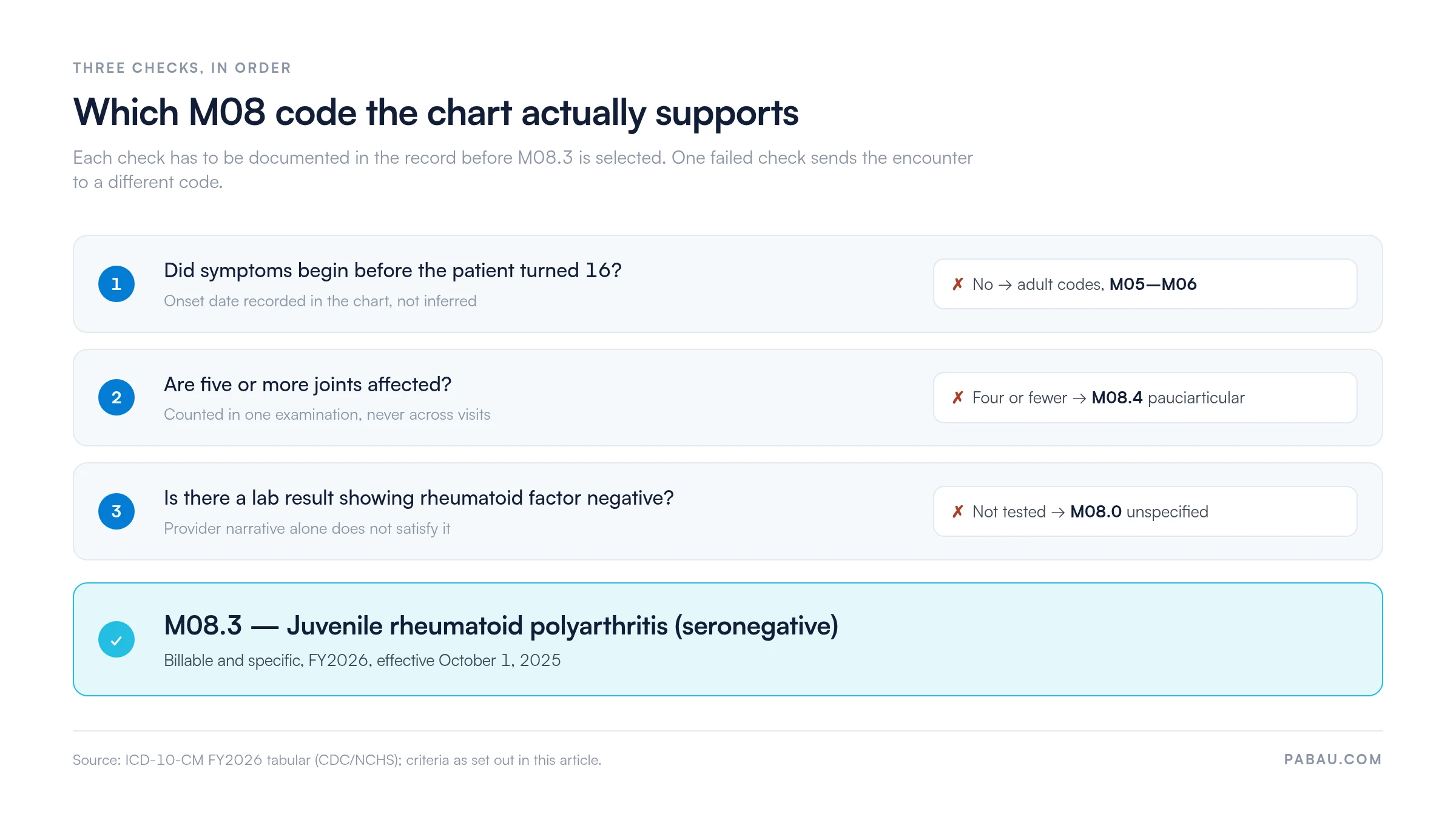
Note that M08.3 does not carry site-specific extensions the way M08.4 does. The seronegative polyarticular code is reported at the M08.3 level whichever joints are involved. Five or more affected joints make site specificity impractical within the code structure. Three documented findings decide the subcode, and the diagram below runs them in the order a coder should check them.
The ICD-10-CM tabular specifies which diagnoses are captured by M08.3 and which require separate coding or a different code altogether. Misreading these notes is a common audit trigger.
M08.3 includes seronegative polyarticular juvenile idiopathic arthritis and RF-negative polyarticular JRA documented in patients under 16. Chart notes using “seroneg polyarticular JIA,” “RF-negative JRA, polyarticular subtype,” or equivalent clinical phrasing all map here.
Excludes2 conditions can coexist with M08.3 and be coded separately when documented. These include juvenile arthritis in diseases classified elsewhere (M08.8-) and certain reactive arthropathies. When the rheumatologist documents both a seronegative polyarticular pattern and a coexisting systemic condition, review the Excludes2 list before adding a second code.
Every M08.3 claim needs five elements in the clinical record. Missing any one of them creates an audit vulnerability, even where the diagnosis is clinically correct.
Age-restricted codes share one weakness: the age qualifier has to be supported by the chart rather than assumed from the patient’s current birthday. Structured encounter templates that prompt for onset date, joint count, and lab results keep that evidence in the note instead of in the coder’s inbox.
Build a documentation checklist into your pediatric rheumatology encounter template. It should cover the RF test result (negative), joint count (5+), symptom duration (6 weeks+), and patient age at onset. Running that checklist before submission catches the omissions behind most M08.3 denials.
Three errors account for the majority of M08.3 denials and audit findings. Each is preventable with the right documentation workflow.
The most frequent error is selecting M08.3 without a negative rheumatoid factor result in the record. Confirm the lab result before the code goes on the claim. Where RF is positive, M08.3 no longer describes the encounter. The coder then works from the documented joint count and clinical presentation to find the correct subcode. Where RF testing has not been performed at all, use an unspecified code and flag the chart for follow-up testing.
M08 codes are age-restricted. Applying M08.3 to a 19-year-old patient whose JIA was diagnosed in childhood but is being actively treated in adulthood triggers an age-conflict edit. Once a patient transitions out of pediatric care, the claim should use the appropriate adult seronegative RA code from the M05-M06 category. Solid denial management in healthcare includes an age-conflict edit check before submission.
A patient with four inflamed joints documented in a single visit does not meet the polyarticular criterion for M08.3. The correct code in that scenario is M08.4 (pauciarticular). Coders sometimes total joints mentioned across multiple visits to reach five, which the documentation does not support. The five-joint threshold must be met in a single clinical examination to justify M08.3.
If the rheumatologist has documented seronegative polyarticular JIA in the chart, M08.0 (unspecified) is wrong. CMS guidelines require the most specific code supported by documentation. M08.0 is appropriate only when the subtype genuinely cannot be determined from the clinical record.
M08.3 is reported alongside CPT codes for office visits, lab panels, imaging, and infusion therapy depending on the patient’s treatment stage. The table below covers the pairings that commonly accompany this diagnosis, with notes on medical necessity documentation. Our CPT code reference carries the full descriptor and billing notes for each one.
CPT code pairing recommendations reflect current clinical practice patterns and do not imply guaranteed reimbursement. Payer-specific medical necessity policies govern coverage decisions for biologics and imaging. Always verify prior authorization requirements before submitting high-cost procedure codes alongside M08.3.
M08.3 carries no relative value unit, because it describes a diagnosis rather than a procedure. Reimbursement flows through the CPT codes submitted alongside it. The diagnosis drives medical necessity for those CPT codes, which is why documentation completeness has a direct financial impact.
Biologic therapies ordered for seronegative polyarticular JIA represent the highest-cost claims paired with M08.3. Payers typically require step therapy documentation showing that conventional DMARDs were tried and failed before approving biologics. Without that step-therapy history in the record, prior authorization is frequently denied however accurately M08.3 is coded.
Practices processing ERA remittances see three CARC reason codes recur on M08.3 claims: age conflict, diagnosis-procedure mismatch, and missing seronegative documentation. Each denial type has its own appeal pathway, and each is preventable with the documentation checklist set out above.
An M08.3 age-conflict denial often lands on a patient diagnosed in childhood and now seen as a young adult. Include the original date of diagnosis from the pediatric chart, plus the treating rheumatologist’s attestation. Payers accept ongoing adult treatment of a pediatric-onset diagnosis when the onset documentation is clear.
An M08.3 denial is usually set in motion in the encounter note, days or weeks before the claim goes out. By the time the rejection arrives, the note has been signed and the patient has gone home. Moving the check into the documentation step is what changes the outcome.
Practice management software like Pabau ships with a built-in ICD-10 code library. Pediatric rheumatology practices can use it to prompt for the required evidence at the point of care. When a provider selects M08.3, the system surfaces a check. It asks for the RF-negative lab result, a joint count of five or more, and the patient’s age. That turns smoother claims management into a documentation habit rather than a monthly clean-up job.

Pabau also connects to Claim.MD for electronic claim submission to thousands of US payers, with real-time eligibility verification and 835 remittance processing. Biologic infusion codes raise the stakes on a lapsed prior authorization. Checking eligibility before the appointment catches it while there is still time to renew.

Pabau’s ICD-10 code library and Claim.MD clearinghouse connection work together on pediatric rheumatology claims. Confirm the RF result, the joint count, and the patient’s age before submission.

ICD-10 Code M08.3 describes a narrow patient population: children under 16 with RF-negative arthritis affecting five or more joints. The code itself is straightforward. The denials come from documentation that falls short of it, through missing lab results, under-counted joints, and age-conflict edits on transitioning patients.
Treat the three criteria as a pre-submission check rather than an appeal argument. The cost of this code then drops to the minutes it takes to read the chart. Book a demo to see how Pabau prompts for M08.3 documentation while the patient is still in the room.

Want to know what a payer counts as a submittable claim? Clean claim sets out the fields a claim needs before it leaves the practice.
Want to understand what happens when M08.3 claims get denied? Denial management in healthcare explains the appeal workflow and CARC reason codes that appear on rejected pediatric arthritis claims.
Looking for a clearinghouse that validates diagnosis-procedure pairings before submission? Claim.MD clearinghouse outlines how Pabau’s integrated clearinghouse connection catches edit failures on ICD-10 code claims.
ICD-10 Code M08.3 is the billable diagnosis code for juvenile rheumatoid polyarthritis (seronegative). It covers chronic childhood arthritis affecting five or more joints in patients under 16, with a documented negative rheumatoid factor test result. It sits in the M08 parent category covering juvenile arthritis subtypes.
Yes. M08.3 is a billable and specific ICD-10-CM code valid for FY2026, effective October 1, 2025. It can be submitted for reimbursement when the clinical documentation supports the diagnosis, including RF-negative status, polyarticular involvement, and patient age under 16.
Seronegative means the patient’s rheumatoid factor (RF) blood test is negative, which is one of the criteria for M08.3. Seropositive means RF is positive, so M08.3 no longer describes the encounter. Either way the distinction requires a laboratory-documented RF result, because provider narrative alone does not satisfy the coding requirement.
Five or more joints must be documented as affected in a single clinical examination. A cumulative joint count across multiple visits does not meet the threshold. Patients with four or fewer joints involved are classified as oligoarticular (pauciarticular) and coded under M08.4.
Joint count separates them. M08.3 is seronegative polyarticular juvenile arthritis, meaning five or more joints with a negative RF result. M08.4 is pauciarticular juvenile rheumatoid arthritis, meaning fewer than five joints, and its subcodes extend to site-specific locations. M08.4 carries no RF or serology distinction of its own.
The most common pairings are 99213-99214 for office visits, 86430-86431 for rheumatoid factor testing, 86200 for CCP antibody assay, and 96365 for biologic infusion therapy. Imaging codes such as 73562 (knee X-ray) are added when joint damage assessment supports medical necessity for advanced treatment.