HCPCS code J2543: Piperacillin-tazobactam billing guide
What is HCPCS code J2543, and what does one unit cover? HCPCS code J2543 is the ...

Last Updated: Oct 30, 2026
HCPCS code J2690 is the Level II code for injection, procainamide HCl, up to 1 gm. Procainamide is a class IA antiarrhythmic. Clinicians give it IV or IM to suppress life-threatening ventricular arrhythmias, such as sustained ventricular tachycardia.
The billing math is simpler than most J codes. Each unit covers up to 1 gram, and each vial or prefilled syringe on DailyMed holds exactly 1 gram. The vials are labeled multiple-dose, so JW and JZ do not apply to them. The IMS prefilled syringe is single-dose, however, so JZ or a JW line can. Watch for modifiers on vial lines and unit counts that leave out the maintenance infusion.
Let Pabau's smart automation suggest the right codes, reduce claim denials, and keep your practice compliant—effortlessly.
Automate repetitive tasks and focus on what matters most—your patients.
Reduce coding errors and ensure compliance with the latest regulations.
Clean claims, fewer denials, and faster reimbursements.
Powerful insights and reporting to help your practice thrive.
HIPAA compliant SOC 2 certified GDPR-compliant Trusted by 4,000+ clinics worldwide

HCPCS code J2690 bills procainamide HCl injection, at one unit for each gram or part of a gram.
Each procainamide vial or prefilled syringe on DailyMed holds 1 gram, so one full container is one billing unit.
Multiple-dose vials take no JW or JZ, but the single-dose prefilled syringe does.
Add the loading dose and the maintenance infusion together before you count units for the day.
Pair J2690 with a documented ventricular arrhythmia such as I47.20, and never with torsades de pointes.
HCPCS code J2690 reports “Injection, procainamide HCl, up to 1 gm.” It sits in the J code range of the HCPCS Level II codes. Procainamide is a class IA antiarrhythmic, given IV or IM to suppress life-threatening ventricular arrhythmias such as sustained ventricular tachycardia.
The FDA label limits the drug to documented ventricular arrhythmias that the physician judges life-threatening. It also asks that treatment start in a hospital or an emergency setting with ECG monitoring. So J2690 lines usually come from emergency departments, hospital outpatient units and cardiology services.
One mix-up is worth ruling out early. Prochlorperazine, the antiemetic, has a similar-looking name. That drug has its own code, HCPCS code J0780, billed per 10 mg. If the vial says prochlorperazine, J2690 is the wrong code.
Bill one unit for every gram given, rounding any part of a gram up to a full unit. So 600 mg is one unit, and 1,720 mg is two. Count the total given on the date of service, across every bolus and infusion.
The label gives two loading methods. Clinicians can push 100 mg every five minutes, up to 500 mg. Or they can run a loading infusion that delivers 500 to 600 mg. Either way, the label caps the loading dose at 1 g. A maintenance infusion then runs at 2 to 6 mg per minute.
The maintenance rows are where units go missing. The loading dose is easy to spot in the record. The infusion, however, adds grams quietly over hours. So multiply the documented rate by the minutes it ran, then add the loading dose.
J2690 pays for the drug only. The administration goes on its own line, matched to the route and time in the record.
In a hospital, the facility reports these administration codes. Read the full medical billing workflow if your team splits drug and administration lines across staff.
CMS has required the JW modifier for discarded drug since January 1, 2017. The JZ modifier, which attests that nothing was discarded, became required on July 1, 2023. Both rules apply only to drugs from single-dose containers.
Procainamide vials are labeled multiple-dose. The Hospira, Nexus, Gland and Caplin vials on DailyMed all carry that label. J2690 is also missing from the CMS list of JW and JZ codes. One product breaks the pattern, though. The IMS prefilled syringe is labeled single-dose on DailyMed.
So a J2690 line billed from a vial carries neither modifier. Leftover drug in a multiple-dose vial is not billable, either. The syringe follows the CMS JW and JZ FAQ instead, because its label decides, not the code list. Add JZ when the whole syringe was given. Put JW only on a separate line for the discarded amount, never on the administered line.
The diagram below sorts each J2690 product by the label that decides its modifier.
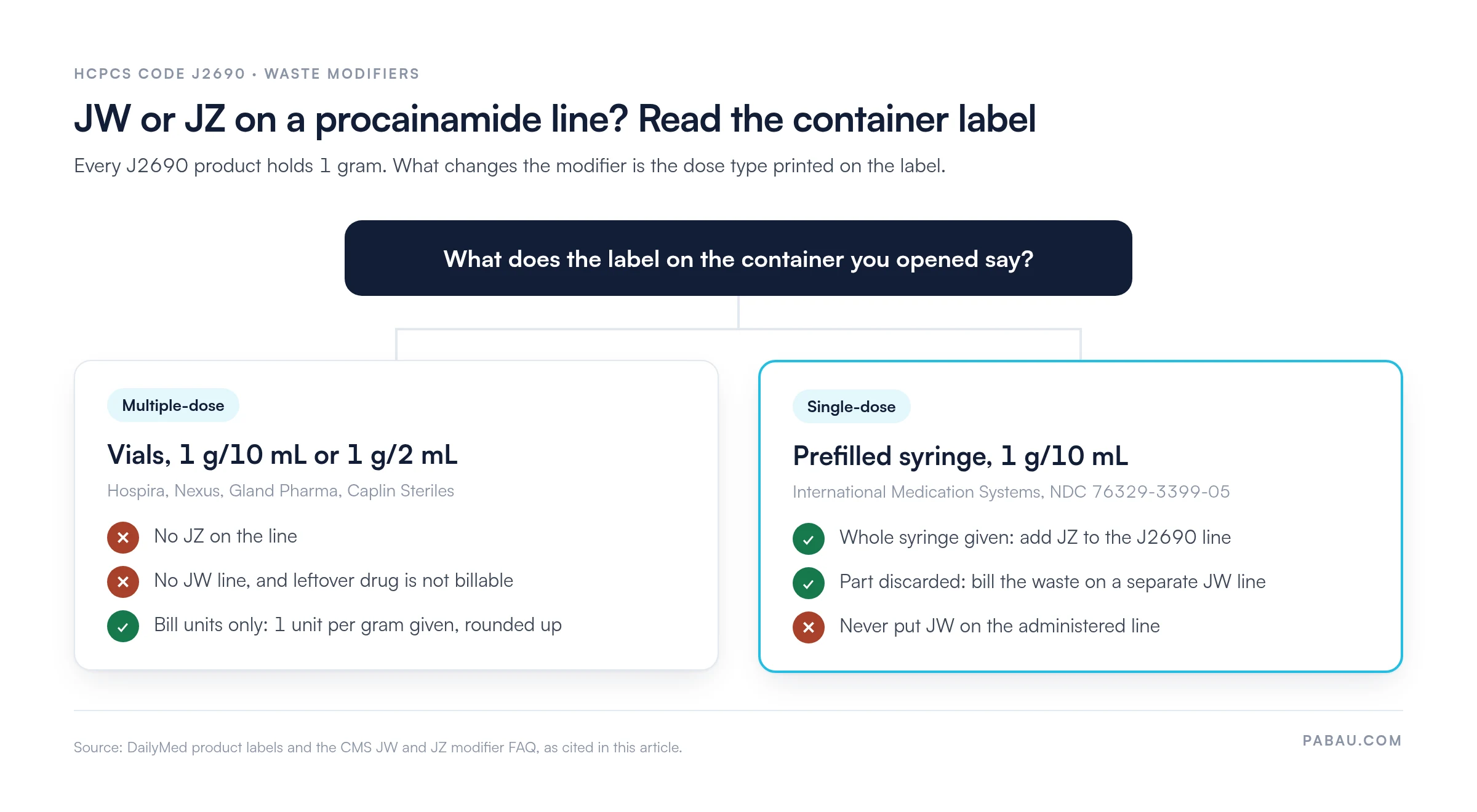
Before you add any waste modifier, read the container label in the record. A “multiple-dose” label means no JW and no JZ. A “single-dose” label, as on the IMS prefilled syringe, brings JZ or a JW line into play.
Medicare Part B pays J2690 from the quarterly Average Sales Price (ASP) file. The payment limit is generally ASP plus 6%, per billing unit. Because the rate changes every quarter, check the current CMS ASP pricing files before you set a fee.
Hospital outpatient claims follow OPPS rules instead. There, the status indicator in Addendum B decides whether J2690 pays on its own or packages into the visit. Check that indicator each quarter, since packaging thresholds move.
The diagnosis has to show a ventricular arrhythmia serious enough to need IV treatment. That is the use on the FDA label. Other uses are possible, but they are off-label and need stronger notes.
I47.2 itself is a header, not a billable code. Claims need I47.20, I47.21 or I47.29 instead. For off-label use, record the clinical reason and the guideline you followed. Medicare contractors judge those claims as “reasonable and necessary” case by case.
Each vial or syringe below holds 1 gram, so each one given is one unit. Several NDCs name a carton of 10 or a case of 25 vials, so count units from the vials, never the carton. Labels are from DailyMed, shown in the 11-digit 5-4-2 format claims use.
Medicaid requires the NDC on every drug line, and many commercial plans do too. Enter it with the N4 qualifier, then the quantity in milliliters. Use the NDC on the package you opened, since NDCs change when products are repackaged.
An auditor reading a J2690 claim wants to see what was ordered, given and monitored. Keep these in the record:
Start and stop times matter twice. They prove the units, and they support the infusion hours in CPT 96365 and 96366. A clean claim carries both before it leaves the practice.
Antiarrhythmic J codes use very different units. Copying the unit habit from one drug to another is an easy way to overbill or underbill.
Procainamide is the outlier, with the largest unit by far. A coder used to amiodarone might enter dozens of units for a 1 g load. The right answer for that load is one unit.
Lidocaine shows how quickly these units can change. CMS deleted J2001, billed per 10 mg, on October 1, 2024. Its replacement, J2003, counts 1 mg per unit, so a unit habit carried over from J2001 undercounts the dose tenfold.
J2690 denials tend to trace back to units, modifiers, the NDC or the diagnosis. Each one has a clear fix.
Track which of these your remittances return most often. A short denial management routine turns those patterns into a pre-submission check.
Procainamide claims fail on details recorded hours apart, in different places. The loading dose sits in one note, and the infusion rate changes sit in another.
Pabau, the practice management platform we build, keeps those details in one patient record. Clinicians record the dose given and any discarded amount at the point of care. The claims management software then pre-fills the claim from that record. Built-in HCPCS and ICD-10 lookup libraries help your team find the right codes.
Before a claim goes out, Pabau checks that every required field is filled in. It then sends the claim to the payer through Claim.MD, the US clearinghouse Pabau connects to. Your team also gets eligibility checks, remittance posting and claim status tracking. Your coders still choose the units, modifiers and NDC, with the full record in front of them.
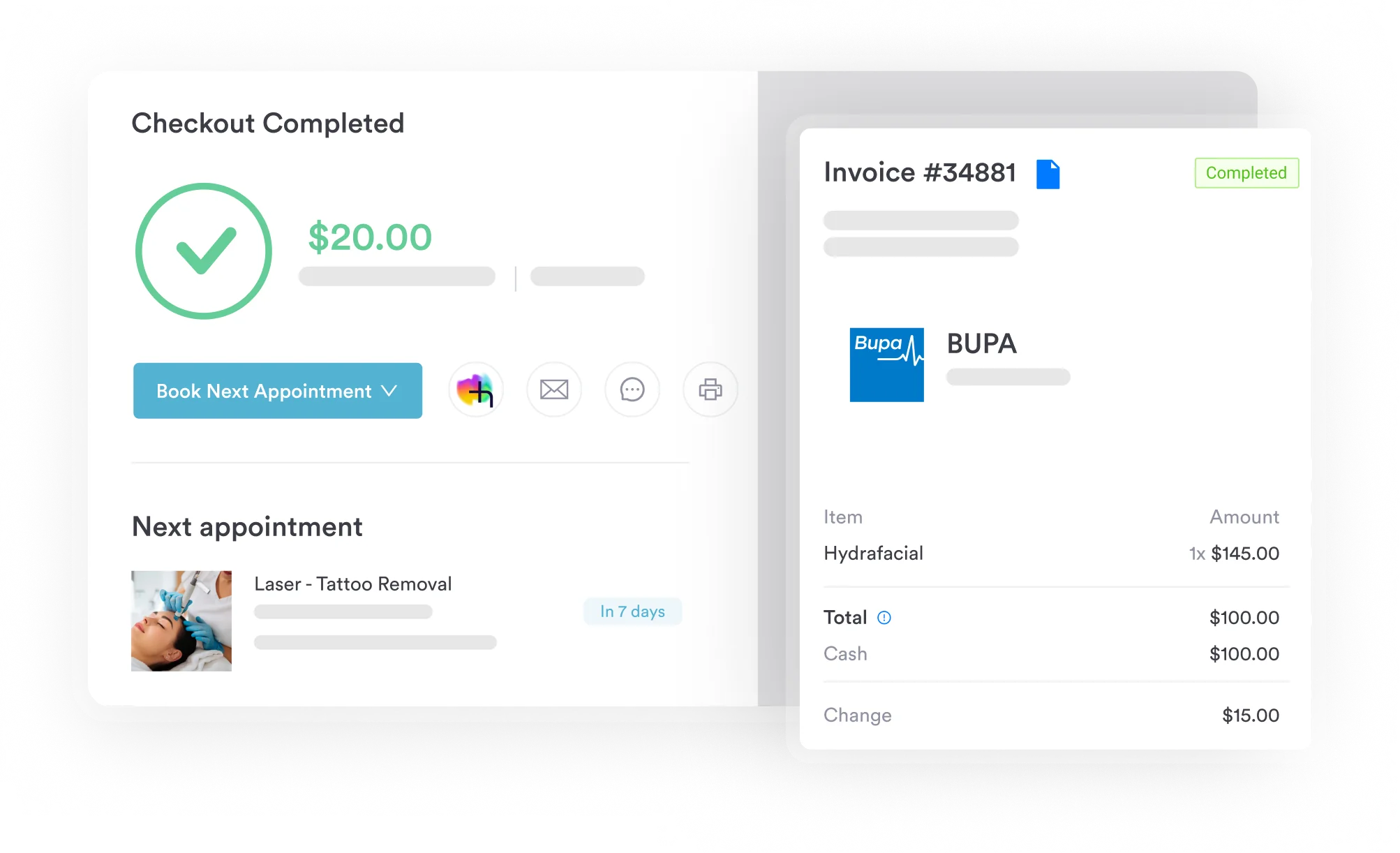

Pabau pre-fills each claim from the patient record and checks required fields before it goes out. After submission, it tracks claim status, so denials surface early.

J2690 is a code where the instinct to add detail causes the errors. The gram-sized unit means fewer units than coders expect. Meanwhile, the multiple-dose vial means no waste modifiers, and only the single-dose syringe brings JW or JZ back.
So the work sits upstream, in the record. Capture the total milligrams across the loading dose and the infusion, note which container was opened, and name the ventricular arrhythmia. With those facts in the record, the units, modifiers and diagnosis follow directly.
Book a demo to see how Pabau carries that record straight into a complete claim.

Billing the antiemetic prochlorperazine instead? HCPCS code J0780 covers its 10 mg units, waste modifiers and NDCs.
Need a framework for reducing claim rejections before submission? Clean claim best practices covers the data elements payers check on every claim line.
Unsure how denial codes map to corrective action? Denial management in healthcare explains how to read CARC and RARC codes and build an appeal workflow.
Want the wider compliance picture for injectable drugs? Medical billing compliance covers documentation standards, audit triggers and corrected-claim protocols.
Giving adenosine for a narrow-complex tachycardia instead? HCPCS code J0153 explains its 1 mg units and how to count them.
J2690 is the HCPCS code for procainamide HCl injection. It bills up to 1 gram per unit, given IV or IM.
Bill 2 units. Each unit covers up to 1 gram, so any total from 1,001 to 2,000 mg is 2 units. Add the loading dose and the infusion for the same date first.
Not on a vial line. Procainamide vials are labeled multiple-dose, and CMS limits JW and JZ to single-dose containers. The IMS prefilled syringe is single-dose, so add JZ when it is fully given. Use JW only on a separate line for the discarded amount.
No. Prochlorperazine injection is J0780, billed per 10 mg. J2690 is procainamide, an antiarrhythmic billed per gram.
Use the 11-digit NDC from the package you opened, such as 00409-1902-11 for the Hospira 10 mL vial. Medicaid plans also want the N4 qualifier and the quantity in milliliters.
The FDA label covers life-threatening ventricular arrhythmias only. Atrial fibrillation use is off-label, so coverage depends on your MAC. Document the clinical reason and the guideline you followed.
No. The infusion has no drug code of its own. Add its milligrams to the loading dose and bill the total as J2690 units. The infusion service itself goes on CPT 96365 and 96366.