HCPCS code K0051: Footrest cam release assembly billing guide
HCPCS code K0051: Official descriptor and code details HCPCS code K0051 describe...

Last Updated: Nov 3, 2026
J1558 is the HCPCS Level II code for injection, immune globulin (xembify), 100 mg. It covers Xembify, a 20% immune globulin given by subcutaneous injection and billed in units of 100 mg administered.
Most denials on this code start with billing per vial instead of per 100 mg. The others come from a missing NDC on Medicaid or commercial claims, or from using the IV NOS code J1599. Xembify always takes J1558.
Let Pabau's smart automation suggest the right codes, reduce claim denials, and keep your practice compliant—effortlessly.
Automate repetitive tasks and focus on what matters most—your patients.
Reduce coding errors and ensure compliance with the latest regulations.
Clean claims, fewer denials, and faster reimbursements.
Powerful insights and reporting to help your practice thrive.
HIPAA compliant SOC 2 certified GDPR-compliant Trusted by 4,000+ clinics worldwide

HCPCS code J1558 covers Xembify, a 20% subcutaneous immune globulin, billed per 100 mg administered rather than per vial.
Divide the milligrams given by 100 to get units, so a 4 g dose is 40 units of J1558.
Medicare Part B pays J1558 at ASP+6% in the office, and the rate changes every quarter.
Home SCIG for primary immunodeficiency goes to the DME MAC under the Part B DME benefit, not the home infusion therapy benefit.
Most commercial payers and many Medicare Advantage plans require prior authorization, while traditional Medicare relies on LCD coverage criteria.
HCPCS Code J1558 is the drug-specific Level II code for 100 mg of Xembify (immune globulin subcutaneous, 20%), given by subcutaneous injection.
It sits in the J-code range of HCPCS Level II, which CMS uses to identify physician-administered drugs outside the CPT framework. Our HCPCS reference for coders covers the rest of the Level II J codes.
If you are new to drug claims, medical billing workflows explains how a code like this moves from the chart to payment.
The official short descriptor is: Inj immune glob xembify 100 mg. The table below captures the key classification attributes.
Xembify is an FDA-approved 20% immune globulin solution manufactured by Grifols. It is the only drug covered under J1558. Key clinical facts coders should know:
J1558 units are billed per 100 mg of Xembify administered, not per vial dispensed. A vial count never belongs in the units field.
Divide the total milligrams administered by 100 to get the number of units to report.
Rounding rule: Report enough units to cover the dose administered (3,750 mg = 38 units). When the vial is single-dose, report any discarded amount on a separate line with the JW modifier. If none is discarded, Medicare expects the JZ modifier instead. Never report fractional units on a claim line.
Common mistake: Billing 1 unit per vial rather than per 100 mg administered. A single 10 g vial of Xembify yields 100 billable units of J1558. One unit would represent a 100 mg dose, far below a therapeutic infusion. This error almost always triggers a low-payment edit or a units-mismatch denial.
The worked example below follows one dose from the administration note to the claim line, including which contractor receives it.
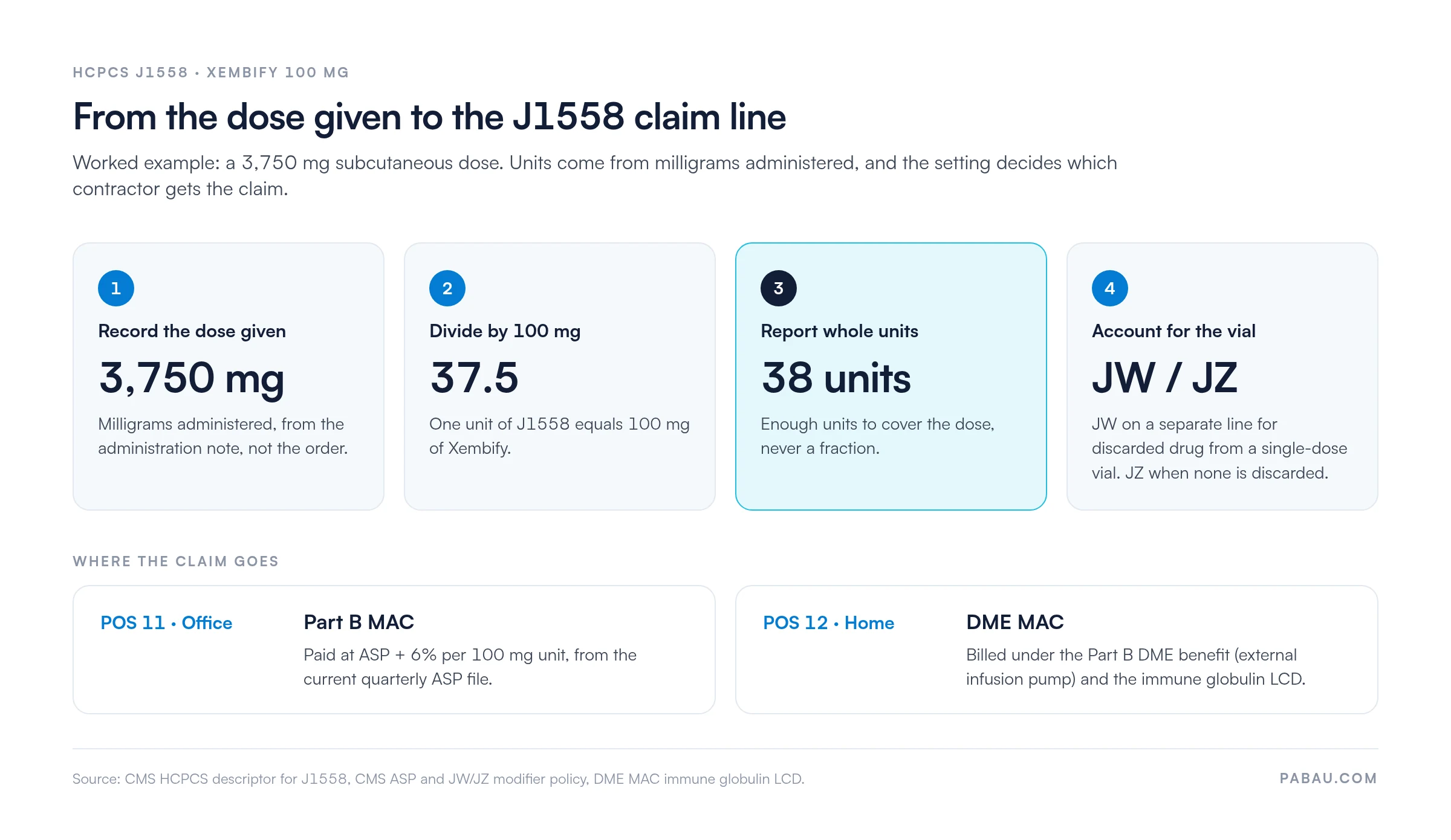
Medicare Part B reimburses J1558 at Average Sales Price plus 6% (ASP+6%), the standard methodology CMS applies to physician-administered Part B drugs. The payment rate changes every quarter as Grifols reports updated sales data to CMS.
ASP is the volume-weighted average price manufacturers charge purchasers, net of discounts and rebates, reported quarterly to CMS. The reimbursement formula is straightforward: ASP + 6% of ASP = payment per 100 mg unit of J1558.
To find the current rate, open the current quarter’s ASP file and search for J1558 to confirm the per-unit payment limit.
Medicare Part B covers subcutaneous immune globulin (SCIG) such as Xembify for primary immunodeficiency (PI) in two ways. In the office, the MAC pays J1558 at ASP+6%. At home, Part B covers it through the DME benefit, billed to the DME MAC. Either way, the patient needs a physician’s order and a covered diagnosis.
J1558 is valid across several place of service codes, but coverage rules and payment rates can differ by setting. Run insurance eligibility verification before each infusion to confirm the patient’s plan covers subcutaneous administration in the intended setting.
Home SCIG (POS 12) is billed to the DME MAC under the DME benefit, because the drug is given with an external infusion pump. It does not fall under the Medicare home infusion therapy benefit or the office ASP+6% payment. The DME MAC’s immune globulin Local Coverage Determination (LCD) sets the coverage criteria, so confirm them before submitting.
Prior authorization (PA) for J1558 is required by most commercial payers and many Medicare Advantage plans. Traditional Medicare fee-for-service does not require prior authorization for J1558, but MAC LCDs may impose coverage criteria that function as de facto authorization requirements.
Typical PA criteria across commercial payers include:
PA requirements vary by payer and MAC jurisdiction. Do not apply universal rules to every plan. Verify requirements through the payer’s provider portal before each authorization period.
A clean J1558 claim needs a medical record that supports medical necessity and confirms the correct drug and dose. It also carries the NDC that Medicaid and many commercial payers require. Missing any of these elements is enough for a payer to downcode or deny. Clean claim submission for biologics depends on documentation being in the chart before billing runs.
Medicaid and many commercial payers require the National Drug Code (NDC) in 11-digit 5-4-2 format. It goes in the shaded area of line 24A on the CMS-1500, with qualifier N4. Medicare Part B physician claims generally do not require it. Recording the Xembify lot number and NDC on the superbill at the point of administration keeps the claim ready for any payer.
Confirm the current Xembify NDC from the FDA DailyMed database before each billing cycle, as NDC numbers can change with new package sizes. NDC reporting on the UB-04 differs by payer, so confirm it in each payer’s billing guide.
Immune globulin has a separate HCPCS J code for nearly every brand, and choosing the wrong one is a fast path to a denial. The determining factors are the specific product administered and the route of delivery.
J1599 is an IV-only NOS code: “Injection, immune globulin, intravenous, non-lyophilized (e.g. liquid), not otherwise specified, 500 mg.” It would not be used for subcutaneous Xembify, which always takes J1558. An unlisted subcutaneous product with no code of its own goes under J3590, unclassified biologics. An NOS or unclassified code applies only in narrow circumstances:
Submitting J1599 for Xembify reports the wrong route and the wrong unit size, so expect a denial or a mispriced payment.
Most J1558 denials fall into six predictable categories. The denial management process for SCIG claims works best when the root cause is found at the billing QA stage. Waiting for the remittance means fixing it after the payer has already said no.
Track denial reasons by code in your practice management system. If J1558 denials cluster around NDC errors or unit counts, the cause sits at the point of administration rather than in billing. Fix the intake workflow, not just the claim. Claims management software that scrubs each claim before submission catches missing fields before the payer does.
The ICD-10 code on a J1558 claim must match a covered indication in the MAC LCD for immune globulin therapy. Primary immunodeficiency codes in the D80 and D83 series account for the majority of covered diagnoses.
Coverage for secondary immunodeficiencies varies significantly by MAC LCD and payer. Always verify the applicable LCD in the patient’s MAC jurisdiction before billing a secondary immunodeficiency diagnosis with J1558. The AAPC HCPCS code lookup and the PGM Billing HCPCS lookup tool help confirm the current descriptor and billing unit for each immune globulin code.
Review your MAC’s LCD for immune globulin therapy annually. LCDs are updated when clinical evidence changes or when CMS issues coverage policy revisions. A diagnosis code that was covered last year may require additional documentation criteria this year. Check the applicable MAC website each October, when new fiscal year coding and coverage changes take effect.
On many infusion teams, authorization dates live in a spreadsheet and units are worked out by hand. A rejected claim then sits in a portal until someone checks it.
Pabau stores each prior authorization as a case and shows how many approved sessions are left. A claim missing its authorization is flagged before it goes out. Claim validation scrubs every CMS-1500 for missing or invalid details, then submits it through Claim.MD.
If a payer rejects the claim, Pabau shows the reason so you can correct it and resubmit. Eligibility checks run before the visit, so coverage problems surface before the drug is given.

Pabau tracks prior authorizations as cases, scrubs each claim for missing details, and shows the reason when a payer rejects one. See how it fits immunology and infusion billing.

J1558 rarely fails on coverage. It fails on the claim line. A vial count lands in the units field, a Medicaid claim goes out without its NDC, or a home dose reaches the wrong contractor.
Fix those at the point of administration and this becomes one of the easier drug claims you file. Record the milligrams given, the NDC and any discarded drug in the note, and bill from that note rather than the order.
The trade-off is a little more charting at the chair for far fewer resubmissions later. Book a demo to see how Pabau tracks authorizations and scrubs J1558 claims before they reach the payer.

Want to reduce claim errors across all your drug codes? Medical billing workflows explained covers the end-to-end process for practice billing teams managing physician-administered drugs.
Dealing with recurring denials on specialty drug claims? Denial management in healthcare walks through root-cause analysis and the appeals workflow for high-cost biologics.
Need a clean-claim checklist for your infusion billing team? Clean claim submission outlines the documentation fields that most often trigger drug-claim edits before they reach the payer.
Billing Gamunex-C or Gammaked instead? HCPCS code J1561 covers the 500 mg immune globulin code used for IV or subcutaneous doses.
Patient switching to HyQvia? HCPCS code J1575 explains the immune globulin and hyaluronidase code billed per 100 mg.
HCPCS Code J1558 covers the injection of immune globulin (Xembify), billed in 100 mg increments and given by the subcutaneous route. It applies only to Xembify from Grifols. Other subcutaneous immune globulin products (Hizentra, Cuvitru, HyQvia) each have their own specific J codes.
Divide the total milligrams administered by 100 to determine units. A 4 g (4,000 mg) dose = 40 units of J1558. When the result is a fraction, report enough whole units to cover the dose, such as 38 units for 3,750 mg.
Medicare reimburses J1558 at ASP+6% per 100 mg unit in the office, with rates updated quarterly. Because the amount changes each January, April, July, and October, check the current quarter’s ASP pricing file on the CMS website before billing.
Traditional Medicare fee-for-service does not require prior authorization for J1558, but most commercial payers and Medicare Advantage plans do. Requirements vary by payer and MAC jurisdiction, so verify them through the payer’s provider portal before each infusion episode.
J1558 is the specific code for Xembify, a subcutaneous immune globulin. J1599 is the NOS code for intravenous, non-lyophilized immune globulin, billed per 500 mg, so it never fits a subcutaneous Xembify dose. An unlisted subcutaneous product with no code of its own goes under J3590 instead.
Report the NDC from the Xembify vial used during the session. Medicaid and many commercial payers require it, in 11-digit 5-4-2 format with qualifier N4 in the shaded area of line 24A on the CMS-1500. Confirm the current NDC on FDA DailyMed, since package changes can update it.
Valid POS codes include 11 (office), 12 (home), 19 (off-campus outpatient hospital), and 22 (on-campus outpatient hospital). Medicare covers home SCIG (POS 12) for primary immunodeficiency under the Part B DME benefit. It is billed to the DME MAC, not through the home infusion therapy benefit.