HCPCS Code L0472: Hyperextension TLSO billing guide
HCPCS code L0472: Official descriptor and device definition HCPCS code L0472 des...

Last Updated: Nov 5, 2026
Billable Code
J0945 is the HCPCS Level II code for injection, brompheniramine maleate, per 10 mg. It reports the supply of this first-generation antihistamine when a clinician injects it, billed in 10 mg units.
The code is still active in the CMS HCPCS file, but the FDA lists every injectable brompheniramine product as discontinued. J0945 is billed with a separate CPT administration code, and it is not the code for epinephrine.
Let Pabau's smart automation suggest the right codes, reduce claim denials, and keep your practice compliant—effortlessly.
Automate repetitive tasks and focus on what matters most—your patients.
Reduce coding errors and ensure compliance with the latest regulations.
Clean claims, fewer denials, and faster reimbursements.
Powerful insights and reporting to help your practice thrive.
HIPAA compliant SOC 2 certified GDPR-compliant Trusted by 4,000+ clinics worldwide

J0945 reports injection, brompheniramine maleate, per 10 mg, so one billed unit equals 10 mg of drug administered.
J0945 is not an epinephrine code, and epinephrine claims from July 1, 2025 use J0165 or a product-specific epinephrine code.
Every J0945 line needs a separate administration code, usually 96372 for an IM or subcutaneous injection or 96374 for an IV push.
The FDA lists every injectable brompheniramine product as discontinued, so confirm the product and its NDC before you bill the code.
CMS publishes no October 2026 Medicare payment limit for J0945, so your Medicare contractor sets payment for any claim.
HCPCS code J0945 is the Level II code for injection, brompheniramine maleate, per 10 mg. It reports the drug supplied when a clinician injects brompheniramine, a first-generation antihistamine, and each billed unit covers 10 mg.
The Centers for Medicare and Medicaid Services (CMS) maintains the code in its quarterly HCPCS file. The October 2026 file lists J0945 as active, with no termination date.
J0945 covers injectable brompheniramine maleate given by a clinician. Brompheniramine is an alkylamine antihistamine that blocks histamine H1 receptors, and its injection was used to treat allergic reactions.
Product supply is the complication. Drugs@FDA lists all three approved brompheniramine injections as discontinued. They are Dimetane-Ten at 10 mg/mL and two generic versions at 10 mg/mL and 100 mg/mL.
The FDA NDC Directory shows no current finished injectable product, only oral medicines and bulk ingredient. Before a J0945 line goes out, confirm which product the clinician injected and read its NDC from the vial or carton.
J0945 does not cover the following:
Divide the dose administered in milligrams by 10. Bill the dose that was given and documented, never the vial size or the volume drawn up.
When the dose is not a whole multiple of 10 mg, Medicare’s claims processing manual tells providers to round up to the next whole unit. A dose below 10 mg still bills as 1 unit.
The doses in this table show the unit math only. They are not dosing guidance.
Record the dose in milligrams, not just the volume. Brompheniramine injection was made at 10 mg/mL and 100 mg/mL, so 1 mL is either 1 unit or 10 units. A note that says only 1 mL leaves the biller guessing, and an auditor will ask the same question.
J0945 reports the drug only. The injection is a separate service, so each J0945 line pairs with an administration CPT code that matches the route in the note. For an intramuscular or subcutaneous dose, that code is 96372.
If the injection happens during a significant, separately identifiable evaluation and management (E&M) visit, append modifier 25 to the E&M code. Without it, the payer may bundle the visit into the injection.
Medicare’s drug-waste modifiers depend on the container. JW reports the amount discarded from a single-dose container, and JZ attests that none was discarded. CMS has required JZ on qualifying single-dose claims since July 1, 2023.
Drugs drawn from a multi-dose vial take neither JW nor JZ.
Medicaid programs collect the 11-digit National Drug Code (NDC) on physician-administered drug claims, and many commercial payers ask for it too. On the 837P claim, it goes in loop 2410 with the N4 qualifier, the unit of measure and the quantity.
On a paper CMS-1500, the NDC sits in the shaded part of box 24A. Following clean claim standards on these fields keeps a drug line from rejecting on format alone.
There is one more check for this code. The CMS October 2026 NDC-HCPCS crosswalk maps no NDC to J0945. If a payer’s edits do not recognize the product’s NDC, call the payer before filing.
J0945 carries CMS pricing indicator 51, the indicator for drugs. Most Part B drugs are paid from the quarterly Medicare Part B payment limit file, which is based on average sales price (ASP).
J0945 does not appear in the October 2026 file, so CMS publishes no national rate for it this quarter. CMS states that a code’s absence from the file does not indicate whether Medicare covers the drug.
Your Medicare Administrative Contractor (MAC) decides coverage and payment. Check its policy and ask what pricing documentation it wants before you submit.
For comparison, the diphenhydramine code J1200 has a published limit of $0.855 per unit for October to December 2026. Medicaid fee schedules and commercial contracts set their own rates, so confirm the allowable in each payer portal.
Each injectable antihistamine has its own J-code with its own billing unit. A code chosen by drug class instead of by the exact drug will deny, or will pay on the wrong unit count.
Read the unit wording closely. A per 10 mg code counts every 10 mg increment. An up to 50 mg code bills each dose of 50 mg or less as 1 unit.
Payers can audit a drug claim after it pays and recoup the money if the record does not support it. The note should carry each of these items:
A structured medical billing workflow carries these fields from the treatment note to the claim, so the biller does not rebuild the encounter from memory. The biller then runs five checks against them, in the order shown below.
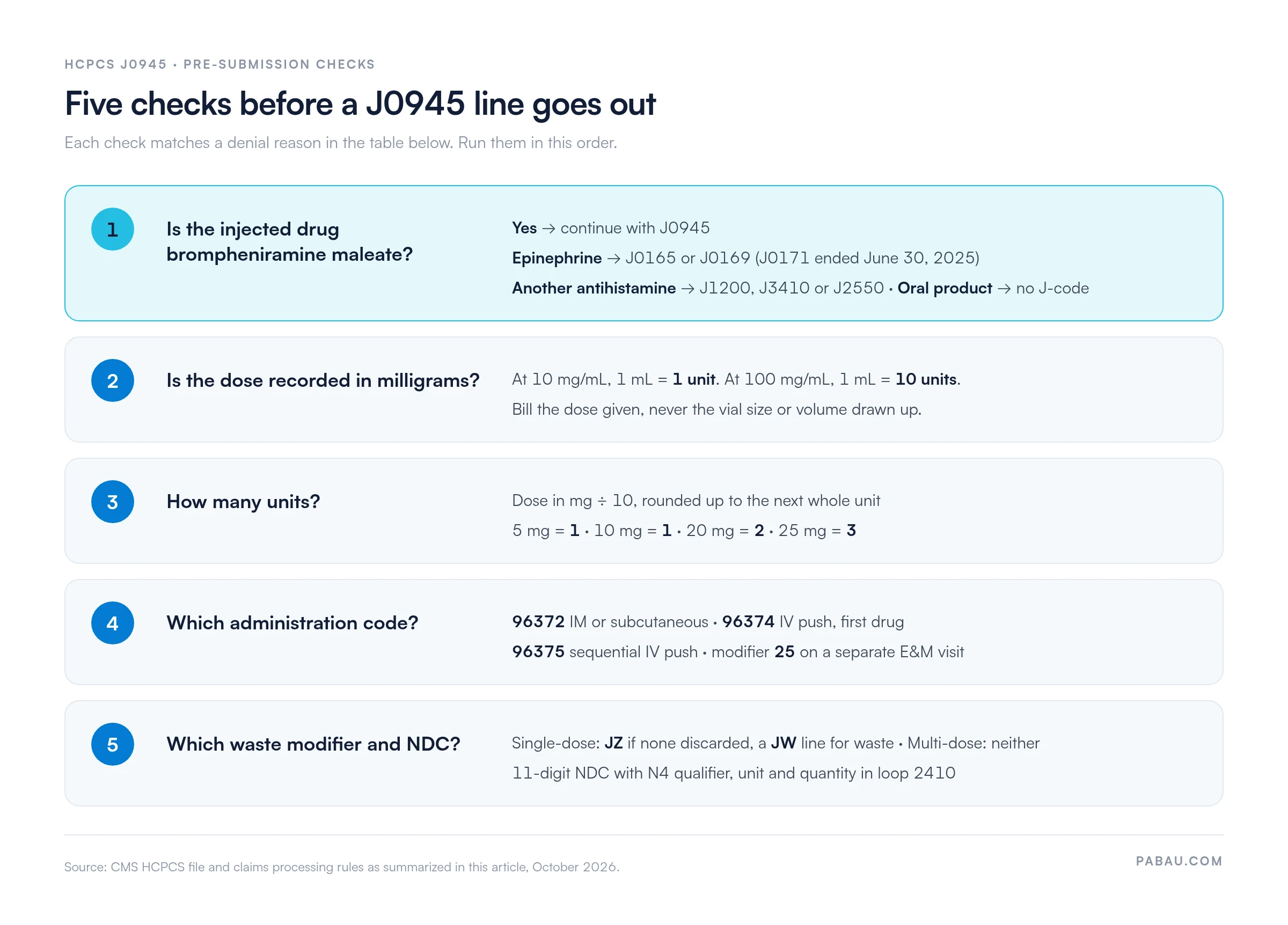
J0945 claims fail for a short list of reasons, and each one is fixable before submission. Good denial management in healthcare starts with these checks.
The remittance will name the problem with a claim adjustment reason code. Our guide to billing denial codes explains what each one means and how to appeal it.
Each denial in the table above starts in the treatment room. The dose is written in milliliters, the route is left out, or the NDC never reaches the billing team.
Pabau, the practice management and billing platform we build, keeps the treatment record, the invoice and the insurance claim in one place. The dose, route and product noted by the clinician sit next to the lines the biller codes.
Pabau’s claims management software supports US insurance billing. Your team can check the units, the administration code and the waste modifier before the claim goes out. Fewer drug claims then come back for rework.
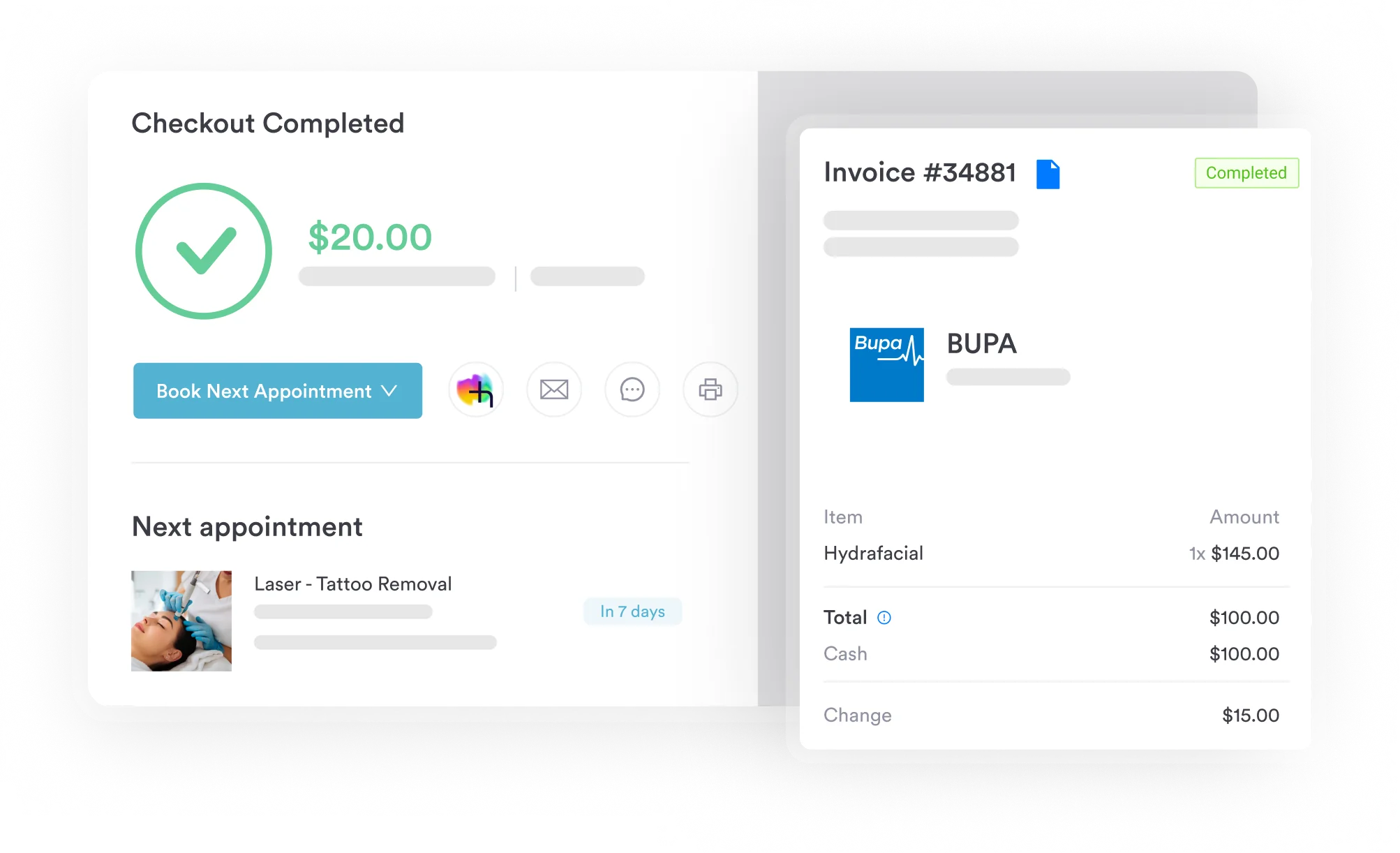

Pabau links the treatment note, invoice and insurance claim, so dose, route and drug details are checked before submission. See how it fits your injectable drug billing.

Treat J0945 as a code to verify before you use it. CMS still lists it, but the injectable products it describes are discontinued, so the first check is the vial in hand.
When the drug is brompheniramine, the claim follows simple math. Divide the milligrams by 10, round up, then add the route’s administration code and the right waste modifier.
When the drug is epinephrine or another antihistamine, J0945 is the wrong code. Correcting it before submission costs far less than an appeal.
To see how Pabau ties the treatment note to a clean drug claim, book a demo.

Need a framework for managing claim rejections systematically? Denial management in healthcare covers the end-to-end workflow for tracking, appealing, and preventing recurring claim rejections.
Want to understand the full claims submission process? Medical claims clearinghouse explains how electronic claims move from practice to payer and where errors are caught.
Looking for best-practice standards for clean drug claims? Revenue cycle management covers how drug billing fits into the broader practice revenue workflow.
Giving brompheniramine as an IV push? CPT code 96374 explains when the initial IV push code applies and how it pairs with the drug line.
Billing a different antihistamine injection? HCPCS code J2550 covers promethazine injection and how its up to 50 mg billing unit is counted.
HCPCS code J0945 covers injection, brompheniramine maleate, per 10 mg. It reports the drug supplied when a clinician injects this first-generation antihistamine. The injection itself is billed separately with a CPT administration code.
No. J0945 describes brompheniramine maleate, an antihistamine. For dates of service from July 1, 2025, epinephrine injection is billed with J0165 or a product-specific epinephrine code, each per 0.1 mg.
Bill 1 unit for each 10 mg administered, and round a partial unit up. A 10 mg dose is 1 unit, and a 25 mg dose is 3 units. Count from the documented dose, not the vial size.
Use 96372 for an intramuscular or subcutaneous injection, and 96374 for an IV push as the first or only drug. Use add-on code 96375 when brompheniramine is a sequential IV push after a different drug.
Yes. The October 2026 CMS HCPCS file lists J0945 as active with no termination date. The FDA lists the injectable brompheniramine products as discontinued, so confirm the product before you bill.
Medicaid programs require the 11-digit NDC on physician-administered drug claims, and many commercial payers do too. Report it in loop 2410 of the 837P claim with the N4 qualifier, unit of measure and quantity.