

HCPCS code E0198: Water pressure pad billing guide
HCPCS code E0198 is a water pad for a standard mattress HCPCS code E0198 is the ...

Last Updated: Oct 13, 2026
J0587 is the HCPCS Level II code for injection, rimabotulinumtoxinB, 100 units. It covers Myobloc, the only rimabotulinumtoxinB product sold in the US, and each billing unit equals 100 units of drug.
A 2,500-unit dose is reported as 25 units of J0587. The code covers the drug only, so the injection is billed with a separate chemodenervation CPT code. FDA-approved uses are cervical dystonia and chronic sialorrhea in adults.
Let Pabau's smart automation suggest the right codes, reduce claim denials, and keep your practice compliant—effortlessly.
Automate repetitive tasks and focus on what matters most—your patients.
Reduce coding errors and ensure compliance with the latest regulations.
Clean claims, fewer denials, and faster reimbursements.
Powerful insights and reporting to help your practice thrive.
HIPAA compliant SOC 2 certified GDPR-compliant Trusted by 4,000+ clinics worldwide

HCPCS code J0587 covers rimabotulinumtoxinB (Myobloc) and is billed per 100 units, so a 2,500-unit dose is reported as 25 units.
Myobloc’s FDA-approved indications are cervical dystonia and chronic sialorrhea in adults, and off-label claims carry a higher denial risk.
Medicare Part B pays J0587 at ASP plus 6% in the office setting, and CMS updates the rate every quarter.
J0587 covers the drug only, so the injection is billed separately, typically with CPT 64616 for cervical dystonia.
Pabau, the practice management platform we build, keeps the dose, injection sites and claim details in one patient record.
HCPCS Code J0587 is the CMS code for “injection, rimabotulinumtoxinB, 100 units.“
It sits in the J-series of HCPCS Level II codes, which covers drugs administered other than by mouth. The code identifies Myobloc, the only commercially available rimabotulinumtoxinB product in the US. Medicare Part B and most commercial health plans use it for reimbursement.
The key number in that descriptor is 100. Each billing unit of J0587 represents 100 units of drug, so a patient receiving 2,500 units of Myobloc is billed 25 units of J0587. This trips up billers who also handle onabotulinumtoxinA (Botox, J0585), where one billing unit equals one drug unit.
RimabotulinumtoxinB is a botulinum toxin type B preparation. It differs from the type A products (onabotulinumtoxinA, abobotulinumtoxinA and incobotulinumtoxinA) in both mechanism and clinical profile. Type B toxin acts strongly on autonomic cholinergic nerves, which explains its characteristic dry-mouth side effect.
The FDA has approved Myobloc for two indications in adults. Cervical dystonia (spasmodic torticollis) was its original indication, and chronic sialorrhea, or excessive drooling, followed in 2019. For most payers, these two diagnoses make the strongest medical necessity case without extra step-therapy documentation.
The surest route to a J0587 denial is a diagnosis code that doesn’t match an FDA-approved indication. A code outside the governing Local Coverage Determination (LCD) fails the same way. The table below maps each approved indication to its main supporting diagnosis codes.
Billing and coding article A52848, “Billing and Coding: Botulinum Toxins,” sits in the CMS Medicare Coverage Database. It lists J0587 alongside the other toxin codes and confirms that J0587 is billed per 100 units. Review the LCD and billing article for your own MAC jurisdiction before billing any botulinum toxin code.
J0587 is billed per 100 units of rimabotulinumtoxinB administered. To find the units to report, divide the total dose by 100 and round to the nearest whole number (.5 rounds up). The diagram below follows a 2,500-unit cervical dystonia dose from the chart to the claim.
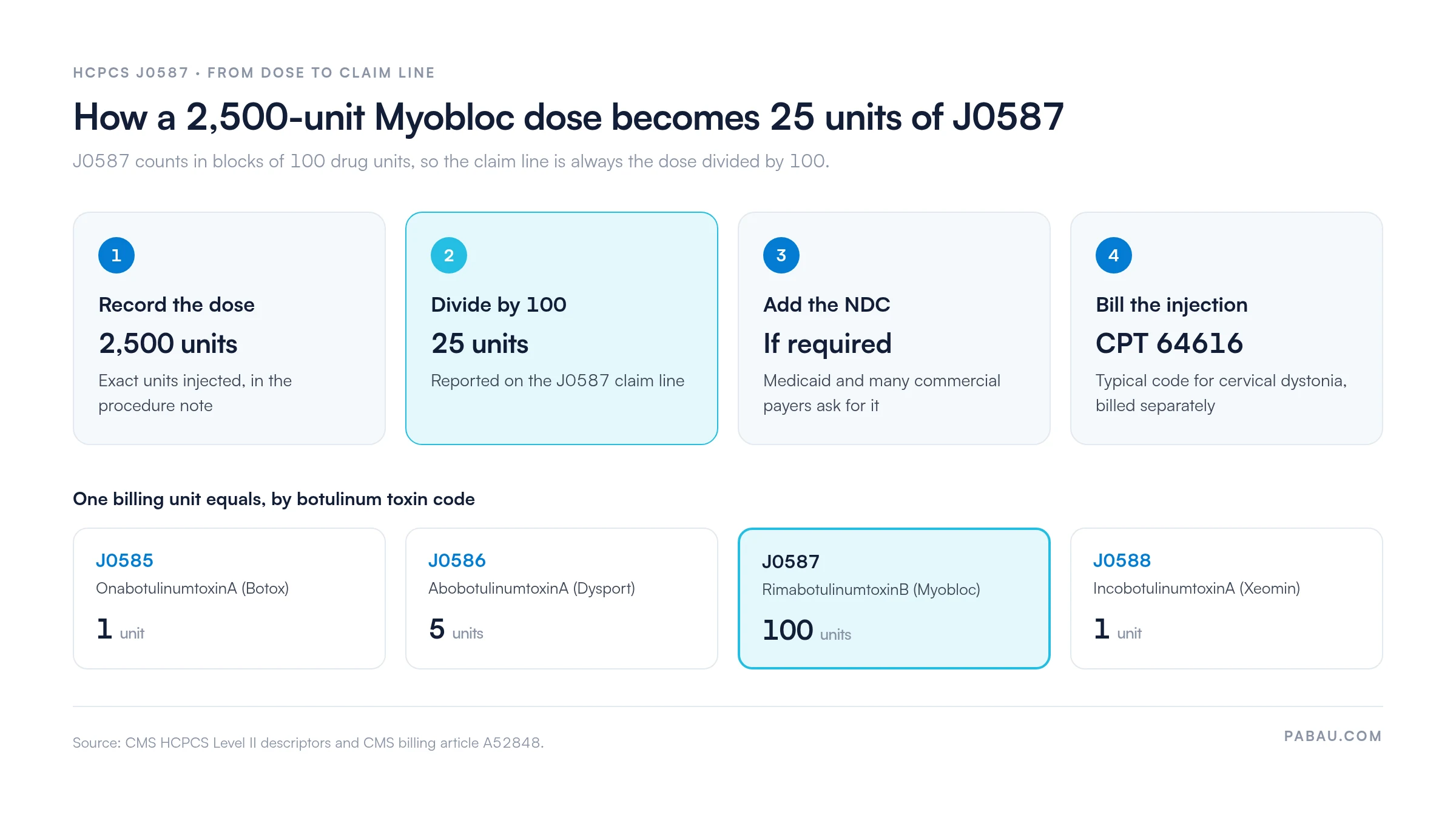
J0587 covers the drug only. The injection service itself is billed with a separate administration code, typically CPT 64616 for cervical dystonia. An off-label axillary hyperhidrosis session is billed with 64650 instead, because the administration code follows the site treated rather than the toxin used.
Stop checking unit math by hand on every claim. Build the dose-to-billing-unit formula into your superbill or EHR charge capture template for Myobloc. A pre-populated field (dose administered ÷ 100 = J0587 units) prevents the most common arithmetic error on this code before the claim reaches the clearinghouse.
Medicare Part B reimburses J0587 at the Average Sales Price (ASP) plus 6% in non-facility (office) settings. In facility settings, payment falls under the Outpatient Prospective Payment System (OPPS), which typically produces a lower combined rate.
CMS updates ASP-based rates every quarter, so any dollar figure in a static reference may be out of date. Before quoting a rate to a patient or payer, pull it from the CMS Physician Fee Schedule lookup tool or the ASP Drug Pricing File.
Medicare does not universally require prior authorization (PA) for J0587 under the standard buy-and-bill pathway, but many commercial payers and Medicare Advantage plans do. Check each plan’s PA rules before every course of treatment. Some payers require re-authorization for each treatment cycle, not only the first injection.
Where a payer requires PA, the supporting documentation typically includes:
Matching this documentation to the language of the applicable LCD, rather than sending generic office notes, improves PA approval rates.
A J0587 claim that survives a RAC or MAC audit needs more in the medical record than a standard office visit note. A claim that pays without this documentation in place still carries retrospective repayment risk.
Keeping medical billing compliance documentation consistent across every Myobloc encounter protects the practice during post-payment review. The record must support the diagnosis, the dose and the medical necessity decision.
The most defensible approach for botulinum toxin billing is structured superbill documentation. It captures every required field at the time of service, rather than through later addenda.
Several HCPCS codes cover botulinum toxin products. The four most often compared are shown below, and their billing unit sizes differ. Billing J0587 at the same unit ratio as J0585, for example, produces systematic over- or under-billing.
In practice, a 500-unit dose of Myobloc is billed as 5 units of J0587. The same 500-unit dose of Botox would be billed as 500 units of J0585. Applying J0585’s per-unit logic to a J0587 claim reports 100 times too many billing units, which payer claim-editing systems flag immediately.
Most J0587 denials fall into one of six categories, and each has a specific root cause and a fixable workflow step. Handling claim denial management at the code level, rather than only at the appeals stage, cuts the administrative cost of each denial.
Submitting a clean claim for J0587 means every element above is correct on the first submission. Myobloc is often given on a fixed 12-week schedule, so an uncorrected workflow error comes back with every treatment cycle.
Run a monthly J0587 denial report filtered by denial reason code. If wrong-units denials account for more than 10% of J0587 rejections, the unit calculation step in your charge capture workflow needs a hard stop. Make it a required field that forces the biller to enter dose ÷ 100 before the claim can be submitted. One workflow change removes the entire denial category.
J3490 (unclassified drug) and J3590 (unclassified biologic) are catch-all codes for drugs or biologics with no specific HCPCS code. They are never correct for Myobloc. J0587 is the assigned code for rimabotulinumtoxinB, and using an unclassified code instead typically leads to denial, delayed payment and audit scrutiny.
J3490 or J3590 might appear in a Myobloc billing context in only three scenarios:
In routine clinical practice, there is no legitimate reason to bill J3490 or J3590 for Myobloc. A rimabotulinumtoxinB claim prepared without J0587 points to a workflow error that needs correcting before submission. Review the CMS HCPCS Level II code set to confirm J0587 remains the active code for rimabotulinumtoxinB.
Most J0587 errors start at the point of care. The dose sits in a procedure note, the NDC on a vial label, and the authorization date in a payer portal. A biller then rebuilds the claim from all three by hand.
Pabau, the practice management platform we build, keeps the treatment note, injection sites and stock records in the same patient record. Its claims management software works from that record. The units, NDC and injection details logged at the point of care carry through to the claim.
Scheduling covers the frequency limit. Booking the next Myobloc appointment at least 12 weeks out, with an automated reminder, keeps re-treatment inside the interval most LCDs allow.

Pabau’s claims management software captures drug units, NDC numbers and injection details at the point of care. J0587 claims go out clean, and the audit documentation is already complete.

J0587 rewards practices that set up the unit conversion once and stop doing it by hand. Put dose ÷ 100 into the charge capture template and check NDC rules payer by payer. Then pair every claim with a diagnosis from your MAC’s LCD.
The trade-off is narrow coverage. With only two FDA-approved indications, an off-label Myobloc claim needs pre-authorization and a documented medical necessity case before the first injection.
To see how Pabau keeps Myobloc doses, NDC numbers and injection records ready for a clean J0587 claim, book a demo.

Need to understand how denials flow through your billing cycle? Denial management in healthcare covers how to build a systematic appeal and prevention process across all claim types.
Billing other botulinum toxins as well? HCPCS code J0586 explains how Dysport is billed in 5-unit increments.
Decoding a denial on a toxin claim? Denial codes in medical billing lists the CARC and RARC codes payers return and what each one asks you to fix.
Want a reference on how drug billing fits into revenue cycle management? What is revenue cycle management explains the full claim lifecycle from encounter to payment posting.
Looking for the broader billing framework? What is medical billing covers the structure that governs how J-codes and other HCPCS drug codes are reimbursed.
HCPCS Code J0587 covers an injection of rimabotulinumtoxinB (Myobloc), billed per 100 units of drug administered. Myobloc is the botulinum toxin type B product supplied by Supernus Pharmaceuticals. It is billed mainly for cervical dystonia and chronic sialorrhea in adults.
Each unit of J0587 represents 100 units of rimabotulinumtoxinB administered. To calculate J0587 billing units, divide the total dose in drug units by 100. For example, a 2,500-unit dose equals 25 units of J0587 on the claim.
Medicare Part B reimburses J0587 at the Average Sales Price plus 6% in non-facility settings. The dollar amount changes quarterly. Check the current CMS ASP Drug Pricing File or the CMS Physician Fee Schedule lookup for the rate on the date of service.
The primary supporting ICD-10-CM codes are G24.3 (spasmodic torticollis) for cervical dystonia and K11.7 (disturbances of salivary secretion) for chronic sialorrhea. Your MAC’s Local Coverage Determination may accept additional codes, so verify against the governing LCD before billing.
Current J0587 rates are published in the CMS ASP Drug Pricing File and the CMS Physician Fee Schedule lookup. CMS sets them quarterly using the ASP methodology, and they vary by place of service. Fee tables in published guides go out of date within 90 days.
J3490 should not be used for Myobloc in standard billing practice. J0587 is the assigned HCPCS code for rimabotulinumtoxinB, and J3490 is reserved for drugs with no assigned code. If a payer system rejects J0587 unexpectedly, contact the payer’s provider relations team rather than substituting J3490.
The most common J0587 denial reasons are a wrong unit calculation, a missing NDC and a diagnosis the payer’s LCD doesn’t cover. Missing or expired prior authorization and exceeding the treatment frequency limit cause denials too. The right charge capture checks prevent each one.



