HCPCS code P9058: Red blood cells, leukocytes reduced, CMV-negative, irradiated
HCPCS code P9058: Official descriptor and key attributes HCPCS code P9058 report...

Last Updated: Oct 26, 2026
H2023 is the HCPCS Level II code for supported employment, per 15 minutes. One unit covers 15 minutes of direct service, so a 60-minute session bills as 4 units.
Medicare lists H2023 as not payable, so state Medicaid programs set its coverage, rates and unit rules. States that pay supported employment by the day use H2024, the per-diem version of the same service.
Let Pabau's smart automation suggest the right codes, reduce claim denials, and keep your practice compliant—effortlessly.
Automate repetitive tasks and focus on what matters most—your patients.
Reduce coding errors and ensure compliance with the latest regulations.
Clean claims, fewer denials, and faster reimbursements.
Powerful insights and reporting to help your practice thrive.
HIPAA compliant SOC 2 certified GDPR-compliant Trusted by 4,000+ clinics worldwide

HCPCS code H2023 bills supported employment in 15-minute units, so 60 minutes of direct service equals 4 units.
Medicare doesn’t pay for H2023, so each state Medicaid program sets its coverage, rates and unit rules.
H2024 is the per-diem version of the same service, while H2025 covers ongoing support once the person is working.
Missing prior authorization, unit mismatches with H2024 and over-billed 15-minute units are the most common reasons H2023 claims deny.
Practice software such as Pabau can build H2023 claims from session times already on the patient record, then submit them and track their status.
HCPCS code H2023 is the Level II code for supported employment, per 15 minutes. One unit equals 15 minutes of direct service, so a 60-minute session bills as 4 units. It sits in the H-series of HCPCS Level II, maintained by the CMS HCPCS workgroup.
Medicare lists H2023 with status I, which means Medicare doesn’t pay for it. State Medicaid programs set coverage, rates and unit rules instead. That is why a claim that pays cleanly in Ohio may deny on the same documentation in Texas.
The 15-minute unit is part of the descriptor, so it holds in every state. Programs that pay supported employment by the day list a separate code, H2024, which is the per-diem version of the same service. Check which of the two codes your state Medicaid billing manual lists before you submit.
The covered service is individualized supported employment. An employment specialist works directly with a beneficiary at or around a job site to help them find competitive integrated employment and settle into it. The Substance Abuse and Mental Health Services Administration (SAMHSA) promotes the Individual Placement and Support (IPS) model as evidence-based. H2023 reimburses much of what IPS delivers.
Covered activities include:
Excluded activities (bill separately or not at all under H2023):
Skill building with no specific job goal attached belongs under H2014, skills training and development, where the state covers it. Bill H2023 once the work is tied to a job the person is seeking or holding.
Every H2023 unit is 15 minutes of direct supported employment service. Add up the documented minutes for the date of service, then divide by 15 to get the unit count. A 60-minute job-site session bills as 4 units, and a 90-minute session bills as 6.
How a partial unit is handled depends on the state. Many Medicaid manuals set a minimum number of minutes before a partial unit can be billed, and some add daily or monthly unit caps. A managed care organization (MCO) contract can set different unit rules from the fee-for-service plan, so check both.
Each state sets its own H2023 rate and updates it on its own schedule, not CMS’s, so no single dollar figure applies. Pull the rate from the current state Medicaid fee schedule, usually published on the state agency’s website. The AAPC’s HCPCS Level II code reference confirms the descriptor but not the state rate.
In most states, only agencies enrolled with Medicaid as supported employment providers can bill H2023, not individual practitioners. Each state Medicaid agency sets the exact eligibility rules. Within an enrolled agency, the employment specialist usually needs a minimum qualification, often a bachelor’s degree in a human services field. A licensed clinician typically supervises their work.
Practices that run mental health services with a vocational arm should confirm their enrollment covers the H-series before submitting any H2023 claim. Billing H2023 under an enrollment category that does not include supported employment services is a common provider-eligibility denial trigger.
Documentation for H2023 claims must show that a covered supported employment service took place on the billed date. It must also show who delivered it, how long it lasted and which employment goal it served. Incomplete documentation is one of the most common denial reasons. Digital progress note templates that capture these fields at the point of service cut rework when a payer requests records.
At minimum, each H2023 service record needs:
Run a documentation audit on a sample of H2023 claims before each billing cycle. Pull five recent service records and check that the IEP is current and signed. Then confirm that the start and end times support the units billed and that the authorization number matches the claim. Catching mismatches internally costs minutes. A payer catching them costs months in appeals.
Most state Medicaid plans require prior authorization before H2023 services begin. The request typically needs a diagnosis that establishes medical necessity, commonly a serious mental illness or developmental disability. It also needs a referral from a treating clinician and a proposed service plan with frequency and duration.
Most authorizations approve a set number of units for the period, so every 15-minute unit billed draws down that total. Authorization periods vary by state, typically running 90 to 365 days. Claims for services after the end date, or beyond the approved units, deny regardless of documentation quality. Log each authorization’s end date and remaining units at intake, and request renewal before either runs out.
Medicaid managed care organizations often have separate authorization processes from the fee-for-service plan. A beneficiary enrolled in an MCO needs authorization from the MCO, not the state Medicaid agency, even if the provider is enrolled with both. Confirm which entity holds authorization responsibility at intake.
Modifiers give payers context about how or by whom the service was delivered. Using the wrong modifier, or omitting one the state Medicaid plan requires, results in denial even when the units are right. Check the state billing manual for the modifier requirements specific to H2023.
Telehealth needs the closest check. Coverage of H2023 via telehealth expanded during the COVID-19 public health emergency (PHE). Since the PHE ended, some states made telehealth coverage for supported employment permanent, while others reverted to in-person requirements.
Verify the current telehealth policy and the modifier the state expects before billing a remote session. Applying GT in a state that does not cover H2023 via telehealth will result in denial.
Four codes make up the supported employment family, and they split on two lines. One is the service stage: initial supported employment or ongoing support after placement. The other is the unit: 15 minutes or per diem. The grid below maps both lines, and billing the wrong one misrepresents the claim.
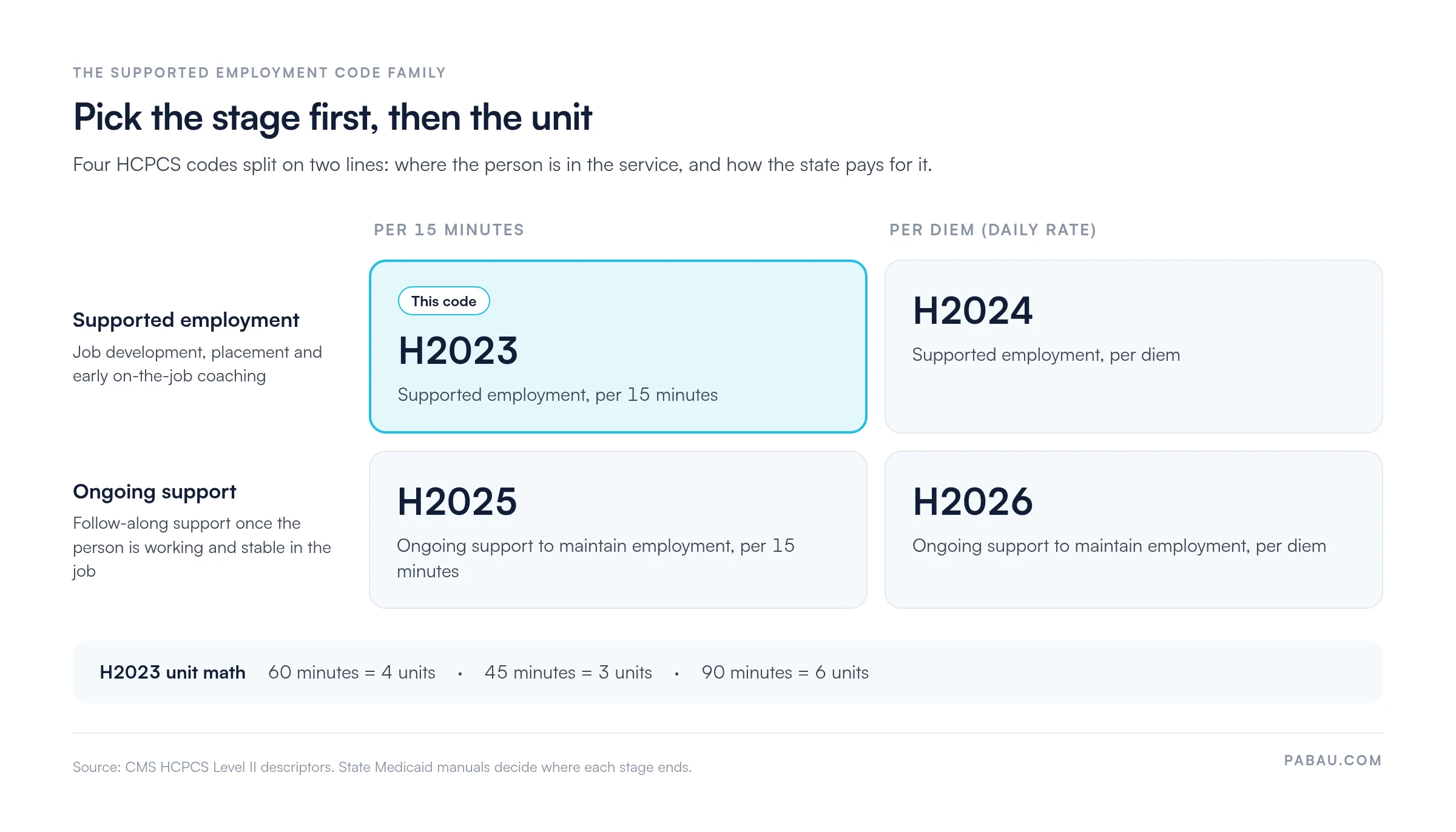
H2023 and H2025 share the same 15-minute unit, so the service decides between them. Each state decides where supported employment ends and ongoing support begins, often at a set point after job placement.
Because H-series definitions can be updated annually, verify current descriptors against the CMS HCPCS Level II file and the applicable state’s billing manual. The PGM Billing HCPCS lookup tool is a quick cross-check before submission.
H2023 denials cluster around a predictable set of errors. Fixing each cause once, rather than correcting denials one at a time, cuts rework for a behavioral health practice. The table below maps each error to its root cause and a fix.
When an H2023 claim does come back, the remittance advice names the reason with a claim adjustment reason code. Our guide to denial codes explains what each one means. For working and appealing the claims that deny, see our guide to denial management.
Because Medicare doesn’t pay for H2023, each state’s Medicaid rules decide how it is billed. Agencies that bill across state lines through waiver programs regularly meet conflicting rules for the same code. The table below lists the variables to check for any state plan. Rate figures are left out on purpose, because only the current state fee schedule is authoritative.
For agencies operating in multiple states, keep a billing rule matrix per state rather than one system-wide configuration. The CMS HCPCS program overview provides the federal framework, and state rules layer on top of it.
Review that matrix whenever a state publishes a new fee schedule or a mid-year billing manual update. Our guide to medical billing compliance covers the records that keep those reviews audit-ready.
Many supported employment agencies record session times in one system and build claims in another. Units then get calculated by hand, which is where over-billed and mismatched H2023 lines start.
Pabau, the practice management platform we build, keeps the progress note, the employment plan and the patient record in one place. Digital forms can require a start time, end time and activity note before a session is signed off. That way, the minutes behind every 15-minute unit are already on file.
Pabau’s claims management software pulls the data already on the patient record into a claim, then submits it electronically and tracks its status. Your billing team still confirms the code, units and modifiers against the state manual. The difference is that the time records and the claim come from the same source.

Pabau keeps H2023 progress notes, employment plans and session times on the patient record. Its claims management software submits claims built from that data and tracks their status.

H2023 rewards precision about time. The code pays in 15-minute units, so the documented minutes decide the claim. A per-diem habit carried over from H2024 is enough to trigger a denial.
Before the next billing cycle, confirm three points for each state you bill in. Check which code it lists for supported employment, how it handles partial units, and how many units each authorization approves. Then make sure every progress note supports the units on its claim line.
Book a demo to see how Pabau keeps H2023 session notes and claim data on the same patient record.

Billing supported employment at a daily rate? HCPCS code H2024 covers the per-diem version of the same service and when a state lists it.
Has the person moved into follow-along support? HCPCS code H2025 explains ongoing support to maintain employment, billed in 15-minute units.
Paying ongoing support by the day? HCPCS code H2026 covers the per-diem version of ongoing employment support.
Dealing with a high denial rate across your Medicaid claims? Denial management in healthcare walks through how to identify, resolve and prevent claim rejections.
Want to understand the full billing compliance picture? Medical billing compliance requirements outlines what practices need to document and track to stay audit-ready.
HCPCS code H2023 is a Level II code for supported employment, billed per 15 minutes of direct service. It covers individualized job coaching, job development and employer liaison by a qualified employment specialist. Medicare doesn’t pay for it, so coverage and rates come from each state Medicaid program.
The GT modifier applies to H2023 when the service is delivered by synchronous audio and video. Coverage depends on whether the state Medicaid plan still allows telehealth for supported employment. Some states made it permanent after the COVID-19 public health emergency, and others reverted to in-person rules. Some also require modifier 95 instead of GT, so check the state billing manual first.
A complete H2023 record includes a current signed individualized employment plan and a dated progress note with start and end times. The note describes activities and progress toward the employment goal, and its minutes must support the units billed. Add the provider’s credentials, the supervisor signature where required, and the prior authorization number if applicable. Post-payment audits tend to check plan currency and time documentation first.
The top reasons are missing or expired prior authorization and unit errors. Unit errors include billing one unit for a full day, which belongs under H2024, and billing more 15-minute units than the documented minutes support. Overlapping session times, an unenrolled provider NPI, incomplete progress notes and unrecognized modifiers round out the list.